“Young Adult” doesn’t always work. But it takes enough chances to be kind of endearing…sort of like a Christmas package with a bomb inside.
For their sophomore effort director Jason Reitman and screenwriter Diablo Cody — who hit indy film gold a couple of years back with their teen pregnancy laugher “Juno” — deliver another comedy, albeit one from a considerably darker place.
I’m not sure how members of other generations will view it, but for this boomer “Black Power Mixtape” was a sort of wonderful time machine to a not-so-wonderful time.
Goran Hugo Olsson’s documentary has been fashioned primarily out of footage shot by crews from Swedish television who in the late ‘60s and ‘70s reported on social upheaval in the U.S.
The Scandinavians were particularly intrigued with race relations in this country, especially the rise of the Black Power movement, the backlash from the powers that be and the arrival of charismatic new voices like Angela Davis, Stokely Carmichael and Bobby Seale.
Charles Eames will forever be associated with the chair that bears his name — sturdy, lightweight and cheap while somehow embodying the essence of post-war modernism.
But as “Eames: The Architect & the Painter” makes abundantly clear, that was only the tip of the man’s iceberg.
Directed by Jason Cohn and Bill Jersery for PBS’ American Masters series, this documentary (narrated by James Franco) makes the case that Eames (1907-1978) may have been the 20th century’s most important designer.
Working for 40 years out of an office/studio in Venice CA (visitors described it not so much as a place of business as a never-ending circus), Eames cast a wide net. Though he made his initial mark with furniture, Continue Reading »
Few things are as compelling as righteous indignation.
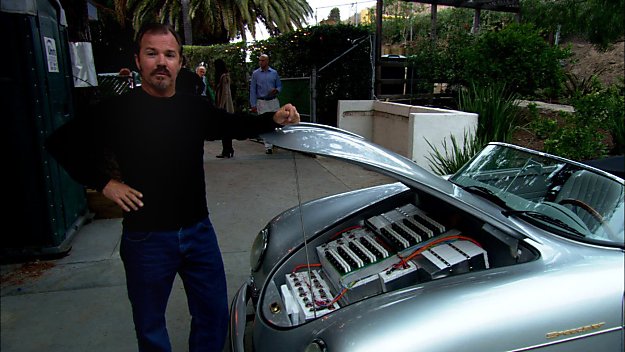
That’s one reason why Chris Paine’s 2008 documentary “Who Killed the Electric Car?” became something of a sleeper hit.
That film dissected the rise and fall of GM’s all-electric EV1, which was leased to hugely satisfied customers (mostly in California), then withdrawn and scrapped when company bigwigs concluded there was no profit in electric vehicles.
“Who Killed…” was ideal for getting people riled up about electric vehicles, fossil fuel pollution, corporate malfeasance and especially the idea of a petroleum-based conspiracy to suppress electric car technology.
Those who prefer their holiday cheer with a bracing dose of bad temper have an ally in Patrick Matthews, operator of the Screenland Crossroads.
Recognizing his establishment as the home of young, hip, thoroughly unsentimental moviegoers, he has in recent years made a point of booking anti-Christmas movies in December.
Last year it was the Finnish “Rare Exports,” a very black comedy which postulated that Santa Claus was actually an ancient demon with a voracious appetite for the flesh of young humans.
This year the Crossroads brings us “Saint,” which through a dark glass views Danish images of old St. Nick.
My criteria for a sports movie is pretty simple. If you don’t really care about the sport in question, can the movie still hold up?
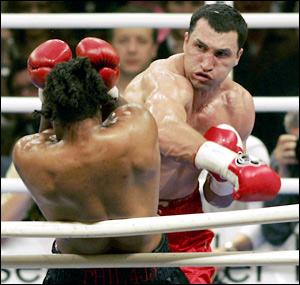
In the case of “Klitschko,” Sebastian Dehnhardt’s documentary about Ukrainian boxing brothers Vitali and Wladamir Klitschko, the answer is a resounding “yes.”
Born of a Soviet military officer, reared in abysmal base housing (at one point they resided in the shadow of the Chernobyl nuclear disaster), the two look-alike brothers managed to develop an impressive work ethic while still finding time to get into trouble. (One great story involves Vitali finding an armed antitank mine and hiding it beneath his father’s bed.)
Inspired by the kung fu movies that until the late ‘80s were banned in the U.S.S.R., the pair got their start in kickboxing, then moved into boxing. Continue Reading »
The multi-character, multi-plot melodrama can be very satisfying.
Robert Altman’s “Short Cuts,” the Oscar-winning “Crash” and Rodrigo Garcia’s excellent “Mother and Child,” for example, each scored big by following several plots united by a common themes (the alienating effects of modern life, race relations, parenthood).
Writer/director Matthew Leutwyler’s “Answers to Nothing” attempts something similar, giving us a sprawling drama unfolding in LA over several days in which the city is abuzz over the presumed kidnapping of a little girl.
But despite a cast of great depth and talent, there’s not much cinema magic here. Leutwyler and co-writer Gillian Vigman take a scattershot approach. They haven’t really focused on their themes — heck, they fail even to define them — and the resulting film seems adrift.
“EVERYDAY SUNSHINE: THE STORY OF FISHBONE” My rating: B
107 minutes | No MPAA rating
I’m ashamed to admit that until seeing this film I knew next to nothing about the seminal black punk band Fishbone.
Now I’m a fan.
One of the best films to play at the 2010 Kansas International Film Festival, Chris Metzler and Lev Anderson’s “Everyday Sunshine” makes a strong case for Fishbone being one of the great rock ensembles.
This doc offers the usual elements: vintage performance footage, talking-head interviews withe the band members and their admirers (Ice T, Gwen Stefani, Flea).
But it also features some wildly inventive animation to follow the rise and fall of this highly unusual group which, according to narrator Laurence Fishburne, “drew on sources too vast for the common mind.”
Indeed, the band somehow synthesized rock, soul, ska, jazz and even rap into an eclectic sound. Moreover, the players incorporated into the music social commentary and gonzo humor. The only other performer who comes close to their approach is the late Frank Zappa.
Of course, that’s a combination guaranteed to wow the critics and intellectuals, but not necessarily the common listener. And, indeed, “Everyday Sunshine” is in many ways a eulogy to musicians who were too good for the rest of us.
But check out this film. You’ll fall in love.
P.S. The filmmakers (Metzler is a Kansas City native) will attend weekend screenings of “Everyday Sunshine” at the Screenland Crossroads and discuss their work.
Achingly beautiful and fiercely nihilistic, “Melancholia” may very well be Danish director Lars von Trier’s ultimate philosophical statement.
And since von Trier (“Breaking the Waves,” “Dancer from the Dance,” “Antichrist”) is both genius and jerk, this is one of those love/hate deals.
You may despise what he has to say; you’ll be floored by the skill and artistry with which he says it.
“Melancholia” begins with a series of mysterious images, all of which will be revisited before the film’s over. These are presented as slo-mo tableaus:
A black horse stumbles and falls beneath a sky illuminated by the aurora borealis.
Electric arcs flicker from a woman’s upraised hands.
A mother struggles to carry her child across a golf putting green, but her legs sink in turf as loose as quicksand.
A bride in white runs through a forest glade, but tree roots and branches reach out to entangle her legs.
Finally the Earth collides with another planet in a cataclysmic dance of destruction. Continue Reading »
Of course, that’s not the same thing as actually being a great movie.
“Hugo” finds American master Martin Scorsese turning his attention from R-rated mayhem to family-film friendliness.
But he struggles to put himself on a child’s wavelength. “Hugo” is too cerebral, too methodical, too cool in its emotional palette. There’s just not a lot of joy here.
Plenty of eye-popping visual magic, though. The film is Scorsese’s first in 3-D and it looks terrific. The settings and effects are splendid.
Still, this feels more like an elaborate test reel meant to try out visual tricks than a fully-shaped and inhabited drama.