Feeds:
Posts
Comments

Felix Kammerer

“ALL QUIET ON THE WESTERN FRONT” My rating: B (Netflix)

148 minutes | MPAA rating: R

Netflix’s new German-language “All Quiet on the Western Front” is not so much an adaptation of Eric Maria Remarque’s classic anti-war novel as a riff on it.

Those familiar with the book or the 1933 and ’79 film versions will recognize a few scenes.  But for the most part this effort from writer/director Edward Berger comes off as a big-budget art film that eschews niceties like character development and plotting for a near total immersion in the madness of war.

Our hero once again is 18-year-old Paul Baumer, a schoolboy who with his comrades is whipped into a patriotic enlistment frenzy by a jingoistic professor.

But as played by Felix Kammerer, Paul is less a personality than an all-purpose Everyman with no back story.

The earlier “All Quiet…” films starred Lew Ayres and Richard Thomas, both of whom possessed an on-screen charisma.  Kammerer, on the other hand, seems to have been cast for the unremarkable presence he projects, for his ability to suggest quiet anguish or shell-shocked blankness.

This is story-telling stripped down. There’s no basic training montage, no getting to meet the other guys in Paul’s unit.  One day they’re in their school uniforms and the next they’re on World War I’s Western Front where the fighting has boiled down back-and-forth assaults across a ravaged no-man’s land and hours of misery in water-filled trenches.

With one exception — an older fellow named Kaz played by the excellent Albrecht Schuch — we really don’t get to know these kids. They’re cannon fodder, doomed to die in all the ghastly ways modern warfare provides.

You might say Berger’s film is populated by zombies. He’s less interested in individuals than the totality of the war experience. By the time you’re done with this 2 1/2-hour effort, he wants you to be nearly as catatonic and crushed as Paul.

The attention to detail is overwhelming, and the battle scenes have been superbly choreographed to suggest the utter unpredictability of combat.  They are on one level exciting, but ultimately dismaying as boys turn into wraiths before our eyes.

The script by Berger, Lesley Paterson and Ian Stokell focusses on Paul’s slow dehumanization, culminating in the famous scene in which he shares a shell crater with the dying Frenchman he has repeatedly stabbed with his dagger.

But it also takes new digressions. Late in the film a hungry Paul and Kaz wander a snowy French countryside…you can’t help thinking of the final scenes of Renoir’s “The Grand Illusion.” 

There’s a subplot about a German diplomat (Daniel Bruhl) trying to achieve an armistice late in the war; and another about a Prussian officer who with just a few moments to go before the cease-fire sends his troops on a pointless suicide mission.

 The film opens with a segment showing a military jacket being stripped off a dead German soldier; it is laundered with hundreds of other jackets, then tears and bullet holes are sewn up. After  which it is recycled to a new enlistee, our hero Paul.

When Paul discovers the previous owner’s name tag still in the collar,  a supply officer says that the jacket most likely was turned in because it was the wrong size. 

Yeah, right.

Particularly effective is Volker Bertelsmann’s non-traditional musical score, heavy on ominously wheezing electronics and snare drum hits that ring out like gunshots.

Ultimately this “All Quiet…” presents the full horrors of war, but perhaps something is lost by downplaying our identification with the characters.

Still, this one sticks with you.

| Robert W. Butler 

Eddie Redmayne, Jessica Chastain

“THE GOOD NURSE” My rating: B (Netflix)

121 minutes | MPAA rating: R

Part thriller, part real-world police procedural, part human tragedy, “The Good Nurse” is open to all sorts of themes and somehow manages to keep them all in balance.

Part of that success is due to the performances of Eddie Redmayne and Jessica Chastain, but a good chunk depends upon Krysty Wilson-Cairns’ excellent screenplay (adapted from Charles Graeber’s nonfiction book), a model of intelligent construction and execution.

Ir’s not dishing spoilers to reveal that “The Good Nurse” — capably directed by Tobias Lindholm — is based on the case of Charlie Cullen, an Intensive Care nurse now serving multiple life sentences in New Jersey after pleading guilty to murdering 29 of his patients.  That cat was let out of the bag in the film’s pre-release media blitz.

In 2003 nurse Amy Loughren (Chastain) found her world falling apart.  The single mother of two young daughters (the oldest of whom is an impossibly surly tweener), Amy works extra shifts to make ends meet.  

And then she discovers she has a serious heart condition, a diagnosis she hides from her kids and her employer — she must stay on the job for at least four more months if she’s to get health insurance (this was pre-Obamacare…how soon we forget the wretchedness of the bad old days of health care coverage).

About the same time she gets a new co-worker, Charlie (Redmayne), who seems too good to be true.  Charlie recognizes that Amy is ill and does what he can to cover for her (because of her heart condition she’s limited physically…and, boy, does this movie illustrate how strong nurses must be).  

Just as important, he becomes a frequent guest at the Loughren home.  The girls love him. Moreover, he soon becomes Amy’s best bud and confidant. (There’s no hint of a romantic attraction.)

For all his skills as a nurse — and Amy believes him to be first class — Charlie has problems.  He has an ex-wfie who hates him and denies him visiting privileges with their two daughters; the only reason he moved to New Jersey from Pennsylvania, he says, is to be closer to his kids.

Interwoven with the Amy/Charlie story is a second plot.  Two local police detectives (Noah Emmerich, Navya La Shay) are assigned to look into an unusual patient death.  They are stymied at every turn by stonewalling hospital administrators (the most visible of these is played by Kim Dickens) who drag their feet on producing patient and employee files.  

Noah Emmerich, Navya La Shay, Jessica Chastain

Think pedophile priests…like the Church that reassigns these creeps to new parishes where they can strike again, the hospitals prefer to let suspicious nurses and doctors find work elsewhere rather than open up the institution to liabilities.

Nevertheless, the cops doggedly work the case, discovering that patients who die mysteriously had excessive insulin or heart medication in their bloodstreams. Suspicion falls upon Charlie when they learn that unexplained deaths soared in ICUs where he has worked, then dropped off to practically nothing when he moved on. 

The detectives quietly recruit Amy to wear a wire and engage her friend in conversation about his suspicious past. She doesn’t want to believe her friend is capable of such horrors, but…

Chastain is solid as a woman about to collapse under the pressure of motherhood, disease and an intense workplace.

Redmaye has a trickier job.  The real Charlie Cullen — who may havre had as many as 400 victims, making him the worst serial killer in American history — has steadfastly refused to discuss his  motivation for the murders.  Maybe they were mercy killings…but some of the victims were recovering when they died.

So Redmayne must walk a fine line here, playing a guy so tightly buttoned-down that his inner reality remains a mystery.  Outwardly he excels at presenting himself as a committed, sensitive caregiver. But there are just enough delicious little cracks in his facade to suggest the turmoil underneath.

Part of writing a good script is knowing what to leave out, and “The Good Nurse” is a great example.  Graeber’s book suggests that the real Charlie Cullen was far more obviously wacko than what we get here. Thus “The Good Nurse” may not be particularly accurate in its depiction, but as drama it works wonderfully.

| Robert W. Butler

Brendan Gleeson, Colin Farrell

“THE BANSHEES OF INISHERIN” My rating: B (In theaters)

109 minutes | MPAA rating: R

Audiences are going to love Martin McDonagh’s “The Banshees of Inisherin”  — right up to the point where they start to hate it.

McDonagh is not the sort of filmmaker to chuck his audience under the chin and send us off with a pat on the head.  His protagonists  (like those played by Frances McDormand and Sam Rockwell in “Three Billboards Outside Ebbing, Missouri”) are often brittle/bitter or comically hateful, and he relishes nudging us in one direction only to see us ricochet off unforeseen developments.

The impeccably-acted “Banshees…” pushes that alienation to its utmost.

The film starts out feeling almost like a sequel to John Ford’s “The Quiet Man.”  This is a 1920s Ireland of horse-drawn carts and thatched roofs, a scape of land and sea so beautifully captured in Ben Davis’ cinematography as to exude postcard perfection.

There’s a plethora of Irish “types”: the chatty pub keeper, the omen-spouting old lady who looks like Death in “The Seventh Seal,” the small-town copper who sheathes his brutality in brisk protocol, the village idiot.

For its first hour or so, “Banshees…” plays like a melancholy comedy, a sort of Gaelic Chekhov punctuated by hilarious exchanges (not that the participants think of themselves as hilarious…that’s for the us to pick up).

And then after that alluring beginning the film becomes incrementally more dark and alarming until it finds itself in tragic mode.

Padraic (Colin Farrell) and Colm (Brendan Gleeson) are Mutt-and-Jeff best buds.  Technically they’re  farmers, but they don’t spend a lot of time working.  Most afternoons they can be found downing pints in the local pub.

Padraic — a childlike fellow followed everywhere by his miniature donkey — is mildly alarmed when one day Colm refuses to answer his door.  He’s in there, all right, smoking a cig in front of the fire. But he’s refusing to acknowledge his best friend.

Colm is immune to Padraic’s` increasingly desperate attempts to re-establish their normal routine.  Finally Colm reveals that he’s been depressed for ages, and fears that his attachment to Padraic is preventing him from achieving his life’s work — to write a tune for his fiddle that will outlive him.

It’s not that he hates Padraic…it’s just that the guy is insufferably dull, and that dullness is infectious.

A key to McDonagh’s screenplay is the way it contrasts the beauty of Inisherin Island against the smothering repetition of its social life. 

It’s not just Colm who’s going stir crazy here.  Padraic’s spinster sister  Siobhan (Kerry Condon) — also his cook and housekeeper — perplexes her proudly anti-intellectual neighbors with a passion for (gasp!) reading and dreams of moving to the mainland.

Never mind that the sounds of Ireland’s “troubles” — explosions and gunshots — are often can be heard from across the water.  Even civil war is better than wasting away in Inisherin.

And then there’s Dominic (Barry Keoghan), the oft-abused son of the local cop and regarded by most folks as an “idjit.” Well, Domiic certainly lacks even the most basic social skills; he might even be on the spectrum. But he’s far from stupid.  Listen to his vocabulary…he may just be the brightest bulb in this pack.


Kerry Condon

Despite the entreaties of his fellow islanders and the local priest to return to the status quo (the film contains possibly the funniest confessional scene in movies), Colm only digs in his heels. In fact, he threatens to cut off one of his fingers for every time Padraic approaches him.

Before it’s all over Padraic will come to dread the thud of severed digits being hurled at his door.

Yeah, dark.

It’s at this point that “The Banshees of Inisherin” (that’s also the title of the fiddle tune Colm is writing) dives so far into the black that a good chunk of the audience will be left stewing in puzzlement (if not outright disgust).

Clearly McDonogh’s sentiments align with Colm’s, whose farmhouse — packed with folk art objects —suggests a sensitive spirit trapped in a world of soul-killing banality that no amount of pretty scenery can relieve.

Farrell’s Paderaic, on the other hand, is an adolescent in a man’s body, friendly and open but apparently incapable of self-reflection. And like a child, he can take only so much hurt and rejection before lashing out,

“Banshees…” is ultimately a scathing takedown of the cliched quaintness of traditional Irish life, where creativity is smothered and self-mutilation becomes a substitute for  professional mental health care.

The big question is how many viewers will be able/willing to ride its glum message to the end.

| Robert W. Butler

Dustin Lance Black and his mother, Anne

“MAMA’S BOY” My rating: A-  (HBO Max)

102 minutes | No MPAA rating

Dustin Lance Black won an Oscar for writing the screenplay for “Milk,” was crucial to the HBO hit “Big Love,” and most recently created the HULU miniseries “Under the Banner of Heaven,”about a murder in Mormon country.

His professional life is impressive.

But his personal saga, as chronicled in the documentary “Mama’s Boy,” is even more flabbergasting.  Indeed, one could easily see Black’s family chronicle becoming yet another knockout miniseries.

No kidding folks, at least three times I had to stop the movie because it had put me into emotional overdrive. This is powerful, inspiring stuff.

Laurent Bouzereau’s film begins with Black’s acceptance speech at the 2008 Academy Awards.  He spoke not about the movies, but about being gay, about the impact of the life of queer icon Harvey Milk, and he issued a promise that in the near future the full rights of homosexuals would be recognized by the federal government.

Then Black, our onscreen narrator, takes us on the 60-year journey of his mother Anne. She was born to sharecroppers in rural Louisiana, crippled by polio as a child (she underwent several ghastly surgeries and spent the rest of her life in leg braces and on crutches), and converted to Mormonism as a young woman.

She married a Mormon man who clearly wasn’t ready for the responsibility…he abandoned her with and their three boys (she’d been advised not to get pregnant but wasn’t about to let medical realities stifle her dreams). 

To keep the family afloat the church dropped off monthly envelopes of cash (a act of charity Black recalls fondly); then arranged for Anne to marry a divorced Mormon who, unbeknownst to the family, had tired to kill his first wife (a deliberate omission Black cannot forgive).

This monster physically abused his wife and her sons; Anne divorced him while he was on a job overseas, then worked her way up through the civil service,  launching a career as a laboratory technician. She also married for a third time…we meet this fellow and he’s pretty wonderful.

Anne was by any one’s reckoning an amazingly brave, resourceful woman.

While all this is happening young Dustin Lance (“Lancer” to his mother) was suppressing his own sexual identity. He realized early on that girls didn’t do it for him, but the Mormon Church left little doubt about what happens to sexual sinners.

Moreover, the one person whose approval he most wanted — his mother Anne —was fiercely conservative.

“Mama’s Boy” throws a wide net, dealing not only with Dustin Lance’s early life in Hollywood and his reluctant coming out as a gay man, but also pulling into the story his two brothers (one of whom dealt with his own tragedy).

Ultimately, “Mama’s Boy” is a tale of healing.  On a rare visit to  her son in L.A. Anne attended a party filled with Lancer’s gay friends. Something inside her clicked.  So much so that when she accompanied her boy to his big Oscar night, she wore on her dress a white ribbon signifying support for gay marriage.

One thing I didn’t realize about Black…in the wake of the passage of California’s Prop 8, which banned gay marriage,  he suspended his movie career for several years to work on undoing  that law.  He wrote a play, “8,” to dramatize the issue; it was performed more than 400 times around the country.

|Robert W. Butler

Zac Efron

“THE GREATEST BEER RUN EVER”  My rating: B+ (Apple +)

126 minutes | MPAA rating: R

I put off watching Apple +’s “The Greatest Beer Run Ever” because…well, because it sounded kind of cheesy.

Notwithstanding that it is based on actual events, this yarn — about a good ol’ boy New Yorker who in 1968 smuggled himself into Vietnam to deliver American-made brews to the neighborhood guys fighting Charlie — sounded just a little too flip and insubstantial for my tastes.

I couldn’t have been more off the mark.

Directed and co-written by Peter Farrelly (who has evolved from the grossout yuks of “There’s Something About Mary” and “Dumb and Dumber” to substantial fare like “Green Book”) this film walks a fine line between shaggy dog comedy and an essentially serious look at a subject the movies often get wrong.

Not having served I cannot testify to the accuracy of the movie’s war scenes.  But I have never seen a film that so accurately captured the conflicts the war generated in our civilian population.  The attitudes of the characters are absolutely right on.

That “…Beer Run” also gives us Zac Efron’s best performance yet is just icing on the cake. 

Chickie Donohue (Efron) is a U.S. Merchant Marine who spends his time between voyages sleeping late and getting drunk at his neighborhood bar.  He’s essentially directionless and irresponsible; politically he’s of the “my country, right or wrong” persuasion, which puts him perennially at odds with his younger sister, a regular at anti-war rallies.

Realizing he’s doing nothing for the cause, Chickie comes up with the idea of loading a duffel bag with beer and signing up as an oilman on a Vietnam-bound cargo ship.  Once there he’ll make an extensive side trip to visit his childhood buddies who are stationed around the country.  To each he will present a beer or two, a little gift of appreciation from the folks back home.

Russell Crowe, Zac Efron

It’s a genuinely dumb-ass idea, but Efron masterfully sells Chickie’s enthusiasm and naivete.  His pals in uniform are amazed to see him in ‘Nam — pleased with the beer but incredulous that anyone who doesn’t have to be there would come voluntarily.

The screenplay (co-written by Brian Hayes Currie and Pete Jones) balances farcical elements with more somber revelations.

For example, Chuckie finds he can get military transport anywhere he wants by implying that he’s working for the CIA. And he has the head-slapping habit of stumbling across his old running buddies in the midst of war’s chaos.

At the same time, we see his his growing realization that most everything he believes about the war is wrong. The film finds our man being shot at while delivering suds at a far-flung fire base. At one point he sees a suspected Viet Cong tossed out of an airborne ‘copter during an interrogation.  And he’s on hand to witness the notorious Tet Offensive, when the Cong struck at the heart of Saigon during the Asian New Year celebration.

Now I have no idea how much of this the real Chickie experienced and how much was invented for the film. Indeed, many may conclude that the filmmakers have a fairly heavy hand in dealing anti-war sentiments in the movie’s latter stages.

But it works. “The Greatest Beer Run Ever” is fueled equally by its far-fetched silliness and its growing sense of sadness — if not outrage — over the war’s toll.

Toss in a couple of fine supporting performances — Bill Murray as the New York bar owner whose jingoism sets the plot in motion, and Russell Crowe as a war correspondent through whose lens Chickie gets an education in real-world violence — and you’ve got a film that will stand up under repeated viewings.

| Robert W. Butler

Lily Collins, Connie Nielsen, Chace Crawford

“INHERITANCE” My rating: C (Netflix)

111 minutes | No MPAA rating

Netflix’s thriller “Inheritance” is marked by not just one but TWO cases of what appears to be major miscasting.

The first big gulp comes when we discover that Lily Collins, she of the impossibly cute “Emily in Paris” (i bailed on Season Two), has been cast as the hard-driving Manhattan District Attorney.  

No, I didn’t buy it, either.

The second involves the casting of Simon Pegg, usually just the fellow to provide light comic relief, in the heavy-duty dramatic role of…well, let’s let that sit for a minute.

Here’s the setup:  After the heart attack death of her filthy rich banker daddy Archer (Patrick Warburton, in and out so fast you might not recognize him), DA Lauren Monroe (Collins) learns from the family lawyer that the old man has entrusted to her his most deeply-hidden secret.

Not some sort of business fraud, although Archer obviously played loosely with the SEC regs. And  not the mistress he kept in the city unbeknownst to his wife (Connie Nielsen). Not even  the illegitimate child he had with her. 

Nah, all that stuff is standard issue for a rich mover and shaker.

Following cryptic clues left behind by Daddy, Lauren uncovers an old bunker (must have been a  fallout shelter) in the woods on the family’s estate. Inside she discovers a bearded, hairy man chained by the neck in a dark cell.   He tells the shocked Lauren that he has been imprisoned by her late Papa for more than 30 years.

This modern-day Ben Gunn  is played by Pegg, and what with all the hirsute prosthetics and a sepulcher-appropriate voice he’s virtually unrecognizable.  It took me about 10 minutes before I exclaimed “Holy shit!  Simon Pegg!”

Simon Pegg

The woeful tale this poor soul relates involves an accidental death, a gravesite deep in the forest and Archer’s fear that a witness to his perfidy could nip his financial career in the bud. Unwilling to commit murder, he instead becomes a jailor, visiting his prisoner just often enough to keep him stocked in protein powder and toilet paper.

Which leaves Lauren with a moral dilemma.  Should she free the man, thus risking not only her career but that of her brother (“The Boys’” Chace Crawford), a Congressman in the middle of a tough re-election campaign?

Should she keep him alive and in chains…but for how long?  

That “Inheritance” works at all is due to Pegg’s canny balancing act.  His prisoner is by turns tearful, pathetic, manipulative and threatening.  We want to be sympathetic but, like Lauren, we wonder how much of his story to believe. The dude seems sane and rational, but after decades in the dark mightn’t he be, well, a bit off?

It makes for a couple of tasty scenes.

Alas, in the third act Matthew Kennedy’s screenplay devolves into thriller-film cliches…and it cannot outrun the many improbabilities we’re asked to swallow to keep the yarn moving. Vaughn Stein’s direction is functional but style-less.

| Robert W. Butler

Sinead O’Connor

“NOTHING COMPARES” My rating: B (Showtime)

97 minutes | No MPAA rating

One of the best indicators of the effectiveness of a music documentary is when after watching it you cannot wait to listen to the artist involved.

After viewing “Nothing Compares,” the new documentary about Irish singer/songwriter Sinead O’Connor, I immediately turned to my old copy of her greatest hits LP.

And then for good measure i went online and began a Sinead buying spree of other tunes from her repertoire.

Directed by Kathryn Ferguson and written by Fergusoon, Eleanor Emptage and Michael Mallie, “Nothing Compares” is less an analysis of O’Connor’s music than a deep dive into her background and personality.

Even those who aren’t particularly familiar with her work instantly recognize her on sight…the shaved head, the huge soulful eyes, and that voice, which one admirer said was capable of “going from a whisper to a scream in half a second.”

Nobody sounds or looks like her; few artists have her burning sense of social justice,  on display even when — as is shown in the film’s opening moments — she has to endure several minutes of booing before beginning a concert.

Often narrated in first person by the now 55-year-old O’Connor (we don’t see her as she looks today until the very end of the movie) “Nothing Compares” depicts a termifying childhood with a mentally ill mother — the singer calls her “a beast” — who abused the child in just about every way a child can be abused.  One of her tricks was to exile her the 8-year-old to live night and day in the family garden.

She grew up “stupidly religious” and was eventually sent to a church-run school for troubled girls; it was affiliated with the notorious Magdalene Laundry system that virtually imprisoned thousands of young Irish women who had children out of wedlock.

This was still a time when the Irish government served as an arm of the  Catholic Church.  O’Connor at one point compares her homeland to an abused child.

As a teen she fell in love with Bob Dylan, specifically the religious-themed “Slow Train Coming” LP; at the same time O’Connor became enamored of drag culture, which pretty much had to lay low in ‘70s Ireland.

Once she launched her singing career, she specialized in writing her own autobiographical songs, as well as covering work by other artists. Who would have expected her to reach the charts with Broadway’s “Don’t Cry For Me, Argentina”?  And then there’s her biggest hit, a brilliant version of Prince’s “Nothing Compares 2 U.” (We’re told in the closing credits that Prince’s estate denied the filmmakers’ request to use the song in the documentary. What’s with that?)

Despite controversy, O’Connor has always insisted on wearing her conscience (and anger) on her sleeve.  She caused a flap in the U.S. when she banned a venue from its usual practice of starting a concert with a rendition of “The Star Spangled Banner.” 

And then’s there’s her notorious”Saturday Night Live” appearance in which she ended her a capella rendition of Bob Marley’s “War” by shredding a photo of Pope John Paul II.

She never apologized, never backed down.

“They tried to bury me,” O’Connor says. “They didn’t know I was a seed.”

| Robert W. Butler

Emily Watson

“GOD’S CREATURES” My rating: B (At the Glenwood Arts, VOD)

100 minutes | MPAA rating: R

A blanket of Celtic fatalism drapes over “God’s Creatures,” rendering even a sunny day wan and gray.

Set in an economically-challenged Irish fishing village, this entry from co-directors Sale Davis and Anna Rose Holmer (“The Fits”) centers on a middle-aged wife and mother who out of love makes a seriously bad decision.

Aileen O’Hara (Emily Watson, sinking her teeth into her meatiest role in ages) is a crew chief at a seafood processing plant. She and her husband Con (Declan Conion) seem to more or less share the same space, brought together mostly by their first grandchild, born to their daughter.

Then, quite unexpectedly, Aileen’s son Brian (Paul Mescal) appears after spending seven uncommunicative years in Australia.  Aileen is overjoyed to have her boy back in the fold. Her husband less so…it’s all he can do to shake Brian’s hand. What’s that about?

At first glance Brian is a handsome charmer.  But his behavior raises questions  He left home suddenly (why?) and rarely communicated with his family during his long absence.  Now he’s back (again, why?) ready to take over the long-unattended oyster beds owned by his uncle.

Aileen is too thrilled having her firstborn back under her wing to dwell on such business. But within weeks of his return Brian is accused of sexually assaulting his old girlfriend Sarah (Aisling Franciosi of “The Nightingale”), one of Aileen’s co-workers.

Interviewed by the police, Aileen lies, providing Brian with an alibi. She does so automatically, almost without thinking.

But in the aftermath her conscience begins gnawing.  She senses something disquieting beneath her boy’s outward magnetism.  Worse, Sarah sticks to her accusation and becomes a pariah in their tiny community.

Viewers who demand that everything be spelled out for them will find little solace in “God’s Creatures.”  The film’s narrative approach is elliptical; there’s all sorts of suggestion but little solid information.

Uncertainty seeps through Fodhia Cronin O’Reilly and Shane Crowley’s screenplay and is reflected in the carefully contained performances.  Watson suggests Aileen’s torn loyalties not with bit speeches but through her eyes.  Similarly, Mescal — who made a big splash as the overwhelmingly decent leading man of Hulu’s “Normal People” — cannily uses his good-guy image to disguise Brian’s true nature.

No doubt many will find the film’s understated approach too remote. And the denouement of Brian’s story arc is borderline ridiculous, a deus ex machina  moment comes out of left field.

On the plus side, the film works extremely well as a study of working class life, with its economic uncertainties and demeaning situations.

| Robert W. Butler


Ana de Armas as Norma Jeane/Marilyn

“BLONDE” My rating: B- (Netflix)

166 minutes | MPAA rating: NC-17

“Blonde” left me feeling…well, ambivalent.

I don’t regret giving 2 1/2 hours to Andrew Dominick’s film. But I’m not eager to see it a second time.

It’s  extremely well-made, and  leading lady Ana de Armas’ turn as Marilyn Monroe goes terrifyingly deep (an Oscar seems likely).

But while I found it interesting, I rarely found it compelling.

What does “Blonde” tell us about the iconic movie star that we didn’t already know?  

What point is Dominik (whose earlier films “The Assassination of Jesse James by the Coward Robert Ford” and “Killing Them Softly” I loved) trying to make?

This is  not a traditional biopic. It is based on a work of fiction (the novel by Joyce Carol Oates) and as such is a brew of historic fact and pure invention. At any given moment it’s hard to know if what we’re seeing ever actually happened.  

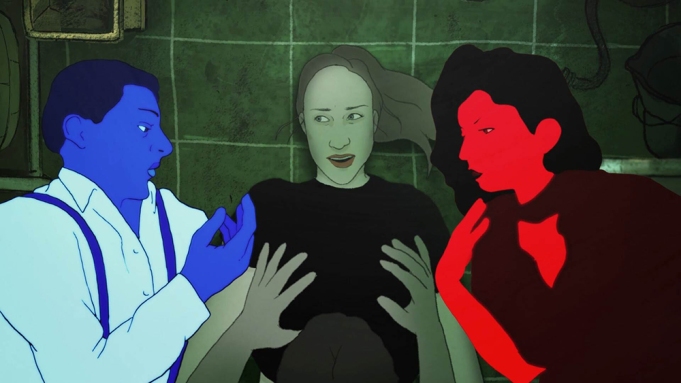
We get real events like Monroe’s marriages to Joe DiMaggio and Arthur Miller (listed in the credits as the Ex-Athlete and The Playwright) and re-creations of scenes from her films. This is  interspersed with pure fantasy (a talking embryo, dream sequences). 

In the end  it all comes down to de Armas, who downplays Marilyn’s sexuality in favor of her sensitivity and vulnerability. The film’s major conceit is that Marilyn Monroe never actually existed.  She was the onscreen creation of Norma Jeane, a fatherless girl who was used/abused by men who acknowledged her beauty but not her intelligence or talent.

So, yeah, “Blonde” is a downer.

Little Norma Jeane has a crazy mom (Julianne Nicholson) who fills her daughter’s head with dreams about an absent father — allegedly a bigwig in the movies — who will one day come to rescue them both.  (Small wonder the grown Norma Jeane refers to her husbands as “Daddy.”) At least once Mama tries to drown the girl in a bathtub.

Norma Jeane is sexually assaulted by the movie producer who gets her into the industry (the film ignores Monroe’s first marriage and her affair with her first agent), and is sexually degraded by a President of the United States. She is coerced into an abortion. 

Based on that description you might expect “Blonde” to be a sad saga of victimization.  And in fact the film has been accused of peddling abuse porn. (The film has been rated NC-17, though what you see is relatively tame…the worst abuse takes place just out of camera range.)

Well, I’d agree except for the way in which de Armas infuses her character with beauty.  Not physical beauty (though there are times in the right light and with the right body language that you find yourself gasping in recognition) but with a tender and desperate need to love and be loved.

This side of Norma Jeane is beautifully exposed in the film’s Arthur Miller segment.  Like the playwright (very well played by Adrian Brody), we find ourselves falling for this woman’s combination of unexpected intelligence and childlike openness.  There’s a genuinely sweetness to these moments that is matched by nothing else in the film.

Instead we get ambiguity.  This is reflected even in Domiik’s technical choices. The movie drifts between color and black-and-white passages…but I’m damned if I can figure out what either signifies.  If all the dream sequences, say, were in black-and-white you could sense what the director is going for. But, no, it all seems terribly arbitrary.

My bottom line: A great heartfelt performance anchoring a half-baked film.

| Robert W. Butler

Sigourney Weaver, Kevin Kline

“THE GOOD HOUSE” My rating: B(In theaters)

114 minutes | MPAA rating: R

“The Good House” is a prime example of cinematic bait and switch…you get sucked into thinking it’s one kind of movie and along the way it becomes something quite different.

That’s the sort of thing that might alienate moviegoers. Except that “The Good House” features Sigourney Weaver in one of her more seductive performances. Who says there are no good roles for women of a certain age?

Weaver plays Hildy Good, a divorced grandmother with her own residential real estate biz in a picturesque seaside New England burg where her family roots go back 300 years (she has descended from one of the Salem witches).

Almost immediately the screenplay (by Thomas Bezucha, Wallace Wolodarsky and director Maya Forbes) lets us in on Hildy’s inner life. While her work requires her to exhibit a gift for schmoozing, our leading lady is in fact a font of sharp-tongued snarkiness who often speaks directly to the audience to diss and dish dirt on her fellow citizens.

Hildy’s outward show of bon homie and civic uprightness and her inner sarcasm provides much of the flim;s dramatic juice. Sardonicism on this level is bracing; when it comes from an older woman it’s damn near celebratory. Not to mention laugh-out-loud funny.

A good chunk of “The Good House” is devoted to a character study of Hildy as she copes with her struggling business (a former assistant has broken away and is now beating Hildy at her own game), a long-ago high school squeeze (Kevin Kline) who over decades has become a blue-collar millionaire (he’s a scuzzy-looking coot who owns a fleet of snow plows, garbage trucks and home renovation vans) and her children and grandchildren.

The film’s real subject sort of sneaks its way in. Hildy, you see, likes her wine. She tells herself (and those of us watching) that she’s totally in control of her intake and that the hand-wringing of her family and friends is just so much do-gooder excess.

Basically “The God House” is about her gradual realization that she’s a first-class alcoholic. At that point the film isn’t so amusing any more.

Now this hardly breaks new cinematic ground; the film works because Weaver is so entertaining and because the ranks of her fellow townspeople have been filled with the likes of Morena Baccarin, Rob Delaney, Kathryn Erbe, Beverly D’Angelo and David Rasche.

All that talent helps compensate for some narrative choices that smack of cheap melodrama. The late-in-life romance with Kline’s character works well enough, but some other subplots involving a neighbor’s autistic child and an extramarital affair being conducted by the local psychiatrist feel underdeveloped and superfluous.

The further the film strays from its central theme — a woman coming to grips with the lies she’s been telling herself — the less effective it becomes.

| Robert W. Butler