Feeds:
Posts
Comments
Catherine Keener, Charlie Heaton

“NO FUTURE” My rating: B- (Amazon Prime)

89 minutes | No MPAA rating

A young man has a love affair with his best friend’s mom.

Sounds like not-very-original porn.

Well, “No Future” isn’t porn, at least not in the conventional sense.  Some viewers may find its singleminded obsession with dead-end lives a form of pornography.

What we’ve got in Andrew Irvine and Mark Smoot’s feature (they share both writing and directing credits) is a dour drama about a recovering addict struggling to stick to the straight and narrow and consumed with guilt about the bad stuff he did while under the influence.

Will (“Stranger Things’” Charlie Heaton, who possesses the saddest set of eyes this side of an abused Bassett Hound) lives in what appears to be a small Texas town.  He’s been going regularly to AA meetings, has an attentive and loving girlfriend (Rosa Salazar).

But he’s haunted by his past.  His widowed father (Jackie Earle Haley) can barely tolerate his son…seems that when Will’s mom was dying of cancer the kid pilfered her pain meds.

Will’s past comes back to haunt him in even more immediate fashion with the unexpected arrival of his childhood friend Chris (“Yellowstone’s” Jefferson White), fresh out of prison and falling back into his old ways.  Will was largely responsible for Chris becoming a junkie; now his old bud’s presence threatens Will’s recovery.  He tells Chris they can’t associate.

Chis resignedly accepts this fact, then goes home and overdoses. Accident or suicide? That’s the question that torments his mother Claire (Catherine Keener), who discovers the body.

Despite the 30 or more years separating them, Will and Claire find themselves in a secret physical relationship that oozes grief, guilt and loss. Maybe they somehow assume their affair will make them feel better.

Nope.  A shroud of desperation and doom envelops “No Future”…hell, the title alone should raise red flags.

To their credit, the filmmakers don’t dwell on the sexual nature of this pairing.  Their approach is utterly sincere, soberly non exploitative. 

And the performances — especially from Keener in full anti-glamour mode — are the stuff of heartbreak.

And yet “No Future” is so unrelentingly glum that it’s a struggle to sit through.  Ultimately the experience is so devoid of hope that some may leave the film feeling that recovery is an impossibility.

Surely that’s not the message we’re supposed to take away.

| Robert W. Butler

Zendaya, Timothee Chalamet

“DUNE” My rating: B (In theaters and HBO Max)

155 minutes | |MPAA rating: PG-13

In making his new version of “Dune,” director  Denis Villeneuve has followed his own version of the Hippocratic oath.

Rather than “First, do no harm,” his mantra has been “Above all, do nothing stupid.”

And he hasn’t. 

 Villeneuve’s adaptation of Frank Herbert’s sprawling 1965 sci-fi epic is consistently smart, effectively acted  and  spectacularly well designed.

 If its slow pacing will irritate some and its emotional distance prove problematic, at least there are none of the wince-worthy moments that marred David Lynch’s 1984 version.

Fans of the novel should be overcome with gratitude that a world-class director took on this material with respect and insight.  It’s an astoundingly faithful film adaptation; whatever narrative issues the film possesses are those of the novel.

First things first…even at 2 hours and 35 minutes this is only half the “Dune” story.  It ends with young Paul Atreides (Timothee Chalamet) a fugitive from the brutal Harkonnen  clan who have killed his father and seized control of the desert planet Arrakis and its vast wealth of spice. When last we see him he’s been taken in by the Fremen, the cave-dwelling locals.

Spice — for any reader who somehow managed to avoid the book as a young person —  is a hallucinogen mined from the sand dunes of Arrakis; its properties make space navigation possible and will fuel the mystical revolution that will undoubtedly dominate a second “Dune” movie. 

But here’s the deal:  I’m not even going to try here to delve into all the story’s plot points: the betrayals, the minor characters,  the allegorical parallels (Paul’s universe-spanning revolt, carried out by religious fanatics from the desert, smacks of our own issues with Islamic fundamentalism).  

I’m gonna assume most of you know the book and want to know how it works as a film.

Well, it works just fine.  Going in I feared that the reedy Chalamet would be just too damn wimpy for the key role of Paul, but you can feel the character grow and mature from scene to scene.

We barely get to spend any time with Zendaya as Chani, the girl-warrior who will become Paul’s paramour (though seen throughout in Paul’s visions, she doesn’t show up as an actual character until the last 15 minutes); but she looks great and exudes the appropriate don’t-screw-with-me desert attitude.

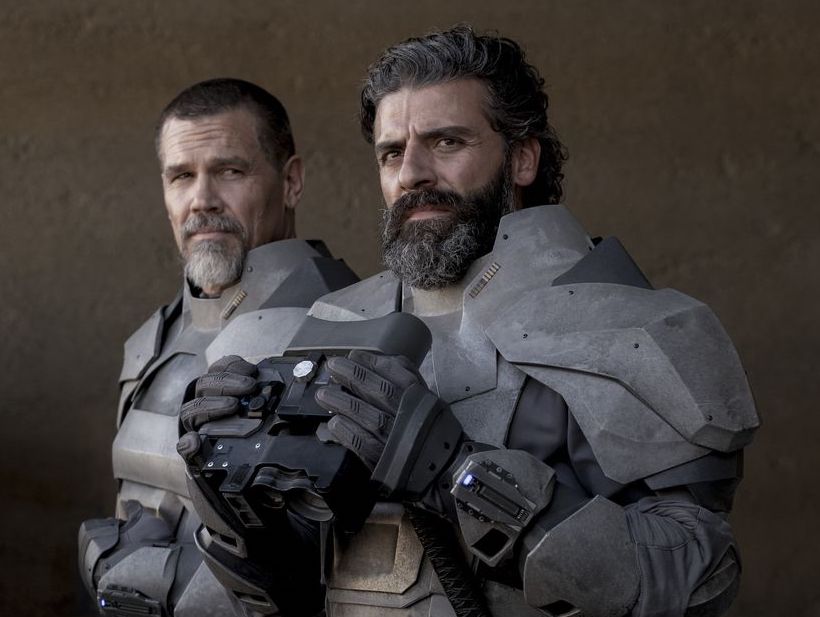
Josh Brolin, Oscar Isaac

There are so many characters here that few get much screen time.  Oscar Isaac and Rebecca Ferguson have real presence as Paul’s parents, while players like Josh Brolin, Stellan Skarsgard, Dave Bautista, Charlotte Rampling and Javier Bardem barely get a chance to register.

A happy exception is Jason Momoa as Duncan Idaho, Paul’s military mentor and friend; I don’t know if it’s good acting or if I just like watching Momoa, but he really makes an impression.

(BTW: Look for Kansas City-reared actors Stephen McKinley Henderson and David Dastmalchian in supporting roles.)

Production quality is off the charts (I was particularly taken with the “dragonfly” aircraft employed on Arrakis) and the costuming hugely effective.

The big battle scenes feel a little generic…the violence is PG-13 and I was a tad underwhelmed.

And while I was never bored by this “Dune,” I was never really moved, either.  It’s a good ride, but I wasn’t blown away.

Still, I’m ready for Part II. The sooner the better.

| Robert W. Butler

The Velvet Underground…and Nico

“THE VELVET UNDERGROUND”  My rating: B (Apple +)

121 minutes | MPAA rating: R

Todd Haynes’ new documentary about The Velvet Underground is a movie made by a fan for other fans.

It presumes a certain amount of shared musical history on the part of viewers. It is most definitely NOT “Velvet Underground 101.”  

It’s not interested in dragging out scholarly arguments about the Velvet Underground’s contribution to punk culture or in laying out a careful chronology of the band’s birth and demise.  There’s no analysis of the place of Velvets Lou Reed and John Cale as formidable  solo artists. Heck, I don’t think even one of the band’s songs is played from beginning to end…mostly we get tantalizing snippets. 

Instead Haynes (who has a history of music-themed films like “Superstar: The Karen Carpenter Story,” “Velvet Goldmine” and the Dylan-centric “I’m Not There”) strives to give us a broad  impressionistic view of the personalities behind the Velvets and the early-‘60s Bohemian New York milieu which spawned them.

He draws heavily on archival footage of Andy Warhol’s Factory, with its heady mishmash of visual artists, actors, poets, dancers and musicians, creating hallucinogenic montages — including tons of split-screen effects — that look for all the world like one of those early rock concert light shows.

He interviews the two surviving members of the original Velvets (the viola-playing Welshman Cale and the androgynous drummer Maureen Tucker) and draws extensively on audio recordings of the late Lou Reed talking about his time with the band.

Fellow musician Jonathan Richman, a Velvets acolyte back in the day, pops up frequently to discuss why, in his estimation, the band mattered.

There is, of course, a chunk of the film devoted to the late Nico, the neurasthenic German blonde hand-picked by Warhol to be the band’s coolly sexy talisman and, hopefully, their introduction to the commercial mainstream. (Keep dreaming, Andy…not in a million years.)

On some levels “The Velvet Underground” is maddeningly superficial.  The rift between Cale and Reed that led to the latter secretly “firing” the former is written off as a personality clash.  Well, yeah, but how about some details?

And Reed’s notorious bad behavior (often drug-fueled) at various stages of his career is pushed aside and glossed over.

But to watch this doc is to be plunged into the heady world of early art rock with all its dissonance and angst.  It’s a time machine really, and for Velvet fans it’s a nostalgic trip back to the creation of a band that regarded nostalgia as the purview of losers.

| Robert W. Butler

Jason Isaacs, Martha Plimptgon

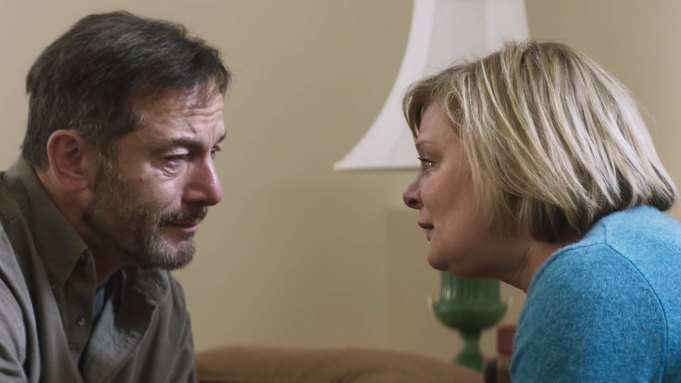
“MASS” My rating: B+ (AMC Town Center)

110 minutes | MPAA: PG-13

There’s no way “Mass” should work.

Or even if it works, the very premise sounds so unbearable that only masochists would show up for it.

But here’s the thing: Fran Kranz’s feature writing/directing debut (up to now I’ve know him only as the actor who nailed the comically stoned Marty in 2011’s “Cabin in the Woods”) is not only supernaturally well-written, but offers performances of jaw-dropping depth.

The squirm-worthy setup: Two couples meet in a nondescript church parlor to discuss a tragedy more than a decade old. One pair are mourning the death of their son in a school mass shooting. The other are the parents of the killer. This is the first time they’ve spoken to each other without the presence of cameras and reporters and lawyers.

The film’s first 20 minutes are a tease of sorts. Kranz devotes much time to the efforts of two church volunteers (Breeda Wool, Kagen Albright) to prepare a space for the meeting. A rep (Michelle N. Carter) of an agency that deals with this sort of reconciliation makes an inspection and offers suggestions (she’s concerned that the sound of a choir practice elsewhere in the building may drift into the room; also, a table full of refreshments makes it look too much like a party).

We meet the first couple, Jay and Gail (Jason Isaacs, Martha Plimpton), sitting in their car outside. They’re not sure they can go through with this.

At this point in the proceeding we’re not sure if they’re the parents of the killer or of one of his victims: in fact, that uncertainty lingers for several minutes after the arrival of the other couple, Linda and Richard (Ann Dowd, Reed Birney). It takes some uncomfortable small talk before they get down to discussing what haunts them all and we figure out who’s who.

Over the course of 90 real-time minutes they move from wary politeness to bitterness, fury, regret and eventually a sort of mutual conciliation borne of shared pain.

For while Jay and Gail finally have the opportunity to rail at Linda and Richard for ignoring the signals that their loner son was homicidal, it becomes clear that far from being neglectful, Linda and Richard watched their boy, got him therapy, and were relieved when it appeared (falsely) that he had finally found his place in high school society.

Ann Dowd, Reed Birney

And in the wake of all that horror, Linda and Richard have been dunned with lawsuits, hounded by the media. Their marriage has fallen apart. They’re so sorry, but don’t know what else they might have done.

A lesser writer than Kranz would have penned all sorts of declarative passages to delineate where these characters are coming from. Not here. We pick up most of the details of that tragic day and its aftermath tangentially, assembling a big picture from small reveals.

Watching this all unfold on a single set, one assumes “Mass” is an adaptation of stage play. Nope. Kranz wrote it for the screen. But even then he doesn’t gussie things up cinematically. His camera is mostly stationary (a couple of pans between speakers), there’s no musical track to speak of…the emphasis is on the characters.

And, Holy Shit, do his four lead players come through.

Isaacs nails the American male who nurses his pain within a shell of outward masculinity (you’d never know he was a Brit); Plimpton brilliantly traverses her character’s journey from resentment to generosity.

But the show is stolen by Dowd and Birney as the parents of the killer. Dowd will forever be known as one of the great villains for her turn as the tormenting Aunt Lydia on “The Handmaid’s Tale”; here she is devastating as Linda, pathetic in her attempts to please and crippled by grief and guilt.

And Birney (the least known of the four major players despite a Tony, an Obie and 45 years as one of Hollywood’s most reliable character actors) damn near steals the show as Richard, a white-collar conservative (he shows up in suit and tie) whom many will initially see as perennially in denial. But just wait; before it’s all over Richard will reveal anguish to match that of anyone else.

Hard to believe this Kranz’s first turn behind the camera. I’m dying to see what he gives us next.

|Robert W. Butler

Cynthia Erivo, Leslie Odom Jr.

“NEEDLE IN A TIMESTACK” My rating: C (VOD on Oct. 15)

111 minutes | MPAA rating: R

Time travel love stories — the ones that work, anyway — convince us of the inevitability of two souls finding each other across temporal and spacial eternities.

Basically you’ve got to leave one of these flicks feeling that the love relationship depicted is so earth-shakingly right that it must have been preordained by the fates.

John Ridley’s “Needle in a Timestack” aims for that sort of certainty in love…but comes up short.

It’s not for want of trying. The film has been very well cast; the performances are solid.

And yet it never quite works. Mainly, I think, because it doesn’t believe it’s own line of b.s.

Ridley’s screenplay (based on Robert Silverberg’s short story) unfolds in a near future that looks pretty much like ours. The big difference is that the world now is plagued with “time shifts,” waves of distortion that move across the landscape like a liquid wall.

In their wake some people’s realities are altered. They now have different spouses or jobs…and they have no memory of their previous lives.

Moreover, time travel is now a luxury available to the very wealthy. Despite rules to prevent the retro-retooling of the present, some of these high-tech vacationers do go into the past in order to fiddle with the future.

How did these “time shifts” come to be? Experiment gone bad? Interplanetary collision? COVID vaccine side effects?

The film doesn’t explain. Which is the first strike against it.

Anyway, Nick and Janine (Leslie Odom Jr., Cynthia Erivo) are deeply in love. So they tell us…I never once felt it.

But in the wake of a particularly disruptive time shift, Nick becomes uneasy, convinced that Janine’s ex, the fabulously wealthy tech industrialist Tommy (Orlando Bloom), is using time travel to alter the past so as to reclaim Janine.

Maybe Nick is just paranoid. Or maybe not…his own sister (Jadyn Wang) has gone deep into debt in order to travel back in time to prevent the accidental death of her best friend.

In flashbacks (are they flashbacks, really, or an alternative reality depicting a different time line?) we witness Nick’s doomed romance with Alex (Freida Pinto)…doomed because without him realizing it, he’s fated to end up with Janine.”Fated” may be the wrong word. As Ridley’s dialogue insists on telling us at every opportunity, time is a circle. No beginning, no end, just an eternal round and round and round.

Now that’s a nifty concept, one thoroughly examined in countless pot-fueled late-night sessions in college dorm rooms. But “Needle in a Timestack” never makes its case emotionally. It’s more like a schematic for a Ted Talk.

Ridley, a cinematic jack of all trades (numerous producing credits, a mess of screenplays — “Three Kings,” “Red Tails,” “12 Years a Slave” — and a ton of TV) gets props for eschewing the usual fx-heavy trappings (when late in the film Nick becomes a time traveler, the tech is absurdly low) and concentrating instead on the human issues.

But something has gone wrong. At film’s end my reaction was less “aaaahhhhhh” than “uuuuuuuhhhh?”

| Robert W. Butler

Mary Elizabeth Winstead

“KATE” My rating: B (Netflix)

106 minutes | MPAA rating: R

If Tarantino’s “Kill Bill” and the noir classic “D.O.A.” had a baby, it would look a lot like “Kate,” a lean, sleek female-centric actioner from director Cedric Nicolas-Troyan that arrives with a bang, knocks your socks off for 90 minutes, and leaves you limp but weirdly invigorated.

Mary Elizabeth Winstead portrays our title character, an orphan (think “La Femme Nikita”) trained in the arts of assassination by an untrustworthy father figure (Woody Harrellson) and turned loose to do the dirty work of the Yakuza families of Tokyo.

Early on Kate passes out while driving; she awakens in a hospital where (like Edmund O’Brien in “D.O.A.”) she’s informed that she has ingested a lethal dose of radioactive material. She’s got maybe 24 hours.

She’ll use that time to ruthlessly hunt down her poisoner, a high-ranking gangster who believes she knows too much to be allowed to retire. Along the way she’ll kidnap the guy’s teenage granddaughter (Miku Patricia Martineau), who over the course of a long night morphs from entitled brat to Kate’s Girl Friday and avenging mini-angel.

Mary Elizabeth Winstead, Miku Patricia Martineau

“Kate” doesn’t require an actress as talented as Winstead (check out her exemplary work on the second season of “Fargo” and the criminally underappreciated political/horror spoof “BrainDead”). Mostly she has to look good with a gun…mission accomplished.

But Winstead imbues her relentless killer with very human moments and frailties. After a while it’s positively painful to watch her radiated body fall apart before our eyes; yet our girl always finds the superhuman strength to take on one more bad guy.

And the fight scenes…wow. They come with clockwork regularity and have the furious intensity of a John Wick confrontation. Guns, knives, swords, feet, knuckles…Kate employs them all to leave behind a long trail of dead Yakuza.

The film is crammed with little homages to other movies: “Kill Bill” (a nightclub with an all-girl band, a duel with samurai swords, a deadly schoolgirl), “Aliens” (Kate chops off her hair into a mayhem-friendly Ripley ‘do), “Sicario: Day of the Soldado” (the adolescent sidekick) and a slew of others.

Plus the Japanese players have been cast for their unique facial features. Talk about a passle of memorable mugs.

Director Nicolas-Troyan is the guy behind the “Snow White” franchise, which I’ve found visually interesting and dramatically inert. But here he boils things down to pure movement — there’s a nighttime shootout involving dozens of gunmen, all armed with laser-equipped automatic weapons, and the ballet of zig-zagging light beams, bloody eruptions and shattering glass is like nothing I’ve seen before.

“Kate” doesn’t go deep, but it is unquestionably the most satisfying of the recent crop of tough-girl action films. Just enjoy the ride.

| Robert W. Butler

Evangeline Lilly, Jason Sudeikis

“SOUTH OF HEAVEN” My rating: C (Glenwood Arts and VOD)

120 minutes | No MPAA rating

Thanks to the awards magnet known as “Ted Lasso,” 2021 is going down as Jason Sudeikis’ year. Not even a misstep like “South of Heaven” will change that.

What we’ve got here is a multiple-personality crime yarn about an ex-con who gets caught up in ugly (and wildly improbable) events.

We first meet Jimmy (the KC-reared Sudeikis) at his parole hearing in a Texas prison.  He tells the board that after serving 12 years of a 15-year sentence for bank robbery, he’s ready to return home and nurse his childhood sweetheart, who is dying of cancer.

“Lasso” fans may be struck with deja vu.  Jimmy has more than a little in common with the Kansas-bred coach.  There’s no ‘stache, but he shares with Ted a laconic nice-guyness and an innate sweetness. (In fact, Jimmy seems way too copacetic to be a career crook; eventually we’ll learn that the botched bank job was his only foray into crime.) 

Moreover, both characters have that aw-shucks Midwestern way of talking. The big difference is that Ted is bent on amusing us, what with all his witty literary and cultural namedropping. Jimmy, on the other hand, isn’t deliberately funny and doesn’t have all that much to say.

Initially Aharon Keshales’ film (co-written with Kai Mark and Navot Papushado) presents itself as a tear-jerking love story.  The paroled Jimmy returns to his gal Annie (Evangeline Lilly with a blond pixie cut); he’s devoted to making her last months count.

But staying straight ain’t easy.  Jimmy’s parole officer, Schmidt (Shea Whigham, a fine actor here shamelessly overacting), is a creep who threatens to send Jimmy back to prison if he doesn’t serve as a mule in Schmidt’s mini crime syndicate.

On Schmidt’s behalf our reluctant hero finds himself running afoul of both a Hispanic drug lord (Amaury Nolasco) and an African-American gangster (Mike Colter).  (Why are the heavies minorities? Just curious.) At one point the latter kidnaps Annie because he believes Jimmy has made off with a half million of his ill-gotten gains.

Mike Colter

A desperate Jimmy responds by snatching the gangster’s entitled tweener son (Thaddeus J. Mixson).

Yeah, there’s way too much plot here, all of it ending in a most unromantic blood bath.

The screenplay alternates between moments of ghastly violence and sadism and genuinely thoughtful interludes, like the odd friendships that develops between Annie and the gangster and Jimmy and the gangster’s kid. 

If Jimmy seems a sort of dry run for Ted Lasso,  Colter’s erudite gangster is a reprise of his recurring character in TV’s “The Good Wife.” 

Sudeikis gives it the old college try, but I so love his gentle comedy that I felt like he was playing an ex-con in an “SNL” skit…you know, just a second away from donning a silly track suit and doing a goofy dance. It’s hard work reconciling the actor’s affable essence with the avenging angel he becomes in the last reel — like watching Mary Poppins mutate into Steven Segal.

| Robert W. Butler 

A slaughterhouse operating in an oversized child’s playhouse…that’s the overriding image of “Squid Game,” a South Korean mini-series that melds the cult-classic mayhem of “Battle Royale,” the winner-take-all ruthlessness of “The Hunger Games,” the cutthroat strategies of “Survivor” and “Big Brother” and the dour social/political underpinnings of “Parasite.”

Written and directed by Dong-hyuk Hwang, this seven-episode mind-blower (reportedly it’s on track to be Netflix’s most popular series ever) envisions a hidden island arena where the has-beens and wannabes of Korean society are given a chance to win millions of dollars by playing childhood games (red light/green light, tug of war, marbles) on a king-sized playground.

The only problem: Lose the round and you also lose your life.

Our protagonist is Seong Gi-hun (Jung-jae Lee), a middle-aged loser who’s been out of work for a decade. A degenerate gambler, he’s deep in debt to murderous loan sharks; like a junkie, he steals from his impoverished mother to finance his days at the track.

Gi-hun has a daughter he adores and an ex-wife who plans on taking the little girl to the U.S. The guy’s desperate.

So when he’s approached on a subway platform by a stranger who engages him in a children’s game and then offers a business card for game playing on an even bigger scale, Gi-hun figures he’s got nothing to lose.

Picked up by a van and sedated by gas, Gi-hun awakens in a vast dormitory filled with bunk beds and more than 400 other desperate contestants. They all find themselves wearing teal-blue sweatsuits; each player has a number instead of a name.

The contests are overseen by a seemingly endless staff wearing hot pink jump suits and mesh masks that sport symbols delineating their ranks: a square (a boss), a triangle (an armed soldier) or a circle (a common worker).

The entire operation is overseen by the masked Front Man, whose all-black outfit makes him look like the love child of Darth Vader and “G.I. Joe’s” Cobra Commander.

Park Hae-soo, Jung-jae Lee and Jung Ho-yeon

A typical episode of “Squid Game” centers on a competitive event that bloodily halves the number of participants. These thrilling nail biter segments are bookended by what goes on in the dorm between games — the contestants form alliances, plan double crosses, try to undermine the competition.

That may mean staying up all night lest you be murdered in your sleep.

Just as insidious, the whole setup is designed to force the players to question whatever notions of morality or decency they may have had in the outside world. It’s on this level of the narrative that Gi-hun becomes more or less heroic — his conscience appears to have the longest self life of any in the place.

“Squid Game” finds lots of time to get into the other players. Sang-woo (Hae-soo Park) is Gi-hun’s childhood friend, a guy who became a business school star but now faces indictment for squandering his clients’ money.

There’s also an old man (Yeong-su Oh) who seems way too decrepit for this competition; ironically, as someone who grew up analog he’s a walking encyclopedia of strategies for the old-school games the island’s masterminds are updating.

A low-level gangster (Her Sun-tae) who stole his boss’s money now forms his own posse of killers to terrorize the other players. A tart-tongued harridan (Halley Kim) uses sexual favors to prolong her survival. A sad-eyed North Korean defector (Jung Ho-yeon) wants to win the game so that she can get her little brother out of an orphanage.

And then there’s the police detective (Hae-soo Park) who in search of his missing brother has infiltrated the island and is hiding inside one of those pink jump suits. From his perspective we’re allowed a glimpse of what goes on behind the scenes.

“Squid Game” is an audacious piece of work. But it’s not perfect.

The Grand Guignol grotesqueries are often at odds with the playful production design, and by series’ end you’ll still have major questions about who’s behind this and how they’ve been able to keep such a massive undertaking a secret from the rest of the world. (It’s not just the hundreds of faceless employees…what about the construction workers who built the place and fabricate the gigantic game pieces?)

And late in the series things turn painfully heavy handed with the arrival of VIP millionaires who have paid to watch the finalists game each other to the death. These creeps all wear gold animal masks (the most reprehensible is, quite literally, a fat cat), talk in American English and with cigars and bubbly lounge about like Romans betting on the gladiators.

Gotta tell you: the dialogue Dong-hyuk Hwang has provided for these wealthy creeps is embarrassingly bad; the delivery is worse. Ouch.

Still, “Squid Game” is a rousing, disturbing, candy-coated, brain matter-splattered experience steeped in societal ennui. An American remake seems a certainty.

| Robert W. Butler

(Left to right): John Pollono, Jordana Spiro, Jon Bernthal, Shea Whigham, Josh Helman

“SMALL ENGINE REPAIR” My rating: C+ (In theaters)

103 minutes || MPAA rating: R

John Pollono’s “Small Engine Repair” isn’t so much a movie as it is several movies, often working at cross purposes.

The upshot is a bad case of emotional/tonal whiplash as what initially looks like a study of blue-collar male bonding — with a healthy dash of toxic masculinity — veers into over-the-top melodrama.

Initially this indie effort presents itself as a workin-class riff on “Three Men and a Baby.”  In the first scene Frankie (writer/director Pollono) comes out of prison to be greeted by his boyhood chums Swaino (Jon Bernthal) and Patrick (Shea Whigham), who have been taking care of Frankie’s infant daughter while he was in stir.

How these two beer-swigging man-boys were allowed to care for a baby is something of a mystery, but we’re led to believe that they did a pretty good job in Frankie’s absence.

Cut to many years later.  That baby has grown up to be the teenage Crystal ( Ciara Bravo), who still lives with her dad Frankie, although she also spends much time with her loving “uncles.” 

Though Frankie has long been on the wagon, he’s still got a temper, especially when Crystal’s druggie mom Karen (Jordana Spiro) makes a rare appearance to stir up old animosities.  With his patience frayed by domestic issues, Frankie needs little provocation to get into barroom brawls; he’s invariably joined in the mayhem by Swaino and Patrick, who in middle age remain single and, emotionally anyway, adolescent.

These early passages seem to be going for a slice-of-life naturalism. Despite the violent blips, we find ourselves taking comfort in the three men’s lifelong friendship.

It doesn’t last.

In the second half of the film is like another movie altogether. Frankie entertains a smugly privileged college kid, Anthony  (Josh Helman), who sidelines as a drug dealer.  Over the course of a drunken evening in Frankie’s small engine repair shop Anthony finds himself duct taped to a chair; apparently he dated Frankie’s beloved Crystal and ruined the girl’s life by posting intimate photos of her online.

Frankie now expects old pals Swaino and Patrick and to help out with his revenge, though they’re not so sure they’re ready to commit homicide.  Things are further complicated when Crystal’s mom Karen shows up and begins goading the menfolk into action.

“Small Engine Repair” is a very weird, scattered film. It originated as a four-man, one-set  play written by  Pollono. On stage the characters of Crystal and her mom Karen are discussed, but never seen.  

Watching the film I found myself reverse engineering it.  The whole first half of the movie apparently was created in an effort open the yarn up cinematically.  The play proper eats up the claustrophobic Act II.

But the old material and the new really don’t mesh.  Which is where this expanded narrative’s dramatic schizophrenia rears its ugly head. 

The good news is that individual scenes in “Small Engine Repair” work really well.  And the performances are terrific. I was particularly taken with Whigham’s Patrick, a social moron whose tech expertise — he’s something of a computer geek — becomes essential to the plot.

| Robert W. Butler

Ben Wishawen Wishaw

“SURGE” My rating: B- (In theaters; on demand on Oct. 25)

105 minutes | No MPAA rating

Modern life can drive a person crazy.  This is not news.  Dozens of films have been based on that very idea.

Few, however carry the visceral oomph of “Surge,” which finds an airport security guard (Ben Wishaw) going off the deep end to spend 24 hours wandering the streets of London in an ever-accelerating psychic meltdown.

The first 20 or so minutes of Aniel Karia’s film play out almost like a documentary about working airport security.  Our protagonist, Joseph, must put up with travelers who radiate everything from contempt to tearful panic; he’s supposed to maintain his own dispassionate calm while patting down passengers who are about one martini away from an eye-rolling implosion.

I’ve always thought of airport security as a physically dangerous job (you know, terrorists and all that) but clearly it’s the mental/emotional toll that leaves a guy a hollow shell.

Joseph is sleep deprived; he has a neighbor who revs his motorcycle all  night long.  

He’s a chronic moper and after meeting his parents we can see why:  Mom (Ellie Haddington, possessor of the glummest face in film history) oozes maternal disapproval and Dad (Ian Gelder) seethes in a cocoon of pre-dementia fury.

At a certain point in the episodic screenplay (credited to Karia, Rupert Jones and Rita Kalnejais) Joseph begins a journey through the streets. His credit card eaten by an ATM, he tries his hand at robbery.

He visits a coworker to help her get her new TV up and running; this results in a sexual coupling that sends him off on a manic high.

That doesn’t last.  Joseph checks into a hotel and proceeds to do a rock star number on the room, then crashes a wedding reception in the ballroom.

By day’s end he’s beaten,  bloody and burned out.  

Now none of this can be viewed as fun.  “Surge” is a downer from start to finish.

But it is also hugely effective.  Much of it appears to have been shot on the fly with handheld cameras.  Wishaw is often seen moving through crowds of people who don’t know they’re being filmed. Nothing seems rehearsed.

And then there’s the soundtrack.  “Surge” features what may be the most effective sonic depiction of mental collapse ever created for the cinema. Paul Davis’ sound design creates an unrelenting  whirlwind of noise — rumbling engines, horns, music pouring out of shops, snatches of conversation — that perfectly matches the unraveling of Jospeh’s sanity.

At one point Wishaw has been so closely miked that his breathing takes on the devastating power of hurricane-force winds.

This is combined with Tujiko Noriko’s musical score of bass rumblings and dissonant treble notes — it’s reminiscent of the Gyorgi Ligeti “music of the spheres” employed in Kubrick’s “2001.”

Together these elements practically scream for an Oscar nomination for sound design.  (While watching the film I listened on stereo headphones and the effect was simply devastating.)

There were moments early on when I feared that “Surge” was slipping into a satiric parody of the whole “modern life is hell” motif. Nope. Everyone involved seems to be taking it very seriously.

| Robert W. Butler