Feeds:
Posts
Comments

Kenneth Branagh, Judi Dench

“ALL IS TRUE” My rating: B

101 minutes | MPAA rating: PG-13

Aside from what’s to be gleaned from his plays and poems, we know next to nothing about William Shakespeare.

Kenneth Branagh’s “All Is True” attempts to rectify that by imagining the great writer’s final days.

The screenplay by Ben Elton informs us up front that in 1613 at the premiere in London of “Henry VIII” a prop cannon started a fire that destroyed Shakespeare’s Globe Theatre.  At that point the bard vanished from public life; he is not known to have written another play.

According to “All Is True,” Shakespeare (Branagh, almost unrecognizable with receding hairline, beard and prosthetic nose) retired to his native Stratford on Avon to be reunited with the wife and children he had kept at arm’s length for decades.

It’s not a joyous homecoming. His arrival is met with indifference by wife Anne (Judi Dench), who has more or less been a widow to her husband’s literary and theatrical career. (“To us you’re a guest.”)

Nor are Shakespeare’s two grown daughters all that thrilled to have Daddy back in the bosom of their family.

Judith (Kathryn Wilder) is married to a joyless Puritan physician (Phil Dunster) who regards his father-in-law’s profession as inherently sinful. Desperate to produce a grandson who will inherit Shakespeare’s comfortable estate (her husband may be firing blanks), Judith is having an affair with a local merchant. She may also have contracted a sexually transmitted disease.

Younger daughter Susannah (Lydia Wilson) is unmarried and carries a huge chip on her shoulder. She knows that her father still mourns the death of his only son, 11-year-old Hamnet, 20 years before. She’ll always be an also-ran in his affections.

Apparently Hamnet inherited his father’s writing talent (“wit and mischief in every line”) and Shakespeare, still grief stricken all these years later, decides to honor his dead offspring by creating a garden outside the family home.

The Shakespeare women are resentful of this male-centric obsession. (“It’s not Hamnet you mourn. It’s yourself.”)

Continue Reading »

Alicia Vikander, Eva Green

“EUPHORIA” My rating: B (Opens June  at)

104 minutes | MPAA rating: R

“When a man knows he’s to be hanged in a fortnight,” observed Samuel Johnson, “it focuses his mind most wonderfully.”

How the siblings  at the center of “Euphoria” focus their minds (or refuse to do so) on imminent mortality is very much the concern of writer/director Lisa Langseth, who initially poses one mystery, only to have it supplanted by a much deeper one.

Ines (Alicia Vikander) returns to Europe at the request of her sister Emilie (Eva Green).  She hasn’t been home for more than a decade, during which time she built a career as an artist in NYC.  Never much of a family person, Ines has delayed this reunion; she’s only doing it now as a way of fleeing the bad reviews of her latest exhibition.

She finds her sister in a curiously spendthrift  frame of mind. Emilie has booked them into a posh hotel and treats her sis to a very expensive dinner. The money, Emilie claims, comes from the sale of her home.

But the big surprise is a trip to Switzerland where Emilie has booked the pair into a posh resort in the middle of a lush forest.

Only when they arrive at their destination does Ines realize what’s going on.  Unbeknownst to her, Emilie has been fighting cancer for years; this is less a vacation than a brief meditative retreat to be followed by a staff-assisted suicide.

Continue Reading »

Taron Egerton as Elton John

“ROCKETMAN” My rating: B+

121 minutes | MPAA rating: R

I’m not sure exactly what I expected from “Rocketman” — probably just another musical biopic — but this retelling of the rise and near-fall of Elton John is nothing short of terrific.

Oh, sure, it has the standard-issue narrative — musical genius rises from nothing to fame and fortune, then almost loses it all in a whirlwind of drugs, drink and ego — but writer Lee Hall (“Billy Elliot”) and director Dexter Fletcher (“Eddie the Eagle”) keep finding inventive, eye-popping ways to tell the story.

It doesn’t hurt that they had access to the Elton John musical library of hits (at one time he was selling nearly five percent of all albums worldwide) or that young star Taron Egerton (of the “Kingsmen” franchise) is absolutely riveting in the transformational starring role.

Toss in a slew of very fine supporting performances (especially Jamie Bell as Elton’s long-time lyricist Bernie Taupin) and you have one of the best musical biopics ever made, one that blows “Bohemian Rhapsody” out of the water.

The film begins with the flamboyantly attired Elton (orange sequined jumpsuit, red angel wings, horned helmet) charging into a rehab group session.

As he “shares” with the other addicts, the film shoots back in time to the boyhood of little Reggie Dwight (Matthew Illesley), keyboard genius and unloved son of an emotionally numb military man (Steven Mackintosh) and a borderline floozie mum (Bryce Dallas Howard, utterly convincing as a working-class British mater).

The first sign of just how off the rails this film is willing to go comes early with a scene set in the local pub where the teenage Reggie (now played by Egerton) witnesses a bar brawl and in one complex, uninterrupted shot stumbles out into the streets singing “Saturday Night’s All Right for Fightin’,” weaving in and out of dozens of gyrating dancers.

It’s a bacchanal of music and sex and heavy-breathing (it’ll leave audiences breathless) and announces that “Rocketman,” though remarkably factual, will at times be played like a Felliniesque musical fantasy. (At times I was reminded of Julie Taymor’s Beatles tribute “Across the Universe”…and that’s a very good sign.)

Continue Reading »

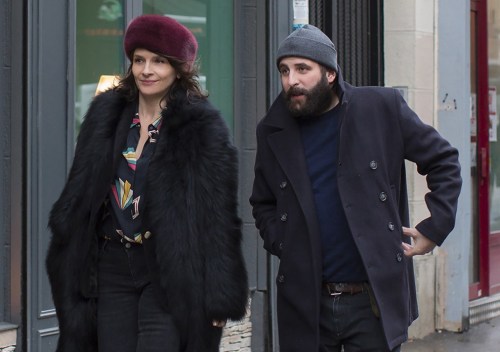
Juliette Binoche, Vincent Macaigne

“NON-FICTION” My rating: 

108 minutes | MPAA rating: R

“Non-Fiction” is populated by intellectuals conversing about literature, books, the internet, blogs versus real news and the changing cultural landscape in our electronic world.

All that endless talkiness could be off-putting, except that these characters are French, which means that in addition to being smart and clever and wonderfully jaded, they’re also having affairs all over the place. Nothing like illicit sex to take your mind off the depredations of social media.

“Non-Fiction” was written and directed by Olivier Assayas, whose most recent efforts — “Clouds of Sils Maria” and “Personal Shopper” — were weighty personality studies dabbling in fate and the supernatural.

But this is comedy — or at least what passes for comedy in French highbrow circles. Which is to say that nobody should expect belly laughs.  A whimsical smirk, maybe.

The tone is set in the first scene in which the schlubby writer Leonard (Vincent Macaigne) visits his editor and publisher, Alain (Guillaume Canet). They chat about how the reading public for “serious” novels like Leonard’s is dwindling (“Writing makes people hysterical”) and debate the value of Twitter (“People sharing witticisms…it’s very French…Tweets are modern-day haikus”).

The two men are old acquaintances who can joke about the projects that flopped (“We didn’t kill many trees”). Over lunch they muse aloud about whether real books will be supplanted by electronic delivery systems.

Eventually, as they are parting, Alain announces that his firm won’t be publishing Leonard’s latest manuscript. Leonard, he says, is out of phase with the times.

Next we meet Alain’s wife Selena (Assayas regular Juliette Binoche), an actress starring in a TV police show. She is noncommittal about her husband’s rejection of Leonard’s latest novel. Actually she’s not at all ambivalent, having been Leonard’s secret lover for  years.

Continue Reading »

“SHADOW” My rating: C+ 

116 minutes | No MPAA rating

There was a time, children, back in the primordial 1990s, when Chinese director Yimou Zhang was on the cutting edge of cinema.

Never mind that he was working in an artistically repressive Communist society — Yimou excelled at turning out thought-provoking period dramas like “Red Sorghum,” “Ju Dou” and “Raise the Red Lantern.” Turning to a modern setting he delivered the sublime “The Road Home.”

Then Yimou discovered kung fu and since then has been devoted to lavish chock-sockey extravaganzas like “Hero,” “House of Flying Daggers,” and the execrable Matt Damon spectacle “The Great Wall.” Forget the intimate drama; he’s now painting on a massive and messy scale.

His latest, “Shadow,” is typical of the new Yimou.

For starters it is an absolute triumph of cinematic design, telling an ancient tale through sets and costumes reduced to the simplest black and white. The only touches of color are provided by human flesh and copious splatters of gore.

The story?  Sheesh, I was afraid you’d ask about that.

Well, there’s this kingdom, Pei, ruled by a handsome but utterly corrupt young idiot (Ryan Zheng) who comes off as the Asian equivalent of Jeoffrey Baratheon.

The king’s success lies largely with the prowess of his general, Zi Yu. Except that Zi Yu isn’t who he seems.

Okay, listen carefully. I’m not going through this twice.

Continue Reading »

Oleg Ivenko as Rudolph Nureyev

“THE WHITE CROW” My rating: B-

127 minutes | MPAA rating: R

Early on in  Ralph Fienne’s “The White Crow” a character observes that Rudolph Nureyev’s dancing is rarely technically perfect but that he compensates with personality and passion.

Ironically, personality and passion are what is lacking in this biopic about Nureyev’s early life.

David Hare’s screenplay adopts a jumbled narrative that leaps between the dancer’s impoverished childhood in the Soviet Union during World War II, his training at Leningrad’s Kirov Ballet and a long visit to Paris that  ends with his defection to the West.

All the makings are here for a compelling real-life tale of an iconoclast (a “white crow” in idiomatic Russian) whose emotional makeup and outsized talent were a poor fit with the do-what-you’re-told culture of Soviet-sponsored arts (“Ballet is about obedience”).  And yet despite a few compelling moments, the film occupies a sort of generic middle ground.

Needless to say, the real Nureyev was anything but generic.

In the end the film’s successes and failures come down to leading man Oleg Ivenko, a dancer talented enough to simulate Nureyev’s astounding leaps (though dance scenes in the film are few and far between) but too limited as an actor to fully inhabit his character.

The film is bookended by the 1961 residency of the Kirov at Paris’ Garnier Opera House. Almost immediately Ivenko’s Nureyev is established as a loner who gets up early to visit the Louvre (just so he can have a few precious minutes of alone time with Géricault’s “The Raft of the Medusa”) and insists on breaking away from the other Kirov members to explore the city’s vibrant night life with the young French dancers who are the Soviets’ hosts.

His willful flaunting of the rules does not go unnoticed; invariably he is tracked on his nightly perambulations by menacing KGB types who sit dourly at nearby tables sipping the house’s cheapest drinks.

Continue Reading »

Sanya Malhora, Nawazuddin Siddiqui

“PHOTOGRAPH” My rating: B-

110 minutes | MPAA rating: PG-13

For most American moviegoers the Indian cinema is defined by the conventions of Bollywood: song and dance, silly plots, sexless romance.

Rites Batra’s “Photograph” is a reminder that this is a narrow view. Here’s a melancholy study of lives that, if not in crisis, are at a sort of crossroads. And there isn’t a dance routine in sight.

Rafa (Nawazuddin Siddiqui) takes photos of visitors to Mumbai’s tourist traps. He’s come to the big city from a faraway village with the intention of earning enough to buy back his family’s ancestral home.  But it’s an uphill climb. He lives in a metal-roofed loft with four other provincials scrambling to survive on the mean streets. At least his roomies are fun-loving and entertaining; Rafi does little more than brood.  When he delivers half a grin it’s an event.

Miloni (Sanya Malhora) is the second daughter of a solidly middle-class family. She’s studying to be an accountant, takes no girly interest in clothing or boys, and while she’s not exactly plain, she doesn’t stand out in a crowd, either.

“Photograph” relates how these two inarticulate strangers meet (Rafi takes Miloni’s picture) and become confidants, each using the other to fend off their families’ insistent attempts at matchmaking. They don’t realize it, but they’re as close to soulmates as they’re likely ever to find.

Continue Reading »

David Dastmalchian, Karen Gillan

“ALL CREATURES HERE BELOW” My rating: B

91 minutes | No MPAA rating

Filmed mostly in Kansas City, Collin Schiffli’s “All Creatures Here Below” reminds of a 21st-century retooling of Steinbeck’s Of Mice and Men.

Its background is not the Great Depression but rather the hardscrabble world of the contemporary underclass. In lieu of the childlike giant Lenny it offers a young woman of similar simplicity, though her mental/emotional fragility is born less of genetics than a ghastly past.

And like Steinbeck’s novel,  David Dastmalchian’s screenplay is rooted in a fatalism that offers only brief flickers of stubborn — and elusive — hope.

The good news is that the piece has been so well acted by its two leads that it keeps us involved long after our logical sides tell us it’s time to bail.

Gensan (Dastmalchian) and Ruby (Karen Gillan) are a young couple living hand to mouth in Los Angeles.

In the film’s first few minutes he is laid off from his job making pizzas (corporate is trimming the work force) and she is let go from her gig on the cleaning crew of a megachurch…apparently Ruby can’t keep from hanging around the nursery, which she has been told is off limits to her. (In Mice… Lenny has a thing for rabbits; Ruby obsesses about babies.)

Desperate for cash, Gensan wagers his severance paycheck on an illegal cockfight. He loses big but in the ensuing chaos of a police raid manages to make off with a stolen car and a wad of cash from the betting table. He gets word to Ruby to meet him away from their apartment; they have to get out of Dodge.

She shows up as directed, only she has with her the infant daughter of their neighbor. Ruby has found the child unattended and decided that she’d be the better mother.

Now the frantic — and let’s face it, not very bright — Gensan must navigate a drive across half the country with the maddeningly illogical Ruby and a crying baby who needs diapers, a child car seat, and nourishment (Ruby is so clueless she attempts to breast feed; even Gensan knows you have to be pregnant before that works).

Continue Reading »

Molly Shannon, Susan Ziegler

“WILD NIGHTS WITH EMILY” My rating: B-

84 minutes | MPAA rating

“Wild Nights with Emily” is such an awesome idea that I wish I liked the film more than I do.

When Emily Dickinson died in 1886 in Amherst, Mass., she left behind nearly 2,000 unpublished poems which would lead future generations to regard her as America’s greatest poet.

For most of the ensuing 130 odd years Dickinson has had the reputation of a recluse, a woman incapable of interacting with others. But if that’s the case, if her personal life were so limited, if she never enjoyed human intimacy, how did she come by the ideas and emotions so brilliantly expressed in her writing?

Seizing on recent research into and discoveries about Dickinson, writer/director Madeleine Olnek has given us a film that presents Emily Dickinson not so much as a recluse as a dedicated artist who, by the by, had a lifelong sexual relationship with the woman who would become her sister-in-law. We’re talking some good old-fashioned lust.

Moreover, Olnek presents her yarn as a comedy in which Dickinson’s vastly superior intellect and talents go head-to-head with the doofuses who run the male-dominated literary world of the 1800s. These bozos are so gobsmacked by her poetry that  all they can do is complain that it doesn’t rhyme.

Olnek’s screenplay time jumps from Dickinson’s mature years and her affair with her sister-in-law Susan (Susan Ziegler) back to her adolescence when the two first fell in love (the girls are played as teens by Dana Melanie and Sasha Frolova).

Continue Reading »

Beanie Feldstein, Kaitlyn Dever

“BOOKSMART” My rating: B 

112 minutes | MPAA rating: R

“Booksmart” is being described as a female-centric version of “Superbad.” Well it is…but it’s more.

For her feature directorial debut actress Olivia Wilde (with the assistance of four screenwriters) has given us one of those teen-age all-nighter comedies, with all the raunch, substance sampling, and sexual awakening the genre implies.

The difference, of course, is that instead of giving us horny adolescent boys we follow a couple of graduating senior girls who have spent their entire high school careers toeing the line and are now ready to party down.

Molly (Beanie Feldstein, whose brother Jonah Hill starred in ‘”Superbad”) and Amy (Kaitlyn Dever) have done everything right.  Great grades, lots of activities, student government, the whole deal.  And it has all paid off with Molly’s admission to Yale and Amy’s plan for a gap year of charity work in Africa.

Initially the two feel superior to their party-hearty classmates who will undoubtedly be heading for military service or the local junior college. But when Molly and Amy learn that many of those slackers have themselves landed in great college situations, they question everything.

I mean, why do everything right if it doesn’t give you leg up on the animals? Realizing they have pretty much wasted their youth on the quest for scholastic greatness, the best buds decide to hit their classmates’ rowdy night-before-graduation bacchanal.

They are, of course, ill prepared to party down. They never really got to know their fellow students in any depth, and their efforts to blend in are hopelessly klutzy.

Continue Reading »