Those fortunate enough to have seen 2015’s “Tangerine” will be well prepped for writer/director Sean Baker’s latest screwball sex comedy, “Anora.”
“Tangerine” was about a trans prostitute scouring the streets for her philandering pimp boyfriend on Christmas eve.
“Anora” focuses on an exotic dancer’s whirlwind romance with the son of a Russian oligarch.
Both films treat sex matter of factly; they refuse to demonize (or even feel sorry) for the sex workers who are their protagonists.
And both films feature a riveting central performance by actors who radiate unstoppable energy.
When we first meet Ani (Mikey Madison…she was the oldest daughter in the superb series “Better Things”) she’s pushing drinks and lap dances in a Manhattan gentleman’s club.
Among the regulars is Ivan (Mark Eydelshteyn), a twenty something party boy who mixes conspicuous consumption with a weird kind of innocence.
Ani has seen too much of life to expect she’ll ever find her white knight, but Ivan gives her hope. Invited to his house, she discovers a veritable modern-day Xanadu.
The guy is obviously loaded (or his folks are). He’s sweet and funny. The sex is great.
So when Ivan suggests that they board a private plane for a Las Vegas weekend, Ani happily complies. And when Ivan, suggests a Las Vegas wedding…well, what more could a girl ask for?
“Anora” (that’s Ani’s legal name) begins sweetly romantic, then veers into breathless hilarity.
Initially the honeymooners spend their days shopping on Fifth Avenue, eating at the best restaurants and partying all night.
Meanwhile, Ivan’s parents in Russia are not pleased with this union and dispatch a couple of local flunkies (Kareen Karagulian, Vache Tovmasyan) to demand an annulment. They’ve brought along some muscle, a hulk named Igor (Yura Borisov), who will end up playing a more important role than one imagines.
The upshot: The faithless Ivan panics and runs off for an all-night Big Apple binge, leaving his bride a captive. The trio of hapless goons and the royally pissed Ani spend a night scouring every hot spot where Ivan may have taken refuge.
In a parody of O. Henry’s “The Ransom of Red Chief,” the film has Ani running circles around the dimwitted thugs. They’ll be only too glad to be rid of her.
Madison’s performance is fierce, funny and even philosophical. Ani may be a sex worker, but she’s not a stupid sex worker. She exhibits more common sense than anyone else on the screen (even Ivan’s exasperated father finds her amusing) and appears to be free of self-delusion.
And she’s overflowing with New Yawk Girl attitude. An Oscar nomination seems likely.
“Anora” has a running time of well over two hours, but it doesn’t feel that long. The humor ranges from raucous to slyly satirical, and the film’s treatment of sex is, well, blush-inducing.
I wasn’t expecting much from “Joy.” I knew one of the stars was the always-watchable Bill Nighy, and that the subject was the development of the in vitro fertilization technique in the 1970s.
Maybe I was in for a docudrama or dry medical procedural?
I wasn’t prepared for the sneakily effective emotional journey cooked up by first-time feature director Ben Taylor and scenarists Jack Thorne, Rachel Mason and Emma Gordon.
“Joy” works so well for a couple of reasons. First, the screenplay focuses less on the scientific challenges facing physician/researchers Bob Edwards and Patrick Steptoe (James Norton, Nighy) than on the cultural backlash their work elicited.
Today IVF is opposed by many who associate it with abortion. A mother is implanted with just one of several of her eggs fertilized in the lab; the rejects may be destroyed. If you believe that every fertilized egg is already human, then that’s murder.
Fifty years ago, though, the opposition to IVF was based on the notion that “test tube babies” would be born with defects that would make their lives a living hell. Voices in the media, the church, the political arena and even the medical establishment compared the work of Edwards and Steptoe to that of the fictional Dr. Frankenstein. The doctors were accused of playing God.
As a result they did most of their work in a remote clinic away from prying eyes. Not precisely off the grid, but close.
Also, the filmmakers were incredibly wise in focusing the film on a third member of the team, Jean Purdy (Thomasin McKenzie), a young nurse whose official title was lab technician but whose pivotal role in IVF wasn’t recognized for decades.
When we first meet her Purdy appears to be all business, not particulxarly warm. But exposed to the desperation of the young women who come to Edwards and Steptoe looking for a miracle, she becomes more than a nurse or researcher. She becomes a friend, a confidant, a cheerleader, a shoulder to cry on.
Only later do we realize that she is motivated at least in part by her own inability to have children.
And because of her work Purdy finds herself ostracized by her church and community and disowned by her rigidly moralistic mother (Joanna Scanlan).
McKenzie, who was so effective as a teenage survivalist in “Leave No Trace” and had a strong supporting perf in “Jojo Rabbit,” is just about perfect here. She’s attractive without being at all glamorous, and she excels at allowing her character’s inner life to percolate through that stiff Brit carapace.
By the time “Joy” is over (the title isn’t explained until the last moment, and it’s sob-inducing revelation) you’ll be deeply invested in the story and its real-life characters.
Danielle Deadwyler, John David Washington
“THE PIANO LESSON” My rating: B(Netflix)
125 minutes | MPAA rating: PG-13
It features near-flawless performances and a script based on a Pulitzer Prize-winning play.
So why didn’t “The Piano Lesson” work for me? Or why did it only work part of the time?
Produced by Denzel Washington, starring his son John David Washington and directed and co-written by yet another son, Malcolm Washington, this production is a family affair.
Which is fitting, since August Wilson’s play centers on a family and the different ways in which its members deal with (or attempt to reject) their shared history.
The piano of the title is a family heirloom, quite literally paid for with the blood of ancestors.
In pre-Civil War Mississippi a plantation owner named Sutter sold members of the enslaved Charles family to buy the upright piano for his wife. Subsequently portraits of the sold slaves were carved into the instrument’s wood by a remaining family member.
In 1911 the piano was stolen by Charles family survivors and it now sits in the Depression-era Pittsburgh home of Doker Charles (Samuel L. Jackson), where it will generate a family crisis.
Doker’s nephew Boy Willie (Joh David Washington in the most astonishingly nuanced performance of his career) has driven up from Mississippi hoping to sell the rarely-played piano. He’ll use the money to buy land long owned by the Sutter clan, now up for sale thanks to the mysterious death of the last Sutter, who fell down a well.
Boy Willie’s plan is fiercely opposed by his sister Bereniece (Danielle Deadwyler). It’s not the loss of a musical instrument she minds (she refuses to play, though her young daughter sometimes doodles on the keyboard); it’s the thought of giving up her last connection to her ancestors.
Also, she suggests Boy Willie may have murdered the last Sutter to get his land. She even claims to have seen a dead white man — Sutter’s ghost — haunting the upstairs hallway.
Though director Washington makes a few attempts to open up the acton “The Piano Lesson” is mostly talk — talk that reveals the various outlooks of a mixed slate of characters (the cast is rounded out by Ray Fisher, Corey Hawkins and Michael Potts). Everyone is excellent.
Here’s where I think things went sour: In Wilson’s play Sutter’s ghost is talked about but never seen. He’s offstage…provided, of course, that he even exists outside the characters’ imaginations.
But in the movie we see him. He even gets into a physical brawl with Boy Willie, amd it threatens to derail the entire narrative. Instead of a figurative haunting we get a literal one.
Now it’s a ghost story. I don’t believe that’s what Wilson had in mind.
Cailee Spaeny and friend
“ALIEN ROMULUS” My rating: C(Hulu)
118 minutes | MPAA rating: R
Going in I suspected that “Alien Romulus” would be a budget-basement spinoff from the long-running monsters-in-space franchise.
You know…cheap f/x, tacky production values, a straight-to-video approach. When Ridley Scott directs (“Alien,” “Prometheus”) you expect top-of-the-line everything…except, perhaps in the script department.
But “Alien Romulus” looks great, and even has been designed with tongue firmly in cheek to reflect on earlier (and much better) episodes. The plot may be one “Alien” cliche after another, but the physical production is solid.
Directed and co-written by Fede Alvarez, this is a teens-vs-aliens movie. On a mining planet a handful of wage slaves plot to hijack an abandoned spaceship and get the hell out of Dodge.
What they don’t realize is that the ship, the Romulus, houses a breeding lab for those nasty, acid-blooded critters. After losing most of its crew to the aliens the ship’s operator, the infamous Weyland-Yutani Corporation, pulled out. The idea was to let gravity suck the ship into the rings that circle the planet, destroying it and its deadly cargo.
But our adolescent heroes know none of that, though once on board they’ll learn quickly.
There are no “names” in the cast. You may recall Cailee Spaeny as the wannabe journalist in “Civil War.” And David Jonsson has a plum role as a replicant (they still prefer the term “artificial human”) whose levels of intelligence and empathy vary depending upon what computer chip is clicked into a slot on his neck.
The real hero here is production designer Naaman Marshall, who has a whole lot of fun recreating the world of the first two Alien films from way back when, right down to the retro/crude graphics on the ship’s computer screens.
Oh…and did I mention that the late Ian Holm has been digitally resurrected? He appears as a worse-for-wear replicant clearly manufactured in the same batch as Ash from the original 1979 “Alien.”
Full disclosure: The first first five minutes or so of “Babes” felt so forced, so over-the-top phony that I was tempted to bail.
Glad I didn’t.
Because rather quicky Pamela Adlon’s film found its voice…or maybe I clicked into its heady mix of raunch and sentiment. Whatever…I ended up lovin’ it.
So imagine a female buddy comedy made by women, …but women with the gross-out sensibilities of Seth Rogan in “Sausage Party”/“Superbad” mode. Think “Bridesmaids” on steroids.
Best buds Eden (Ilana Glazer) and Dawn (Michelle Buteau) have been friends since childhood. Now they live in NYC where Eden, single, runs a yoga studio out of her apartment and Dawn, a dentist, has a hubby (Hasan Minhaj), a four-year-old, and another on the way.
The screenplay by Glazer and Josh Rabinowitz deftly and hilariously dissects the relationships on display, relishing the woke-free sensibilities of two women who’ve known each other so long they don’t hesitate to check each other for vaginal leakage. In public. (I told you it was raunchy.)
But a one-night stand with a sweet but struggling actor (Stephen James) leaves Eden pregnant. She opts to become a single mother…because of course she’ll have her soulmate Dawn to back her up, right?
The film follows Eden throughout her pregnancy while circumstances push her friendship with Dawn to the breaking point.
Visually “Babes” rarely rises above the level of an ‘80s made-for-TV movie. But Adlon — the brilliant comedic actress whose series “Better Things” belongs in the pantheon of great television — shows in her feature directing debut that brilliant sense of comic timing, along with a big heart and some deep wisdom when it comes to the ups and downs of female friendship.
The big revelation here is Glazer, an actress I don’t recall having seen before. But, man, does she make an impression. She oozes the New Yawk City funkiness and droll hilarity of a Fran Lebowitz. In fact, with her frizzy black hair she looks like the Franster.
“Babes” also features a handful of recognizable faces in small but effective perfs: Sandra Bernard, Elena Ouspenskaia, Oliver Platt and John Carroll Lynch as possibly the most lovable OB-GYN ever depicted on celluloid.
You’ll probably hate yourself for laughing at some of the material tossed out here — there’s a discussion of bowel movements during childbirth that rivals Jeff Daniels’ diarrhea scene in “Dumb & Dumber” — but you WILL laugh. And then probably hit the replay button.
Early in Steve McQueen’s “Blitz” a single London mother tries to convince her reluctant son that he must board a train filled with other children to spend months — even years — in the countryside, safe from the nightly rain of German bombs.
It will be, she cajoles, “an adventure for children only.”
She doesn’t know the half of it.
Rita (Saoirse Ronan) and her 9-year-old George (Elliott Hefferman) share a home with her father, the piano playing Gerald (Paul Weller). They’re a tight bunch, which helps explain George’s dismay and ultimate fury at leaving his familiar streets and being shipped off to God knows where.
So at the first opportunity he leaps off the train and heads back to the city, encountering along the way a regular Pilgrim’s Progress of characters good and bad and more than a few close calls with mortality.
“Blitz” is several things at once, not all of them coexisting comfortably.
It begins with a hair-raising sequence showing civil defense crews fighting the fires caused by the bombing. There’s a visceral oomph to the moments depicting the air raids and the citizenry’s desperate search for shelter.
George’s adventures on the road are, well, remarkable. More happens to this kid in a few days than the rest of us experience in a lifetime.
Sneaking aboard a freight train he shares a few giddy thrills with three brothers who, rather than being farmed out to different families, have gone rogue.
Once in London —basically he’s lost — George finds himself hijacked by a Fagin-inspired crook (Stephen Graham) who uses him to steal valuables from bombed buildings and off dead folk. Very Dickensian.
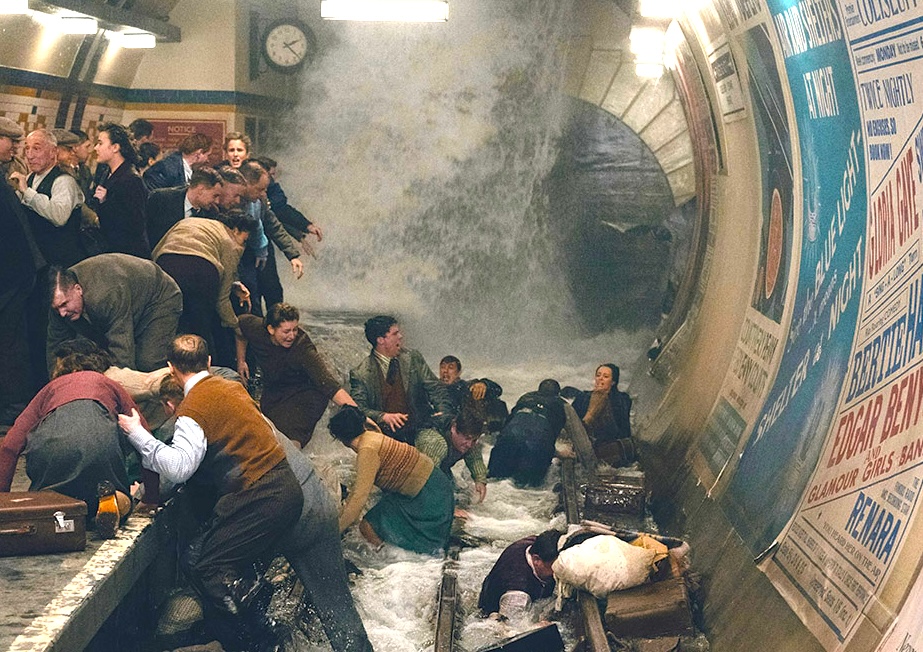
Hr’d befriended by a civil defense guard (Benjamin Clementine) and spends a couple of nights crammed into a tube station with hundreds of other Londoners. On one of these occasions the tunnels are flooded with Thames water, creating a deathtrap.
Flooded tube station in “Blitz”
Here’s something I haven’t yet mentioned. George’s father was a black man deported years earlier. And his very blackness makes the boy’s journey all the more problematic,
Writer/director McQueen, of course, is a black Brit, and his resume is peppered with titles that delve deeply into the black experience (“12 Years a Slave” and the TV series “Small Axe” in particular). And in fact he was inspired to write “Blitz” after finding a vintage photo of a young black child with suitcase en route to the provinces.
So in addition to just staying alive, young George encounters numerous displays of racial intolerance.
But that’s only half the movie. Meanwhile Rita and her all-female fellow workers at the munitions plant must deal with the chauvinism of the management and unfair treatment. They are particularly incensed that the government has blocked the desperate public from using certain underground shelters. (There’s no explanation of what this is all about…makes one wonder if it was trimmed from the final cut.)
Eventually Rita gets word of George’s disappearance and goes on her own frantic search of London, abetted by a neighbor and civil defense warden (Harris Dickerson) who is quietly yearning for her.
And I haven’t even addressed the extensive flashbacks of Rita’s pre-war romance with Marcus (CJ Beckford) and the inevitable racial fallout from that taboo relationship.
Whew. That’s a lot of plot. Too much, in fact.
The performances are good, the physical production impressive, the handling of individual scenes generally tight and effective.
But there’s just so much going on that I practically succumbed to eye-rolling. More is not always better.
Director Ridley Scott’s followup to his 2000 Oscar winner (what were they thinking?) is less a sequel than a loose remake. It’s forever repeating beats from the original.
You see that right in the opening credits, which unfold over a montage of moments from the original “Gladiator,” albeit this time rendered in painterly animation.
Once again we get color-desaturated dream sequences and flashbacks.
Then there’s the plot, which begins with a massive battle, then becomes the story of an honest man reduced to slavery and a life of fighting in the arena. (Remember the gladiator owner played by Oliver Reed the first time around? This time those duties are fulfilled by Denzel Washington.)
The first film had a crazy emperor. This one has two crazy emperors.
And again there’s an iffy subplot about Roman political machinations with lots of uplifting/dubious oratory espousing democratic ideals that sound more like Thomas Jefferson than Marcus Aurelius. (At one point we even get an “I am Spartacus” moment.)
But here’s the thing: “Gladiator II” is bigger, noisier, faster. Special effects that looked phony in the original are now so sophisticated that one cannot tell a real rampaging rhino from a digitally created one. The city-scapes are awe-inspiring.
The whole thing pulses with visceral/sensory overload.
And it needs to, because dramatically “Glad II” feels like amateur hour. (The screenplay is by David Scarpa, Peter Craig and David Franzoni.)
Our hero (I never caught his name…I now see that this was deliberate) is played by Paul Mescal. I’ll call him Hero.
Paul Mescal
Hero comes to Rome in chains after a Roman fleet destroyed his city on the coast of North African. Having lost his home and his wife in the battle, Hero carries a chip on his shoulder. All he wants before dying is revenge on the general who ruined his life.
That would be Marcus Acacius (Pedro Pascal), who is now married to the princess Lucilla (Connie Nielsen, reprising her role from the first film). Together they are plotting to overthrow the sibling emperors Geta and Caracalla (Joseph Quinn, Fred Hchinger), a debauched pair of painted syphilitic psychos.
Before it’s all over, Hero’s path will cross those of Marcus and Lucilla in an unexpected (and wildly unlikely) plot reveal.
But then there’s the spectacle. Scott and his production designers have outdone themselves in creating the Colosseum in beautiful downtown Rome.
The first big brawl finds humans battling a troop of killer baboons. Then we move on to that armored rhinoceros, which is about the size of a Sherman tank. Most awe inspiring of all is a naval battle staged in the flooded arena. Those Romans thought of everything, including introducing huge sharks which swim around the galleys to snatch anyone who falls overboard.
The acting? It’s okay. Just okay.
Which is disappointing because Mescal has in recent roles (“Aftersun,” “All of Us Strangers,” “Normal People”) displayed a subtly seductive approach. He’s one of the few actors who can find interesting things to do with “nice” characters.
Ironic, then, that as our vengeful protagonist he’s kind of a one-note creation. Barely suppressed rage gets tiresome after a while.
Washington has been getting some awards-season buildup for his work as the gladiator master and Machiavellian power broker Macrinus. I don’t see it. The character has a few moments of gloating triumph as he turns the tables on Rome’s blue-blooded politicians, but I yearned for Washington to exhibit some wickedly comic impulses. Nope.
Denzel Washington
Everyone else delivers their lines with the sort of bloviating declamatory dialogue that wouldn’t be out of place in an old Hollywood epic from the 1950s.
Here’s the thing: “Gladiator” is all surface and no substance. There are no interesting ideas beneath the grandeur and violence, no emotional engagement.
Like Scott’s last film, the curiously untethered “Napoleon,” “Gladiator II” is a display of elephantine emptiness. No wonder it feels about 45 minutes too long.
There’s much satisfaction to had in the performances of veteran actors June Squibb (age 93) and Richard Roundtree (age 81) in “Thelma.”
Squibb has found stardom late in life, but her work goes back decades (she was one of the strippers in the original 1959 Broadway production of “Gypsy”).
Roundtree, of course, found screen immortality in 1971’s “Shaft.” His death last year adds a touch of haunting melancholy to his work in “Thelma,” his final screen project.
I loved watching them. I wish I liked the film more.
“Thelma,” the feature debut of writer/director Josh Margolin, is clearly a personal work. Margolin based his lead character on his own grandmother and in fact incorporated some of her idiosyncratic speaking style into the movie’s dialogue.
But he cannot find the right balance of emotions and emphasis. “Thelma” veers from goofy comedy to sit-commy family dynamics to crime caper to glum end-of-life meditation. It’s enough to cause whiplash.
The central premise, though, is quite workable. Thelma (Squibb) is scammed out of $10,000 by crooks who call her up pretending to be her grandson in desperate need of bail money. Panicked, Grandma Thelma immediately mails the money to the kid’s “lawyer.”
Of course her grandson Danny (Fred Hechinger) is not in jail. He is, however, a mess — an insecure, sweet-tempered twentysomething man child with no discernible skills or ambitions and a head that has never seen a comb.
But, boy, he loves his Grandma.
Then there’s Danny’s folks, Thelma’s daughter Gail (Parker Posey) and her husband Alan (Clark Gregg), a pair of hovering helicopter do-gooders who are always intruding on Danny and Thelma’s business.
The film’s narrative centers on Thelma’s determination to get her money back. With old friend Ben (Richard Roundtree) as her sidekick, she tools around L.A. on a motorized wheelchair-scooter, sifting clues and staking out the mail drop where her money was sent.
Watching the two solve the mystery is by far the most interesting thing on screen — certainly better than the old-age navel gazing Margolin periodically delivers.
Malcolm McDowell has a nifty last-reel turn as one of the miscreants.
Periodically “Thelma” dives into cuteness and stereotype. Ben is playing Daddy Warlocks in a nursing home production of “Annie” in which all the roles — including Annie and the orphans — are played by senior citizens. He’s got a roommate who is basically a zombie. And a recurring gag involves old folks’ supposed inability to use a computer.
But Squibb and Roundtree? Loved ‘em.
Hugh Jackman, Ryan Reynolds
“DEADPOOL & WOLVERINE” My rating: B+ (Disney +)
128 minutes | MPAA rating: R
I’m so over Marvel movies. It’s not the cost of the ticket…it’s the loss of two-plus hours.
But there is one festering corner of the Marvel Universe where I feel perfectly at home.
I’m talking, naturally, of Ryan Reynolds’ Deadpool character, the profane court jester of Stan Lee’s fantasy world, a hideously scarred wiseass who dons a red suit and mask and…well, I was gonna say he fights evil but he’s not nearly that focused. He just likes fighting…the bloodier the better.
“Deadpool & Wolverine” is a fantastically entertaining team-up, with Reynolds delivering an endless hilarious arsenal of rude, profane, grotesque pronouncements (he co-wrote the script with Rhett Reese and Paul Wernick), while Hugh Jackman’s sour-tempered Logan snarls and flexes.
It’s a buddy film of unsurpassed crudeness, filled with knowing putdowns of all things Marvel and an insouciant attitude that has the characters often breaking down the fourth wall to comment directly to the viewer.
In other words, “D & W” has it both ways, exhibiting an encyclopedic knowledge of the comic book universe while simultaneously roasting it.
The plot? Well even after seeing the movie I’m not sure. Basically Deadpool resurrects Wolverine (who died at the end of “Logan” back in 2017), and together they are transported by a smug dweeb running the Time Variance Authority (Matthew Macfayden, satirizing his own performance as Tom Wambsgans in “Succession”) to the Void…which is just as unpleasant as it sounds.
There our boys must contend with the universe-destroying plans of Charles Xavier’s long-lost sister Cassandra Nova (Emma Corrin, with shaved head). They also run into Marvel superheroes now in exile: Elektra (Jennifer Garner), Blade (Wesley Snipes), Gambit (Channing Tatum) and Johnny Storm (Chris Evans). Listen carefully and you may hear the voices of Nathan Fillion, Blake Lively (aka Mrs. Ryan Reynolds) and Matthew McConaughey.
With the exceptions of some unnecessarily sappy digressions into our two heroes’ tortured pasts, director Sean Levy keeps the yarn churning along at a breakneck pace.
And late in the film he delivers an epic battle between our two protagonists and an army of Deadpool variants that is one of the best action sequences ever. Think “The Wild Bunch” played for laughs.
By all rights “Emilia Perez” should collapse under the weight of its borderline crazy ambitions.
That it doesn’t, that in fact it keeps us from sneering despite a staggering level of telenovela-level melodrama, is one of those weird wonders that makes watching movies so much fun.
This Spanish-language effort from French director Jacques Audiard (he shares screenplay credit with Thomas Bidegain and Lea Mysius) is many things all at once.
Gangster picture. Social commentary. A tale of personal (and sexual) liberation.
Oh…and did I mention it’s a musical?
The yarn starts out with Mexico City criminal lawyer Rita Castro (a makeup-free Zoe Saldana) hitting a personal and professional dead end. She hates her job getting bad people off the hook, venting her frustrations in an opening musical number.
(Throughout the film Camille Clement Ducal’s songs are employed to reveal the psychology of the various characters. There’s very little in a traditional musical comedy sense; the emphasis is less on melody than on percussive delivery and a kind of repetitive chanting. In many instances backup singers deliver what can only be described as choral raps. Visually the restless approach to these numbers reminds of Baz Luhrman’s work on “Moulin Rouge.”)
Looking for something new, Rita agrees to meet with a shadowy new client, and finds herself grabbed and blindfolded. When the hood comes off she’s sitting opposite one of Mexico’s most notorious drug lords, Manitas Del Monte, a bearded, tattooed terror with a long history of murders.
Manitas has a very special job for Rita. He has for years desired a sex change operation, and wants his new attorney to search the world for medical clinics where he can undergo the transition in ultimate privacy. This is all top secret…not even his wife Jessi (Selena Gomez) and their two young children know of Daddy’s double life. And all the while his freedom and very existence are threatened by the authorities and rival gangs.
The upshot is that Manitas fakes his own death, goes to Israel for months of surgery and therapy, and emerges as Emilia Perez.
Here’s what’s mind boggling…both the scarily masculine Manitas and the very feminine Emilia are portrayed by Karla Sofia Gascon, a Spanish actress who made the transition from man to woman several years ago. She is utterly convincing with either persona.
Manitas/Emilia returns to Mexico and with Rita’s help tries to atone for her sins by creating a non-profit that works to determine the fates of thousands of citizens who have vanished in Mexico’s never-ending drug wars. Manitas was responsible for not a few of those deaths. There’s a documentary-style montage in which imprisoned sicarios testify to the atrocities in which they have participated.
Selena Gomez
On a personal note, Emilia finds love with the grieving mother (Adriana Paz) of a missing teenage boy.
And, posing as Manitas’ cousin, she invites Jessi and the kids to live with her. This way Emilia can be close to the children she was forced to abandon, and she can keep tabs on how Jessi is handling the considerable fortune her “dead” husband left behind.
Yeah, that’s a lot. And there’s more, but this isn’t the place for a litany of plot points. Let’s just say that “Emilia Perez” had me glued to the screen even when my b.s. meter was sending up red flares.
But the acting…Holy Cow!! No wonder Saldana, Gomez (doing a 180 from her buttoned-up character in “Only Murders…”), Paz and especially Gascon were jointly named best actress at this year’s Cannes Film Festival, where “Emilia…” also won the jury prize as best film.
Different segments of the film feel like reflections of other movies (trans drama, gangster epic, family trauma, Almodovar’s “The Skin I Live In”), yet the way these familiar elements have been combined feels surprisingly original. And here’s where the musical elements play a big role — by having the characters periodically break into song writer/director Audiard signals early on that we’re dealing with a heightened realism, that while the film may appear to be rooted in the real world, it’s operating on an entirely different emotional and intellectual plain.
I can honestly say I’ve seen nothing quite like it.
Earlier this year I opined that Colin Farrell might never again be as good as he is in “Sugar,” a mind-bending Netflix series that blends the usual private eye tropes with “The Man Who Fell to Earth” weirdness.
But I hadn’t anticipated the jaw-dropping wonder that is “The Penguin,” a spinoff of the “Batman” franchise featuring Farrell in one of the greatest performances the small screen has ever seen.
Here Farrell takes his brief appearance as gangster Oswald Cobb (aka The Penguin) in 2022’s “The Batman” and fills it with Shakespearean depths.
This epic crime drama (it’s a very different show from “The Godfather” but carries much of the same dramatic weight) allows a famous actor to absolutely get lost in a character.
Usually when actors — especially handsome ones — submit to a latex-and-prosthetics transformation there’s a whiff of look-at-me-Mom cheese wafting through the proceedings.
Not here.
If you didn’t know it was Colin Farrell beneath that makeup you’d never guess. Hell, you’d not guess that it was makeup. It’s a metamorphosis so complete that even after watching the entire first season I can’t wrap my brain around it.
But it’s more than paint and putty, more than the avian waddling gait (Oz wears a leg brace, the legacy of a childhood injury). Farrell’s Penguin is an ugly duckling determined to be a king, a complex character who one moment can be a seemingly caring mentor to a young recruit to crime, and the next can immolate a mother and son.
This Oswald Cobb may be ugly, but he can be as charming as Iago. He’s a Machiavellian marvel, a self-serving plotter and killer, a liar on a Trumpian scale who in middle age remains a Mama’s boy. Every time you think you’ve got his number, he pulls the rug out.
Here’s the thing…Farrell’s Penguin is only one of two great performances in the series. The other belongs to Cristin Milioti, who plays Sofia Falcone, his sometimes ally, sometimes nemesis.
The heir to a criminal empire, Sofia was framed for serial murder by her conniving family and spent a decade in a madhouse for the criminally insane. Finally released, she has become an avenging angel — half ruthless killer, half broken child.
The bulk of the first season of “The Penguin” finds Oz and Sofia jostling for control of Gotham’s drug trade. Both are reprehensible, but also scarily compelling.
They’re backed by a deep cast of familiar faces, among them Theo Rossi, Clancy Brown, Michael Kelly, Shohreh Aghdashloo and, in a turn that has Tony written all over it, Deirdre O’Connell as Oz’s demanding, dementia-warped mother.
And where is the Batman in all this? Nowhere. There’s been absolutely no mention of the Caped Crusader in Season One…whether he exists in this timeline or will show up in later seasons I don’t know.
But he’s not missed…there’s more than enough to chew on in this bat-free wonder. At some point the series’ unrelenting darkness may start to wear thiin…but right now I’m nowhere near that point.
≈
Allison Janney, Rupert Sewell, Keri Russell
“THE DIPLOMAT’ (Netflix)
The new season of “The Diplomat” picks up with the car bomb explosion that ended Season One and never slows down.
For my money this Keri Russell starrer is a political thriller on the level of “The West Wing” (not only were both series directed by Alex Graves, but Alison Janney shows up late in Season Two to blow our minds).
This season finds Ambassador Kate Wyler (Russell) grappling with the aftermath of a London bombing that kills one of her staff. Meanwhile she ’s trying to decide if a fatal attack on a British naval vessel was actually a black flag operation approved by the British P.M. (Roy Kinnear) looking to shore up his failing numbers with a manufactured national crisis.
“The Diplomat” will keep you guessing with narrative twists and turns (it’s got one of the greatest end-of-season revelations ever), but while the big story arc plays out, there are all sorts of terrific little dramas.
Ambassador Wyler and her sexy/mansplaining husband (Rufus Sewell) continue to navigate their marital difficulties, while Embassy staffer Stuart (Ato Essandoh) hits a stone wall in his affair with CIA hard-ass Eidra (Ali Aha).
And Celia Imrie has a delicious recurring role as a shadowy British mover and shaker who may be the key to the mystery.
Great pacing, scintillating dialogue, dead-on performances, subtle characterizations and a tongue-in-cheek approach that manages to find humor even in the grimmest circumstances…they all come together for a hugely-satisfying viewing experience.
Left to right: Aiden Tyler Patdu, Beauty Gonzalez, Sid Lucero, Marco Masa
“OUTSIDE” My rating: B+(Netflix)
142 minutes | No MPAA rating
If Eugene O’Neill had written a horror script it would play like “Outside,” a Philippine production in which family dysfunction is even more terrifying than the flesh-chomping undead.
Think of it as “Long Day’s Journey into Zombie-ism.”
Writer/director Carlo Ledesma wastes no time on preliminaries. The film opens with a much-battered family van (it’s covered in bloody handprints) chugging down a country road.
Inside are father Francis (Sid Lucero), mother Iris (Beauty Gonzalez) and their two boys, teenage Josh (Marco Masa) and little brother Lucas (Aiden Tyler Patdu).
They’re fleeing the city, headed for the sugar cane farm on which Francis grew up. Once there they discover Grandpa dead from a self-inflicted gunshot; Grandma is a rapidly decaying wraith.
Francis gets to work burying the bodies and turning the farmhouse into a fortress. There are fewer zombies in the sticks (fewer people, yes?) but they’re fast and hungry and attracted by loud noises.
The problem is that Dad’s idea of a secure space feels a whole lot like a prison.
With his wire-rimmed glasses and soft tummy, Francis is the very embodiment of an unassertive suburban Dad. But in a weird way the zombie apocalypse has transformed him into an alpha male. Now he gets to call the shots.
Turns out Francis is carrying a whole load of baggage. As a boy he was frequently locked in a dank cellar and raped by his father, and being back in that environment has set his paranoia to tingling.
And then there’s his relationship with the Missus. Iris comes off as shellshocked and innervated…it’s all she can do to cook rice for the family. Later we’ll learn the clan’s darkest secret…Francis is sure the two boys are the result of his wife’s infidelity.
Dad’s rapidly advancing mania (in many aspects the plot echoes “The Shining”) has him rejecting Iris’ and Josh’s pleas to drive north to what is reputed to be a zombie-free zone. He’s not above sabotage to keep them under his thumb.
Every now and then we get a close call with the zombies, but “Outside” plays down the usual horror tropes in favor of psychological realism.
It’s been spectacularly well acted — this sort of subtlety is almost unknown in horror — and the two-hour-plus running time zips by.
Mia Goth (left)
“MAXXXINE” My rating: C+ (Hulu)
101 minutes | MPAA rating: R
The collaborations of writer/director Ty West and leading lady Mia Goth (“Pearl,” “X”) have been hailed in some quarters as as the new best hope for the horror genre.
I’m not so sure…and “MaXXXine” hasn’t convinced me.
This latest effort finds West working with some really big names (Elizabeth Debicki, Giancarlo Esposito, Kevin Bacon, Bobby Canavale, Michelle Monaghan, Lily Collins). But all that talent is frittered away on a cheesy premise.
Maxine (Goth) is a Dixie chick who came to LA and ended up in porn. Now past 30, she recognizes that her expiration date in the flesh industry is fast approaching. She needs to pivot to a “real” movie with a “real” director.
After giving a killer audition, this tart-talkin’ Southern gal seems poised to realize her dream. But even as she launches her new legit career Maxine finds herself being stalked by an unseen killer who seems to follow her every move and begins picking off her friends and acquaintances.
Set int the late 1970s, “MaXXXine” is nothing if not ambitious. West wants to comment on unbridled ambition and the whole star-making apparatus, and much of the movie unfolds on studio back lots familiar from other films. There’s a sequence set in the Bates house from Hitchcock’s “Psycho”; the final confrontation with the mysterious killer unfolds at night at the foot of the famed Hollywood sign.
But it doesn’t add up to much, largely because the character of Maxine feels painfully undernourished. There’s not a smidgen of humor or even irony in Goth’s joyless performance. Maxine starts out thick-skinned and hard-assed and never evolves into anything more.
C’mon. Watching a thriller is supposed to be fun, but there’s not much pleasure to be had from “MaXXXine.”
Actress Anna Kendrick makes a way-more-than-adequate directing debut with “Woman of the Hour,” a chilling retelling of one of American pop culture’s more bizarre incidents.
Kendrick’s subject is serial killer Rodney Alcala, who in the middle of a long murder spree appeared as a contestant on the “Dating Game” TV show.
Ian McDonald’s screenplay cleverly exploits two plot threads. In one, struggling actress Sheryl (Kendrick) attempts to navigate the treacherous waters of 1970s Hollywood. The casting agents are asses, her semi-clumsy neighbor (Pete Holmes) is putting the moves on her, and she’s running out of money.
So when her agent lands her an “easy” gig on “The Dating Game” she can hardly refuse.
Interwoven with all this are incidents from the murderous career of Alcala (a skin-crawling Daniel Zovatto), who uses his camera and charming personality (he could give Ted Bundy lessons) to lure in insecure, homeless and otherwise vulnerable women.
The central chunk of the film is the “Dating Game” broadcast, in which Sheryl, figuring she has nothing to lose, infuriates the show’s host (Tony Hale) by ignoring the “script” and going rogue, asking of her three unseen suitors questions designed to explode their macho poses.
Guess which of the three is chosen by our leading lady.
If a scriptwriter had dreamt all this up you’d probably sneer. The fact that it is all based on fact gives “Woman of the Hour” skin-crawling intensity.
Alcala was finally caught, thanks to the smarts of one of his intended victims, a runaway perfectly played by Autumn Best.
Rodney Acala died in 2021 after 40 years in prison. Authorities believe he may have been responsible for more than 100 murders.
Ingrid Torelli, David Dastmalchian, Laura Gordon
“LATE NIGHT WITH THE DEVIL” My rating: B- (Hulu)
93 minutes | MPAA rating: R
Found-footage horror went global with “The Blair Witch Project” and has been a staple of the genre ever since. Now we have “Late Night with the Devil,” which purports to be the unedited videotapes of a TV talk show featuring an honest-to-God demonic possession.
Writers/directors Cameron and Colin Cairnes have come up with a fiendishly clever setup. On Halloween night in 1977 a struggling late night network TV talk show (it can never catch up with Carson) has as its guests a debunker of the paranormal (think the Amazing Randi) and a teenage girl only recently rescued from the satanic cult that raised her.
The debunker (Carmichael Haig) is a sneeringly pompous rationalist. The girl (Ingrid Torelli) exhibits no particular personality…at least until her psychologist guardian (Laura Gordon) attempts an on-air hypnosis session, at which point all hell literally breaks loose in the TV studio.
Overseeing the mayhem is host Jack Delroy (K.C. native David Dastmalchian), a man struggling not only with mediocre ratings but also with the recent death of his beloved wife.
Aside from a couple of jump scares “Late Night…” didn’t particularly terrorize me. But I was absolutely mesmerized by the filmmakers’ recreation of a time and place.
Everything about this production — from the set’s pastel rainbow design to the interplay between the host and his second banana (Rhys Auteri), the attitudes of the on-stage band members, the onscreen graphics, the vintage equipment, the themesong — feels absolutely dead on. It’s like taking a trip in a time machine.