Feeds:
Posts
Comments

Chelsea Lopez, Michael Patrick Nicholson

“ARE WE NOT CATS” My rating: C+

78 minutes | No MPAA rating

“Are We Not Cats” is a slacker love story.

Or maybe it’s a horror yarn centering on the human equivalent of a cat’s hairball.

The answer is up to the individual. Some viewers will be weirdly moved by writer/director Xander Robin’s short (only 78 minutes) debut feature. Others will be totally grossed out and repelled.

The film’s first half hour centers on Eli (Michael Patrick Nicholson),  a hapless twentysomething adrift in the scuzziest corners of New York City.

In short order Eli is rejected by his girl, loses his job as a trash hauler and is abandoned by his parents, who unceremoniously decamp to Arizona. He’s reduced to sleeping in the ramshackle delivery truck which is his sole means of making money.

Even if we hadn’t seen Eli’s world imploding around him, we’d know he was in the grip of a big-time existential dilemma. His unkempt hair, untended chin bristles and haunted eyes announce a dude in crisis. Told he looks tired, Eli can only shrug: “This is what I look like.”

Desperate for cash, he takes a job driving a massive truck motor to a customer upstate. Along the way he gives a ride to Kyle (Michael Godere), who takes him to a sort of underground nightclub for rural punks and introduces him to his girl, Anya (Chelsea Lopez), a naifish beauty with black lipstick and a wig concealing her bald pate.

Cancer patient?  No. Anya suffers from trichotillomania and trichophagia — she is compelled to pull out her own hair and eat it.

Nonetheless, she and Eli drift into a semi-romantic relationship…at least until the massive hairball in Anya’s intestinal tract creates a health crisis that requires improvised surgery.

The film’s title references not only the line chanted by the animal men in the classic horror movie “The Island of Lost Souls” (“Are we not men?”) but to Anya’s unhappy hairball.

In a sense this is two movies. The first is a sort of deadpan ashcan comedy as Eli drifts through a world of crumbling buildings and rusting, abandoned heavy machinery.

Then the oddball romance kicks in, only to be twisted inside out by one of the most gruesome scenes in recent movie memory.

| Robert W. Butler

Charlotte Vega, Bill Milner

“THE LODGERS” My rating: C+

92 minutes | MPAA rating: R

Atmosphere trumps just about everything else in the Irish-lensed “The Lodgers,” a ghost story as ephemeral as “The Turn of the Screw.”

Brian O’Malley’s yarn unfolds in the early 1920s on a decaying Irish estate.  Twins Rachel (Charlotte Vega) and Edward (Bill Milner) live alone, the last of their once-wealthy family.

They’re going slowly mad, living by arcane rules (for instance, they must be in bed by midnight) that make no sense.  Edward is further down the head-case highway than his sister and acts as the enforcer of these edicts; Rachel is quietly defiant and looking for a way out of her situation.

As is so often the case in these stories, the real conflict arrives with an outsider. Sean (Eugene Simon) has returned from the Great War with a wooden leg and the scorn of the local louts, who consider him a traitor for fighting side by side with the hated Brits.  But Sean spots Rachel on one of her rare trips to town and, well, he gets interested.

David Turpin’s screenplay is bigger on weird moments than well-developed characters, and the deep generational secrets that keep the twins in virtual bondage are predictable if improbable (incest, anyone?).

But coherent storytelling takes a back seat to director O’Malley’s visual flourishes: a stagnant pond that erupts in disturbing visions, a trap door in the floor that oozes viscous liquid, a blue/gray palette that cloaks everything in twilight dimness.

Don’t expect “The Lodgers” to provide any kind of  coherent statement. But its dank/dark visuals are compelling in their own right.

| Robert W. Butler

“BLACK PANTHER” My rating: B- 

134 minutes | MPAA rating: PG-13

Some films are noteworthy for their artistry.

Others earn a niche in the history books for their cultural footprint, for staking out sociological territory at just the right moment, for tapping into the zeitgeist.

Ryan Coogler’s “Black Panther” leans heavily toward the second category.

Narratively this is a  typical Marvel release, a superhero origin story that, as all Marvel movies must, ends with an extended fx-heavy smackdown.

But  there’s far more to “Black Panther.”  The first Marvel movie starring a black superhero, featuring a predominantly black cast and backed by with a heavy presence of African Americans in key creative roles,  the picture arrives at a moment when America’s oppressed groups — galvanized by an onslaught of alt-right rhetoric and rampant assholism — are asserting themselves with renewed determination.

Last year  “Wonder Woman” introduced a whole slew of female issues into the superhero universe; in retrospect it feels like a calling card for the “Me Too” movement.

“Panther” does pretty much the same thing for African Americans.  Think of it as Black Pride on steroids.

Based on the character created in 1966 by Stan Lee and Jack Kirby, the yarn introduces us to Wakanda, an African nation that to all outward appearances is pretty much your Third World backwater.

Ha.

Thanks to the nation’s supply of vibranium — an element brought to Earth in a meteor — Wakandans live in a high-tech paradise.  The clothing, artwork and architecture may be right out of “The Lion King,”  but behind the scenes vibranium provides unlimited energy, healing power and weaponry. Invisible aircraft, even.

What’s more, in conjunction with tribal spirituality, vibranium imparts to the Wakandan king  superhuman abilities, transforming him into the all-but-invincible Black Panther.

All these wonders are hidden behind a shimmering energy wall which protects Wakanda from the outside world  (also the case with the Amazonian homeland in “Wonder Woman”). By keeping to themselves the prosperous and happy Wakandans ensure that  vibranium never falls into the hands of weapons-crazy Westerners who, it’s obvious, are their inferiors in just about every category worth measuring. Continue Reading »

2017 OSCAR-NOMINATED DOCUMENTARY SHORTS  Overall rating: B

“DEAR BASKETBALL” (USA, 5 minutes)  A-

Having pretty much ruled the world of sports, NBA great Kobe Bryant now seems bent on dominating the world of arts.

Directed by Glen Keane, “Dear Basketball” is based on a prose poem written and read by Bryant and animated through spectacularly effective pencil/charcoal illustrations.

It’s a love letter from Bryant to the sport that inspires him and made him world famous: “I did everything for you. That’s what you do when someone makes you feel as alive as you do.”

This isn’t some sort of ego rant; it’s a deeply personal meditation on Bryant’s inevitable retirement and his belief that while the body may take a beating the spirit keeps on ticking.

Grown men will weep.

And having a soaring John Williams musical score doesn’t hurt, either.

“NEGATIVE SPACE”  (France, 5 minutes) B

Animating what appear to be stop-moition papier mache figures (most likely they’re computer generated), Max Porter and Ru Kuwahata’s short centers on a father-son relationship built around packing suitcases.

A father who travels often bonds with his son over the fine art of packing; the kid gets so good that Dad allows him to prepare his suitcase before departing on a business trip.

As the boy grows into manhood the ritual of efficient packing becomes a major factor in his life.  Some fathers pass down religious faith or a love of baseball; why not folding clothes to create negative space?

“LOU”   (USA, 7 minutes) B

The schoolyard bully is a familiar trope in film and literature, but we’ve never seen a take like that offered by Disney/Pixar’s “Lou.”

Directed by Dave Mullins and Dana Murray, the dialogue-free film centers on a big kid — think a mini Jack Black — who makes life miserable for the other kids in his class.

But this dorky bully gets a pointed lesson from a fantastic creature that assembles itself from items in the lost-and-found box.

Sounds weird, and “Lou” is almost impossible to describe with words. But in the end it reveals what we already knew: behind most bullies there’s a hurt and lonely kid blindly striking out.

“REVOLTING RHYMES” (UK, 29 minutes) B

Roland Dahl’s book of poems offering a sort of “Fractured Fairy Tales” approach to Mother Goose is the basis for this amusing but overlong effort from Jakob Schuh and Jan Lachauer.

It’s all very British, beginning with an encounter between a proper woman and a trench coat-clad wolf in a quaint suburban tea shop.

This episodic entry throws together characters from various yarns — Snow White and Red Riding Hood, a family of wolves, and a pack of pigs who operate a banking institution.

Dahl’s wordplay is as clever as ever, but the storytelling runs out of steam about halfway through.

“GARDEN PARTY” (France, 7 minutes) B+

The camera drifts through what appears to be a posh California home, but something’s wrong.

The swimming pool is full of leaves and debris, a meal sits uneaten and decaying on a table, and there appear to be bullet holes in the marble columns flanking the entryway.

The only living things in Victor Caire and Gabriel Grapperon’s wordless effort are the frogs and toads that have taken over the place.

What the hell is going on?

“Garden Party” provides and answer — well, sorta — but the real attraction here is the unbelievably detailed photorealistic animation. It’s flabbergasting.

| Robert W. Butler

2017 OSCAR-NOMINATED LIVE ACTION SHORTS  Overall rating: A- 

“DEKALB ELEMENTARY” (USA, 20 minutes)  B+

It’s a torn-from-the-headlines concept that could have been exploitative.  Instead Reed Van Dyk’s “DeKalb Elementary” his all the right humane notes.

The office of an elementary school is invaded by a young man (Bo Mitchell) with an assault rifle.

“This is for real,” he tells the office lady (Cassandra Rice) behind the counter. “We’re all going to die today.”

The next 19 or so real-time minutes are both hair-raising and wrenching. The shooter takes a few potshots at the police who have converged on the school, but mostly he’s freaking out. He says he’s a mental patient with nothing to live for.

The desk lady immediately gets to work proving him wrong, calling him “Sweetie,” dispensing maternal comfort and carrying on a telephone conversation with the cops.

Tensely paced and powered by two wonderfully subtle performances, “DeKalb Elementary” will stick with you.

“THE SILENT CHILD”  (UK, 20 minutes) A-

Chris Overton’s “The Silent Child” is like “The Miracle Worker” condensed to 20 insightful minutes.

Libby (an astounding Maisey Sly) is an adorable 6-year-old living with her parents and teen siblings in England’s rural midlands. But she’s deaf, and over time she’s figured out how to use that to pretty much get whatever she wants.

Overworked and time strapped, her parents hire a therapist, Joanne (Rachel Shenton, who also wrote the screenplay), to spend days in the home, preparing Libby for public school.  The girl quickly picks up the basics of sign language; not unexpectedly, she bonds with Joanne, the only other person with whom she can fully communicate.

But their relationship spawns new problems. Libby’s mother Sue (Rachel Fielding) and other family members are too busy to learn signing; rather than make that effort they want  to emphasize lip reading as Libby’s main communication skill. And then there’s old-fashioned jealousy, as it dawns on Sue that she’s losing her daughter to another woman.

“The Silent Child” is in a sense propagandistic. Shelton is an advocate for the hearing impaired, and the film is intended to educate and change minds.

But that cannot diminish its effectiveness as drama.   This is a quiet heartbreaker.
“MY NEPHEW EMMETT’   (USA, 20minutes) A

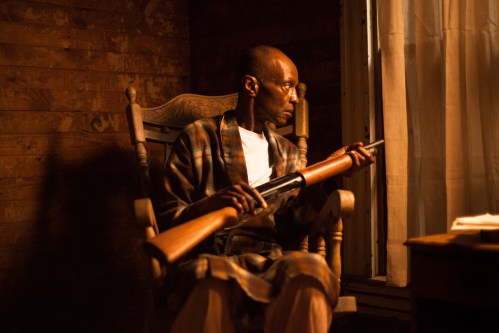
One of the most shocking and horrific episodes of the Jim Crow era comes wrenchingly to live in Kevin Wilson, Jr.’s “My Nephew Emmett.”

The subject, of course, is the torture murder of 14-year-old Emmett Till, a Chicagoan visiting relatives in Mississippi in 1955 when he reportedly whistled at a white woman.

The focus here is less on young Emmett (Joshua Wright), who is seen only fleetingly at the beginning and end of the film, than on  his uncle, Mose Wright (L.B. Williams), a preacher who learns too late of his nephews unthinking transgression, and spends a soul-shaking night standing guard with a shotgun, awaiting the redneck posse that will surely come for the boy.

The film has been impeccably mounted and perfectly acted. Special kudos to Jasmine Guy (yes, the “A Different World” star) as the preacher’s wife and Dane Rhodes as the profane and intimidating leader of the lynching party.

Prepare to be shaken.

“THE ELEVEN O’CLOCK”  (Australia, 13 minutes) B

Derin Seale and Josh Lawson’s “The Eleven O’Clock” plays like a classic Monty Python sketch, an absurd situation fueled by delightful wordplay.

Here’s the setup:  An 11 a.m. appointment in a shrink’s office.  The doctor’s new patient is a megalomaniac who believes himself to be a psychiatrist.

The problem facing the viewer: We don’t know which of these two pomposities (played by Lawson and Damon Harrison) is the mental patient, and which the M.D.  Both insist they are the psychiatrist. This leads to spectacularly gnarly exchanges like this one:

“I don’t think it’s healthy for a doctor to pretend to be a patient for a patient who thinks he’s a doctor. Wouldn’t you agree?

“I would…except you’re not a doctor talking to a patient. You’re my patient who thinks he’s a doctor talking to a patient who thinks he’s a doctor indulging the illusions of a patient who thinks he’s a doctor.  Is that clear?”

Perfectly.“WATU WROTE / ALL OF US” (Germany, 22 minutes) A-

The brotherhood of man gets a brief but intense examination in Katja Benrath and Tobias Rosen’s “Watu Wrote/All of Us.”

Based in real events of a few years ago, this moral thriller unfolds on a bus ride from Nairobi, Kenya, through the civil war-torn borderland with Somalia.

A young woman (Adeline Wairimu) keeps to herself. She is a Christian, and as such is a target for the Islamic militants who ravage the countryside. At one point she reveals that her husband and child were murdered by a militia; she is only taking the risk of returning to her home town because of her mother’s failing health.

Understandably paranoid, she bristles when approached by a Muslim teacher (Abdiwali Farran) heading north for the birth of his fifth child. But when the bus is stopped by trigger-happy militants and the Muslim passengers are ordered to identify their Christian fellow travelers, the result is an I-am-Spartacus moment that hammers home themes of personal bravery and shared humanity.

Technically proficient and brimming over with slowly-building tension, “Watu Wrote / All of Us” sticks with the viewer long after the lights come up.

| Robert W. Butler

OSCAR-NOMINATED DOCUMENTARY SHORTS  Overall rating: B+ (Opens Feb. 9 at the Tivoli)

“TRAFFIC STOP” (USA, 30 minutes)  B+

Breaion King doesn’t look like a candidate for a roughing up by the police.

She’s an elementary school teacher (a good one, if the footage we see is to be believed), a churchgoer, a dancer and singer.

Of course, she’s also black, which may trump all of the above.

In 2015 King was stopped for speeding by Austin, Texas, police officer Bryan Richter. She questioned whether he had stopped her properly, then asked him to hurry up in writing the ticket.

The confrontation and violence that followed were captured by Richter’s dash cam.

Kate Davis and David Heilbroner’s thought-provoking doc (it debuts Feb. 16 on HBO)  balances harrowing police footage of the arrest  (and King’s subsequent squad-car conversation with one of the officers) with scenes from her daily life.

Although she had never been in trouble with the law, King said that when she now Googles her name, she mostly gets hits connected to her arrest: “You get over the physical. It’s about getting over the spiritual and the mental.”

Her lawsuit against Officer Richter is pending.

“HEAVEN IS A TRAFFIC JAM ON THE 405”  (USA, 40 minutes) A-

Frank Stiefel’s “Heaven is a Traffic Jam on the 405” is a celebration of the fantastic art of Mindy Alper.

It is also among the cinema’s finest depictions of mental illness.

Alper is a brilliant artist specializing in line drawings and monumental papier mache sculptures. From childhood, though, she has suffered from depression and other mental/emotional issues which are only kept at bay (sometimes not successfully) by a daily regimen of antipsychotic drugs.

Alper tells her own story here, often in a peculiarly slurred voice (the result, possibly, of extensive shock therapy) and employing bizarre linguistic tics (especially when it comes to numbers…she describes 40 as “four circle”).

But while Alper sometimes struggles for words (at one point she didn’t speak for nearly a decade), there is no mistaking her fierce intelligence. She may have mental issues, but she is no fool. She recognizes how disquieting a presence she offers, but can’t do much about it.

And yet her inner light bursts through in her transcendent art.

“EDITH + EDDIE”   (USA, 29 minutes) B+

Beautiful, sad, infuriating and gut-wrenching, “Edith + Eddie” is a heartbreaker about late-in-life romance and honest-to-God death-by-broken-heart.

The widowed Eddie and Edith met playing Lotto. It was love at first sight. They married at ages 95 and 96 and live together in the house Edith and her first husband bought in 1960.

But now their lives are threatened by a family squabble.  Edith’s daughter Patricia, who has power of attorney (Edith has a mild case of dementia), wants to take her mother to her home in Florida, several states away.

Edith protests, saying that in the past Patricia’s husband has abused her. Eddie, who has never flown, refuses to go. He will be left behind.

Meanwhile Edith’s other daughter, Rebecca, who has cared for her mother for years, suspects this is all a plot to vacate the house and sell it.

Oh, and did I mention that Eddie is white and Edith is African American?

Laura Chaeckoway’s hankie-grabber concentrates on the old couple’s last days together: going to church, putting in their dentures, sitting in lawn chairs and watching the world go by.

The legal issues that are tearing the two apart are somewhat vague, but the emotion coursing through this film is inescapable.

“HEROIN(E)” (USA, 39 minutes) A

“Heroin(e)” plays like an episode of “COPS” in which all the macho has been replaced by compassion.

Elaine McMillion Sheldon’s profoundly disturbing and deeply moving look at the opioid epidemic in Wilmington, W. Va. centers on three women dedicated to saving lives and helping others get clean.

Patricia Keller is a drug court judge who mixes tough love and an achingly humane approach in an effort to keep offenders on the straight and narrow. She’s so empathetic that even when she sends a relapsed user back to jail, she assumes the persona of a mother sending a misbehaving kid off to bed with the hope that tomorrow things will get better.

Necia Freeman is, quite literally, a church lady who once a week cruises the streets handing out free lunches to addicted prostitutes. Trying to understand heroin’s pull, she queries a user and gets this response:  “For you it would be like kissing Jesus.”

Especially there’s Jan Rader, a fire department official through whose eyes we experience the epidemic.  These are mostly working class people who were injured, got hooked on pain pills and then turned to heroin. Five or six times a day she responds to an overdose emergency.  Once or twice a week she arrives too late.

“Hopelessness. Unemployment. Lack of education. It’s a recipe for disaster,” she observes. “I fear we’ve lost a couple of generations.”

“KNIFE SKILLS” (USA, 40 minutes) B+

Building a world-class French restaurant from scratch sounds like tough going.

Staff it almost entirely with recently-released prison inmates — and teach them how to cook, serve and pour in just the six weeks leading up to the grand opening — and  you’ve got the makings of a fiasco.

Except that Brandon Chrostowski’s Edwin’s Restaurant in Cleveland pulled it off.

Thomas Lennon’s film cross cuts between a handful of  ex-cons struggling to change their lives — they spend their days studying at Edwin’s culinary institute, then return at night to halfway houses and Salvation Army hostels — and Chrostowski, an aggressively upbeat mentor who as a teen faced a 10-year-sentence and has been working ever since to do the right thing. In one revelatory scene we see just what an emotional price Chrostowski has paid for his participation in this idealistic crusade.

Edwin’s opened two years ago to solid reviews and steady business, but it wasn’t all smooth sailing.  Of the original class half dropped out, were re-arrested or were dismissed for infractions.  Those who hung on, however, got a second chance at life.

| Robert W. Butler

Fanzine Harduin, Mathieu Kassovitz

“HAPPY END” My rating: C+

107 minutes | MPAA rating: R

It’s got several auteuristic moments and a bevy of solid performances.

But “Happy End” never decides what it’s all about.

At first glance one might assume that this latest effort from director Michael Haneke mostly avoids the extremes of human behavior that mark so many of his titles (“Funny Games,” “The White Ribbon,” “Amour”).   Of course even in a seemingly mundane setting Haneke finds undercurrents of perversion and corruption.

To the extent that “Happy End” has a central character it is 13-year-old Eve (Fanzine Harduin), a dour/stoic kid who in the film’s opening segment makes a cell-phone video of her hamster succumbing to an overdose of Mom’s antidepressants. Hmmm.

Shortly thereafter Eve’s mother dies after a long bout with mental illness and the girl relocates to the mansion occupied by her father, the surgeon Thomas Laurent (Mathieu Kassovitz), his second wife, their newborn son, and other members of the extended Laurent family.

Among these are Eve’s aunt Anne (Isabelle Huppert), who operates the clan’s construction business and is currently occupied with a fatal on-site accident.

Anne’s son Pierre (Franz Rogowski) — Eve’s cousin — is second-in-command and being groomed to take over the business, but it’s pretty obvious he lacks the head or the instincts for the job. He’s depressed.

Jean-Louis Trintignant

Hovering in the background  is wheelchair-bound grandfather Georges (Jean-Louis Trintignant), who may be slipping into dementia and who has his heart set on suicide…though he can’t get anyone to cooperate in his quest for self-destruction.

There’s considerable ugliness percolating beneath the bourgeoise surface of the Laurent clan.  For example, the tech-savvy Eve discovers  that her Papa has been writing explicit erotic emails to a mistress. The girl accepts this with a shrug.  It’s pretty hard to shock her…she oozes the seen-it-all ennui  of a 50-year-old.

And Pierre seems to be totally losing it. He shows up at the wedding of his mother and her English beau (Toby Jones) with a half-dozen African refugees, demanding that they be given a table at the reception.

Haneke’s handling of all this is bleakly comic…but never actually funny.

Making “Happy End” worthwhile is the performance of young Harduin, whose Eve is both compelling and creepy. Whatever genetic sins the family possesses seem to have found their way into her small frame; she radiates a cool pathology that you can’t quite put a name to.  Let’s just say that in some regards “Happy End” bears a resemblance to “The Bad Seed.”

Christian Bale

“HOSTILES” My rating: B-

133 minutes | MPAA rating: R

Westerns have always been a guilty pleasure (violent melodramas aimed at little boys and grown men who still think like little boys), but one cannot recall another Western that so openly oozes guilt as does “Hostiles.”

Written and directed by Scott Cooper (“Crazy Heart,” “Out of the Furnace,” “Black Mass”) and based on a 20-year-old manuscript by the late Donald E. Stewart (“Missing” and three of the Tom Clancy/Jack Ryan films), this revisionist oater unfolds in 1892 when the Indian wars are winding down and the frontier is giving way to civilization.

But not quite yet.

Capt. Joseph Blocker (Christian Bale) rounds up renegade Indians.  His methods are matter-or-fact brutal. He nurses a slow-burning racial hatred fueled by the ugly deaths of comrades over the years and the atrocities he’s witnessed.

So he’s furious when for his last mission before retirement he’s ordered to accompany Yellow Hawk (Wes Studi), a dying Cheyenne war chief, from a New Mexico prison to his tribe’s hunting grounds in Montana. No sooner does their little expedition get out of sight of the fort than Joe claps irons on the old man, less to prevent escape than to humiliate the cancer-riddled warrior.

Wes Studi

Joe is, of course, a direct descendant of Ethan Edwards, the Indian-hating antihero of John Ford’s great Western “The Searchers.” Both films are about a character on a moral and geographical journey.

The difference is that everyone in “Hostiles” is being eaten alive by hate or regret.

Joe’s second-in-command is Sergeant Metz (Rory Cochrane), who’s been diagnosed with “melancholia” but more accurately is being consumed by his conscience after decades of dogged persecution of Native Americans.  Then there’s Corporal Woodsen (Jonathan Majors), a black buffalo soldier who found acceptance in the white man’s world by hunting down another minority.

A young lieutenant (Jesse Plemons) straight out of West Point is about to get a crash course in frontier justice. And then there’s the military convict being taken to another outpost for hanging after butchering a local family. An old colleague of Joe’s, the prisoner (Ben Foster, naturally) wonders why he’s going to swing when he’s seen Joe do worse.

Finally there’s Rosalie (Rosamund Pike), traumatized almost to insanity after witnessing her husband and children slaughtered by renegade Comanches in the brutal episode that opens the movie.

Continue Reading »

Timothee Chalamet, Armie Hammer

“CALL ME BY YOUR NAME” My rating: A-

132 minutes | MPAA rating: R

“Call Me By Your Name” could be categorized as a coming-out story, but that’s oversimplifying things… like saying “Citizen Kane” is a movie about the newspaper business.

Director Luca Guadagnino (“I Am Love,” “A Bigger Splash”) and screenwriter  James Ivory (yes, the director of “Howards End,” “A Room with a View” and the Kansas City-lensed “Mr. and Mrs. Bridge”) are painting on an intimate canvas here, yet their adaptation of Andre Caiman’s novel is an epic of mood and emotion.

It’s about youth, sexual awakening, family love and the warm glow of summers past. It’s enough to make you swoon.

Set in the summer of 1983, “Call Me…” chronicles a lazy but significant six weeks for 17-year-old Elio (an unbelievably good Timothee Chalamet).  The son of an American father and an Italian mother, he’s been raised in Italy with all the intellectual stimulation he can handle. He’s smart, multilingual and maybe some sort of musical prodigy.

Enter Oliver (Armie Hammer), the American grad student hired by Elio’s professor father (Michael Stuhlbarg) for a summer of research on Roman statuary. Oozing a big grin, Yankee self-confidence and nonchalant studliness, Oliver makes a big wave among the town’s young women.

Initially this visitor strikes Elio as arrogant. But Oliver also stirs something else in Elio. Not that Oliver seems at all receptive…if anything he appears oblivious.

Interestingly enough, it’s Elio’s father and mother (Amira Casar) who first notice the slow-burn sexual sizzle that’s been introduced to their household…not that they comment on it directly. But their sidelong looks speak volumes. (They must be the most understanding movie parents of all time. Atticus Finch could take lessons from them.)

Continue Reading »

Daniel Day-Lewis

“PHANTOM THREAD” My rating: B 

130 minutes | MPAA rating: R

“Phantom Thread” is an exquisite love story.

“Phantom Thread” is a cynical black comedy.

That both of these statements are accurate suggests the complex mix of ideas, emotions and impulses percolating through Paul Thomas Anderson’s latest film.

That “Phantom Thread” also features what is allegedly Daniel Day-Lewis final screen performance (he and Anderson collaborated earlier on “There Will Be Blood”) makes it a must-see event.

Reynolds Woodcock (Day-Lewis) is the premiere dress designer in ’50s London. He caters to the rich and titled; his fashions are elegant and controversy-free.

His effete manner and rep as a lifelong bachelor might suggest to some that the graying Reynolds is gay, but they’d be wrong. Reynolds enjoys women on the physical level.  In fact, as the film begins he indicates over breakfast to  his sister-collaborator-facilitator  Cyril (Leslie Manville) that his current paramour has worn out her welcome.

It falls to Cyril to deliver the bad news and escort the rejected young woman from the premises; a great artist like Reynolds cannot be bothered with such mundane duties.

“Marriage would make me deceitful,” he says, as if using and discarding women somehow makes him honest.

Anderson’s screenplay follows Reynolds on a side trip to his family’s seaside cottage.  At a local tearoom he encounters  Alma (Vicky Krieps), an Eastern European immigrant waiting tables. She’s a woman with a real physical presence, not one of those wraithlike models he’s used to dealing with, and she knows nothing about Reynolds or his work.

Her lack of guile, non-glamorous appearance and forthright emotional bearing appeal hugely to the jaded dress designer. He brings her to London, installs her in his household, looks to her as his creative muse  and, finally, marries her: “I feel like I’ve been looking for your for a very long time.” Continue Reading »