Feeds:
Posts
Comments

Saoirse Ronan

“LADY BIRD” My rating: B+ 

93 minutes | MPAA rating: R

That Saoirse Ronan gives an Oscar-worthy performance in “Lady Bird” is expected. She is, after all, perhaps the greatest actress of her young generation. (Exhibit One: “Brooklyn.”)

What’s really surprising about this funny/furious coming-of-age yarn is the voice behind the camera.  “Lady Bird” is the first feature soley written and directed by Greta Gerwig, the actress known as indie filmdom’s go-to gal for slightly ditzy heroines (“Greenberg,” “Frances Ha,” “Mistress America”).

Gerwig gives us not only a first-rate dramedy about a young woman’s growth from cranky teen to independent woman, but also the most incendiary mother/daughter movie relationship since “Terms of Endearment.”

Combining savage wordplay, satiric insights into adolescent life and a genuine sense of family dynamics, “Lady Bird” is simultaneously familiar and fiercely original.

Christine (Saoirse Ronan) is a high school senior (the year is 2002) and  pissed off about nearly everything. Her general dissatisfaction may be behind her decision to change her name to Lady Bird…or to at least demand that her parents, friends and teachers call her  that. A new name may lead to a new life, right?

In the film’s first scene Lady Bird and her mother Marion (Laurie Metcalf) are reduced to tears while driving down the highway listening to a book tape of The Grapes of Wrath.  It’s a rare moment when mom and daughter are on the same page; seconds later Lady Bird’s temper flares and she impulsively bails from the moving car. (She will spend much of the movie with a cast on one hand.)

The source of the argument is college.  The two are returning from a scouting trip to regional universities, but Lady Bird has her heart set on something back east, a place with “real culture, like New York…or Connecticut.” Marion, a glum financial harpie, warns that there isn’t any money for an Ivy League education.  A small state college the next town over will have to do.

This is the film’s central conflict: a smart, ambitious and somewhat spoiled adolescent versus her penny-pinching, essentially joyless parent.  (Lady Bird’s dad, played by Tracy Letts, is a laid-back  noncombatant who offers moral support to both mother and daughter but not much else, having been downsized from his tech job.)

Continue Reading »

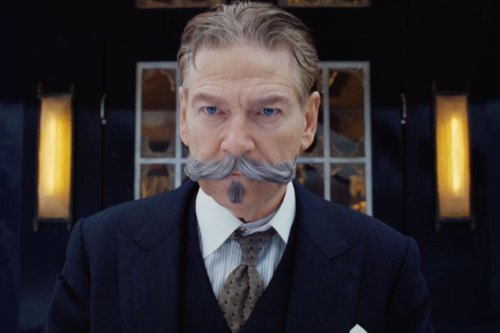
Kenneth Branagh as Hercule Poirot

“MURDER ON THE ORIENT EXPRESS” My rating: C  

114 minutes | MPAA rating: PG-13

The year’s strongest cast wrestles inertia to a standstill in “Murder on the Orient Express,” the latest addition to the pantheon of unnecessary remakes.

We already have Sidney Lumet’s perfectly delightful 1974 adaptation of Agatha Christie’s great  railway mystery. But as with Shakespeare, Dame Agatha’s yarns are worthy of retelling for each new generation.  Problem is, this retelling is stillborn.

It’s always difficult to know exactly why a movie goes wrong, but in this case it may very well lie with the decision to have Kenneth Branagh both direct and star as eccentric Belgian detective Hercule Poirot.

The character dominates virtually every scene, which means the acting weight alone was exhausting. To then also ride herd on a huge cast of heavy hitting thespians was too much to ask of anyone.

As it now stands, Branagh disappoints in both capacities. His features masked by absurd facial hair as obviously fake as the computer-generated backgrounds, he makes a mess of Poirot, who goes from crowd-teasing cutup to moody depressive without much in between. Lines that should evoke a laugh barely generate a tentative smile.

As for the directing end of things…well, what can you say when you have this much talent on hand and still end up with a dull yarn weighted down by blah characterizations?

Set aboard a snowbound luxury train on the Istanbul-Paris run, Michael Green’s screenplay clings to the basics of Christie’s tale (the “who” in the “whodunnit” makes for a one of the better revelations in all detective fiction) while dabbling with some of the particulars, largely in an effort to make the project more attractive to today’s mass audience.

Thus the screenplay finds time for one karate fight, a chase down a railroad trestle and a shooting — none of which are to be found in the novel or the earlier film.

While a few of the characters have undergone some tweaking (a physician aboard the train is now a Negro played by Leslie Odom Jr., providing the opportunity to dabble in some racial issues), most cling to Christie’s parameters. Continue Reading »

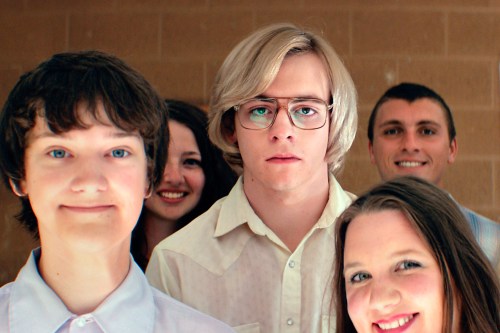
Ross Lynch (center) as future serial killer Jeffrey Dahmer

“MY FRIEND DAHMER”  My rating: B

107 minutes | MPAA rating: R

Right off the bat, the title “My Friend Dahmer” puts potential audiences on edge.

After all, Jeffrey Dahmer was one of our more notorious serial killers of the last 50 years. Between 1978 and 1991 he murdered 17 men and boys, often preserving their bones and feasting on their flesh. He was beaten to death in prison in 1994.

The obvious question: What’s the take of writer/director Marc Meyers’ film?  Is it a blood-soaked bit of gross-out exploitation? A black comedy?

In truth “My Friend Dahmer” is a smart, insightful and disturbing study of the killer’s high school years.  Based on the graphic novel by John Backderf, Dahmer’s classmate and one of the few who paid the dead-eyed loner any attention, it’s both creepy and sad.

From almost the first frame of this film we understand that Jeff, played by Disney discovery Ross Lynch (“Austin & Ally,” “Teen Beach Movie”), has issues. In a shack in the woods behind his family’s semi-rural Ohio home he keeps jars in which dead  animals are slowly dissolving in acid solution. He always keeps a black plastic garbage bag in his pocket, lest he stumble across an intriguing bit of road kill.

“I like bones,” he explains. “It interests me — what’s inside.”

Gawky and outwardly unemotional, Jeff is a target for school bullies. Not that things are much better at home.

Mom (Anne Heche) is a former mental patient who lives life in just two speeds: fetal and combative. Her depression and raw emotions prove unbearable to her decent but  ineffectual husband (Dallas Roberts). At least Jeff’s father, himself the victim of a solitary  childhood, recognizes his oldest son’s plight and urges the kid to try to fit in.

Jeff’s plan to win his classmates’ attention is typically bizarre and tone-deaf.  He begins staging fake epileptic fits in the school hallways. His arm-flapping, screeching antics draw the attention of John Backderf (Alex Wolff) and a small coterie of social outsiders who adopt Jeff as their mascot.

“I think with you as our fearless leader we can really disrupt this school,” John tells Jeff.

“Let’s do a Dahmer,”  becomes their rebellious battle cry before each new example of perverse performance art. Continue Reading »

Steven Yeun

“MAYHEM”  My rating: C+ (Opens Nov. 10 at the Screenland Tapcade)

86 minutes | No MPAA rating

Joe Lynch’s “Mayhem” more than lives up to its name.

This giddy celebration of pointless violence finds Steven Yeun, late of cable’s “The Walking Dead,” playing attorney Derek Cho,  an employee of a take-no-prisoners law firm that represents the worst in contemporary American culture and capitalism.

Framed by a fellow attorney for a major screwup on a big case, a defeated Derek is cleaning out his office when police surround the firm’s high-rise  and inform those inside that a particularly malevolent virus has been detected on the premises.

Known as ID-7, this nasty bug causes the infected to lose all the inhibitions that normally keep us from sexually assaulting and or mercilessly beating our fellow men.

An anti-virus has been released into the building’s air conditioning, but it will take eight hours to kick in. Until then the place is under strict quarantine.

Continue Reading »

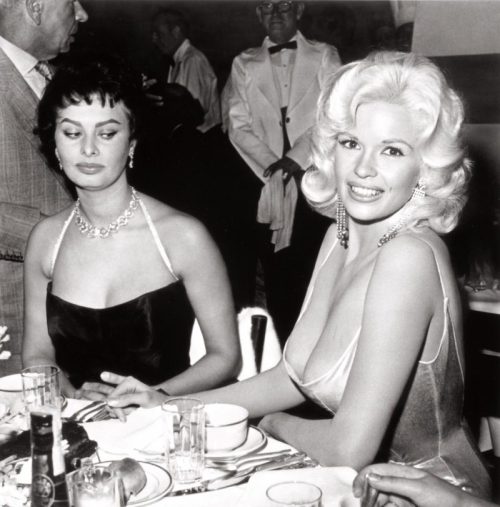
Jayne Mansfield (right) with pulchritudinous competitor Sophia Loren.

“MANSFIELD 66/67” My rating: C+ (Opens N ov. 3 at the Screenland Tapcade)

84 minutes | No MPAA rating

Given the aura of cheesy tackiness that still hangs over her life and career, perhaps it’s appropriate that the new documentary about sex bomb Jayne Mansfield is itself a triumph of cheesy tackiness.

P. David Ebersole and Todd Hughes’s films opens with the declaration that it is a “true story based on rumor and hearsay.”  Well, it certainly isn’t your History Channel approach to documentary biography.

For one thing, no cooperation was offered by any member of the Mansfield family (the most prominent being her actor daughter, “Law & Order’s” Mariska Hargitay).

The film clips, photos and other archival elements were taken from public sources. Mostly the filmmakers relied on talking-head interviews with Mansfield admirers (John Waters, Mary Waronov), fellow show-biz types (Mamie Van Doren), a slew of feminist and pop culture scholars, and Kenneth Anger, the great chronicler of Tinseltown tawdriness who put Mansfield’s picture on the cover of his great expose Hollywood Babylon.

The doc is also peppered with animated segments and “production numbers” in which a chorus of college-age performers in blonde wigs do garishly-lit  go-go routines or engage in artless “interpretive” dances.

It says something about the filmmakers’ intentions that the first thing they address is Mansfield’s 1967 death in a horrific car accident and the long-standing rumor that she was beheaded in the crash.  The man who embalmed the movie star says her scalp was torn off but that her noggin remained attached to that voluptuous body.

Continue Reading »

Takuya Kimura

“BLADE OF THE IMMORTAL” My rating: C+ (Opens Nov. 3 at the Screenland Tapcade)

140 minutes | MPAA rating: R

Beautifully mounted and crammed with enough head-spinning violence to lure moviegoers not already familiar with its manga origins, “Blade of the Immortal” is a samurai epic with edge.

Not only does Takashi Miike’s film (incredibly, his 61st feature in 13 years) mix the expected swordplay with a sort of mutated vampire tale, but its look blends feudal Japan with a punk sensibility — bizarre weapons, hairdos, tattoos and costuming (primitive sunglasses).

Not to  mention dialogue you’ll never hear in an Akira Kurosawa film: “Blow it out your ass!”

That said, it’s still a samurai movie, a genre we’ve see so many times that it takes something really special to grab the attention of jaded viewers.  “Blood of the Immortal” comes closer than most.

The premise finds a rogue samurai teaming up with a pre-pubescent girl (it’s like “Leon” with lots of sharp objects).

Manji (Takuya Kimura) is a wanted man after unwittingly engaging in a conspiracy against the current shogun. In the film’s opening scene he singlehandedly dispatches about a hundred soldiers who have been sent to kill him.

His face slashed, a hand severed and an eye gouged out, he’s dying when a mysterious crone appears to weave a magic spell. She inserts into his wounds “blood worms” which ensure immortality. Manji quickly heals, his hand reattaches, and like one of Bram Stoker’s undead he’s left to wander the earth in solitude, doomed to outlive anyone he cares about.

Fifty years later the never-aging Manji runs afoul of a renegade band of samurai — the Itto-ryu — who are bent on imposing their particular brand of martial arts on all of Japan.  Under their charismatic leader, Anotsu (Sota Fukushi), they are destroying the dojos of all competing fighting schools. Continue Reading »

Jane Goodall and friend

“JANE”  My rating: A-

90 minutes | No MPAA rating

It’s not like Jane Goodall’s story hasn’t been told before.

If you recognize her name you probably know that she was the untrained amateur assigned in 1957 by her boss, anthropologist Richard Leakey, to study chimpanzees living in Tanzania’s Gombe Stream National Park. Lacking higher education and all credentials, Goodall, 26, eventually was accepted by the animals and began collecting astounding data and observations; her program is now the longest-running study of animals in the wild.

Over the years there’s been no shortage of coverage of Goodall’s work.  But “Jane” — the new documentary from writer/diredtor Brett Morgan — tells her story from a personal point of view, drawing from 100 hours of never-before-seen footage of this remarkable woman from all stages of her career.

The film — narrated by the 83-year-old Goodall — is visually splendid. But even more striking is the emotional power of Goodall’s tale, of her love of these animals (her scientific detachment has often been called into question), of the amazing moments she has experienced, and of her long study’s revelations, especially the deep connections between simian and human behavior.

It’s also something of a feminist statement. Goodall reveals that in her childhood dreamlife she was always a man: “I wanted to do things men could and women couldn’t.”

She was chosen by Leakey (she was his secretary) to do the chimp study because she had no preconceptions about primate life and behavior. A longtime lover of animals, Goodall saw herself as a distaff Dr. Doolittle: “I wanted to come as close to talking to the animals as I could.”

Enduring rain, heat, poisonous snakes and her subjects’ frustrating fear of humans, Goodall became a sort of jungle girl, a long-legged blonde who bathed in mountain streams and climbed trees to get a better look at the chimps.  Later, she recalls, she was perfectly willing to entertain beauty-and-the-beast comparisons if they would publicize her study and attract funding.

Listening to Goodall speak, one is pinned to the nexus of the scientific and the near mystical. Looking into the eyes of a chimpanzee, she says, “I saw a thinking, reasoning personality looking back.” Continue Reading »

Joan Didion circa 1970

“JOAN DIDION: THE CENTER WILL NOT HOLD” My rating: B (Now on Netflix)

94 minutes | No MPAA rating

As an introduction to the life and work of one of our finest observers of contemporary American life, “Joan Didion: The Center Will Not Hold” fulfills one of the major obligations of a literary biography. It spurs the viewer to actually read the author’s books.

Whatever its shortcomings, this documentary from Didion’s nephew, actor/filmmaker Griffin Dunne, has the potential to create hundreds of thousands of new Didion geeks. And that’s a good thing.

We’re introduced to Dunne’s octogenarian subject through a recent interview.  Didion looks frail and withered, but her brain clicks along smoothly.

Her salient feature, she says, is a “predilection for the extreme.” In her life, her career, her choice of subject matter, that predilection holds steady.

A native Californian, she was encouraged to keep a journal by her mother. Winning a writing contest sponsored by Vogue, Didion went directly from college to that chronicle of New York fashion despite knowing next to nothing about clothing. Instead she wrote personal essays that spoke to millions of other young women.

These would become her calling cards…autobiographical essays that formed a history of our times.

During the upheaval of the Sixties she wrote rock ‘n’ roll profiles (the Doors) and a legendary piece on Haight Ashbury in its prime (“the horror of disorder”).  Branching out, she covered the civil war in Salvador (opposing a CIA-backed government), the Central Park Jogger incident (she never accepted the guilt of the young black men convicted in the crime and exonerated years later) and even turned to politics (she was the first major writer to recognize the soullessness of Dick Cheney). Continue Reading »

Willem Dafoe, Brooklynn Prince

“THE FLORIDA PROJECT” My rating: B+

115 minutes | MPAA rating: R

Six-year-old Moonee (Brooklynn Prince) lives in the shadow of Disney World.

Not that she’s ever visited the Magic Kingdom.  Moonee and her mom Halley (Bria Vinaite) are guests/inmates at the Magic Castle, a purple monstrosity of a motel where rooms go for $36 a night and the clientele consists mostly of homeless families struggling to survive in the tourist-oriented economy of central Florida.

It’s not like Moonee feels deprived at never having been up close and personal with Mickey and Donald and all the other Disney characters. She’s the kind of kid who creates her own adventures, and if she often runs afoul of grownups  (people don’t like brats who amuse themselves lobbing phlegm bombs onto other people’s cars), she’s sassy and defiant and seemingly untamable.

Moonee and her  playmates regard the motel complex as their own personal realm, and their pint-size depredations are the bane of the existence of Bobby (Willem Dafoe), the manager forever trying to walk the fine line between corporate dictates and those of his own conscience.

Bobby chastises Moonee and pals for cutting off power to the entire motel by throwing the master switch in the utility room — but even as he does so you can sense that on another level he admires the kids’ lippy defiance.  But he’s also a sort of guardian angel to these mini-Visigoths, quickly swooping down on a pathetically feeble-minded pedophile (Carl Bradford) who hangs around the motel’s swing sets and struggling mightily to cover up Gloria (Sandy Kane), an overpainted septunagerian who insists on sunbathing topless.

Continue Reading »

James Booth as Armand Roulin

“LOVING VINCENT” My rating: B

93 minutes | MPAA rating: PG-13

“Loving Vincent” is work of adoring fanaticism, an investigation into Vincent Van Gogh’s death through animation that mimics his dynamic and instantly recognizable style of painting.

Van Gogh’s portrait of the real Armand Roulin

It is, we’re told, “the world’s first fully painted feature film” in which each  of the movie’s 60,000-plus frames have been rendered in oil by a crew of more than 100 artists.

What directors Dorota Kobiela and Hugh Welshman have accomplished here is, from a visual point of view, spectacularly mesmerizing.

As a narrative their film (co-scripted with Jack Dehnel) has some issues, but ultimately it works its way under the viewer’s skin.

Unfolding a year after Vincent’s death in the small French town of Auvers-sur-Oise, the story centers on Armand Roulin (James Booth).  Armand is a dedicated drinker and brawler living in Arles, where the artist often lived and painted during his last years. (Vincent actually did a portrait of Armand, and  throughout the movie the young man wears then bright yellow jacket in which he posed.)

This handsome ne’er-do-well is sent on a mission by his father, the local postmaster (Chris O’Dowd).  The elder Roulin has in his possession a letter written by Vincent to his brother Theo but never sent.  Now the old man dispatches Armand off to Paris to deliver the letter to its intended recipient.

Alas, he discovers that Theo died not long after his brother.  Hoping to locate Theo’s widow, Armand travels to Auvers, along the way collecting information about Vincent from those who crossed his path.  (Vincent, played by Robert Gulaczyk, is seen only in black-and-white flashbacks painted to resemble charcoal drawings.)

Continue Reading »