Feeds:
Posts
Comments

Charlize Theron

“ATOMIC BLONDE”  My rating:  C+ 

115 minutes | MPAA rating: R

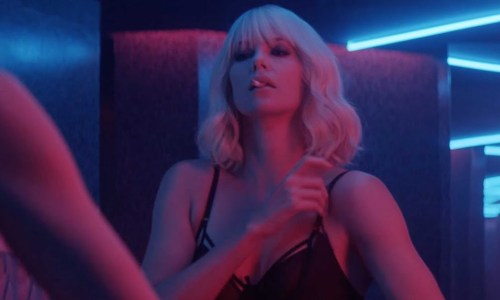
Leggy Lorraine Broughton, the nearly superhuman Cold War spy at the center of stylish “Atomic Blonde,” is all platinum hair, high fashion and fierce physicality.

The performance is barely skin deep. Good thing the skin belongs to Charlize Theron.

It’s hard to recall another recent movie in which the camera so obsessively and totally dwells on its leading lady. Theron,  one of the film’s producers, always has been an attractive screen presence (she won an Oscar for making herself ugly to play a serial killer in 2003’s “Monster”), but here she radiates an icy beauty that is overwhelming.

Even bruised, battered and bloody she is gorgeous.

That watchability is vital, for big chunks of “Atomic Blonde” — based on the graphic novel “The Coldest City” — are narratively incomprehensible.

The story begins in 1989 London where Lorraine, looking as if she’s just gone 15 rounds with Muhammad Ali, is summoned to MI6 headquarters for a debriefing. One of her bosses (Toby Jones) and an American CIA bigwig (John Goodman) want details on her recent mission to Berlin. The bulk of the film unfolds in flashback.

In this retelling Lorraine is dispatched to Germany to retrieve “the list,” a directory of Western agents in the possession of an East German security official who wants to defect (Eddie Marsan). “The list” is a classic Hitchcock “Macguffin” — we never learn how it was compiled or by whom, only that both sides are desperate to lay their hands on it.

Leading the search is the Brits’ cynical Berlin station chief, Percival (James McAvoy), who has “gone native,” running a black market operation, moving back and forth over and under the Berlin Wall. In this setting, communism is on its last legs, with frustrated East Berliners holding massive protests.

There’s a French spy (Sofia Boutella of “The Mummy”) with whom Lorraine has an energetic roll in the hay (our heroine’s sexuality is quite fluid), and an assortment of thuggish Eastern Bloc assassins and torturers.

It’s all rather confusing. Kurt Johnstad’s screenplay is a jumble of tongue-twisting foreign names and clunky exposition interrupted by periodic outbursts of violence. Continue Reading »

“A GHOST STORY”  My rating: B+

93 minutes | MPAA rating: R

Your typical ghost movie is about humans terrorized by the supernatural.

But “A Ghost Story” turns that tradition inside out by taking the point of view of a silent, mournful spirit that clings to its earthly home hoping for, well, who knows what?

David Lowery’s film will be hailed as profound and damned as pretentious — sometimes in the same breath. Love it or loathe it, we’ve not seen anything quite like it.

Casey Affleck and Rooney Mara (they also starred in Lowery’s 2013 rural noir ballad “Ain’t Them Bodies Saints”) play a couple living in a rather shabby tract home on a sparsely populated street that’s not quite rural and not quite suburban.

We never learn their names, though the film’s credits identify the characters as “C” and “M.”

The scruffy C is a musician who spends his days at a piano recording complex songs with various layers of sound. The two seem content enough right up to the point where he is killed in a traffic collision at the end of their driveway.

In the hospital morgue M identifies his body, which is then covered with a sheet. The camera lingers on the lifeless form for a full minute — at which point the corpse sits upright, still shrouded, and shuffles through the hospital.

Some audience members may break out in laughter. The ghost looks exactly like that cheapest of Halloween costumes, a white sheet with eye holes cut out. (Though looking into those holes we see nothing but black.)

Returning to his former home, the voiceless spirit observes M as she puts her life back together. We lose all sense of time — days, weeks or months pass in a series of silent scenes. When M begins dating, the ghost shows its displeasure by making a few books fly off the shelf.

It should be noted at this point that while we see Affleck at the beginning and end of the film, for the most part he’s covered from head to toe. In fact, there’s no way of knowing if he’s actually the performer under the sheet. That said, the body language astoundingly evokes the ghost’s thoughts and emotions. It may be one of the great physical performances ever captured on film. Continue Reading »

Aaron Glenna, Aaron Pederson

“KILLING GROUND” My rating:” B-

88 minutes | No MPAA rating

Certain stereotypes and genre tropes span various cultures.

Take, for example, the feral-hillbillies-prey-on-travelers scenario, which found its acme in Wes Craven’s “The Hills Have Eyes” (1977) and has been appropriated by the Aussies in the “Wolf Creek” series.

“Killing Ground” is yet another Down Under variation on the theme, one whose rampant sadism is made all the more unbearable by the competence of writer/director Damien Power.

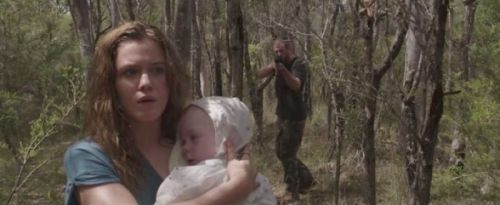
Ian (Ian Meadows) and Sam (Harriet Dyer) are a young city-dwelling couple (he’s a doctor) taking a camping vacation in the sticks, where they run afoul of a pair of murderous local louts.  Nothing particularly fresh about that setup, but Power tweaks the basic premise by giving us two tales unfolding simultaneously on two consecutive days.

When Ian and Sam arrive at a remote creekside campground (so remote there’s no cell phone service), they discover a tent already set up.  But the owners of the tent are MIA.

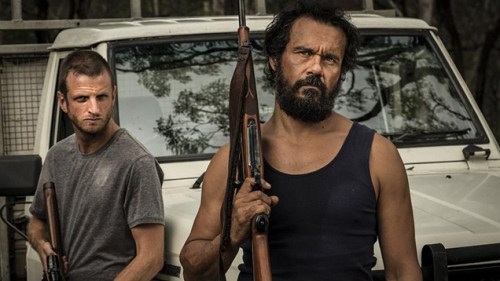
In  the parallel story we see the fate of the missing campers, a couple (Maya Strange, Julian Garner) with their moody teen daughter (Tiarne Coupland) and infant son. They become the prey of a pathological pair, Chook (Aaron Glenane) and German (Aaron Pederson), who have rape, torture and murder on their minds.  Apparently they’ve done this before.

These guys are so warped that not even a baby’s life is sacred.

Harriett Dyer

In the second story, unfolding the next day, it’s Ian and Sam’s fate to be targeted by these forest-savvy fiends.

One would like to dismiss “Killing Ground’s” lurid nastiness but Power is so assured — building unbearable tension and revulsion and getting more-than-solid performances out of both the killers and their victims — that  this  is impossible.

Moreover, he introduces surprisingly sophisticated moral conundrums.  Chook is  a reluctant killer egged on by the much more vicious German.

And Ian, given a chance to escape or rescue the captive Sam, bails.  He heads for town to notify the local authorities.

Of course in the real world, this makes sense.  An unarmed city boy is unlikely to overcome two rifle-toting psychopaths.

But in the world of cinema — where average guys often rise to heroism — this is an act of cowardice. We’re forced to ask just how much he loves Sam if he’s willing to leave her in the hands of two Neanderthals.

“Killing Field” undoubtedly will prove deeply satisfying to fans of this sort of twisted mayhem. And even those of us who squirm through the experience must acknowledge that Damien Power has the right stuff.  It should be interesting to see where he turns next.

| Robert W. Butler

“DUNKIRK”  My rating: B

105 minutes  | MPAA rating: PG-13

Largely jettisoning character development and conventional exposition in favor of a you-are-there immersion, Christopher Nolan’s “Dunkirk” is clearly a descendent of “The Longest Day,” producer Darryl F. Zanuck’s massive 1962 recreation of the D-Day invasion.

It moves swiftly and explains little, weaving together three story lines in a chronologically jumbled narrative that covers a week’s worth of history as the British nation rallies to rescue more than 300,000 troops trapped by Germans on the French coast in the early years of World War II.

Nolan’s unconventional storytelling is simultaneously confusing and compelling.  It’s disconcerting to jump back and forth between a daytime aerial dogfight and a nighttime sea illuminated by fires and explosions. Don’t expect an explanation of what’s going on.

But by eschewing a linear narrative Nolan is able to ramp up the tension, zigging and zagging between cliffhanger moments as various characters fight to survive.

The first of these tales is set among the soldiers crowded on the beach, sitting ducks for the German pilots who seem to control the sky.

A British naval commander (Kenneth Branagh) desperately coordinates an evacuation that relies on the Mole, the sole pier in water deep enough to accommodate a large ship.

Most of this sequence centers on a young soldier (Fionn Whitehead) who is desperate to save himself. He poses as a stretcher bearer, hoping to get aboard a medical ship being loaded with the wounded. He’s fortunate enough to take refuge in an evacuation ship, but it is torpedoed and he must return to shore. He eventually joins another unit taking refuge in the hold of a beached trawler…they’re hoping for high tide to take them to sea while the boat becomes a target for Nazi marksmen.

Continue Reading »

Kate Micucci, Alison Brie, Aubrey Plaza

THE LITTLE HOURS” My rating: C+ 

90 minutes | MPAA rating: R

Set in rural Italy in 1347, “The Little Hours” strives for historical accuracy, from the costumes and settings to the musical score beneath the action.

Except, that is, when it comes to dialogue. These 14th-century characters — nuns, priests, noblemen, servants — converse in the most modern of idioms.

They swear like drunken sailors. They employ 20th-century phrases.

It’s the contrast between the visual authenticity and the film’s aural outrageousness that gives “Little Hours” — based on a raunchy story by Boccaccio — its comic oomph.

That and a handful of wickedly funny performances from a remarkably deep roster of players.

Mostly the yarn — written and directed by Jeff Baena, maker of the zombie comedy “Life After Beth” — is set in a convent where the fundamentally decent Mother Superior (Molly Shannon) has her hands full keeping peace among her brood of black-habited and foul- tempered nuns.

The snippiest of the bunch is Sister Fernanda (Aubrey Plaza), a explosively nasty woman with an unblinking death stare and a vocabulary capable of peeling paint.

Her cohort is the clumsy Sister Geneva (Kate Micucci), the convent’s gnomish tattletale, a snoop always eager to inform on her sisters.

Continue Reading »

Sally Hawkins

“MAUDIE” My rating: B 

115 minutes | MPAA rating: PG-13

Simultaneously a biopic about an eccentric outsider artist and a politically incorrect love story, “Maudie” isn’t exactly warm and fuzzy.

Director Aisling Walsh’s study of Nova Scotia painter Maud Lewis  — the Canadian equivalent of Grandma Moses — is both inspiring and troubling.

Inspiring because the naive Maud overcame crippling arthritis to develop her primitive yet poetic visual style, and troubling because of her marriage to a man who, at least early in their relationship, was guilty of both physical and psychological abuse.

Good thing, then, that Walsh and screenwriter Sherry White have for their stars the terrific Sally Hawkins and Ethan Hawke, whose performances transcend our usual notions of marital right and wrong.

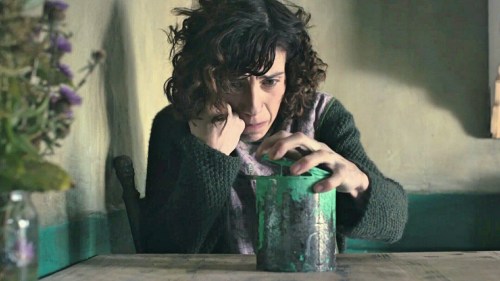
When we first meet Maud (Hawkins) in the late 1930s, she is a prisoner of her domineering aunt and her indifferent older brother.  Thanks to the arthritis from which she has suffered most of her life, the thirtysomething Maud moves slowly and clumsily; her unimpressive physical presence leads many to assume she’s mentally incapacitated as well.

Hardly.  Though poorly educated, Maud has a biting wit and fierce sense of self.  When she learns that crusty local bachelor Everett Lewis (Hawke) is advertising for a housekeeper, she declares herself a free woman and goes after the job.

Basically she ends up working for room and board for a laborer who was reared in an orphanage, has minimal people skills and is often ruled by his volcanic temper. She puts up with his cruelty because she has nowhere else to go…and because she realizes she’s smart enough to manipulate this angry ignoramus, eventually marrying him.

Continue Reading »

Fred Armisen, Adam Pally, Zoe Lister-Jones

“BAND AID” My rating: B-

91 minutes | No MPAA rating

Communication between married couples is an eternal minefield.

You say too much. You say too little. You can’t take criticism.  You find too much enjoyment in dishing criticism.

For Anna (Zoe Lister-Jones) and Ben (Adam Pally), the miserable couple at the center of the comedy “Band Aid,” the answer to their misery is to start a band and pour all their issues into caustic but catchy pop tunes.

Turns out to be pretty good therapy.

Lister-Jones not only stars in “Band Aid,” but she wrote it, directs it and composed the funky/punky songs.  It is pretty much a one-woman show…and it pretty much rocks.

As the film begins Anna and Ben are engaged in  yet another ragfest.  They live lives of not-so-quiet desperation.

She was an award-winning writer in college; now she’s an Uber driver.  He’s supposed to be a graphic designer, but he spends all day playing video games.

They have knock-down-drag-outs about dirty dishes piling up in the sink.  About his grooming issues. And of course about their lack of physical intimacy. (“The sensation I get from sex and the one I get eating pizza are pretty much interchangeable now.”)

Continue Reading »

Joicie Appell

” THE TREE” My rating: B- (Opens July 14 at the Tivoli)

  95 minutes | No MPAA rating

KC-based ma-and-pa filmmakers Stephen Wallace Pruitt and Mary Settle Pruitt cannot be accused of taking the easy way out.

To date they have produced three mostly self-financed feature films, all of remarkably high technical quality and all of which avoid genre labeling. The Pruitts are, for want of a better word, humanists whose work eschews  violence, sexuality, offensive language and the sort of conflict that requires  a villain. I’m yet to encounter any actual bad guys in their cinematic world.

Their latest, “The Tree,” has cleaned up on the festival circuit and is now receiving a commercial run at the independent  Tivoli Theatre. It’s a relatively simple yarn that gains depth thanks to the lead performance of Joicie Appell, for decades a staple on the Kansas City theatre scene and now, at 88, making the most of her first movie leading role.

Appell plays widowed grandmother Dorothy Thorp, a resident of Wamego, Kansas, who has a mind to drive her old car east to Terre Haute, Indiana, her birthplace.  As she approaches 90 she’s been thinking a lot about the little girl who was her best friend way back then, and about the magnificent tree which became their playground, hiding place and sacred site.

The Pruitts’ film is a series of vignettes as Dorothy makes her way across the Midwest. Periodically the story returns to Wamego where her neighbors, Marge and John (Laura Kirk, Paul Fellers)  fret over whether they should be telling Dorothy’s relations of this late-in-life fling. John takes a hands-off approach; Marge, though, is serious about her gig as Dorothy’s unofficial guardian. Like everyone in this movie, they’re decent folk.

There are also flashbacks to Dorothy’s semi-idyllic childhood.

“The Tree” quickly falls into a pattern. Dorothy meets folks along the way, gets insights into their troubles, and does what she can to help.  Often that means financial generosity:  leaving a humongous tip for a waitress who has poured out her heart to the traveller, or leaving behind a survival fund for a homeless veteran she finds sleeping in a doorway.

After a while a certain sameness sets in — each scene employs the same setup and rhythms — but keeping us involved is Appell’s performance, a low-keyed wonder in which her character’s thoughts and emotions are presented with refreshing economy. It’s the furthest thing from scenery chewing.

“The Tree” looks and sounds great, which is no small thing when you consider that with a budget of only $60,000 the filmmaking couple had to do darn near every job on the set themselves (cinematography, editing, direction, casting, production design, art direction, sound…etc.).

Like all of their films to date, “The Tree” is an obvious labor of love.  Stephen Wallace Pruitt —  a member of the economics faculty at the University of Missouri-Kansas City — based the story on his own late mother and her childhood best friend.

Even if you take exception to some of the particulars, you cannot remain immune to “The Tree’s” wealth of feeling.

| Robert W. Butler

Zoe Kazan, Kumail Nanjiani

“THE BIG SICK”  My rating: B 

119 minutes | MPAA rating: R

Romantic comedy is so ubiquitous — so familiar and overworked and recycled — that nobody expects originality from the genre.

Then along comes “The Big Sick” to take us by surprise.

Directed by Michael Showalter, produced by Judd Apatow and penned by stand-up comic Kumail Nanjiani and his wife, Emily V. Gordon, the film starts out in familiar boy-meets-girl territory only to take us to unexpected places.

Nanjiani, a regular on cable’s “Silicon Valley,” is a Pakistani who came to the U.S. for college. Here he plays a slightly fictionalized version of himself, also named Kumail.

The film’s first hour will seem more than a little familiar to fans of “Master of None,” the much-awarded Netflix comedy from Aziz Ansari, the son of Indian immigrants.

While working as an Uber driver, Kumail struggles to make it on the comedy circuit, determined not to rely too much on his ethnicity for laugh fodder. His deadpan persona is belied by the dry hilarity of his zingers.

His mother and father (Zenobia Shroff, Anupam Kher) expect him to be a good Muslim (when visiting them, Kumail dutifully retreats to the basement with his prayer rug but spends his time there digging through boxes of childhood belongings).

Moreover, our hero is subjected to a steady stream of available Pakistani woman (they exhibit everything from firm self-confidence to embarrassment and desperation) who just happen to be in the neighborhood when he’s having dinner with the folks.

Kumail hasn’t the heart to announce that he’s not interested in a traditional arranged marriage.

Romance intervenes with Emily (Zoe Kazan), who gently heckles Kumail during a show then sticks around for a little intense cross-cultural interaction.  In one of the film’s goofiest moments, she decides to end their night of passion by calling for a ride; since he’s the closest Uber driver, his cellphone goes off. Continue Reading »

Okra,An Seo Hyun

“OKJA” My rating: C (Now on Netflix)

118 minutes | No MPAA rating

Following up his multi-layered sci-fi extravaganza “Snowpiercer,” Korean auteur Joon-ho Bong delivers the Netflix original movie “Okja.”

Like its predecessor it blends dystopian imagery, social criticism and first-rate special effects, this time to tell the tale of a girl and her best friend, an elephant-sized pig-creature.

Unlike “Snowpiercer,” though, the pieces don’t fit together. Satire, childlike innocence and violence collide in an adventure nearly derailed by jarring tonal shifts.

The film begins with Lucy Mirando (Tilda Swinton), the head of the massive agribusiness that bears her family name (it sounds like Monsanto for a reason), announcing to the world that her firm has developed a super pig that will solve all our food needs.  To kick off the project she is sending baby pigs to farmers in 26 countries; over 10 years these porkers will be monitored as they are reared under local animal husbandry conditions.

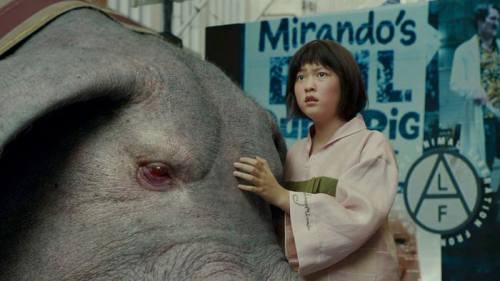
The piglet Okja is blessed to be sent to the mountains of Korea where she is seen to by young Mija (An Seo Hyun) and her grandfather.  Mirja and the massive Okja lead a life of bucolic bliss.  They are best friends — though Bong is careful not to ascribe to Okja human intellect.

Of course, Mija doesn’t know that her big bud is destined to become superbacon.

“Okra” treads a familiar path when it becomes the tale of a fugitive child and her pet outrunning the evil forces of grown-up life.  But Bong isn’t really all that interested in that plot line, preferring to devote much screen time to a ham-handed (sorry about that) satire of corporate greed, human vanity and nitwit idealism.

Continue Reading »