Feeds:
Posts
Comments

Charlie Hunnam

“THE LOST CITY OF Z” My rating: B

141 minutes | MPAA rating: PG-13

There are really two movies at work in James Gray’s “The Lost City of Z.”

One unfolds in the well-appointed parlors, bucolic fields and imposing halls of turn-of-the-last-century England.

The other plays out in a world of daunting jungles,  piranha-infested rivers and unpredictable Amazonian cannibals.

Holding those two realities together is the real-life figure of Percy Faucett, an Englishman who embodied his era’s spirit of discovery, scientific exploration and a seemingly superhuman need to experience physical challenges and personal perils.

“The Lost City of Z” (the Z is pronounced “zed,” Brit-style) is the most expansive, grandest vision of writer/director Gray’s career (“Little Odessa,” “The Yards,” “The Immigrant”), achieving at times the sweep of a David Lean epic.

And as is the case with Lean, it sometimes seems that the epic overpowers the human elements.

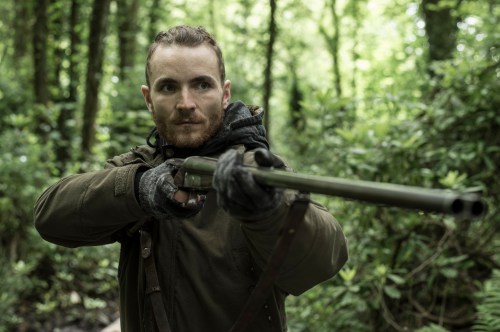
We first meet Faucett (Charlie Hunnam, about 180 degrees away from his biker Hamlet in cable’s “The Sons of Anarchy”) as a struggling young military officer whose prospects are limited, in the words of one aristocratic snob, because he has been “rather unfortunate in his choice of ancestors.”

Faucett gets a shot at fame and glory when he’s asked by the Royal Geographic Society to travel to the Amazon to prevent a war.  Seems the Bolivians and the Brazilians cannot agree on an official border between their two nations; Faucett is to survey the impenetrable jungle and set a boundary that will ensure the peace.

Accompanied by his equally adventurous assistant, Henry Costin (Robert Pattinson in full beard mode), the two not only accomplish their mission but stumble across tantalizing evidence that somewhere deep in the wilderness are the ruins of a centuries-old city, a metropolis that would have been bigger and more sophisticated than anything in Europe at that time.

Returning to Britain a national hero, Faucett touts his belief in the lost city, leading to accusations that he has fallen for an “El Dorado”-type myth. That attitude is as much racist as it is scientific…Faucett’s belief that the Amazon Indians once had a world-class civilization doesn’t go down well with imperialists who embrace the white man’s duty to raise and/or exploit the world’s great unwashed. Continue Reading »

Cezanne (Guillame Gallienne) and Zola (Guiilame Canet)

“CEZANNE ET MOI”  My rating: B

117 minutes | MPAA rating: R

Real friends can endure almost anything.

In the case of the famous true friendship shared by novelist Emile Zola and post-impressionist painter Paul Cezanne, it meant enduring class differences, professional jealousy, romantic entanglements and, perhaps, a touch of mental illness.

“Cezanne et Moi,” the latest from writer/director Daniele Thompson, attempts nothing less than to encapsulate a nearly 70-year relationship between two giants of French arts. Not that it was always a given that both of them would become artistic immortals.

The boys met when Cezanne, a son of provincial wealth, befriended new-kid-in-town Zola.  Their adventures in the forests and mountains around Aix cemented a connection that could not be broken even by the disapproval of Cezanne’s father, who thought the Italian-born Zola no respectable companion for his up-and-coming son.

Ironically, it is the financially strapped Zola (played as an adult by Guillaume Canet) who first scores success with novels like 1867’s Therese Paquin. Money and celebrity follow…much to the consternation of Cezanne (Guillaume Gallienne), who has been disowned by his family and struggles to find the artistic style that finally will be his enduring legacy. (It will be a long struggle; Cezanne’s genius wasn’t recognized until late in his life.)

Cezanne becomes an unwashed antisocial brawler (he instigates a fistfight with swells who dare criticize Manet’s “Dejuener sur l’herbe”), a drinker and a frequenter of whorehouses. He is driven to paint, yet for most of his life his painting isn’t particularly good.

He resents Zola’s success and bourgeoise lifestyle, especially after Zola marries a former seamstress (Alice Pol) with whom both men had been intimate.

Even worse, Cezanne finds himself fictionally depicted  in Zola’s novels and, in effect, doing research for the author.  Too sexually uptight to to actually visit the dens of inequity he is writing about, Zola relies on Cezanne’s misadventures for ideas.

Continue Reading »

Jack Lowden

“TOMMY’S HONOUR”  My rating: B (Opens April 14 at the Town Center, Glenwood Arts and Cinemark Palace)

117 minutes | MRAA rating:  PG

If the Yankees’ Babe Ruth and Lou Gehrig had been father and son, their story would play a lot like that of Thomas Morris and his son, Tommy Jr.

More than anyone before or since, these 19th-century Scotsmen refined, codified, and popularized the game of golf.

That most of today’s 60 million golfers have never heard of the Morris clan is a crime. The new film “Tommy’s Honour” is poised to remedy this situation.

Director Jason Connery (Sean’s son) and scripters Pamela Martin and Kevin Cook have fashioned a great-looking duo biopic that delves into the origins of a huge popular sport, follows one character’s tragic arc amid generational conflicts, and delivers a swift kick to an overbearing British class system.

It’s a satisfying mix of sport, personal drama and social conscience.

In the 1850s young Tommy Morris grows up under the wing of Tom Morris Sr. (the ever reliable Peter Mullan), who runs what today you’d call the pro shop at Scotland’s St. Andrews Links, where the game was invented a century earlier.

Tom Senior’s job description is flexible. He coaches players (invariably they are drawn from the snobbish nobility). He designs and manufactures clubs and other equipment in his shop. He maintains the course. He caddies.

And he plays professionally, though that means something different than what we now recognize as professional golfing.

There are no prize purses. Instead the elder Morris is sponsored by a cabal of rich gentlemen.  Each match is surrounded by furious wagering; when Tom triumphs his backers give him a share of the winnings. How much is up to them. Being a working class bloke, he accepts that this is the way things are.

Young Tommy (Jack Lowden) comes of age with a club in his hand and by his late teens can outplay his father.  But whereas Dad is an undemanding traditionalist, Tommy announces to the rich swells that from now on he’ll collect the winning bets and dole out the money to them. 

The stuffed shirts (Sam Neill plays their leader) grouse but finally give in. The kid is that good. He’s the sport’s first true superstar.

Continue Reading »

Alan Arkin, Morgan Freeman, Michael Caine

“GOING IN STYLE”   My rating: C 

97 minutes | MPAA rating: PG-13

The story told in “Going in Style” — three disgruntled old codgers rob a bank — has the makings of a fine movie.

We know this because of the original “Going in Style” starring George Burns, Lee Strasberg and Art Carney.  I saw it just once when it opened in 1979, but the film’s seamless blend of comedy and end-of-life seriousness has hung strong in my memory for nearly four decades.

Minutes after watching the new “Going in Style” its memory already is fading.

Which is a shame, given that it features three Oscar-winning actors — Michael Caine, Alan Arkin and Morgan Freeman — whose combined thespian power should be enough to power a battleship.

Oh, there are flashes of genuine emotion here, but they are fleeting, buried under cheap laughs, grotesque improbabilities, and the jittery pacing of short-attention-span filmmaking.

Joe (Caine), Willie (Freeman) and Albert (Arkin) are Brooklyn neighbors and longtime workers at a steel plant.  Retired for a decade, they’re still best buds.

But getting old isn’t for sissies. The bank is taking the house Joe shares with his daughter and granddaughter.  Willie is dying of kidney disease.  Albert is terminally grumpy.

The final blow comes when their old employer is bought by a European outfit that closes down all American operations and terminates the pension fund upon which our protagonists rely for their survival.

After 50 years of living honest American lives, the three are indignant at this turn of events.  They decide to get even by robbing the bank overseeing the dismantling of the pension fund. That it’s the same institution foreclosing on Joe’s house only makes revenge that much sweeter. Continue Reading »

Pierre Niney, Paula Beers

“FRANTZ”  My rating: B

113 minutes | MPAA rating: PG-13

“Frantz” is a rewardingly old-fashioned affair, a love story (sort of) set in the immediate aftermath of World War I and told with a quiet, unhurried perceptiveness that reminds of Truffaut’s “Jules and Jim.”

This Cesar-nominated film from writer/director Francois Ozon (“Swimming Pool,” “Eight Women”) is steeped in love and loss.

Anna (a gently radiant Paula Beer) lives in a provincial German town with Doctor and Mrs. Hoffmiester (Ernst Stotzner, Marie Gruber), who would have been her in-laws had not their son, Frantz, been killed in the recent  hostilities. They’ve unofficially adopted Anna; it’s one way to deal with their overwhelming loss of their only child.

Each day Anna dutifully lays flowers on Frantz’s grave (actually his body is somewhere in France); she’s surprised to discover one morning that someone else has been doing the same.

That someone is Adrien (Pierre Niney), a young Frenchman who claims to have befriended Frantz during the latter’s pre-war visits to Paris.

Initially Anna and the Hoffmiesters are appalled. Like many of their neighbors they want nothing to do with their former enemies.

But Adrien’s soulful earnestness — and his obvious distress at the loss of Frantz — softens even unforgiving Teutonic hearts. Ere long the  Hoffmeisters embrace the stranger, happy to hear his tales of carousing with Frantz in the City of  Light.

Anna slowly opens up to this gentle stranger, who despite having been an enemy combatant still seems preferable to the middle-aged burgher who’s been wooing her…a fellow who practically has “future Nazi” stamped on his forehead.

All goes nicely until Adrien, wracked by guilt, confesses that he never knew Frantz before the war, that they only met briefly on a battlefield, and that something awful happened.

Continue Reading »

Kris Avedisian

“DONALD CRIED” My rating: B  

85 minutes | NoMPAA rating

Kris Avedisian’s “Donald Cried” is a comedy of discomfort.

The premise finds a reasonably normal individual being held a virtual captive by a socially inept, borderline delusional idiot whose behavior is alternately needy, manic and childlike.

But beneath the film’s high squirm factor some interesting cross currents are at work.  Avedisian’s screenplay is sneakily good at misdirection, and before it’s over our views of these characters will undergo a significant metamorphosis.

NYC investment banker Peter (Jesse Wakeman) has returned to his wintry New England home town to settle the estate of the grandma who raised him. He’s not happy to be back…in fact, he’s not set foot in the place since his high school graduation 20 years earler.

To make things worse, he lost his wallet — cash, credit cards, i.d. — on the bus ride from the city.  Desperate, he reluctantly turns to his neighbor and boyhood friend Donald (director Avedisian), a gawky manchild with a terminal case of arrested development.

Donald is a total geek who apparently cuts his own hair with manicure scissors. He still lives in his mother’s house and works a part time in a bowling alley. He does a lot of pot and blow. His hobby is attending adult entertainment conventions. (“Do you still masturbate?” is one of his first questions to his long-lost friend.)

Continue Reading »

Nicole Kidman

“QUEEN OF THE DESERT”  My rating: C+

129 minutes | MPAA rating PG-13

“Queen of the Desert” is quite possibly the oddest film of director Warner Herzog’s wildly idiosyncratic  career.

A mash-up of woman’s picture, real-life biography and sweeping  “Lawrence of Arabia” images, it stars Nicole Kidman as Gertrude Bell, a British adventuress, diplomat, archaeologist and feminist who became an expert on the Middle East in the years before World War I.

We first encounter our heroine in 1888. The daughter of a steel magnate, she’s being groomed for a fitting marriage.

“You will not scare the young men with your intelligence,” her mother warns, but Gertrude is having none of it. She’s too independent, too strong willed to endure simpering aristocratic society.

(Kidman, now 49, plays Bell from age 21 to 40. Remarkably, she pulls off the youthful Gertrude, thanks to great makeup and God-given bone structure.)

Her exasperated father finally agrees to let her join the British embassy in Teheran where she soon finds herself falling for Henry  Cadogan (James Franco, struggling to maintain a Brit accent), a low-ranking staff member assigned as her escort. Henry’s prospects aren’t promising, but like Gertrude he loves the desert. And he’s not afraid of her independent streak.

Daddy, however, nixes this liaison, and a heartbroken Gertrude turns her back on romance, devoting herself to travels in the Middle East, crossing vast deserts with a handful of faithful local guides.

During her travels she runs across a young T.E. Lawrence (Robert Pattinson), working on an archaeological dig at Petra in Jordan. Years away from his exploits among the Arab tribes in the Great War, Lawrence already wears the native costume that will become his trademark.  He and Gertrude flirt innocently, but neither is looking for a relationship.

Over years Gertrude is befriended by the Bedouin. She also finds a lover — platonic — in married British statesman Charles Doughty-Wylie (Damien Lewis).

Eventually Gertrude is recognized by her government and with Lawrence is part of the commission that divides up the Middle East in the wake of the war.


Continue Reading »

Bill Ackman

“BETTING ON ZERO” My rating: B

99 minutes | No MPAA rating

Capitalism is a system designed to produce a few big winners and many more losers. Hopefully the majority will find themselves holding their own somewhere in the middle.

As an illustration of that principle in action, we have “Betting on Zero,” Ted Braun’s documentary about Herbalife, the international health food/vitamin supplement company.

The real business of Herbalife, the doc makes clear, is less selling goods and services — which are not available through conventional retail outlets –than recruiting new participants who pony up thousands of dollars to start their own Herbalite distribution operations. That money, and any they earn from selling products, flows upward to the person who recruited them, and then to that person’s recruiter, and so on.

The only way for a late arrival to the system to flourish is to recruit dozens more participants from a shrinking pool of possibilities.

It is, one economist says in the film, a textbook definition of a pyramid scheme.

Several years ago hedge fund whiz Bill Ackman concluded that the Herbalite system was due to collapse as fewer and fewer people were recruited into its ranks. So he took a short position on Herbalite stock, making a billion-dollar bet that the company’s stock would go belly up.

If that happened, Ackman would make a huge killing.  At the same time he attempted to seize the high moral ground, saying that only a couple of times has he come across a company doing so much harm that taking it down is a public service.

He will learn that the high moral ground and high finance operate in mutually independent worlds.

Braun’s film alternates between Ackman’s high-profile campaign and the stories of individuals who lost nearly everything by getting involved with Herbalife. Many of them are recent immigrants who saw the company’s slick sales approach as a gateway to riches in America.  Even after concluding they were being ripped off, most declined to take their case to court — many were in the country illegally and weren’t about to draw unwanted attention by turning to the courts for redress.


Continue Reading »

Jessica Chastain

“THE ZOOKEEPER’S WIFE”  My rating: C (Opens wide on March 28)

124 minutes | MPAA rating: PG-13

“The Zookeeper’s wife” — destined to be recalled as the-movie-where-Jessica-Chastain-hugs-all-the-cute-baby-animals — is based on a marvelous true story of heroism.

So why does it feel so flat-footed and indifferent, so drained of blood and emotion? How come almost nothing clicks?

Maybe it’s a case of going to the well one too many times.  We’ve seen enough Holocaust-themed movies in recent years that it takes something really special to get our attention.  And this  adaptation of Diane Ackerman’s non-fiction bestseller from screenwriter Angela Workman and director Niki Caro is almost unbearably conventional.

In pre-war Warsaw, Antonina Zabinski (Chastain) and her husband Jan (Johan Heldenbergh) operate the local zoo.  It’s a pretty idyllic life…every morning Antonina hops on her bicycle and pedals around the grounds, calling out good mornings to the various animals. She’s followed by a gangly young camel that views her as an adoptive mother.

But war comes to Poland and parts of the zoo are flattened by Nazi bombs. Pretty soon the place is overrun with Germans, including zoologist Lutz Heck (Daniel Bruhl), who operates the Berlin Zoo and offers to take the Zabinskis’ prime breeding stock to a safe place. Oh, yeah…Heck has a crush on Antonina. That will create problems down the road.

The Zabinskis and their young son watch in dismay as Warsaw’s Jews — including some of their friends — are rounded up and confined to an overcrowded, filthy ghetto. They come up with a daring plan.

They offer to turn the zoo into a breeding center for pigs.  The German army needs fresh meat, right?

At the same time, Antonina and Jan will allow their home to serve as a way station for Jews on the run.  The Germans will never think to look for the fugitives right under their noses.

Continue Reading »

Kristen Stewart

“PERSONAL SHOPPER”  My rating: B+ (Opens March 31 at the Tivoli and Glenwood Arts)

105 minutes | MPAA rating: R

The problem with most ghost stories is that they’re bent 0n explaining.

The unexplainable is far creepier.

Which brings us to Olivier Assayas’ “Personal Shopper,” his second collaboration with actress Kristen Stewart (after the evocative if somewhat off-putting “Clouds of Sils Maria”) and one of the eeriest ghost stories in recent memory.

Stewart plays Maureen, a young American woman whose life is split along a rather dramatic fault line.

Professionally, she’s a personal shopper.  Her boss, Kyra, is a rich (and spoiled) Paris-based jet-setting celebrity who always needs a new outfit for this photo session or that charity event.  Kyra trusts her Girl Friday to buy or borrow just the right outfit for any occasion, which means that Maureen is always zooming around Paris on her moped, hitting the boutiques and fashion design studios on behalf of her employer.

But there’s a darker side to Maureen.  Months earlier she lost her twin brother, Lewis, to a congenital heart condition — a condition that afflicts her as well (she’s been told to avoid physical and emotional heavy lifting).

Both Maureen and Lewis were psychics, and for years they had a pact that whoever died first would find a way to contact  his/her sibling from the Great Beyond.

As the film begins Maureen is spending a night in the now-empty house Lewis shared with his wife, listening to every creak and groan as a possible missive from the hereafter.

While nothing happens on this particular evening, a few days later she will repeat the experiment with what can only be described as bone-chilling results. Assayas has staged a big reveal that will leave audiences breathless and covered in goosebumps.

Simultaneously, Maureen begins receiving anonymous texts from an individual (or is it a disembodied spirit?) who seems to know her exact whereabouts at any given moment. This mystery person encourages Maureen to break Kyra’s rules by trying on the impossibly expensive clothing she has collected. After all, what’s the point of being surrounded by all this luxury if you can’t partake?

Late in the proceedings, “Personal Shopper” takes a detour into 19th-century seances (apparently author Victor Hugo was big on the spirit world) and then, quite unexpectedly, into murder.

Continue Reading »