Feeds:
Posts
Comments
Ethan Hawke and canine costar

Ethan Hawke and canine costar

“IN A VALLEY OF VIOLENCE” My rating: C

104 minutes | MPAA rating: R

Notwithstanding the participation of two major stars — Ethan Hawke and John Travolta — Ti West’s “In a Valley of Violence” is a toss off,  an indifferent diversion at best.

It’s a mashup of Sergio Leone Spaghetti Western elements — an animated credit sequence that mimics that of “The Good, the Bad and the Ugly” and an ersatz Morricone soundtrack of tympani, Indian flutes and electric guitars — and oater cliches somewhat bent by eruptions of oddball humor.

Paul (Hawke) is a lone rider headed to Mexico in the company of his dog, an adorable mutt.  Everybody who sees the pooch wants to know if it does tricks. “She bites,”  is Paul’s sullen reply.

John Travolta, Ethan Hawke

John Travolta, Ethan Hawke

In an all-but-abandoned former mining town Paul slows down for a bath and a shopping spree in the general store.  But he runs afoul of Gilly (James Ransone), the pushy, trigger-happy deputy and son of the local marshal (Travolta).

After leaving the burg Paul is waylaid by Gilly and his fellow deputies, who do bad things to him and his dog.  Left for dead, Paul gets his shit together and heads back to town for revenge.

There are some small pleasures here.  Travolta’s Marshal is a loquacious sort out of a Tarantino film, and he at least has the decency to be embarrassed by his idiot offspring. Taiga Farming plays a teen-age hotel maid who becomes our hero’s confidant; Karen Gillan is her prettier spoiled sister.

The film looks good but, really, West’s “High Noon”-ish plot is way too familiar and the abrupt tonal changes — bloody sadism to goofy silliness — are less intriguing than irritating.

| Robert W. Butler

man-ove1452256400306_0570x0400_1452256432643“A MAN CALLED OVE” My rating: B

116 minutes | MPAA rating: PG-13

Black comedy and heart-tugging sentiment are strange bedfellows. It’s the rare film (“Harold and Maude” and “Bad Santa” come to mind) that can stir them together without curdling the meal.

To that short list we can now add “A Man Called Ove,”  writer/director Hannes Holm’s amusing and surprisingly moving adaptation of Fredrik Backman’s international best-seller.

Basically it’s a droll character study of an old grump who, in the wake of his beloved wife’s death, is bent on suicide.

But every time crusty Ove (Rolf Lassgard) is about to do the deed — his proposed methods range from noose to shotgun — he is interrupted by one of his neighbors with some sort of emergency that must be seen to. (A man can’t even kill himself in peace, goddammit.)

For though he is a royal pain who patrols his housing estate every morning, anally obsessed with violations of the community ordinances, Ove possesses skills that his hapless fellow humans lack.

He’s a handyman with a garage full of tools,  a car mechanic  capable of bringing the automotively deceased back to life.  (A loyal Saab customer, he breaks with his oldest friend when the other fellow has the temerity to purchase a BMW.)

He’s a firm hand at the wheel, a big plus since he seems always to be taking someone to the hospital (though he does cover the car seats with newspapers, lest his riders befoul his precious upholstery).

Continue Reading »

Ben Affleck

Ben Affleck

“THE ACCOUNTANT”  My rating: C+

128 minutes | MPAA rating: R

A killer with autism.

How has it taken Hollywood this long to glom onto such an awesome concept?

Consider: An efficient, ruthless assassin whose Asperger-ish condition guarantees that he won’t empathize with his targets no matter how much they beg. A stoic largely immune to crippling emotions like guilt, fear and panic. A wrecking machine who can pass for civil but at heart cannot create lasting attachments. An obsessive who, once he’s started a job, is driven to finish it.

I’d pay to see that movie.

Unfortunately, that movie isn’t “The Accountant.”

Oh, Ben Affleck’s latest makes noises like it’s heading that direction before deteriorating into silliness and mayhem. But the pieces never add up.

Affleck plays Christian Wolff, a CPA with an office in a south Chicago strip mall and a roster of mom-and-pop clients. But that’s only his cover.

In reality Christian is a mathematical savant and emotional cipher whose clients include drug cartels, mobsters, international arms dealers and other nasty folk. Whenever these crooks suspect that someone has been pilfering cash or cooking the books, they call in Christian to do a little forensic sleuthing.

With a mind like a mainframe computer, he always finds the culprit — who usually ends up in a landfill.

It’s dangerous work but pays well. In a rented storage facility Christian keeps an Airstream trailer packed with cash, weapons and authentic Renoir and Pollack canvases (which he has accepted from grateful clients in lieu of cash).

And as flashbacks reveal, he’s also deadly, having been trained by his military father in martial arts, ordnance, sniping and other skills that might be useful for a kid who is always being bullied.

The plot is set in motion when Christian is called in to audit a robotics firm where a lowly bean counter (Anna Kendrick) has stumbled across a bookkeeping anomaly. What our man finds puts both Christian and his gal pal in the crosshairs of an international criminal conspiracy. Continue Reading »

Shia

Shia LaBeouf, Sasha Lane

“AMERICAN HONEY”  My rating: B

163 minutes | MPAA rating: R

Andrea Arnold’s “American Honey” is about being young, horny, and blessedly free of  what adults view as “normal life.”

This near-plotless road trip across the Heartland (including a long sequence shot in Kansas City) is all about  the journey, not the destination. Arnold flirts with self-indulgence (some will say she positively wallows in it), but offers a haunting portrait of disaffected youth while surveying the vast emptiness (physical, moral, intellectual) that makes up so much of modern America.

We first encounter 18-year-old Star (newcomer Sasha Lane) somewhere just off the interstate in shit-kicker Oklahoma. She and two young children (her siblings? Perhaps the offspring of her redneck boyfriend?) are dumpster diving for lunch. They appear to be old hands at scrounging provisions.

But Star’s world is about to change.  At  the local K-Mart she encounters a crew of young people  behaving like a bunch of good-natured rowdies.  She’s particularly intrigued by their leader, Jake (Shia LaBeouf), a charismatic guy whose conservative shirt and slacks are in stark contrast to  his dangling rattail and bristly chin.

Oozing sly seduction, Jake explains that his party-hearty entourage sell magazine subscriptions door to door. Angel is welcome to join them.

The possibility of romance with Jake and the chance to leave her crummy life behind provide an irresistible temptation.

Not that her new world is all spliffs and cognac.

Jake answers to Crystal (Riley Keogh, Elvis Presley’s granddaughter), the owner of the operation. A decade older than her teen crew members, Crystal sports  the come-hither fashion sense and hardass authority of a whorehouse madam (“Show me you can do it or I’ll leave you on the side of the road”).

She’s a steel fist in a velvet glove kind of manager — she provides meals,  cheap motel lodging, weed and booze for her tribe of misfits, most of whom are running away from bad homes. She picks the neighborhoods they’re going to hit, sets sales quotas and pockets the money (whether the operation actually sells magazine subscriptions or just scams customers out of their cash is never explained).

While the youngsters are packed like sardines into a minivan, Crystal scouts ahead in her shiny white convertible — usually with Jake in the passenger seat.  It soon dawns on Angel that Jake is Crystal’s kept man…which only makes him sexier in her eyes.

Much of “American Honey” is devoted to simply observing how Angel’s new friends behave.  They’re a rambunctious bunch, always a bit stoned and ever ready to roughhouse or party down around a camp fire. Arnold has cast the film with non-actors, and they radiate uncontrollable energy. So unforced and spontaneous are these kids that they rub off even on the cast’s few professional actors, who eschew anything like conventional performance mannerisms.

There’s a marvelous sequence shot in Mission Hills (“Rich motherfuckers,” observes  Jake. “We’re hopin’ to do very well today.”) in which Jake and Angel, posing as brother and sister, charm their way into the home of an uptight suburban mom (Laura Kirk).

Continue Reading »

Harry DeLeyen and Snowman

Harry de Leyer and Snowman

“HARRY & SNOWMAN” My rating: B

84 minutes | No MPAA rating

For those who regard horses as beautiful, dumb brutes, “Harry & Snowman” poses a conundrum.

Ron Davis’ documentary is a real-life man/horse love story featuring an animal whose personality threatened to outshine those of the humans around him.

At age 85, trainer and rider Harry de Leyer looks back on his life and declares that “Snowman was more than a horse. He was my best friend.”

Snowman, for those with little interest in the equestrian sports, was a plow horse on his way to the glue factory when he was rescued by de Leyer.

The Dutch immigrant (he had been active in the anti-German resistance in his native Netherlands, hid Jews in his cellar and saw friends executed)  had come to a livestock auction in 1956 hoping to pick up a few cheap mounts for his students at a posh Long Island boarding school for girls.

The horse  he would name Snowman was already in a trailer destined for the rendering plant, having found no buyers.

As Harry recalls, he looked at the horse. The horse looked at him.  It was love at first sight.

He bought the newly christened Snowman for $80, and over the next few years rode this Cinderella steed to the world championship of jumpers.

(Snowman’s story bears an uncanny resemblance to that of Dream Alliance, the Welsh racing champion featured in last summer’s doc “The Dark Horse.” The two films would make a hell of a double feature.)

Continue Reading »

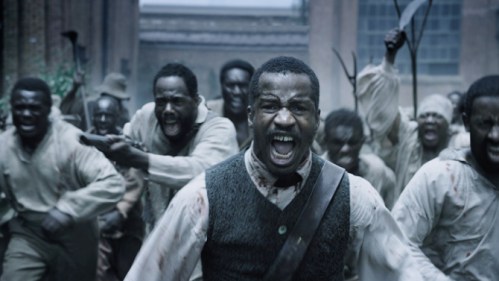
Nate Parker (center) as Nat Turner

Nate Parker (center) as Nat Turner

“THE BIRTH OF A NATION” My rating: B+

120 minutes | MPAA rating: R

The first provocation in Nate Parker’s provocative debut feature comes with the title.

“The Birth of a Nation” was, of course, the blatantly racist (though artistically daring) 1915 silent film that President Woodrow Wilson said was “like writing history with lightning.”

Parker’s film — he co-wrote it, directed it and plays the lead role — appropriates the title of D.W. Griffith’s epic celebrating the rise of the Ku Klux Klan. Except that Parker’s “Birth” is more a case of writing history with dignity and sorrow.

His subject is Nat Turner, the Virginia slave who in 1831 led a two-day rebellion that left as many as 60 whites dead. In the aftermath more than 200 blacks were murdered out of fear and retaliation.

It’s a fictionalized biography that follows Turner from childhood — he grew up playing with the white boy who would become his master, and despite his slave status learned to read and became an accomplished preacher — to his death on the gallows.

As with any film set in the antebellum South, we get plenty of pain (Jackie Earle Haley plays a slave catcher who exudes toxic cruelty).

But this “Birth” is no mere wallow in atrocity. Parker devotes much of the film to depicting familes and universal experiences.

So while the screenplay by Parker and Jean McGianni Celestin follows Turner’s slow radicalization, it also deals with the tiny joys and pains of just existing.

That may be why, despite scrupulously accurate art direction, much of the movie is composed of close-ups. Parker appears obsessed here with the landscape of the human face and how it registers joy, pain, fear and yearning. Slavery cannot be blithely dismissed as a “peculiar institution” when you can look deep into the eyes of those on the stinging end of a whip.

Continue Reading »

Emily Blunt

Emily Blunt

“THE GIRL ON THE TRAIN”  My rating: C 

112 minutes | MPAA rating: R

“The Girl on the Train” is something of an anomaly — an otherwise mediocre film containing an Oscar-caliber performance.

That the award-worthy performance comes from Emily Blunt should surprise no one. This English actress has an uncanny ability to meld with diverse screen incarnations (she’s played Queen Victoria, a modern dancer, a futuristic kidkass Marine, an ethically compromised FBI agent). As Rachel — the alcoholic, anguished, out-of-control heroine of Paula Hawkins’ best-selling novel — Blunt is by turns painfully compelling and utterly alienating.

Too bad that the rest of Tate Taylor’s film is indifferent.

One could argue with some of the Hollywoodization at work here . The novel is set in Great Britain and its heroine is a slightly zaftig  sad sack who comes off like a tormented Bridget Jones. The film, on the other hand,  takes place in a bucolic suburb of New York City and Blunt can hardly be called overweight.

But that’s not the real problem. No, the film’s downfall is the screenplay by Erin Cressida Wilson, a hodgepodge of narrative feints that makes it almost impossible to relate to any of the characters and which leaves the cast members to emote to no good end while director Taylor (who had a vastly better film with “The Help”) must try to pave over the narrative hiccups and improbabilities with a slick visual style.

You can almost feel the desperation.

We first encounter Blunt’s Rachel on the commuter train that takes her to the city every day.  As the train passes the neighborhood where she used to live with her now-ex husband, Rachel is always on the lookout for the beautiful  young blonde woman who lives just a few doors down from her old home.

That would be Megan (Haley Bennett), who likes to lounge on her balcony (facing the train tracks) in her skimpy undies. Megan has a husband, Scott (Luke Evans, late of the “Hobbit” franchise), and frequently Rachel can see the couple passionately spooning through the windows or around a fire pit in the back yard.

In voiceover narration Rachel tells us that she has built a huge romantic fantasy around the couple. She doesn’t know them, but between slugs of vodka (she keeps the booze in one of those plastic sports-drink bottles), Rachel imagines herself part of their loving scenario.

Uh, have I mentioned that since her divorce Rachel has become a pathetic basket case?

Turns out that Megan is currently the nanny for Rachel’s ex, Tom (Justin Theroux), and his new wife Anna (Rebecca Ferguson).  Poor needy Rachel is making life impossible for the couple, phoning at all hours of the day and night, and on one occasion sneaking into the house and walking out into the yard with their new baby. (Rachel and Tom couldn’t conceive, and this failure haunts her.)

Continue Reading »

Sharon Jones

Sharon Jones

“MISS SHARON JONES!”   My rating: B 

93 minutes | No MPAA rating

Barbara Kopple made her reputation with hard-hitting, left-leaning documentaries like “Harlan County, U.S.A.” and “American Dream.”

But she also has a long history of music-themed films, including “Wild Man Blues” (Woody Allen’s Dixieland jazz band), “Shut Up & Sing” (the post-9/11 Dixie Chicks) and “Woodstock: Now & Then.”

“Miss Sharon Jones!” is about a musician, but it’s really not about music.  Rather, Kopple uses her cameras to record singer Sharon Jones’ battle with pancreatic cancer.

Jones, who was once told by a recording exec that she was  “too old, too fat, too short, and too black,” has recorded several albums, one of them Grammy-nominated.  But her career rests on her heavy tour schedule with the Dap-Kings, her nine-member interracial backup band.

For Sharon Jones in action is a sight to behold.  She swaggers, she sways, she gets funky, she dances, and she has a voice that absolutely shreds r&b and soul numbers. Continue Reading »

Marg

Margherita Bay, John Turturro

“MIA MADRE” My rating: B- 

106 minutes | MPAA rating: R

Nanni Moretti’s “Mia Madre” is like Fellini’s “8 1/2” melded with a dying mom movie.

It’s not always a graceful union, but since the film stars Margherita Buy (who makes middle age look impossibly attractive), we go along for the ride.

Margherita (Bay) is in the middle of directing a movie about economic upheaval, ruthless corporations and striking workers.

That would be enough to keep her plate full, but every evening after closing down the set she goes to a  hospital where her mother, Ada (Giulia Lazzarini), a retired teacher, is awaiting the results of tests. It’s not looking good.

Margherita is torn between a demanding, often maddening profession and an abbreviated personal life.  Divorced, she has no lovers and only rarely sees her teenage daughter (Beatrice Mancini).  And while she may be a master of emotional nuance on the big screen, she struggles to connect in real life.

She feels particularly helpless and guilty about Ada.  Thank heaven for her brother (writer/director Moretti), who has taken a leave of absence from his job to care for their mama…although this only makes Margherita feel even guiltier.

Moratti, who specializes in droll comedies (“We Have a Pope,” “Caro Diario”), is in a more sober mood this time around.  A dying parent, after  all, is a sobering topic.

But he nevertheless finds humor in the form of an American actor (John Turturro) who has been cast as a factory owner in Margherita’s movie and brings along a backpack of neuroses, bullshit anecdotes (he claims to have been a protege of Stanley Kubrick, though nobody can find his name in the credits of any Kubrick film), and the inability to remember his lines.

There are some surreal dream sequences (another nod to Fellini) as Margherita’s overtaxed psyche attempts to deal with all the chaos in her world

A lot of the on-set movie scenes are inside baseball, and will be far more amusing to viewers who’ve actually worked in the movies than to the average filmgoer.

The parts of the film dealing with Margherita and her mother,while fairly glum, certainly reflect a common parent/child dynamic.

Bottom line: “Madre Mia” is fine, but nothing to write home about.

| Robert W. Butler

AltamiraBison“FINDING ALTAMIRA” My rating: C+

97 minutes | No MPAA rating

The conflict between science and superstition (not to mention stubbornness and stupidity) is nothing new.

In Hugh Hudson’s “Finding Altamira” a 19th-century archaeologist sees his life and reputation reduced to tatters over his discovery of spectacular prehistoric cave paintings.

Marcelo Sanz de Sautolo (portrayed here by Antonio Banderas) was a wealthy Spaniard and gentleman of leisure.  He was also an amateur scientist who loved getting his hands dirty digging up old things.

In 1879 Sautolo was excavating a cave discovered a few years earlier.  His nine-year-old daughter Maria (Allegra Allen) wandered off from the entrance and stumbled upon a magnificent chamber decorated with drawings of animals — mostly massive bison — rendered in red ochre and black ash.

Sautolo  concluded that this was the work of prehistoric man — but work of undreamed-of sophistication. As it turned out, that was the sticking point. No one — not even Europe’s most acclaimed archaeologists — believed primitive man capable of such efforts.

Sautolo was accused of forging the cave paintings to satisfy his own need for celebrity. Twenty years later he was vindicated posthumously after other such sites were discovered around southern Europe.

The screenplay by Olivia Hetreed and Jose Luis Lopez-Linages employs these historic facts as the backbone for a tale that takes on religion, professional pride and father-child relations.

Continue Reading »