Feeds:
Posts
Comments

bosch-temptationstanthony“HIERONYMUS BOSCH, TOUCHED BY THE DEVIL” My rating: B-

86 minutes | No MPAA rating

Under most circumstances the Tivoli Theater would play an art-themed documentary like “Heironymus Bosch, Touched by the Devil” for one night only. Maybe two at most.

But Pieter van Haste’s film has a Kansas City connection that makes it of more than routine interest to folks hereabouts. Which is why today it begins a week-long run at the Westport art house.

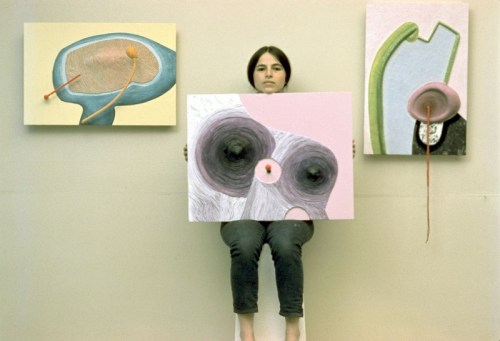
The movie follows a team of art historians and museum types as they prepare for a special exhibition of the paintings of the Dutch master Heironymus Bosch — famous for his hallucinogenic depictions of heaven and hell — in his hometown of Den Bosch in the Netherlands.

The show (it ran earlier this year) celebrated the 500th anniversary of the artist’s death, and featured as many of his paintings as the curators could lay hands on (only about two dozen authenticated Bosch works are recognized).

What makes this of local interest is that in researching Bosch’s output the experts determined that a painting held by the Nelson-Atkins Gallery of Art for the last 70 years (most of that time in storage), was indeed done by the hand of Bosch and not one of his imitators or pupils.

The “discovery” of the Nelson-Atkins’ “The Temptation of St. Anthony” occurs in the last 20 minutes of the documentary.

Up to that time the film focuses on preparations for the big show. We see how art historians use infrared technology to peer beneath the surface of works to reveal earlier images that subsequently were painted over.

An expert in wood — Bosch painted on wood panels — can count the tree rings in a particular piece and identify years of drought. Comparing those rings to the records of rainfall and drought 500 years ago, he can approximate the year the tree was cut down.  A wood panel that was harvested after Bosch’s death cannot have been painted by the master himself.

The film also devotes much time to the cautious dance of courtship and rejection as the Dutch scholars attempt to convince the staff at Madrid’s Prado Museum — the single largest repository of Bosch paintings — that they should lend their masterwork, the triptych “The Garden of Delights,” for the show.

In a quiet but emphatic display of curatorial territoriality, the Spaniards turn down the request.

All this is mildly interesting but a bit dry.  The film fares better when it zeroes in on the paintings themselves, lingering on Bosch’s scary/fascinating menagerie of demonic creatures, on the twisted naked forms of tortured souls, and on his eerie depictions of nighttime landscapes illuminated by mysterious fires (no doubt inspired by a devastating conflagration that destroyed Bosch’s hometown when he was a boy). Continue Reading »

Eddie Murphy

Eddie Murphy

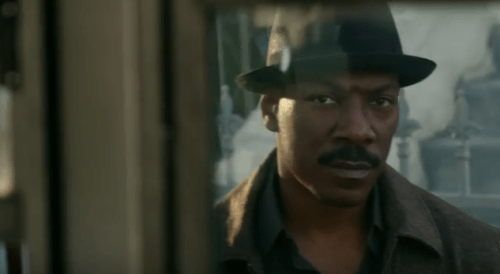
“MR. CHURCH”  My rating: C+

104 minutes | MPAA rating: PG-13

An opening credit for “Mr. Church” claims that the film was “inspired by a true friendship.”

Actually it seems to have been inspired by every other racially-tinged tearjerker ever made.

Which isn’t to say it doesn’t work, at least part of the time.

Director Bruce Beresford (“Breaker Morant,” “Tender Mercies” and especially “Driving Miss Daisy”) is a skilled enough director to finesse many of the emotional and narrative landmines that litter Susan McMartin’s screenplay, and the performances of Britt Robertson, Natascha McElhone and Eddie Murphy in the title role are good enough that we’re moved…even if we resent it.

The film’s first five minutes unload enough revelations to fill an entire movie.  The time is the mid-’70s, the location Los Angles.

The beautiful Marie Brooks (McElhone) is the single mother to young Charlotte/Charlie (played as a child by Natalie Coughlan).  Charlie awakens one morning to find a rather elegant black man (Murphy) cooking a gourmet breakfast in the kitchen.

Charlotte is informed that the cook, Mr. Church, was bequeathed to Marie by her former lover, a wealthy  married man who before dying specified that Mr. Church work as a cook and caregiver until Marie’s death, and that thereafter he will continue to receive his salary for the rest of his life.

What Charlotte doesn’t know is that her mother is dying of cancer. Thus this unusual gift from her one-time paramour.

Except that Marie hangs in there. Expected to last only six months, she lives for another six years. And Mr. Church faithfully sticks around.

By this time Charlie is a teenager (Britt Robertson, who has the unusual ability to convincing play any age between 16 and 30). She heads to college on the East Coast, but after a year or two turns up on Mr. Church’s doorstep, pretty and pregnant. They resume the unofficial father/daughter relationship that has sustained them for most of Charlie’s life.

Continue Reading »

beatles_592x299“THE BEATLES: EIGHT DAYS A WEEK — THE TOURING YEARS”  My rating: B+ (Opens Sept. 15 at the Tivoli)

106 minutes | No MPAA rating

There have been plenty of Beatles documentaries and no doubt there will be plenty more.

But if I had to explain to one of today’s teens what Beatlemania  was all about, I’d sit them down to watch Ron Howard’s “The Beatles: Eight Days a Week — The Touring Years.”

The doc focuses on the first five years of the Beatles’ timeline, ending with the 1966 concert at San Francisco’s Candlestick Park that ended their live performances.

Employing endless archival footage (some of it shot by fans and never before disseminated) and cleaned-up audio tracks that prove just how terrific a live band the Fab Four were (even if concertgoers couldn’t hear much because of all the screaming), the movie is more than just a factual document.

It is an emotional one.  Want to know what it was like to be young in 1964? Watch this movie.

What’s really amazing is how well the four Beatles — John Lennon, Paul McCartney, George Harrison, Ringo Starr — kept their shit together in the madhouse of Beatlemania.  They were bemused and not a little awed by it all, but tried to keep their heads on straight with cheeky humor and a what-the-hell attitude.

Asked if they saw themselves as pioneers of a cultural revolution, the Beatles said they were having a good “larf.” Who knew when it might end?

Ringo reveals how they had an entire floor of New York’s Plaza Hotel and still couldn’t get any privacy.  The four lads ended up hiding in a bathroom, laughing over the insanity of it all.

Continue Reading »

Aaron Eckhart, Tom Hanks

Aaron Eckhart, Tom Hanks

“SULLY”  My rating: B  

96 minutes | MPAA rating: PG-13

Clint Eastwood is not a film stylist. No fancy camera angles. No innovative editing. No signature flourishes.
What he is is a terrific and seemingly effortless storyteller, one of the best now making movies.
Exhibit A is “Sully,” Eastwood’s recreation of 2009’s “Miracle on the Hudson,”  in which a crippled jetliner landed on the Hudson River without the loss of one of the 155 souls aboard.
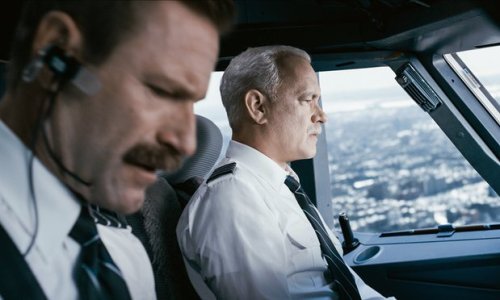
Tom Hanks stars as Capt. Chesley Sullenberger, the 40-year aviation veteran who within seconds of losing both engines to a flock of Canada geese realized a return to La Guardia Airport was impossible…that the only chance of salvation was a water landing.
Todd Komarnicki’s screenplay (based on the memoir by the real Chesley “Sully” Sullenberger) devotes half of the film’s 96-minute running time to the brief flight and the crash itself.  
The near-disaster is experienced from several vantage points (pilots and crew, passengers, first responders, witnesses), with each iteration providing new insights and not a few thrills.
This is absorbing, shocking, logic-defying stuff.
Now we all know that nobody died on US Airways Flight 1549. Still, the film generates tension by revealing that  NTSB investigators were all but prepared to pin the blame on Sully and first mate Jeff Skiles (Aaron Eckhart). (The film takes dramatic license by launching the hearings immediately after the incident; in reality, they came 18 months later.)
Computer simulations suggested that the damaged aircraft could have returned to the airport. Did Sully make a bad call that put everyone on board at risk?

Continue Reading »

LifeAnimated_Trailer“LIFE, ANIMATED” My rating: A-  (Opens Sept. 9 at the Tivoli)

89 minutes | MPAA rating: PG

If you can watch “Life, Animated” without experiencing at least one throat-constricting, utterly devastating sob, you may want to consider a career as a CIA interrogator.

Everyone else had best bring a hankie or two to this autism-themed documentary.

At the center of Roger Ross Williams’ outstanding film is Owen Suskind, now in his early 20s, who was a perfectly normal little boy until age 3, at which time he began showing signs of profound autism.

His parents, Ron (a Wall Street Journal reporter) and Cornelia were devastated. Their once-bright, verbal and loving son had turned into a silent, solitary creature.

Salvation came — and this is absolutely the truth — in the form of Walt Disney cartoons.

Disney’s animated features were among the few pastimes that engaged young Owen. A breakthrough came when, while watching “The Little Mermaid,” Owen spoke for the first time in years. At first it sounded like gibberish, but when Ron rewound the tape several times he realized Owen was repeating a line from the movie: “Just your voice.”

Recalls his dad in joy and disbelief: “He’s still in there. He’s still in there.”

Ron utilized a hand puppet of one of Owen’s favorite Disney characters, the villainous parrot Iago (voiced by Gilbert Gottfried) from “Aladdin,” to engage Owen in conversation. Only then did he realize that Owen had memorized every Disney film he’d ever seen and was able to speak using the characters’ dialogue.

“Life, Animated” uses old photographs and home video to tell Owen’s story, augmenting the archival material with new animated sequences (how appropriate) as well as classic clips from the Disney canon (Disney, usually fiercely protective of its intellectual properties, appears to have set aside its litigious ways in favor of getting Owen’s story out to the public).

Continue Reading »

Rachel Weisz

Rachel Weisz

“COMPLETE UNKNOWN”  My rating: B (Opens Sept. 9 at the Tivoli)

90 minutes | MPAA rating: R

Some films dole out facts.

Others, like “Complete Unknown,” trade in mood.

Joshua Marston’s film isn’t a thriller exactly…more like a character study…except that’s not quite right either, since the main character of Martson‘s screenplay (written with Julian Sheppard) is a sort of human chameleon.

In a brilliantly assembled opening sequence we see a woman (Rachel Weisz) in a variety of situations. She’s a grad student renting an apartment. A magician‘s assistant in what appears to be China. An E.R. nurse.

The woman is Alice (at least that’s her current name) and we slowly realize that she is a master imposter, someone who every few months or years changes her identity, personality and career.

It isn’t like Alice is antisocial. She’s witty, charming, entertaining, and has terrific stories about the various jobs she’s held all over the world.

Now she shows up at a dinner party as the date of Clyde (Michael Chernus), a schlubby government paper pusher and colleague of Tom (Michael Shannon), whose birthday is being celebrated.

Tom immediately realizes that this woman calling herself Alice is in fact Jenny, with whom he was living when she vanished 15 years earlier. Tom is now married (though that union is shaky). Nevertheless Alice/Jenny has befriended Clyde precisely so she can reconnect with her old flame Tom.

“You were the last person who really knew me before I left,” she explains.

Continue Reading »

Brian De Palma...with "little friend"

Brian De Palma…with “little friend”

“DE PALMA” My rating: B (Now on DVD)

107 minutes | MPAA rating: R

Is Brian DePalma a giant of American filmmaking?  Or just a moderately successful journeyman?

It’s pretty clear from their documentary “DePalma” that filmmakers Noah Baumbach and Jake Paltrow believe in the first analysis.

In this  two-hour journey through the director’s mind and career we mostly get the 75-year-old DePalma seated in front of a camera and in more or less chronological order discussing the films he has made over more than a half century.

These range from the off-the-cuff craziness of “Greetings” to boxoffice champs like the first “Mission: Impossible” and “The Untouchables” to genuinely provocative works like “Scarface,” “Carrie,”  “Casualties of War” and “Carlito’s Way.”

Of course there are flops, too: “Bonfire of the Vanities” (he maintains that if no one had read the book they’d like the film), “Mission to Mars” (he was a last-minute replacement who joined a production that already had left the station) and the politically-drenched war-on-terror spasm “Redacted.”

The film makes extensive use of film clips, not only from DePalma’s resume but from other filmmakers who have influenced him (Hitchcock’s “Vertigo” is a major touchstone).

Continue Reading »

Alicia Vikander, Michael Fassbender

Alicia Vikander, Michael Fassbender

“THE LIGHT BETWEEN OCEANS”  My rating: C+ 

  132 minutes | MPAA rating:  PG-13

There’s a world of weeping on display in “The Light Between Oceans.”

The good news is that most of the sobbing is done by Alicia Vikander.  If you’ve got to stare for two hours at a tear-stained face, it might as well be that of this Oscar-winning actress. She makes suffering almost transcendent.

The not-so-good news is that in making its transition from best seller to big screen, M.L. Stedman’s story has lost a good deal of its power.

For all the lacerating emotions displayed by Vikander and co-stars Michael Fassbender and Rachel Weisz, relatively little of it is experienced by the viewer.

What was deeply moving on the printed page seems mechanically melodramatic when dramatized.  You want to be moved, but can’t shake the feeling that mostly you’re being manipulated.

After four years in the trenches of World War I, Tom Sherbourne (Fassbender) returns to his native Australia a hollow man. Seeking solitude and time to rediscover himself, he signs up as the lighthouse keeper on Janus Island, a windswept hunk of rock 100 miles from the nearest coast.

But he won’t be alone for long. In one of the most satisfying passages in Derek Cianfrance’s film, he meets, woos and weds Isabel (Vikander), a local girl who seems to relish life on the island. Their’s is a civilization of two…the only thing that could make it better would be a baby to share the experience.

Fate has other plans.  Isabel suffers a miscarriage (during a hurricane, no less) and later gives birth to a stillborn child.  Things are looking pretty glum.

And then a rowboat floats in on the tide. Inside is a dead man and a baby girl. Continue Reading »

our little“OUR LITTLE SISTER” My rating: A-

128 minutes | MPAA rating: PG

“If God can’t figure things out then we’ll have to,” says one of the four Koda siblings whose day-to-day lives are limned in Hirokazu Koreeda’s “Our Little Sister.”

Surely the most profound film ever based on a  graphic novel, “Our Little Sister” is a quiet revelation, a movie of seemingly insignificant moments that add up to an emotionally gripping, transcendent statement about fate and family.

Koreeda’s film (an adaptation of Akimi Yoshida’s celebrated manga) begins with the three Koda sisters — Sachi (Haruka Ayase), Yoshino (Masami Nagasaki) and Chika (Kaho) — learning of the death of their father. They are indifferent. He abandoned his marriage and his daughters years before to take up with one woman, and has since been married to yet another.

But out of a sense of obligation the three young women travel to a distant town to attend the funeral. There they meet Suza (Suza Hirose), their adolescent half sister who was the child of her father’s earlier relationship.

Sachi, the oldest and de facto leader, impulsively asks if Suzu wants to come live with them.  The girl agrees, and suddenly they are a family of four women.

“Our Little Sister” isn’t heavily plotted. In some way it resembles Ang Lee’s “Eat Drink Man Woman,” though Koreeda’s film is virtually melodrama free. Its major attractions are the characters, presented with subtlety and depth, their personalities unfolding slowly.

Continue Reading »

Matthew McConaughey, Ken Watanabe

Matthew McConaughey, Ken Watanabe

“SEA OF TREES” My rating: C

116 minutes | MPAA rating: PG-13

At the outset of Gus Van Sant’s “Sea of Trees,” a university lecturer played by Matthew McConaughey buys a one-way ticket to Tokyo and has a taxi deliver him at the entrance of Aokigahara,  a vast forest and park famous — or infamous — for the number of people who go there to commit suicide (100 or so each year…some of the bodies are never found).

Even before we see the signs advising visitors to think of heir families before killing themselves, we know that the American — eventually we learn his name is Arthur — is in bad shape. He’s hollow-eyed and morose and has a vial of little blue pills with which he plans to chug-a-lug himself into the hereafter.

Arthur hikes deep into the dark and eerie forest, but before he can do the deed  he is interrupted by Takumi (Ken Watanabe), a Japanese businessman wandering about lost, his shirt cuffs bloody from a botched attempt to slit his wrists. Apparently the guy’s career has spiraled into the crapper and he can’t stand to lose face.

Altruism trumps suicide, and Arthurs decides to put off offing himself until he can steer Takumi to a trail out of the park. It’s the decent thing to do. Except that Arthur is himself seriously injured in a horrendous fall off a cliff, and now the two men must rely on each other to — ironically enough — survive.

Continue Reading »