Feeds:
Posts
Comments

Posts Tagged ‘Cillian Murphy’

Sasha Luss

“ANNA” My rating: B- (Netflix)

118 minutes | MPAA rating: R

“Anna” is a guilty pleasure, delivering just enough cheese/sleaze to satisfy a viewer’s baser instincts but wrapping it all up in a clever storytelling style that keeps us on our toes and guessing.

I didn’t realize until watching the final credits that this spy thriller was written and directed by French icon Luc Besson…but I should have guessed.  “Anna” is basically a remix of Besson’s 1990 hit “La Femme Nikita.”

Both films center on a young woman recruited by a spy agency and trained as a ruthless assassin specializing in seduction and mayhem.

This time around our heroine is the Russian orphan Anna (Sasha Luss), a loner who becomes one of the KGB’s most relentless killers while working as a fashion model in Paris. Besson’s plot finds her undertaking a host of dangerous missions, often disguised by wigs.

What’s intriguing is the film’s structure.  After each kill the film flashes back to reveal that what we assumed about the mission was in fact wrong, that there were hidden intentions and meanings that shot right by us. With this setup what might otherwise be just a series of violent encounters instead triggers jaw-dropping revelations.

The supporting cast ain’t bad, either.  “Anna” counts two Oscar winners on its roster:  Helen Mirren is a delight as the chain-smoking cynical Russian spymaster who controls Anna’s life; Cillian Murphy is a CIA agent who tries to turn our girl to America’s interests.  And Luke Evans is just fine as the Anna’s field handler.

I was initially unimpressed by Luss’s turn as Anna…pretty but vacant.  Over time, though, one realizes that Anna is playing a long con on everyone…the Russians, the Americans and especially the audience. She’s revealing to each of these demographics only enough about herself to keep her plans in play.

Smart girl.

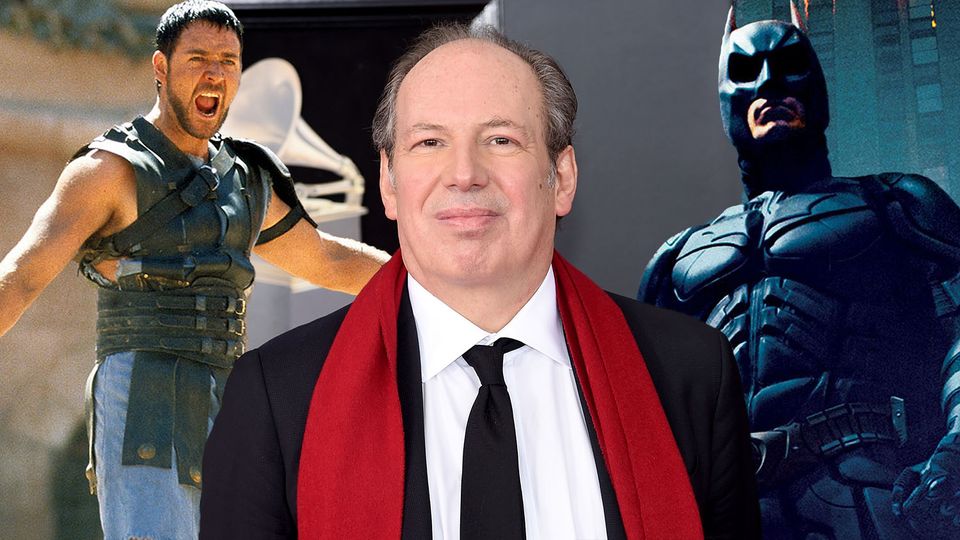
Hans Zimmer

“HANS ZIMMER: HOLLYWOOD REBEL”My rating: B (Netflix)

60 minutes | No MPAA rating

Checking out composer Hans Zimmer’s IMDB page is pretty mind-boggling.  The two-time Oscar winner has scored some of the seminal films of the last 40 years: 

“Gladiator,” “Dune,” virtually all of Christopher Nolan’s movies, “Thelma & Louise,” “A League of Their Own,” “The Lion King,” “Muppet Treasure Island,” “The Thin Red Line,” the “Mission: Impossible” franchise, “Black Hawk Down,” “The Last Samurai,” “The Da Vinci Code,” “The Pirates of the Caribbean” franchise, “Kung Fu Panda,” “12 Years a Slave,” “Hidden Figures,” “Blade Runner 2049,” “Dune,” “Top Gun: Maverick.”

Not to mention a ton of documentaries and a little TV show called “The Simpsons.” 

Francis Hanly’s “Hans Zimmer: Hollywood Rebel” can’t really explain Zimmer’s astonishing productivity and creativity (“superhuman” doesn’t seem too hyperbolic), but it does provide in a neat, one-hour session an intriguing overview of the man’s life and career.

What struck me most about the German-born Zimmer’s work is his reliance on atmosphere and rhythm over melody.  Some of my favorite movie scores (Jerry Fielding’s work on “The Wild Bunch,” for example) are less about delivering tunes than creating a sonic background reflecting the emotional tenor of the scene. 

This is what Zimmer does so well, often working alone at a keyboard/synthesizer to create sonic landscapes that only later are performed by a full orchestra (or not…Zimmer excels at mimimalist arrangements as well).  

The man appears to be unflaggingly good natured, if dangerously obsessive about his work.  His grown children describe him as an absentee father, though in recent years he’s been working to make up for lost time.

His coworkers and the directors he’s composed for — James L. Brooks, Stephen Frears, Ron Howard, Barry Levinson, Steve McQueen, Christopher Nolan, Denis Villeneuve, etc. — can’t wait to team up with him again and again.

Kingsley Ben-Adir

“BOB MARLEY: ONE LOVE” *My rating: B (Apple+)

107 minutes | MPAA rating: PG-13

I never saw “Bob Marley: One Love” in the theater. This may have been an OK thing, since I would have missed half the dialogue, which is delivered in a thick Jamaican/Rasta patois.

So let’s hear a round of applause for streaming service captioning.

Reinald Marcus Green’s film (it was written by  Terence Winter, Frank E. Flowers and Zach Baylin) is essentially hagiographic, but still compelling. 

We get the essentials on Marley’s brief but impactful life…his conflicts over the white father he never knew, his Jamaican nationalism (during the violent 1976 national election he was the target of an assassination attempt), his embracing of Rastafarianism (if you’re going to go whole hog into religious silliness, that’s the coolest option), his prodigious ganga consumption.

Marley is played by Brit actor Kingsley Ben-Adir, who doesn’t resemble Marley all that much but who nails his body language and stage presence.  Lashanda Lynch is fine as his wife and backup singer Rita Marley (and she has a terrific third-act eruption confronting her husband over his infidelities). 

But the real star of the show is the music itself.  It’s just one damn great song after another; Marley was reggae’s greatest tunesmith and lyricist, laying down spectacularly produced tracks that are yet to be equalled.  

| Robert W. Butler

Read Full Post »

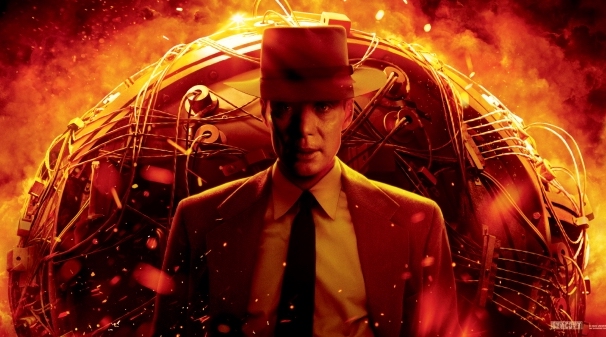
Cillian Murphy as J.Robert Oppenheimer

“OPPENHEIMER” My rating: B+ (in theaters)

180 minutes | MPAA rating: R

Christopher Nolan’s monumental and astoundingly dense “Oppenheimer” is a study in contradictions.

It starts with contradictions of one man — physicist J. Robert Oppenheimer (Cillian Murphy), who led the Manhattan Project to develop the first atomic weapon and later wondered if he’d done the right thing — but throws an even  wider net. 

Such as: The contradictions between scientific inquiry and the fear of what we might discover. The contradictions in the rules we live by, when we bend them and when they stiffen.

The three-hour film follows the creation of the atom bomb, but while that provides the plot it isn’t really what “Oppenheimer” is about. Looming over it all is the fallout (not the radioactive kind) of that literally earth-shaking moment in history.

We’re talking about big moral questions and writer/director Nolan presents them in all their maddening complexity, without telling us which side we’re supposed to take.

“Oppenheimer”is less an emotional experience than an overwhelmingly intellectual one.  I can think of no other film in recent years that left me thinking so long and hard about the questions it raises…and the answers it cannot give.

Long a lover of warped time lines (“Memento, “ anyone?), Nolan here cuts back and forth between several of them.  

Of course there’s the race to beat the Nazis in making an atom bomb, with Oppenheimer creating a small city from scratch in the New Mexico desert so that his scientists and engineers (and their families) can work in secure isolation for as long as it takes (more than two years, as it turned out). 

Another timeline centers on a 1954 Atomic Energy Commission hearing, a McCarthy-ish kangaroo court called to determine if Oppenheimer — by now a critic of America’s Cold War policies — should be stripped of his high-level security clearance.

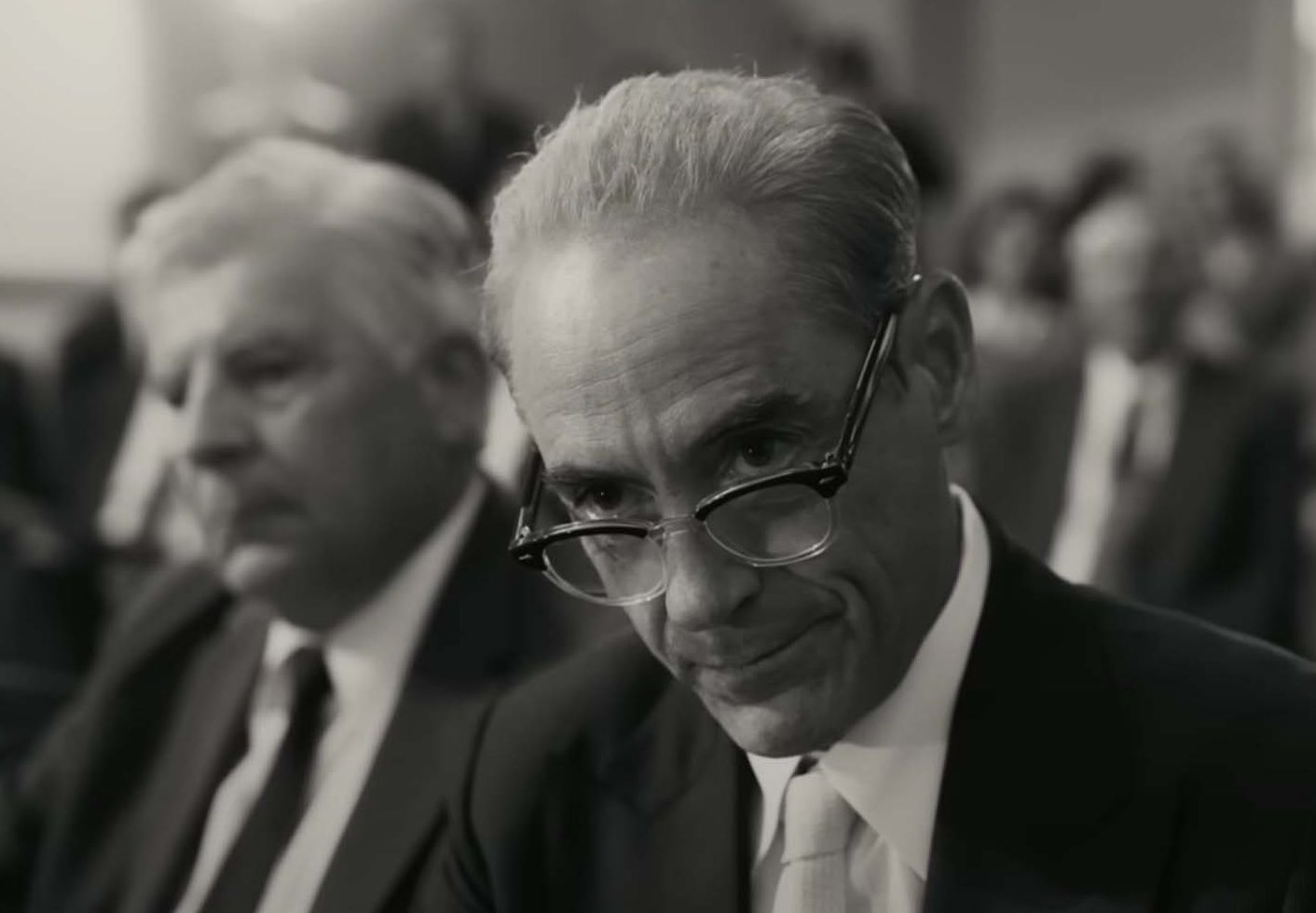
And then (in black-and-white footage) we witness the 1959 Senate confirmation hearing of Lewis Strauss (Robert Downey Jr., in a career-high performance). Strauss is the former AEC chair and Eisenhower’s nominee for Secretary of Commerce. Many of the questions aimed at him  concern his relationship over the years with Oppenheimer, whose reputation by this time is marred  by the widespread belief that he was a Communist sympathizer.

Robert Downey Jr.

Nolan’s screenplay deftly weaves together these threads, and while we may not at first understand just what is going on (why so much emphasis on Downey’s Strauss, surely a minor figure in all this?), the setup pays off with a last-act revelation that most viewers won’t see coming.

At the heart of it all is Cillian Murphy’s brilliantly contained portrayal of Oppenheimer.  What’s amazing about all this is that Oppenheimer was not a demonstrative character — he wore a mask of scientific calm and reason. Yet Murphy’s eyes suggest all that’s churning in that head. 

Only after the film is over does the viewer realize he’s been totally sucked in by a performance that ignores the usual big actorish moments. 

Instead he is quietly intimidating. Oppenheimer is a genius who taught himself Dutch in six weeks so that he could present a lecture on molecular physics in the audience’s language. He’s not a great mathematician or lab guy, but he sees/imagines  what others cannot.

He’s arrogant. Gently dissing young leftists he advises that to  really understand Das Kapital it should be read in the original German. 

He’s a moral puzzle, described as “a dilettante, womanizer and Communist,” yet he’s a man whose conscience will not leave him alone.

I’m not sure I’d even like J. Robert Oppenheimer…but he was precisely the man America needed at the time.

Getting far more stirm und drang screentime  are the women in Oppenheimer’s life. Florence Pugh plays Jean Tatlock, whom he meets in a  gathering of college Commies and with whom he maintains a sexually-charged relationship even after it’s obvious she’s slipping into mental illness. 

And then there’s Mrs. Oppenheimer, played by Emily Blunt.  For much of the film Blunt seems little more than window dressing, but in the third act she becomes a fireball of righteous indignation when her husband’s patriotism is questioned.

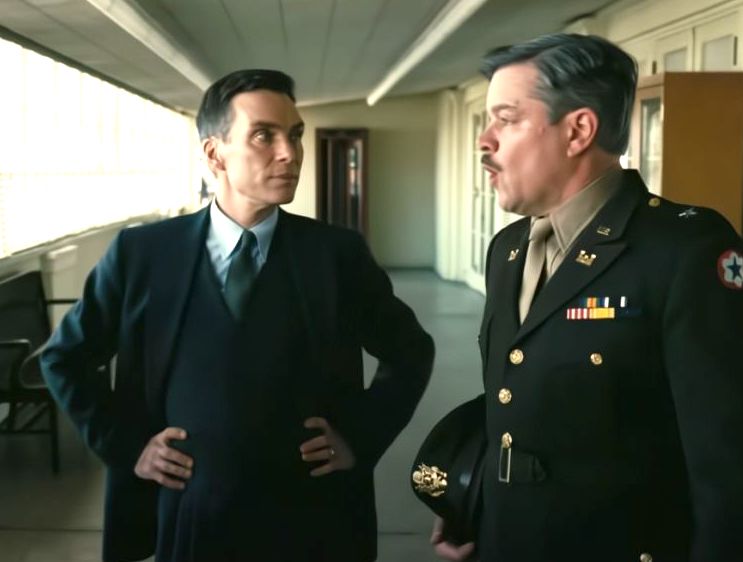
Matt Damon is terrific as Gen. Leslie Groves, heading up  the project’s military component. Groves is a mix of old-school discipline and pragmatism…he was willing to waive objections over political purity to get the brains he needed.

Cillian Murphy, Matt Damon

Then his job is to keep a lid on scientists whose natural inclination is to share information, not compartmentalize it. There’s not much humor in “Oppenheimer,” but Graves’ cat-herding frustration provide most of it.

There are dozens of other speaking roles here, some taken by familiar faces who may have only limited screen time.  Just a few of them: 

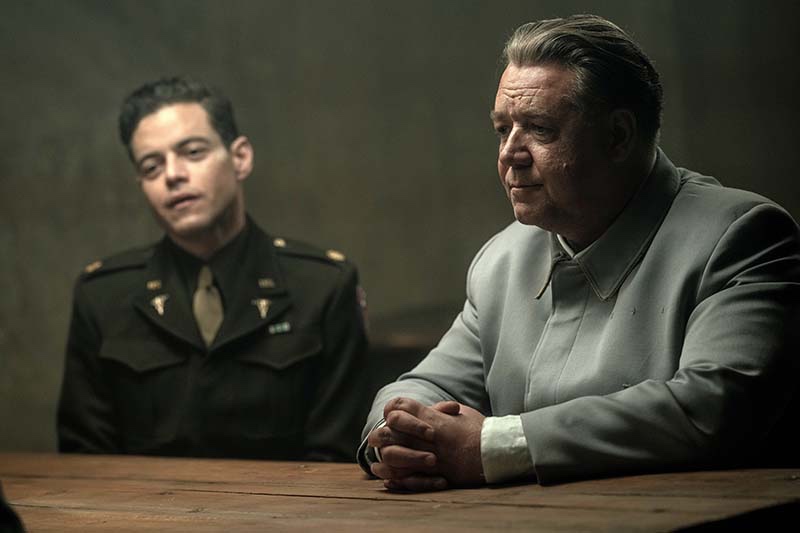
Oscar winners Rami Malek, Casey Affleck and Gary Oldman (the last as President Harry Truman). Josh Hartnett. Jason Clarke. Matthew Modine. Tony Goldwyn. James Remar.  Kenneth Branagh. Tom Conti (as Einstein!!!). Dane DeHaan. Kansas City’s own David Dastmachian. 

Nolan masterfully keeps all these balls in the air.  His accomplishment is doubly impressive because “Oppenheimer” has so few look-at-me-ma moments.  Very few directorial flourishes.

But those he does indulge in are woozies.  

Early on Nolan delivers almost abstract visions of swirling sparks and dividing cells to suggest the workings of Oppenheimer’s imagination.

The buildup to the detonation of the first atomic bomb outside Los Alamos is a tension-packed slow burn. The emphasis isn’t on the nuts and bolts of making the bomb, but on the nervous anticipation of Oppenheimer and his crew.

Would it work? Would it, as some members of the team suggest, start a chain reaction igniting Earth’s atmosphere and killing everything?

We already know the answers, but audiences nevertheless will be on the edge of their seats.

And in the midst of a rowdy, patriotism-drenched celebration of the end of the war, Oppenheimer looks out over his audience of cheering colleagues and imagines their faces dissolving in the heat of a nuclear blast.

It’s an image that says more than pages of dialogue.

“Oppenheimer” is the ultimate yes/but experience.  For every argument it presents there pops up a counter argument. Was it immoral to drop the big one on civilians?  Would it have been better to sacrifice 500,000 American lives in an invasion of Japan?

Those who want to be spoon fed answers will find “Oppenheimer” frustrating.  Tough. The film tells us the world doesn’t work like that. Black and white is rarely that.

Like I said, contradictions.

| Robert W. Butler

Read Full Post »

Noah Jupe, Millicent Simmonds, Emily Blunt

“A QUIET PLACE PART II” My rating: B

97 minute | MPAA rating: PG-13

With only two directing credits under his belt, actor-turned-filmmaker John Krasinski has proven himself one of the brightest up-and-comers in cinema.

“A Quiet Place” and its just-released sequel, “A Quiet Place Part II” remind a bit of the Spielbergian splash made by “Jaws” more than four decades ago. Like that seagoing classic, Krasinski’s “monster” movies exhibit a Hitchcockian sense for building suspense.

They have their own look and — perhaps even more important for a franchise about eyeless aliens who use their ears to track human prey — their own sound.

And they effectively mine notions of family and parenthood, with a tiny clan battling indescribable horrors to survive.

“A Quiet Place Part II” is a generally enjoyable thrill ride, peppered with gotcha shock moments and performances that far exceed what we’ve come to expect from the horror genre.

Yet despite the many upsides of this sequel, I found myself a bit let down. Not by the execution, but by the sameness. Krasinski sticks with ideas he introduced in the first film, but I never felt he was advancing them so much as recycling them.

You’ll recall that Krasinki’s character Lee Abbott, died in the first film, sacrificing himself to save his children. The new film (the screenplay is credited to Krasinksi, Scott Beck and Bryan Woods) opens with a hugely effective flashback to the aliens’ arrival in the Abbott’s small upstate New York town. It’s got an impressive “War of the Worlds” vibe — and gives us our Krasinski fix before he vanishes from the screen for good.

(more…)

Read Full Post »

heart-of-the-sea-trailer-10162014-073506“IN THE HEART OF THE SEA”  My rating: C+  

121 minutes | MPAA rating: PG-13

“In the Heart of the Sea” is a romantic title for a most unromantic film.

The latest from director Ron Howard is based on the real-life tragedy of The Essex, an American whaler that in 1820 was rammed and sunk by a huge sperm whale. Surviving crew members were adrift in longboats for more than three months before being rescued.

By that time they’d begun eating their dead comrades.

Happy Holidays!!!!!

The story of the Essex inspired Herman Melville to write Moby Dick, and Charles Leavitt’s screenplay begins in 1850 with a visit by Melville (Ben Wishaw) to the whaling center of Nantucket MA to interview the last surviving member of the Essex’s crew.

Thomas Nickerson (Brendan Gleeson) was the Essex’s cabin boy and 30 years later is still reluctant to discuss his experiences. He’s a depressed drunk; only financial desperation forces him to accept  Melville’s offer of cash for a night’s conversation.

As the two men drink and talk, the doomed voyage unfolds in flashbacks.

It all plays out like a variation on Mutiny on the Bounty/Men Against the Sea. 

The Essex’s experienced first mate, Owen Chase (Chris Hemsworth), is a farmer’s son who rose through the ranks. He was promised his own ship but the owners have reneged.

Instead the command goes to George Pollard (Benjamin Walker), who lacks Chase’s skill but has the social connections that come with being a member of one of Nantucket’s great mercantile families.

So there’s class conflict and professional resentments brewing.

Of course, personal issues are irrelevant when you’re battling a furious behemoth of the deep. Once the Essex has gone to the bottom the men in the longboats face weeks of thirst, hunger and madness. Simple survival is all that matters.

(more…)

Read Full Post »