
“NICKEL BOYS” My rating: B ( In theaters)
140 minutes | MPAA rating: PG-13
That Colton Whitehead’s Pultizer-winning novel Nickel Boys is unfilmable is pretty much a given.
The book, a first-person retelling of a young black man’s stay in a brutal reformatory in the early 1960s, has one of those “Sixth Sense:”-level “gotcha” endings that works on the printed page but defies visual representation.
(Sorry if I seem coy. Those who have read the novel know what I’m talking about, and I don’t want to ruin the movie for those who haven’t.)
So I’m happy to report that first-time writer/director RaMell Ross has found a way to tell Colson’s story with the surprise intact. The answer to the conundrum is the first-person camera.
First-person camera movies — in which the camera views the protagonist’s world though his/her eyes — have a limited and not terribly successful track record.
Back in 1946 Robert Montgomery directed the Raymond Chandler mystery “Lady in the Lake” using a first-person camera. Montgomery plays detective Phillip Marlowe, but we only see the actor when the character looks into a mirror.
A year later in “Dark Passage” Bogart played an escaped convict. We see the film through the character’s eyes until about halfway through, when he undergoes plastic surgery and emerges looking like, well, Humphrey Bogart.
Neither film works all that well.
Here writer/director Ross resurrects the technique and the results are simultaneously satisfying and unsettling.
The plot is fairly straightforward. Elwood, a black teenager in Civil Rights-era Florida, is on his way to college when he hitches a ride in what turns out to be a stolen car. He ends up sentenced to spend the next few years in the Nickel Institute.
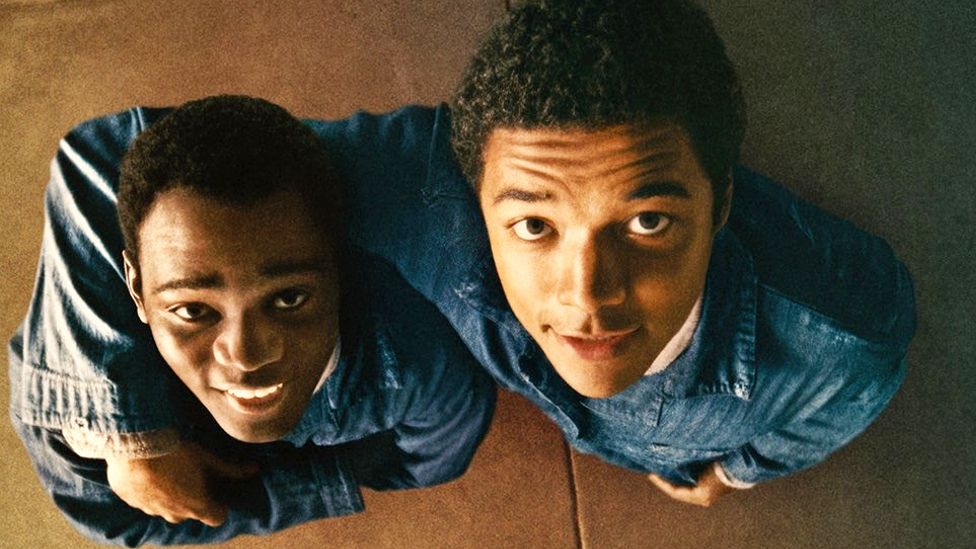
Ethan Herisse, Brandon Wilson
Elwood’s early life — including the influence of his doting grandmother (Aunjanue Ellis-Taylor) — is depicted in a cataract of kaleidoscopic images.The effect is breathless yet lyrical, with editing (by Nicholas Monsour) that gives the entire film a sort of life-is-flashing-before-your eyes staccato sensation.
When the film began I assumed this creative but challenging approach would be retired after an opening sequence. But no…it’s there for the duration.
“Nickel Boys” is unique in that we almost never get a scene with a conventional beginning, middle and end. Rather we get snippets of scenes zapping by, and from these threads we have to assemble a tapestry.
If you can’t handle it (and many viewers won’t be able to) this movie will drive you nuts.
Teenage Elwood is played by Ethan Herisse, whose voice we hear but whom we rarely see (unless there’s a mirror in the room).
Since he’s black Elwood resides in a segregated wing of Nickel. He and his fellow inmates must attend class, but the administration puts more emphasis on putting them to work, either on the grounds or hired out to local farmers and homeowners. (The parallels to slavery are unmistakeable.)
The bookish, utterly inoffensive Elwood also discovers that physical brutality — torture, in fact — is part of the curriculum. One of the white teachers, Spencer (Hamish Linklater), is particularly fond of taking boys to the “white house,” a cottage on the edge of the property where their screams will not disturb the sleep of others.
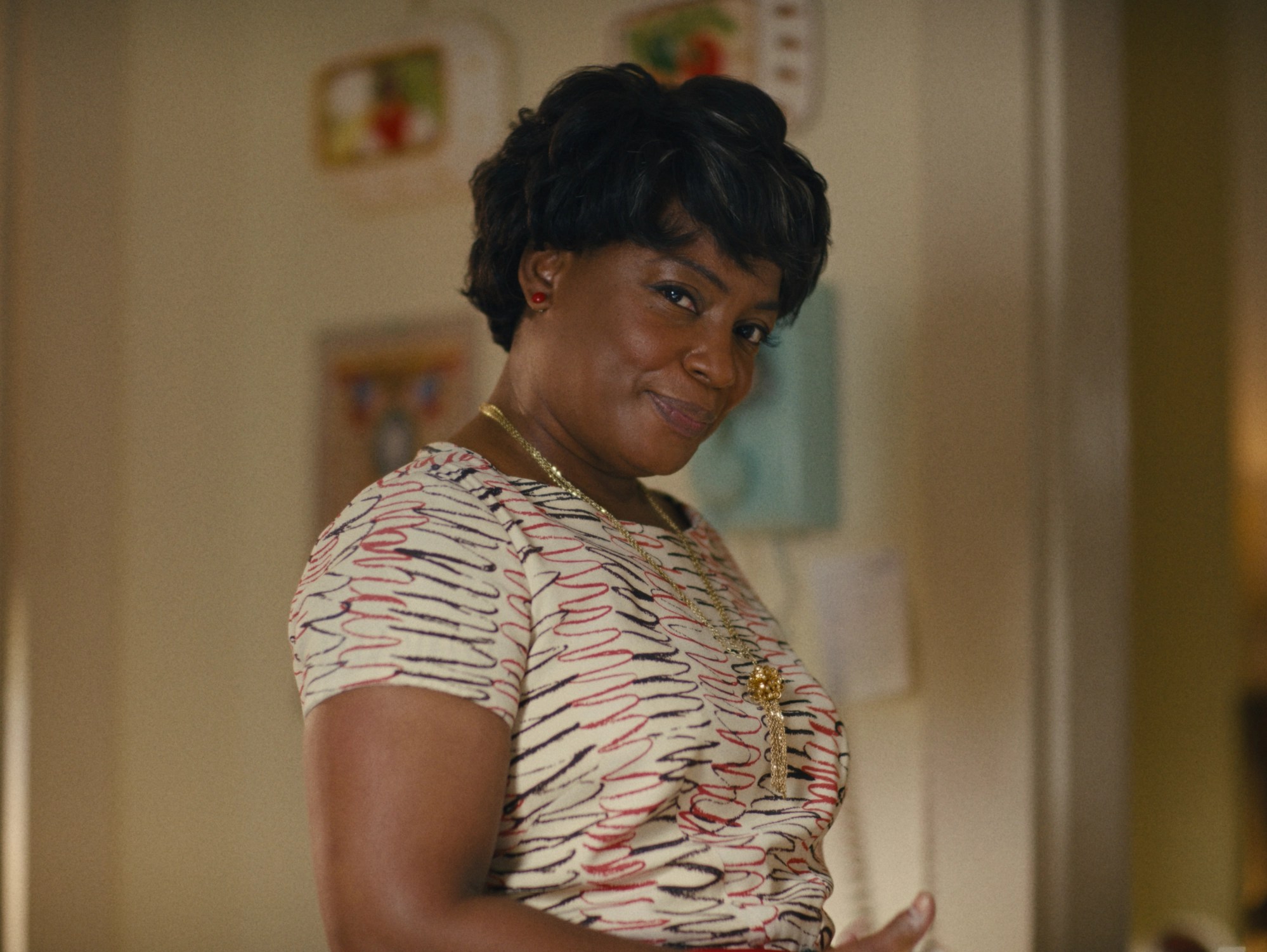
Aunjanue Ellis-Taylor
Periodically a boy will vanish. The teachers will claim he ran away, but there are little mounds of dirt on the grounds that look an awful lot like graves.
All this is filtered through Elwood’s relationship with another boy, Turner (Brandon Wilson). Turner is as cocky as Elwood is retiring, but they watch each other’s backs.
When we first see Turner it is through Elwood’s eyes. But a few minutes later Ross does something extraordinary. He gives us a conversation between the two boys in which we’re in Elwood’s head. And then he replays the whole scene, only this time we’re looking at Elwood through Turner’s eyes.
From that point on the film will shift points of view between the two youngsters. The only time we see them together in the same frame is when they stand beneath a shop’s mirrored ceiling and look up at their reflections.
In the final third of the film we are introduced to Adult Elwood. Thirty years have passed and Elwood lives in NYC and runs a moving business. He’s married and devotes his evenings to scouring the Internet for news about the now-defunct Nickel Institute, where investigators are sifting through dozens of unmarked graves.
Adult Elwood (as he’s listed in the credits) is played by Daveed Diggs of “Hamilton” fame, but we only see him from behind. There’s a reason for this; readers of the book will understand.
Despite having to do most of his acting with his voice and the back of his head, Diggs has a marvelous scene where his character has a random encounter in a bar with another Nickel survivor.
All of this leads up to the yarn’s head-smacking last-moment revelation, which comes as Adult Elwood recalls the night Elwood and Turner attempted to escape Nickel once and for all.
On many levels “Nickel Boys” is a brilliant piece of work. So I feel somewhat churlish in stating that the thing that makes it work — the first-person camera — is also the thing that kept me at arm’s length emotionally.
I ended up admiring the film more for its ambience and message than for its dramatic palette.
Even so, I cannot think of another movie quite like it.
| Robert W. Butler
 Butler's Cinema Scene