Feeds:
Posts
Comments

Posts Tagged ‘Diane Lane’

Michael Douglas

“FRANKLIIN” (Apple+)

 I love just about everything about “Franklin”…except for Franklin himself.

So let’s be brutally honest here: Michael Douglas as Benjamin Franklin? Just doesn’t work.

I’m not saying Douglas makes the series unwatchable. It’s not that off-putting.

But Michael Douglas the movie star is here wrestling with Michael Douglas the actor…and the movie star wins.  More on that later.

This 8-part series (the writers are Kirk Ellis and Howard Korder, adapting Stacy Schiff’s non-fiction A Great Improvisation; all episodes are directed by TV vet Timothy Van Patten) takes us to Paris in the late 1770s.  

Inventor/journalist/all-round Renaissance man Benjamin Franklin, now 71, has been dispatched by the rebellious American colonies to seek France’s aid in the fight for freedom.

Accompanied by his teenaged grandson/secretary Temple (Noah Jupe), the wily old Franklin gets to work seducing French society, determined to secure money, arms and men for the American cause. Meanwhile British agents are bent on undermining those efforts.

“Franklin’s” scripts are the very model of effective historic drama. The intrigues of the French court are presented in all their complexity (the French characters speak French with English subtitles); meanwhile more personal dramas are playing out. (Every time a character or situation popped up that seemed like a writer’s invention, I’d do a bit of research and discover that it’s all based on fact.)

Despite his age, Franklin sets the French ladies aswooning…especially Madame Anne-Louise Brillon (Ludivine Sagnier), a composer who sees in Franklin the possibility of sexual equality. (The series is coy about whether Franklin had physical relations with these women, but controlling his active libido apparently was a lifelong struggle.) 

Meanwhile in a parallel story line, young Temple finds himself seduced by the many vices of upper-crust French society.  

The physical production is spectacular; much of the series appears to have been filmed in the actual historic settings.  The costuming (and the ladies’s wigs, oh, my!) are sumptuous.

All good.  

And then you have Douglas’ central performance.  I’m not sure exactly how I envisioned Franklin as a personality, but this wasn’t it.  Douglas’ Franklin in grumpy, dour and, frankly, not nearly charming enough.

But what really bugged me was his hairline.

Portraits of Franklin show him with long locks, but bald from his brows to the crown of his head. Douglas, though, has a hairline positioned several inches lower than that.  

Another thing: the real Franklin had a physique not unlike a potbellied stove.  But Douglas’ Franklin is notably trim.

The overall effect is less balding old man than aging rock star.  I came away with an impression of an actor more concerned with looking good than with nailing an historic truth.

Jeff Daniels

“A MAN IN FULL”(Netflix):  

Jeff Daniels is so adept at playing good guys (he was Atticus Finch on Broadway, for Chrissake) that when he shows a dark side (as in the Western “Godless”) it’s a shock.

In “A Man in Full” he portrays a fellow who in another show might be a villain. But because he’s played by Daniels we get a more nuanced approach.

Charlie Croker (Daniels) is an Atlanta real estate mogul who mixes good ol’ boy charm with a cutthroat business sense.  The plot of this David E. Kelley-scripted three-parter centers on Charlie’s efforts to avoid ruin…he’s a billion dollars in debt to a local bank that’s maneuvering to seize his assets.

Now Charlie probably deserves whatever comeuppance awaits him, but Daniels is so good we end up rooting for him to find a way out.  Also, the bank executive bearing down on him (the great Bill Camp) is such a nasty piece of work Charlie seems benign by comparison.

“A Man in Full” is less about finance, though, than about characters.

There is, for instance, Charlie’s current trophy wife (Sarah Jones)  who turns out to be a whole lot smarter and empathetic than one anticipates.

There’s  his ex Martha (Diane Lane) and their son (Evan Roe), who view the old mover and shaker with equal parts resignation, affection and wariness.

And especially there’s a bank underling (Tim Pelphrey), a sort of milquetoast everyman seeking to redress old hurts.  He ends up dating Lane’s character…but whether he’s bent on revenge or actual romance (this is Diane Lane we’re talking about) even he can’t decide.

As directed by Regina King and Thomas Schlamme, “A Man in Full” swoops in, throws some dramatic haymakers and sharply drawn performances, and concludes before wearing out its welcome.

“SECRETS OF THE OCTOPUS” (Disney +):

Octopi may be the coolest animals on Earth.

That’s the impression left by the three-part “Secrets of the Octopus,” a Paul Rudd-narrated nature documentary.

I mean, an octopus can change its color and skin texture to blend in with its surroundings.  We see one of these creatures using tools…a discarded shell becomes a shield to protect the octopus from predators.

Octopi appear to show other signs of intelligence, including a sense of curiosity about human visitors. And despite a reputation for being loners, some species live in colonies and one displays a relationship with a fish…the fish serves as a hunting dog, sniffing out and pointing to prey hidden in the coral and sand.

Think of this series as an expansion of the Oscar-winning “My Octopus Teacher.” 

It’s almost too much (the three hours feel a bit padded). But the underwater cinematography is so gorgeous — and the creatures themselves so weirdly compelling — that you can’t tear yourself away.

| Robert W. Butler

Read Full Post »

“FOR ALL MANKIND”(Apple+):

Most of what we call science fiction is in fact science/fantasy.  But “For All Mankind” is sci-fi in its truest sense. The show, which recently dropped its fourth season, offers an minutely detailed alternative history of the space race.  

In this version the Soviets get to the moon first and the Americans must play catch-up. Communism more or less flourishes with a repressive regime in Moscow still railing against capitalism well into the 21st century.  Al Gore is elected President; so is a  woman—a closeted gay woman.

(“For All Mankind” sees women as key figures in the space program. One could almost call this feminist sci-fi.)

Meanwhile astronauts and scientists from all countries are working to explore the vastness of space, with international colonies established on the moon and Mars. Of course, our conflicts as human beings don’t magically go away when we relocate to distant planets. There are labor issues, rebellions, sabotage.

Basically the series explores where we might be now if only we hadn’t put space exploration on the back burner.

The special effects are utterly convincing and the science completely plausible.

I’m especially impressed at how well certain characters — an original NASA flyboy played by Joel Kinnaman, a genius engineer/supervisor played by Wrenn Schmidt — age over the course of several decades.

The series deals not only in space exploration but in the lives of its many characters.  There are failed marriages and affairs. Generational disputes. Political gamesmanship.

The has led some to complain that there’s too much soap gumming up the science. I must disagree…our humdrum human foibles do not evaporate just because we are confronted with the vastness of space.

Throughout, the series never abandons the idea of real science.  No laser guns, shape-shifting aliens or woo woo transcendentalism. Just people designing and making machines that reflect the real possibilities of our technology, imaginations and capacity to hope.

Naomi Watts, Tom Hollander

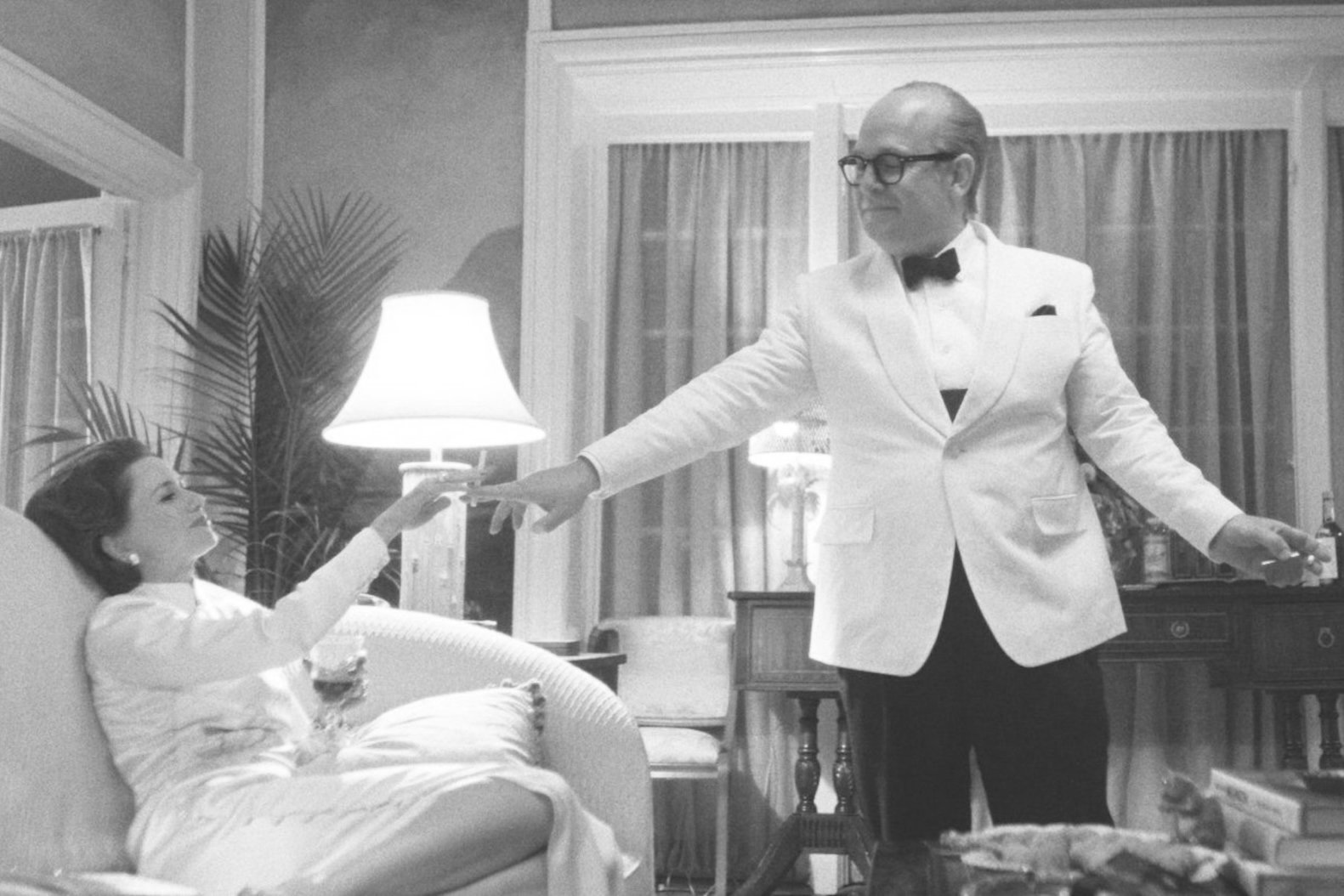
“FEUD: TRUMAN CAPOTE VS. THE SWANS” (Hulu):
For its second season (the first, in 2017, focused on the antipathy shared by Bette Davis and Joan Crawford during the filming of “Whatever Happened to Baby Jane?”) Ryan Murphy’s “Feud” concentrates on writer/raconteur Truman Capote.

Set in the 1960s and ‘70s, “Capote and the Swans” delves into the novelist’s relationships with a half dozen or so society wives, women married to powerful movers and shakers who, from the outside anyway, appeared to live lives of pampered opulence and studied hautiness.

Capote (portrayed by Brit Tom Hollander with a helium-and-molasses voice and fierce attention to his character’s fey mannerisms) calls his gal pals “the swans” because, he says, they seem so graceful on the surface, while below the water line they are desperately paddling. 

These ladies who lunch are portrayed by the likes of Naomi Watts, Diane Lane, Chloe Sevigny, Calista Flockhart and Demi Moore — all of whom appear to be having one hell of a good time mining the bitchiness.

Not that it’s all fun and games. For all their affluence these women are fairly miserable, saddled with philandering hubbies and thankless children.  The openly gay Capote becomes their best friend, shrink, confidant and shoulder to cry on.

“I play the part. It’s all a performance,:” he admits in an unusually honest moment. “They pick men who are rich but cannot act.”

Of course Capote —his creative juices dried up — also betrays these women by turning his intimate knowledge of them into a scandalous novel…thus the feud of the title.

Now I’m only halfway trough the season, but the fourth episode, “Masquerade 1966,” is so freaking good — and so beautifully sums up what the series is about — that it’s practically a stand-alone experience.

John Robin Baitz (who has scripted the entire series) has come up with a brilliant idea. He tells the story of Capote’s famous Black-and-White Masked Ball (one of the most memorable if overhyped society events in Manhattan history) by using “found footage” reputedly made by documentary giants Albert and David Maysles.

The entire episode — directed by the great Gus Van Sant — is shot with handheld cameras and captured in grainy black-and-white and in a classic square frame. The Maysles Brothers not only observe the preparations with fly-on-the-wall intimacy, but conduct interviews Capote and with the Swans…each of whom is convinced that she will be the secret guest of honor to be named at the big event.

Clearly, they can’t all be queen for a day, but master manipulator Capote knows how to exploit each woman’s insecurities and desires to his will.

The result is 60 minutes of absolutely brilliant television.  

| Robert W. Butler

Read Full Post »

Diane Lane, Kevin Costner

“LET HIM GO”  My rating: C

114 minutes | MPAA rating: R

There are moments early on when “Let Him Go” seems to be a thoughtful examination of a long marriage between a couple with fundamental differences about how the world works.

That Thomas Bezucha’s film stars Kevin Costner (one can usually feel safe whenever he’s wearing a cowboy hat) and Diane Lane (OMG: the eternally beautiful one-time child star is now portraying a grandmother!!!) generates even more hope that this might be a keeper.

Uh…no.

Before it’s all over “Let Him Go” will have descended into a quagmire of cult film wackiness and action/revenge melodrama, wasting a promising cast along the way.

Set in the early 1960s, the yarn begins on the Montana ranch of retired lawman George Blackledge (Costner), his wife Margaret (Diane Lane) and their son James (Ryan Bruce).  James has a wife, Lorna (Kayli Carter), and an infant boy. They’re just one big happy multigenerational family.

A riding accident leaves Lorna a widow and the story suddenly jumps several years into the future where we see her remarrying. Her new hubby is Donny Weboy (Will Brittain), who turns out not to be a nice person at all. (Why did Lorna fall for a creep, even while she’s still living with the sheltering George and Margaret?  Well, that would take some explaining, so Bezucha’s screenplay doesn’t even try.)

And then one day the little family vanishes without a trace.

The  emotion-driven and fiercely maternal Margaret is determined to mount a pursuit to rescue her grandson Jimmy — wherever it is that Donny may have taken Lorna and the boy.

Husband George, the sort of guy who says little and then only after considerable rumination, is morosely pragmatic. His life has been ruled by the law, and he knows they haven’t a legal leg to stand on.

But the stubborn Margaret announces she’ll go on the quest by herself if needs be. What’s a guy supposed to do?

(more…)

Read Full Post »

Diane Lane

“PARIS CAN WAIT”  My rating: C+

92 minutes | MPAA rating: PG

“Paris Can Wait” is piffle. But it’s pleasant piffle.

Written and directed by Eleanor Coppola — yes, Francis’ wife and Sofia’s mom and the director of the killer doc “Hearts of Darkness” (about the making of “Apocalypse Now”) —  it stars Diane Lane as an American wife thrown together with a charming French fellow for a road trip from Cannes to Paris.

The film will appeal to women looking for a romance with a distinctly feminine perspective…and of course to guys who just like watching Diane Lane.

The film begins on the Riviera where Anne and her producer husband Michael (Alec Baldwin) have been attending the film festival. The plan is for the couple to fly to Budapest where Micheal has a movie in production, but an ear ache grounds Anne.

Michael’s business associate Jacques (Arnaud Viard) offers to drive Anne to Paris. He’s got a spiffy sporty convertible (which he drives like a teen on his first solo cruise); why doesn’t Anne take the scenic route as his co-pilot?

What was supposed to be a one-day drive turns into an extended trek.  The bachelor Jacques has a decidedly Gallic take on time management and cannot pass an attraction without showing it to Anne. And he has an encyclopedic knowledge of every good restaurant along the route.

“I can’t remember the last time I played hooky in the afternoon,” Anne marvels.

There are stopovers for an awesome ancient Roman acquaduct, and for museums dedicated to the Lumiere Brothers (the fathers of cinema) and textiles (one of Anne’s passions).

(more…)

Read Full Post »