
Aaron Pierre
“REBEL RIDGE” My rating: B (Netflix)
131 minutes | No MPAA rating
After “Rambo: First Blood” you’d imagine small town cops would think twice before antagonizing a homeless military veteran possessing singularly deadly skill sets.
But, no. Movie cops never learn. Especially the swaggering assholes that populate (in fiction, anyway) burgs like the one portrayed in “Rebel Ridge.”
This thriller (the title is fundamentally meaningless) offers a surprisingly thoughtful if viscerally devastating take on the “First Blood” scenario, giving us a nail biter that is also socially relevant.
Terry Richmond (a blindingly charismatic Aaron Pierre) is bicycling down a Louisiana highway, listening to heavy metal on his earphones…which is why he doesn’t hear the police siren behind him.
So right from square one he’s “refusing” to obey the orders of an officer.
Within minutes Terry is handcuffed and his backpack searched. The two arresting cops (David Denman, Emory Cohen) discover more than $30,000 in cash. Hmmmm….suspicious.
Terry explains that he’s on the way to bail his cousin out of jail; to raise the funds he sold his car and his stake in a restaurant.
The boorish cops say the money may be the result of criminal activity, and so they confiscate it. And then let the incredulous and infuriated Terry go on his penniless way.
The opening moments of writer/director Jeremy Saulnier’s latest film are riveting. Not only is Terry legally robbed (“civil forfeiture,” as it is known, is a much-abused practice that allows police to seize and keep any property they deem involved in a crime), but there’s the whole racial thing. Terry is black; the cops are white.
Being a good citizen, Terry wants to work through all the legal and proper channels. What he discovers is a police department (Don Johnson is the reprehensible chief) financed almost exclusively with the proceeds of civil forfeitures. The local court and its judge (James Cromwell) are in cahoots with the scheme.
Terry does find an ally in a young woman (AnnaSophia Robb) who works in the courthouse and has long suspected skulduggery. Together they team up in an effort to bring the bad guys down.
Turns out he has the wherewithal to do just that — as a Marine Terry taught hand-to-hand combat techniques.
With films like “Blue Ruin” (a brilliant thriller more interested in the emotional/ethical fallout of revenge than the act itself) and “Green Room” (members of a punk band are trapped in the dressing room of a neo-Nazi biker bar) Saulnier has proven adept at blending genre with provocative social sentiments.
“Rebel Ridge” is his most accessible effort to date. It’s smart, tense, and yet it never devolves into a high-body-count fantasy. It walks right up to the edge of overkill, but never crosses the line.
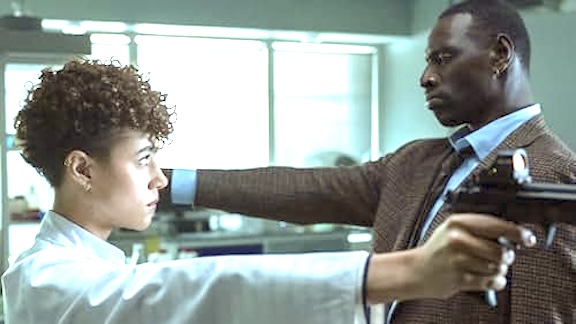
Nathalie Emmanuel, Omar Sy
“THE KILLER” My rating: C (Peacock)
126 minutes | MPAA rating: R
John Woo’s “The Killer” feels uncomfortably like a parody of a John Woo movie.
All the trademarks of the Woo style are there, but they feel forced and phony. Even kinda silly.
The original “Killer” from 1989 was something of a cultural landmark, introducing a whole new audience to Hong Kong cinema, making an international star of leading man Chow Yun-Fat, and establishing Woo’s poetic/visceral approach to onscreen action.
So, why a remake?
The big selling point, apparently, was switching the sex of the titular killer, a paid assassin having misgivings about career choices.
This killer, Zee, is played by Nathalie Emmanuel (“Game of Thrones”), an attractive young actress but not a typical movie glamorpuss…she’s able to get lost in the many disguises and alternate personas her character employs to go about her bloody work. She’s less compelling when wallowing in the off-duty angst that afflicts her character.
Zee has a handler (Sam Worthington) who years earlier rescued her from the streets and trained her in the art of assassination; he’s a father figure, but also kinda creepy.
Also a father figure but much more simpatico is a tailor (Tcheky Karyo) in whose shop our heroine finds respite from the pressures of the job.
The screenplay (by Woo, Brian Helgeland and Josh Campbell) roughly follows that of the original film, though this time around the setting is Paris (if nothing else, you can occupy yourself identifying the famous locations).
From the outset we know that Zee is having second thoughts about her job. She spends a lot of time in a deconsecrated church replete with dripping water and fluttering doves (throughout his career Woo has been obsessed with churches and doves); she regularly lights candles for her victims.
And as in the original our killer goes soft for a young woman (Diana Silvers) unintentionally blinded during one of Zee’s killing sprees. This puts her on a collision course with her shady employers, who view the now-sightless girl as a potential witness and want her dead.
(You might view this as a setup for a same-sex relationship, which would indeed be a novel twist in the Woo canon. But, no, Zee is asexual, her wardrobe of to-die-for outfits notwithstanding.)
There’s a whole second plot about a French detective (“Lupin’s” Omar Cy) on the trail of a heroin syndicate; like Dirty Harry he’s always being accused by his timid supervisors of going too far. He starts out tracking down Zee , and ends up teaming with her.
Here’s the thing: “The Killer” is not only crammed with crime movie cliches, its tone is borderline operatic, as if big gestures could somehow compensate for the narrative overkill.
The action? Yeah, it’s typical Woo, highly choreographed and utterly implausible. Almost cartoonish.
| Robert W. Butler

 Butler's Cinema Scene