Angela Nikolau, Ivan Beerkus
“SKYWALKERS: A LOVE STORY” My rating: B (Netflix)
100 minutes | MPAA rating: R
If the usual horror movies no longer creep you out, spend some time with the young protagonists of “Skywalkers.” This doc will leave you sweating, swaying and palpitating.
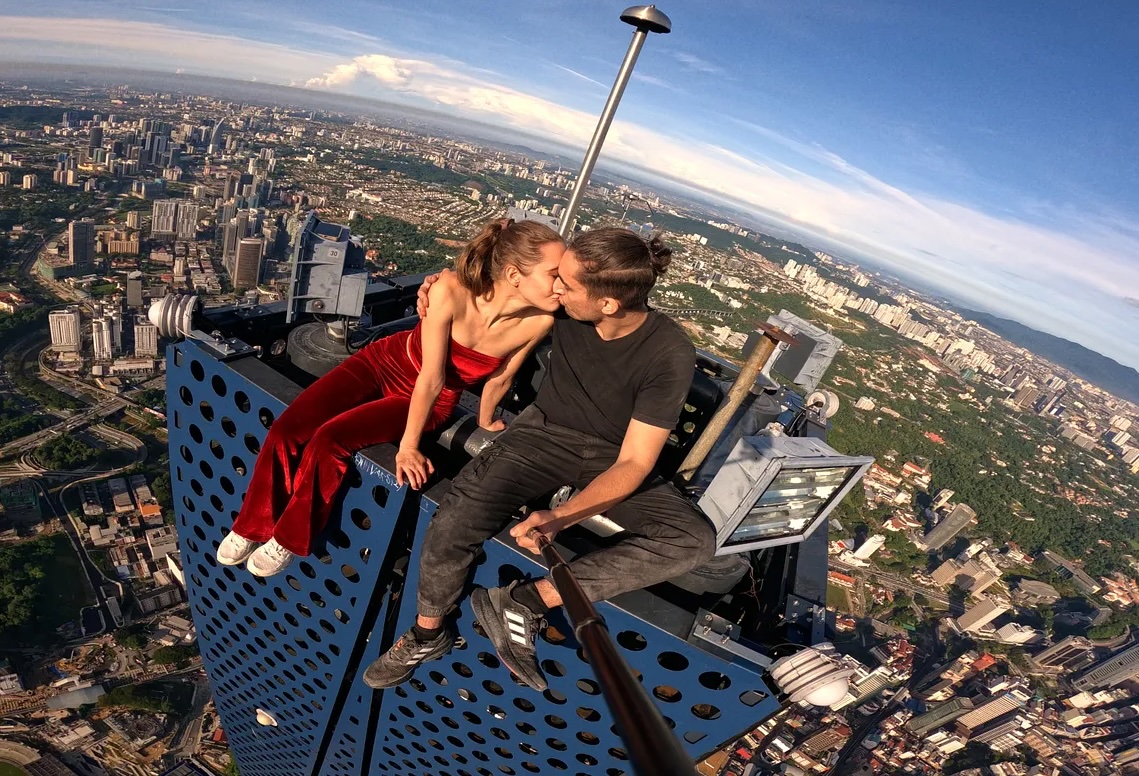
Angela Nikolau and Ivan Beerkus are Russian twenty somethings who practice extreme climbing, also known as rooftopping. They get their kicks — and earn a living — by sneaking (or breaking) into high-rise buildings, climbing to the very top floor and then shimmying up the narrow spires that point to the heavens.
The climb is only part of it. Once on top of the world Angela and Ivan take photos and videos that they sell worldwide through the Internet.
Often Ivan will lift Angela over his head in a death-defying pas de deus. She will change into fancy costumes and then pose on the precipice like a runway model with a death wish. They employ drones which often fly around the summit, inducing in viewers a massive case of vertigo.
It’s beautiful.
It’s terrifying.
Jeff Zimbalist’s documentary centers on the couple’s attempt to climb Kuala Lumpur’s Merdeka, at 118 stories the second tallest structure in the world.
The local authorities have already nabbed other climbers and sentenced them to long prison sentences. Angela and Ivan try to reduce the risks by doing all their planning in nearby Thailand and only going to Kuala Lumpur on the eve of their climb, scheduled to coincide with a big World Cup game which, hopefully, will keep construction workers and security guards looking at their TVs and not for intruders.
(Narratively, the film bears a close resemblance to “Man on Wire,” the Oscar-winning documentary about Philippe Petit’s 1974 tightrope walk between the World Trade Center towers.)
“Skywalkers” calls itself a love story, and it is that, too. Angela, who has the lithe figure and acrobatic instincts of a ballerina, comes from a broken family and discovers with Ivan not only personal romance but also an sense of accomplishment. They may be viewed as a troublesome Bonnie & Clyde by the authorities, but they see themselves as practitioners of a new art form.
The most riveting moments are provided by the footage the two climbers get from the Go-Pro cameras they carry with them. We feel like we’re on the climb with them. And the views are spectacular (they’re usually so far up there are clouds below them).
On the ground…well, I wonder if what we see there is genuine documentary footage or after-the-fact re-enactments. I say this because the interactions between the two lovers seem so carefully staged, the camera angles and editing so sophisticated, that I have a hard time accepting that this was fly-on-the-wall cinema verite footage. It looks too polished.
But there’s no doubt about the authenticity of the climbs themselves. They’re a visual assault that’ll leave you gasping for breath.

Jude Law, Alicia Vikander
“FIREBRAND” My rating: B (On demand)
221 minutes | MPAA rating: R
The makers of “Firebrand” want very much to examine a famous bit of Tudor history through a feminist perspective.
It’s a little ironic, then, that the overwhelming personality on display is that of good old Henry VIII, played so memorably by Jude Law that I wouldn’t be surprised to see him get an Oscar nod.
Directed by Karim Ainouz and scripted by Henrietta Ashworth, Jessica Ashworth and Elizabeth Fremantle, “Firebrand” centers on Katherine Parr, the last of Henry’s six wives.
Queen Katherine (a makeup-free Alicia Vikander) is, initially at least, so trusted by the King that he leaves her in charge of the country while he’s off battling Frenchmen.
But Katherine thinks for herself. She is particularly troubled by Henry’s Church of England which, after a few years of relatively liberalism (commissioning an English translation of the Bible so that the common citizen could read the Gospels). has now retreated into control-freak mode just as smothering as the now-outlawed Catholicism.
Early in the film Katherine sneaks off to visit her childhood friend Anne Askew (Erin Doherty), an intellectual, preacher and fugitive for her incendiary opposition to the English Church’s iron-fisted version of Protestantism.
That meeting will come back to haunt her when Katherine is accused of betraying her royal hubby. And we all know how Henry dealt with wives who didn’t please.
For a while it appears that “Firebrand” is going to get lost in the weeds of period politics and cultural minutiae. All that changes when Henry returns from France and Law takes over the proceedings.
Sexy Jude Law as bloated, bloviating Henry VIII? Doesn’t sound like that should work.
But with a prosthetic stomach and a bristly beard Law makes a seemingly effortless transformation. His Henry is suffering from a gangrenous leg that eventually will kill him, but not even pain and the prospect of death can curb his emotional sadism and casual brutality.
Moments of human frailty and emotional neediness are eclipsed by episodes of anger and physical violence. The guy may be king, but he’s a loathsome mess. And the most compelling thing in the film.
In its final stages “Firebrand” blows off actual history for a “what if” approach that will induce winces from dedicated Anglophiles but proves satisfying from a dramatic viewpoint. Hey, it’s only a movie.
| Robert W. Butler
 Butler's Cinema Scene