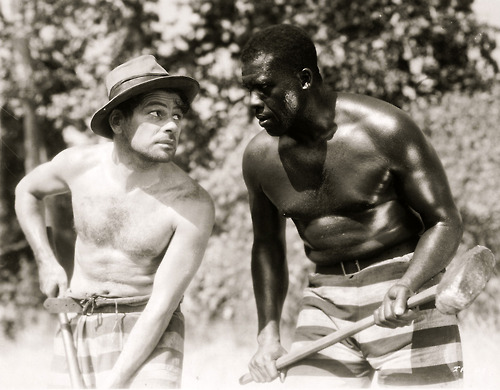
Paul Muni (left) in “I Am a Fugitive from a Chain Gang”
“I AM A FUGITIVE FROM A CHAIN GANG” screens at 1:30 p.m. Saturday, Dec. 14, at the Kansas City Central Library, 14 W. 10th St., as part of the film series Muni the Magnificent.
The old-time movie moguls weren’t interested in making art or changing minds.
“If you want to send a message,” M-G-M’s San Goldwyn is reported to have said, “use Western Union.”
But the Great Depression nevertheless found the big studios dabbling heavily in what we now call “social problem pictures.” These movies, while frequently very entertaining, also brought to the public’s attention flaws in the system. They exposed injustices, they picked at situations and policies detrimental to society.
Problem pictures could range from gangster dramas (purportedly intended to inform the public of the criminal scourge created by Prohibition, but popular for their violence and the outsized personalities of the characters) to prison films, stories of mob justice, and tales of poverty, unemployment, and police corruption.
Prostitution and “fallen women” were also dealt with … but that ended in 1934 when Hollywood began enforcing the Motion Picture Production Code, which among other things banned all mention of sex from the screen.
The greatest of all social problem pictures was Warner Bros.’ “I Am a Fugitive from a Chain Gang,” released in November, 1932.
 Butler's Cinema Scene