
Jeffrey Wright
“AMERICAN FICTION” My rating” B (In theaters)
117 minutes | MPAA rating: R
Cord Jefferson may have just made the season’s most impressive directing debut with “American Fiction,” a whip-smart dramady that savagely satirizes the racial assumptions that keep us apart while exploring the experiences that make us all the same.
When we first meet novelist/teacher Thelonious “Monk” Ellison (Jeffrey Wright) he’s conducting a lit class on Southern writers. A young woman (white) protests that any mention of the “n” word makes her so uncomfortable she cannot function.
Shoots back Monk (who is black): “I got over it. You can, too.”
For that justified but arrogant retort the curmudgeonly Monk finds himself on mandatory leave until things cool down.
Monk is that rarest of individuals, a race-blind American. A snob at heart, he’s most comfortable in an ivory tower; soon he’ll be straddling a cultural fence.
His prose style is polished and too academic for popular tastes. If Monk wants success, advises his sympathetic agent (John Ortiz), his writing needs to be “more black.”
Thing is, Monk is disgusted by the new black fiction. Particularly appalling is a reading by best-selling author Sintara Golden (Issa Rae), whose new novel We’s Lives in Da Ghetto he dismisses as a pandering amalgam of racial cliches.
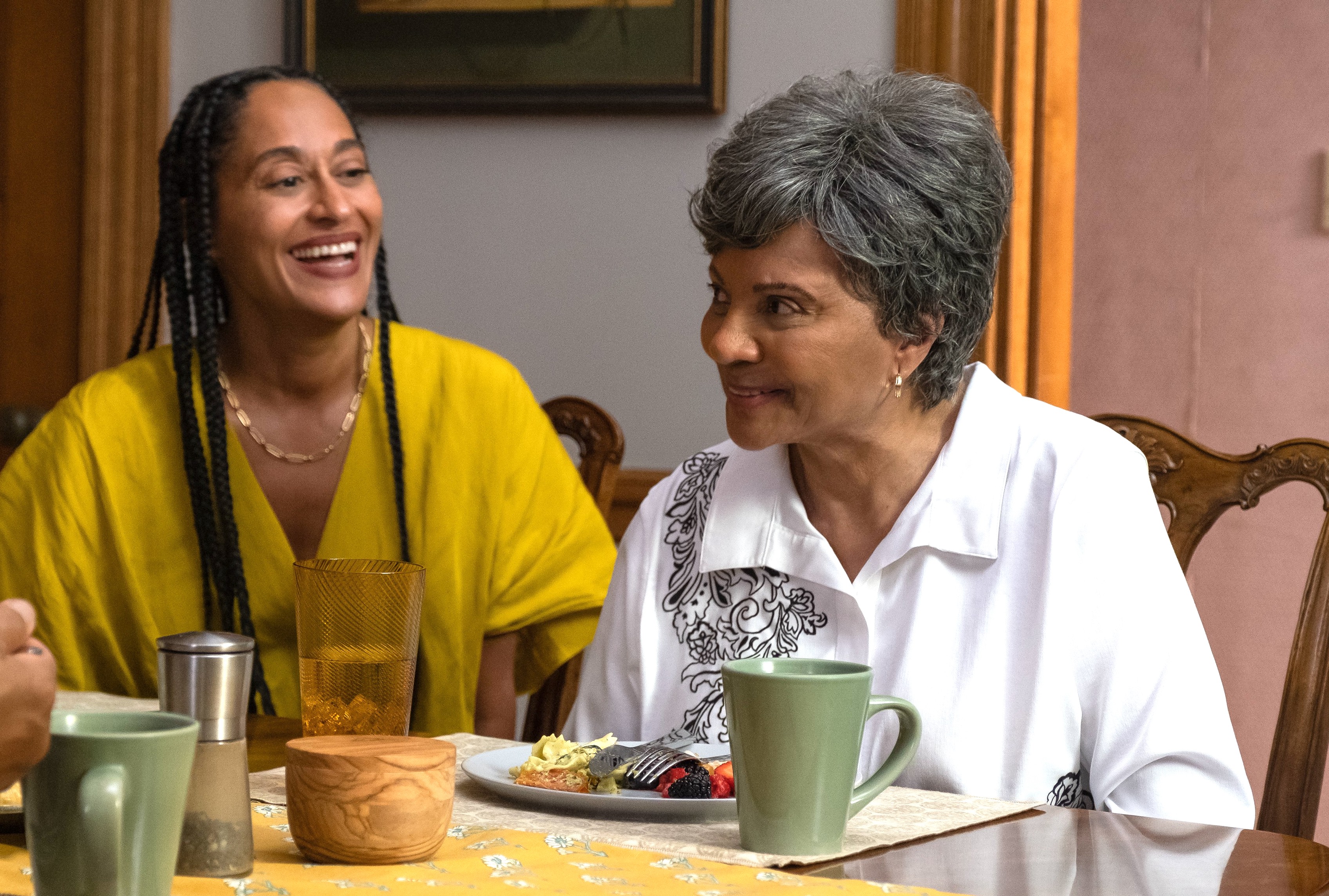
Traces Ellis Ross, Leslie Uggams
The clever conceit at the heart of Jefferson’s screenplay (co-written with Percival Everett) finds the frustrated Monk writing a deliberately bad novel about ‘hos and players under the nom de plume Stagg R. Leigh.
Thing is, his satire of terrible African American literature becomes the most popular thing he’s ever produced, with publishers and critics (all white) proclaiming it a modern masterpiece. This even after Monk, hoping to scuttle the project, insists that the title be changed to Fuck.
Desperately in need of the cash the book will generate but but determined to keep his academic reputation, Monk creates a life for the non-existence Stagg R. Leigh. The writer, he decides, is an ex-con currently on the run from the law (a fabrication that allows the “fugitive” to turn down all offers of in-person media interviews). That last invention may be one too many…to Monk’s dismay the FBI launches a national manhunt for the criminal turned celebrity.
The film’s bleakly funny passages set in the world of publishing (and, later, movies) are interspersed with more somber interactions between Monk and his long-estranged family. So there’s an effortless back-and-forth between dark humor and everyday trial and tribulations.
Monk’s sister (Tracee Ellis Ross) has long been taking care of their aged mother (Leslie Uggams) and now expects the essentially antisocial Monk to take over. Things are complicated by the fact that Momma is quickly sliding into dementia.
Their brother Cliff (Sterling K. Brown) is no help; he has recently left his wife and is devoting himself to exploring life as a gay man.
Monk finds himself in a romantic relationship with the nice lady who lives across the street from Mama’s (Erika Alexander) and is even sucked into participating in the late-in-life wedding of the family’s long-time cook and housekeeper (Myra Lucretia Taylor).
All of this slowly opens up Monk’s long-ignored humanity. Like it or not, circumstances may force him into becoming a good person. But he’s still too ashamed to let loved ones know that he’s Stagg R. Leigh.
“American Fiction” ends with one of the more mind-blowing tricks in recent cinema. Basically the filmmakers turn the movie into a choose-your-own adventure experience, offering three different resolutions to Monk’s story and allowing viewers to settle on the one that seems most appropriate.
It should come off as a gimmick, but instead it feels just right.
| Robert W. Butler


 Butler's Cinema Scene