Feeds:
Posts
Comments

Posts Tagged ‘Leonard Bernstein’

Bradley Cooper, Cary Mulligan

“MAESTRO” My rating: A (Netflix)

129 minutes | MPAA ratingL R

Here it is, folks.  The year’s best film.

From the very first frame of “Maestro” we know that we’re in good hands.

Some movies are like that.  They flow effortlessly, leading us into their visual and aural landscape. They know what they’re about. They have their own personalities.

Bradley Cooper’s film (he directed, co-wrote and stars in it) centers on the relationship of real-life composer/conductor Leonard Bernstein and his actress wife, Felicia Montealegre.

It was not your conventional marriage.  Lenny (Cooper) was unapologetically bisexual. Five minutes into the film we see him waking up in bed with another man. At one point he addresses the new baby of friends, asking “Do you know that I slept with both your parents?”

But Felicia (Carey Mulligan), exhibiting a way-ahead-of-the-curve tolerance, buys into their partnership knowing the score. In her book, love is tolerant to a fault.

Here’s what I relish about “Maestro”: You can feel yourself falling in love as these two characters do.  Their repartee is amusing, seductive, astonishingly honest. You want to be part of it.

And like Lenny and Felicia we’re so smitten that we don’t think about how difficult it will be to maintain a mutually satisfying equilibrium.

The acting?  Holy crap it’s good.

Bradley Cooper

Cooper, with a bit of help from a prostethic nose, absolutely nails the Leonard Bernstein we recall.  He’s got the vocal patterns perfect, and on the podium he exhibits the intense joy and bodily enthusiasm that made him the most identifiable conductor in the world.

But he’s just as effective as the private Lenny, a man who was about as matter-of-fact when it comes to sex as is humanly possible. The problem, of course, is that few of us are so hangup free.

Mulligan’s Felicia is his perfect match. She is utterly supportive of her husband and children, but as time goes on Lenny’s escapades start to wear. Mulligan has a few moments of transcendent fury.

Expect Oscar nominations for both.

For that matter, comedian Sarah Silverman is astonishingly good in the straight role of Bernstein’s sister. 

Covering nearly 50 years of modern American cultural history, “Maestro” draws its musical score mostly from Bernstein’s compositions: “West Side Story,” “On the Waterfront,” “Candida,””Fancy Free,” not to mention samplings of various orchestral and choral works.

Yet it never becomes a “and-then-I-wrote…” musical biopic.

Lenny’s career is always there in the background, but its his relationship with Felicia (and later with his daughter Jamie, played by Maya Hawke) that provides the narrative and emotional spine.

Most of the film has been shot in gloriously rich black and white (Matthew Labatique is the cinematographer), with every frame meticulously composed for maximum effect. (Cooper reportedly has been working on the project for a decade; he has left little to chance, yet “Maestro” feels fresh and spontaneous.)

There are moments here that can leave a viewer in tears, both for our beautiful possibilities and for our inevitable shortcomings. In giving us the story of a great artist and his loved ones Bradley Cooper has tapped into the transcendent.

Can this really be only his second feature as director?  There’s a sort of Orson-Welles-makes-“Citizen Kane” wonder and audacity at work here.

Let’s just give him an armload of Oscars and be done with it.

| Robert W. Butler
Read Full Post »

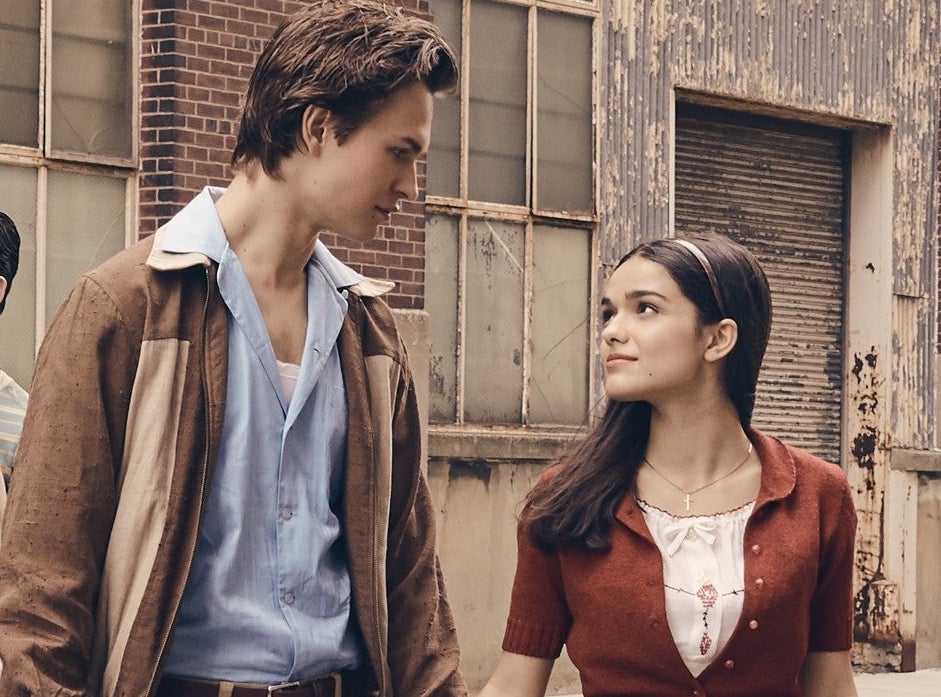
Ansel Elgort as Tony, Rachel Zegler as Maria

“WEST SIDE STORY”  My rating: B (In theaters)

156 minutes | MPAA rating: PG-13

There’s really no point in remaking “West Side Story” if you’re only going to recreate the 1961 version. Which was, after all, pretty damn definitive.

And so Steven Spielberg’s  daring re-imagining of this classic — my favorite piece of musical theater, rivaled only by Stephen Sondheim’s “Sweeney Todd” — consistently takes its audience by surprise. You may think you know the show inside out; just wait until the master filmmaker  lays a modern sensibility over the story’s late ‘50s ambience.

In this “WSS” the Puerto Rican characters deliver many of their lines in Spanish without subtitles (not that you’ll need them…you can tell by the performances what’s going on).

Moreover, where appropriate the film has been cast with Latinx performers…no lily white actors trying to pass for ethnics.

Spielberg and writer Tony Kushner, adapting the Arthur Laurents/Ernest Lehman script, have shaken things up, shifting the order of the musical numbers and in some cases giving songs to characters who didn’t sing them in the original.

Of course the dancing (not pure Jerome Robbins but close enough to generate goosebumps), the memorable Leonard Bernstein melodies and those brilliant orchestrations (jazz meets mainstream) remain potent enough to generate tears of aesthetic gratitude.

And the core story of star-crossed lovers seeking fulfillment in a world of hatred and strife is as strong as ever (hey, it’s Shakespeare’s “Romeo and Juliet”…borrow from the best.)

But perhaps the filmmakers’ biggest reach is to pump up the material’s psychological and social realism to a near breaking point. It is for this effort that Spielberg’s film has been generating off-the-charts praise — and yet I’ve got to admit to a lot of ambivalence.

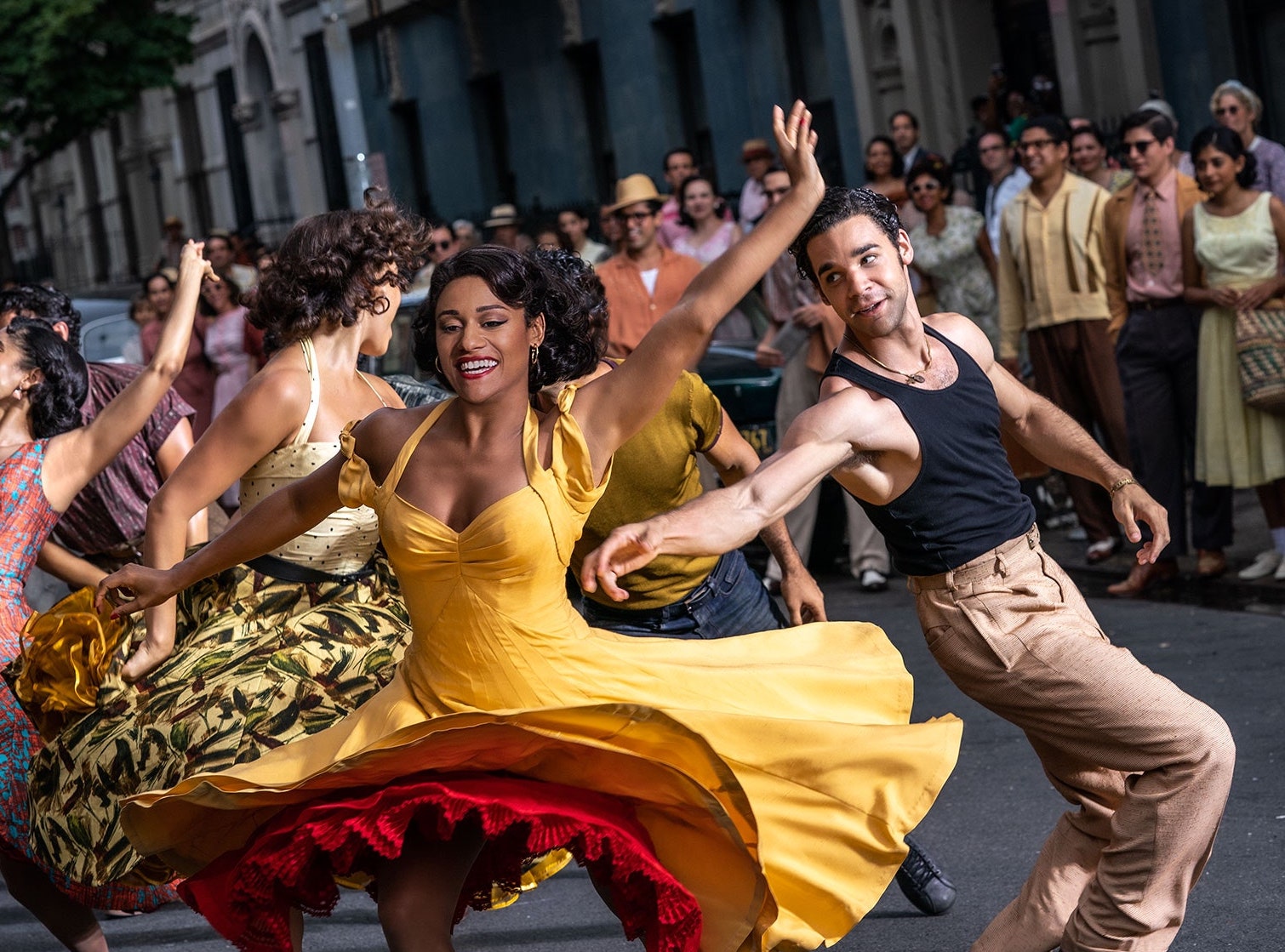
Ariana DeBose (in yellow) as Anita, David Alvarez as Bernardo

We understand that the film is taking on some big ideas from the first shot, a flyover of a Manhattan neighborhood falling under the wrecking ball. The few tenement walls still standing are surrounded by piles of rubble and abandoned bathtubs. A billboard announces that this will be the future home of Lincoln Center. 

Of course, when the livable turf is reduced, the remaining inhabitants must duke it out for possession of what’s left.

“West Side Story” has always had an undercurrent of social commentary (just listen to Sondheim’s caustic lyrics for “America”) and an aura of liberal awareness. But this new version brings those concerns front and center, then hammers away at them.

In this retelling Riff (Mike Faist) and his Jets view themselves as the last white men standing against a brown tidal wave. The cynical police detective Schrank (Corey Stoll) taunts the Jets as “the last of the can’t-make-it Caucasians,” in effect goading them into continual warfare with the just-off-the-boat Puerto Ricans.

That the Jets are nativists has always been an element of “West Side Story,” but never before has that idea been banged on so relentlessly.  No one in the film utters the words “Proud Boys,” but you’d have to have spent the last few years in a cave not to see the racial signifiers.

Simultaneously the film paints a vibrant picture of Latin culture, depicting a neighborhood where huge Puerto Rican flags are painted on walls and the locals can effortlessly turn a block of storefronts into a bubbling ethnic festival. (Indeed, the show-stopping “America” is here performed not at night on a rooftop but in bright sunshine on a busy city street.)

“I Feel Pretty,” a song that has always seemed vaguely out of place, gets a major transformation. Instead of being performed by Maria (Rachel Zegler), Anita (Ariana DeBose) and friends in a modest dress shop, the number unfolds after hours in the department store where the immigrant women fill the ranks of the cleaning crew.  They deliver the lyrics while surrounded by mannikins posed in vignettes drawn from majority white culture…what up to now has been a hummable but thematically thin song suddenly is crawling with wry political/social commentary.

Kushner’s script also pumps up what we know about the characters.  Thus we learn that our Romeo stand-in, Tony (Ansel Elgort), is on parole after spending a couple of years in prison for nearly killing another young man in a brawl. Once one of the Jets’ fiercest fighters, he’s now steering clear of conflict.

Anybody’s, the girl who desperately wants to be one of the Jets, is usually portrayed as a tomboy.  Here, though, she is played by non-binary actor Iris Menas, bringing a whole new level of sexual politics and sexual ambiguity into the mix.

Characters that were basically placeholders in earlier incarnations get a major reworking.

Officer Krupke (Brian d’Arcy James), usually depicted as  a hapless flatfoot, comes off as a decent if weary bloke who’d like to see everybody get along.

Perhaps the biggest character expansion falls to Chino (Josh Andres Rivera), Maria’s gang-approved suitor, who is anything but a thug…he’s going to night school and wants to become a CPA. This bespectacled brainiac is the hope of his community, so much so that Bernardo (David Alvarez) and the Sharks work to keep him out of their conflict with the Jets.

But all that is merely a prelude to the big whopper, the casting of Rita Moreno (she won an Oscar for her portrayal of Anita in the 1961 film) as the widow of Doc, operator of the local pharmacy/candy store.  

Doc, inspired by “Romeo and Juliet’s” Friar Lawrence, never had much of a presence in earlier “WSS” incarnations.  But Moreno emerges as a major character, Tony’s employer and moral backup; she even gets to sing the haunting “Somewhere,” a number traditionally performed by Tony and Maria.

Here’s the thing…all these augmentations and observations had the effect of taking me out of the central romance.

Oh, there were some terrifically romantic moments. Tony and Maria’s meeting at the community dance here unfolds beneath the bleachers, a very nice touch.  And songs like “Maria” and “Tonight” absolutely nail the swooning universal yearning for a love capable of changing the world.

But at a certain point I found the ever-thickening patina of commentary got in the way. A marvel of traditional musical theater is the way in which one-dimensional characters expand through song, finding their true humanity through the synthesis of melody and lyric.

This “West Side Story” gave me so much information, so much detail that I felt I was being force fed rather than discovering.

It’s at moments like this when your faithful critic wonders if I have at long last reached the ranks of grumpy old men.

| Robert W. Butler

Read Full Post »