Feeds:
Posts
Comments

Posts Tagged ‘Lily Gladstone’

“REMEMBERING GENE WILDER” My rating: B+ (Netflix)
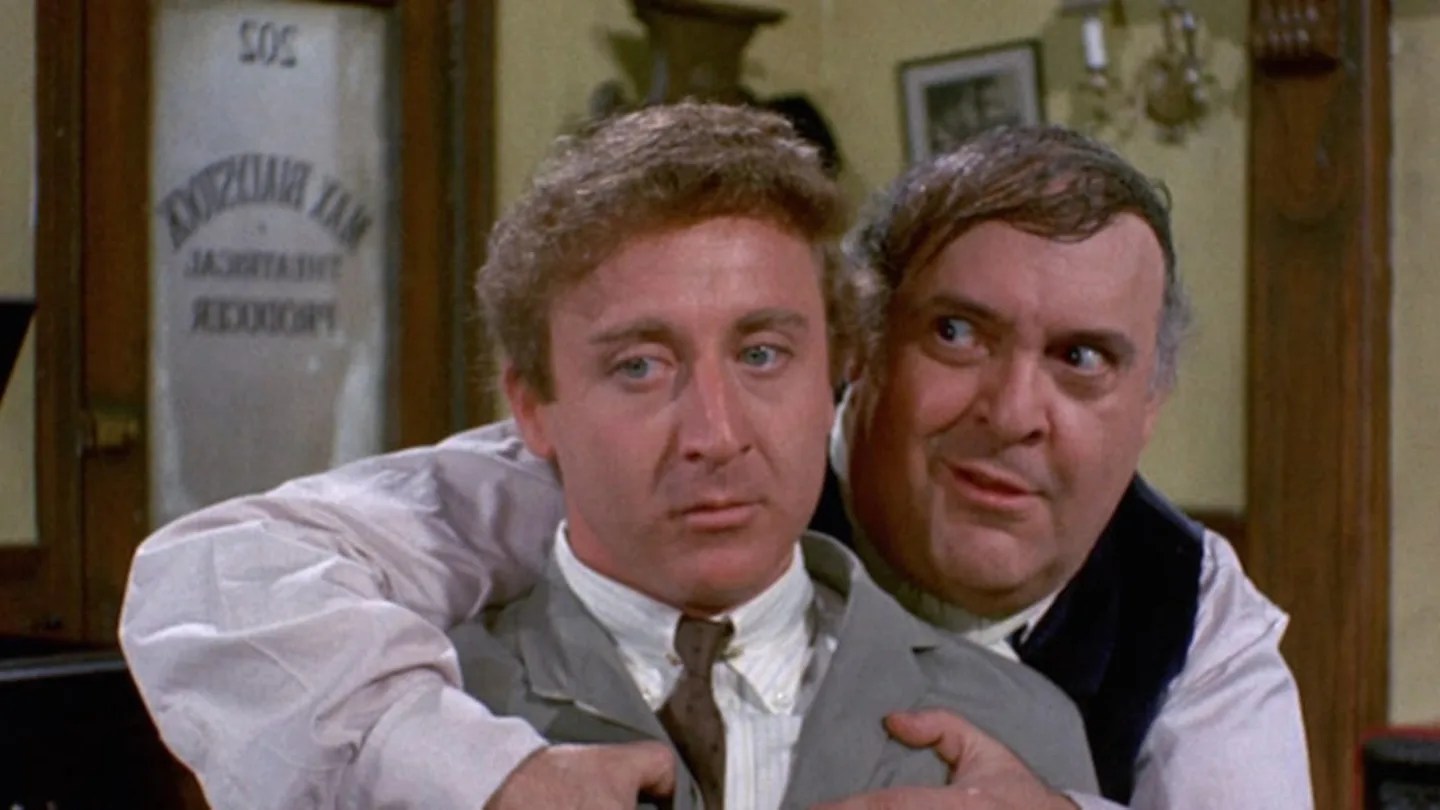
Gene Wilder and Zero Mostel in “The Producers”

“REMEMBERING GENE WILDER” My rating: B+ (Netflix)

92 minutes | No MPAA rating

I’d almost forgotten what a wonderful performer Gene Wilder was.

But then I caught Ron Frank’s documentary “Remembering Gene Wilder” and it all came rushing back.

The film makes the case that Wilder was a comic genius…and given that he was the instigator of “Young Frankenstein” and wrote the original screenplay, you won’t hear me arguing.

But there’s so much more, from his first high-visibility gig as a kidnapped bank employee in “Bonnie and Clyde,” to his landmark work with Mel Brooks (“The Producers,” “Blazing Saddles,” “Young Frankenstein”), his comic collaborations with Richard Pryor and especially his turn as the star of “Willy Wonka & the Chocolate Factory.”

He appears to have been a very nice man, an impression reinforced by his two marriages (the first to Gilda Radner, who died from cancer).

Plenty of colleagues and friends show up to share memories — Brooks, Alan Alda, Harry Connick Jr., Carol Kane, Eric McCormick — but the backbone of the piece are the clips from Wilder’s films. They’re so good you end up making a list of the man’s features that need to be revisited.

Isabel Deroy-Olson, Lily Gladstone

“FANCY DANCE” My rating: C+ (Apple+)

90 minutes } MPAA rating: R

Perhaps seven or eight years ago — pre-“Reservation Dogs” — Erica Tremblay’s “Fancy Dance” might have seemed like a revelation.

Now it carries a whiff of been-there-done-that, an aroma not dispelled even by Lily Gladstone’s slow-burning lead performance.

Filmed mostly on Indian land in Oklahoma, the film centers on Jax (Gladstone), who has become the caregiver for teenaged Roki (Isabel Deroy-Olson), her niece. Loki’s mom vanished a couple of weeks earlier.

Jax suspects foul play, but the indifferent authorities are dragging their feet; meanwhile she tries to keep Roki’s hopes up that the girl’s mom will appear in time for the mother/daughter dance at the upcoming tribal powwow.

For much of its running time “Fancy Dance” is a study of poverty and dead ends. Jax has a long history of trouble with the law and she’s already got Roki boosting needed food and other items from local merchants.

Need a ride? Steal a car. Pretty simple.

Things come to a head when the child welfare people move to place Roki in foster care. An outraged Jax snatches the girl and together they go on the run.

As a snapshot of reservation life, “Fancy Dance” seems accurate if not exactly revelatory. Similarly, the theme of missing indigenous women isn’t exactly fresh, having been tackled in the most recent season of “True Detective” and in the striking feature “Catch the Fair One.”

Still, you’ve got Gladstone, hot off her triumph in “Killers of the Flower Moon” and possessor of the saddest pair of eyes in current cinema. Even when the film loses momentum, her presence keeps us watching.

Mads Mikkelson

“THE PROMISED LAND”  My rating: B (Hulu)

127 minutes | MPAA rating: R

The difference between actor and movie star is nicely delineated  in the career of Mads Mikkelson, who appears to care not a whit about his image while always on the lookout for  unexpected characters.

Viking berserker. Alcoholic high school teacher.  James Bond villain. Drug pusher.

The guy doesn’t care if we like his characters. In fact, I often think he goes out of his way to glom onto the off-putting.

In the period piece “The Promised Land” Mikkelsen plays a highly fictionalized version of the real-life Ludvig Kahlen,  who after 25 years as a soldier (rising from private to captain) retires to his native Denmark with a crazy dream of turning the barren Jutland heath into a paradise.

Kahlen is not a warm, fuzzy guy.  He’s humorless. Stiff.  Ill at ease in social situations. And so invested in the idea of achieving legitimacy through an agricultural miracle that he has no time for anything that might get in his way…especially other people.

Written and directed by Nikolaj Arcel, “The Promised Land”  melds several genres to satisfying effect.

There’s the whole man-against-nature thing, with Kahlen battling the elements to survive brutal winters, improve the nutrient-poor soil and bring in a crop of potatoes, a vegetable at the time (mid-1700s) unknown to the Danes but capable of growing just about anywhere.

Even more daunting is the opposition of local landowner Frederik De Schinkel (Simon Bennebjerg),  the Danish equivalent of a Deep South plantation owner who rapes, beats and even kills the peasants under his thumb. (He’s a hateful prick…the model might very well have been Tim Roth’s arrogant sadist from “Rob Roy.”) De Schinkel is not thrilled with the idea of this plebeian newcomer improving the “unimprovable” land under his very nose, going so far as to form a marauding hit squad of murderers plucked from prison.

Finally there’s the human side of the equation. Despite his loner personality, Kahlen slowly finds himself part of a makeshift family along with a housemaid who has fled De Schinkel’s predatory grasp (Amanda Collin) and an orphaned child (Melina Hagberg) reared by forest-dwelling bandits.  

So what’s it going to be…stick with his master plan or succumb to the temptations of human interaction?

Terrific cinematography (Rasmus Videbaek) and utterly convincing production design (Jette Lehmann) mark this intimate epic, which ends on a much more positive note than the one experienced by the real-life Kahlen…but then, that’s why we go to the movies.

| Robert W. Butler

Read Full Post »

Lily Gladstone, Leonardo DiCaprio

“KILLERS OF THE FLOWER MOON” My rating: B (In theaters)

306 minutes | MPAA rating: R

More than any film I’ve seen in a decade, Martin Scorsese’s “Killer of the Flower Moon” has left me at a loss for words.

Sometimes that’s a good thing, suggesting a cinematic experience so overwhelming that it defies easy summation.

In this case it means I left the film with mixed reactions. It’s taken days to sort them out and I’m still struggling to come to a neatly encapsulated conclusion.

The setup:

“Killers…” is a lightly fictionalized version of David Grann’s superb nonfiction study of the notorious Osage murders of the 1920s.  With the discovery of oil in Oklahoma, members of the Osage tribe who had been settled on this presumably worthless land became overnight millionaires.  

This made them targets for predatory whites who often married Osage women.  Frequently those women— and other members of their clans — died under mysterious or outright murderous circumstances, with the oil rights reverting to their white husbands.  It took a major investigation by the fledgling FBI to uncover a cabal of conspirators behind the murders of at least 30 tribal members.

Scorsese’s film (co-written with Eric Roth) is noteworthy in that it isn’t really about solving a crime (the first federal agent doesn’t show up until more than two hours into the 3 1/2-hour film, and the audience knows who the bad guys are almost from the get-go).  Its focus is split between one particular marriage. and a study of unapologetic corruption.

After serving in the Great War Ernest Burkhart (Leonardo DiCaprio) arrives in Oklahoma to work for his uncle, William Hale (Robert De Niro), the most powerful white man living in the Osage Nation.


Robert DeNiro, Leonardo DiCaprio

Hale is a mover and shaker who has been among the Osage for so long he speaks their language fluently.  He advises tribal leaders and maintains that the Osage are the finest people on the planet. But beneath his benevolent paternalism there’s sinister intent.

At his uncle’s urging, the slow-witted and morally anchorless Ernest marries Mollie (Lily Gladstone), an Osage woman who, for all of her family’s wealth, is a nurturing, down-to-earth individual.  They start a family.

But little by little Ernest is drawn into his uncle’s manipulative world. Early on he participates in the armed robbery of a wealthy Indian couple; before long he’s a middleman setting up the assassinations of individuals fingered by Hale. Among the targets are his own in-laws.

The yarn is thick with moral ambiguity. For even as he does his uncle’s murderous bidding, Ernest remains desperately in love with his wife. At some point he’s going to have to choose between love and his white family.

The film’s recreation of life in Oklahoma during this period is astonishingly authentic.  Tribal customs, language and attitudes have been scrupulously researched and depicted.  Some of the long shots of oil derricks and oil pools pocking the landscape are epic (Rodrigo Prieto is the cinematographer).  Costuming and set decoration are impeccable.  The late Robbie Robertson has created a haunting minimalist musical score heavy on native drums rhythmically thudding like a heartbeat.

My hangup is the film’s emotional neutrality.  I get it, intellectually.  But I felt more an observer than a participant.

Possibly it’s best to see the film without having read the book.  That way the perfidy of the “killers” comes as a shocking revelation with attendant moral revulsion. Maybe I knew too much going into the experience.

More problematic is the focus on Ernest, a stupid, easily manipulated oaf. As played by DeCaprio he is resoundingly unempathetic, a spineless sort whose only redeeming quality is that he grows to love his wife despite his many sins against her family. (I can’t recall another major actor so willing to alienate his character from the audience, so there’s that.)

Were “Killers…” only, say, two hours long, Scorsese’s sheer filmmaking bravado might well compensate for our having to spend so much time with this thick hick. But the film’s butt-numbing length stretches matters out while diluting the dramatic impact — the movie’s trailers are more effective in this regard than the film itself.

Scorsese and Roth find some grim humor in the killers’ desperate machinations as the net closes on them (Jesse Plemons portrays the main Fed doggedly digging into the murders), but the film is largely humorless.

The saving grace in all this is Gladstone, a Native American actress whose most compelling previous performance was in Kelly Reichardt’s “Certain Woman” from 2016. Her Mollie becomes the moral/emotional center of the film, a woman radiating empathy, quiet dignity, intelligence and a sort of stoic resignation as life piles on one tragedy after another. It’s damn near impossible to explain what she does here…it’s a kind of soulfulness rarely seem on the screen.

At the other end of the spectrum is DeNiro’s William Hale, a villain with a breathtaking ability to compartmentalize the conflicting aspects of his life.  In public he’s everybody’s uncle and friend; behind closed doors Hale becomes an amoral master manipulator with an unquenchable thirst for wealth and power. Anyone smarter than the thick-headed Ernest would recognize his pervasive malevolence right off the bat.

Advance word on “Killers of the Flower Moon” has the film pegged as a masterpiece, perhaps the highlight of Scorsese’s illustrious career.

Well, it’s good. It’s got its moments.  But in my opinion not enough to fill 3 1/2 hours.

| Robert W. Butler

Read Full Post »