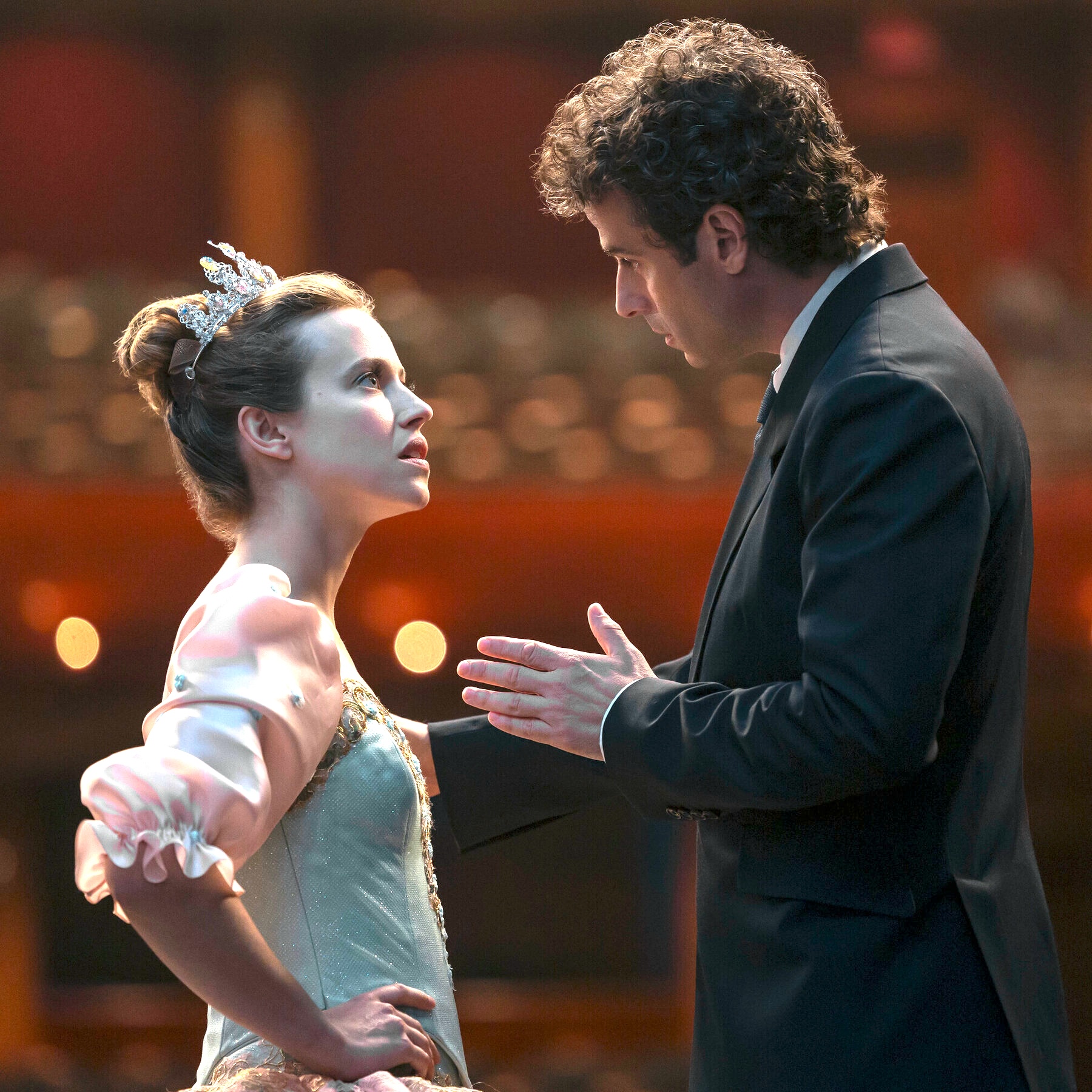
Lou de Laâge, Luke Kirby
“ÉTOILE” (Amazon Prime)
Given that the hardasses at Amazon have already cancelled “Étoile,” one might question whether it’s worth investing time in a show for which there will apparently be but one season.
Well, yeah.
Let me put it this way…if you got off on the cultured people doing below-the-belt things in “Mozart in the Jungle” (a series about the backstage goings-on at a big-city symphony orchestra), you’re a perfect candidate for this show set in the rarified world of ballet.
The show was created by Daniel Palladino and Amy Sherman-Palladino, the big brains behind “The Marvelous Mrs. Maisel,” and like that long-running series “Étoile” (French for “star”) is a potent mix of comedy and social observation.
And there’s an astonishing cast. More on that in a sec.
The premise is that to battle a post-COVID downturn in attendance, ballet companies in NYC and Paris hold a cultural exchange, sending key players across the Big Pond in the hope that fresh blood will revive public interest in dance.
Running the two companies are Jack McMillan (Luke Kirby, so terrific as Lenny Bruce in “Maisel”) and Charlotte Gainsbourg.
Both are fine actors, and Gainsbourg brings with her a rep as the most desired French actress since Bardot. She’s not a conventional beauty and almost never plays a seductress, yet I personally know several middle-aged men who think she’s sex on wheels. That audience base in itself should have been enough to keep the show around for a second season.
Stealing his every scene is Simon Callow as Crispin Shamblee, the ruthless mogul (we’re talking international arms dealing and heavily polluting industries) who uses his millions to rescue the two dance companies but in return demands a big say in their artistic and day-to-day decisions. He’s hateful in a Koch-ish way, but so puckishly erudite the screen lights up every time he’s on.
Tobias Bell is a font of insecurity and arrogance as the American choreographer shipped to France for the season; David Haig is loveably amusing as the New York company’s artistic director, nearing retirement and overflowing with sex-and-drug anecdotes from his dance career.
The breakout star, though, is Lou de Laâge as Cheyenne, the French prima ballerina who come to NYC with a chip on her shoulder and a bad attitude that could singe your bangs. When we first see Cheyenne she’s on a Greenpeace ship confronting a fishing fleet…think Greta Thunberg on speed.
In my book the surly Cheyenne is one of the season’s great characters. And the fact that de Laâge also appears to be a first-class dancer only seals the deal.
For that matter, all of the actors playing dancers seem to actually know their stuff. I kept looking for evidence of post-production sweetening in the big production numbers, but couldn’t find any. This appears to be the real thing — good actors who are also terrific ballet dancers.

Conleth Hill
“SUSPECT: THE SHOOTING OF JEAN CHARLES de MENEZES” (Hulu)
In 2005 the London transportation system was racked by a series of terrorist bombings that brought the metropolis to a standstill.
This four-part Brit docudrama divides its time between the Jihadist perpetrators and the authorities engaged in a nationwide manhunt.
But as the show’s title suggests, there was collateral damage. A Brazilian worker named Jean Charles de Menezes was misidentified as a possible suspect and murdered by trigger-happy police as he innocently rode a subway. This was followed by a massive coverup as the police tried to minimize their culpability in his death.
British viewers are no doubt already familiar with the incident, which may account for the satiric edge creators Kwadjo Dana and Jeff Pope give to the proceedings.
At least some of that attitude is warranted. After a successful subway attack a second wave of suicide bombers were dispatched, but their homemade bombs were duds, succeeding mostly in scaring commuters and burning the would-be martyrs who triggered them. It was a sort of black comedy of incompetence and “Suspect” plays it that way.
But the real knives are sharpened for Sir Ian Blair, the head of the Metropolitcan Police and portrayed by Conleth Hill as the worst sort of pompous autocrat, always ready to burnish his resume or cover his ass.
Hill already had strong credentials in unctuousness thanks to his turn as the conniving eunuch Lord Varys in “Game of Thrones.”
But here he ups the ante, delivering a dissection upper class arsery so shamelessly self-serving that I found myself roaring with laughter.
Which is not what you expect from a show about real-life terrorism, but there you have it.
Actually, “Suspect” is the perfect title. It’s not only about suspected perpetrators. It’s also about officials whose motives are suspect.
| Robert W. Butler

 Butler's Cinema Scene