
Emma Corrin
“A MURDER AT THE END OF THE WORLD” (Apple+)
It starts out with such promise that the last episode was almost bound to be a letdown.
Yet there are moments in Zal Batmanglij and Brit Marling’s “A Murder at the End of the World” that have struck with me for weeks.
Young true-crime writer Darby (Emma Corrin) is one of a dozen international movers and shakers invited by an eccentric tech billionaire (Clive Owen) to spend a long weekend at his latest brainstorm, a luxury hotel in the snowy wastes of Iceland.
Among the guests is Darby’s old flame, the graffiti artist Bill (Harris Dickinson). A decade earlier Darby and Bill were young lovers working to identify a serial killer who had left a trail of dead women across the Southwest…their adventure became the basis for Darby’s first best-selling book.
As the title implies, one of the guests is murdered. There’s a blizzard which keeps the local authorities from reaching the scene. Another guest dies mysteriously. Then another.
The setup is basically post-modern Agatha Christie. With the exception of Darby, everyone’s a suspect (at least until they’re killed).
But the mystery aspect of “A Murder…” is far less interesting than the extended flashbacks of a young Darby and Bill cruising around in an old car trying to identify a killer who has eluded capture for years. There’s a lovers-on-the-run sadness and fatality percolating through their relationship; it’s both tender and troubling. Not to mention an undercurrent of dread.
Holding it all together is Corrin, much praised for her work as the young Princess Diana on Netflix’s “The Crown.” Her Darby is the daughter of a rural county coroner much more at home at an autopsy than a pajama party. She’s intellectually strong, but there’s an intriguing fragility to her physical and emotional selves. It’s a haunting performance.
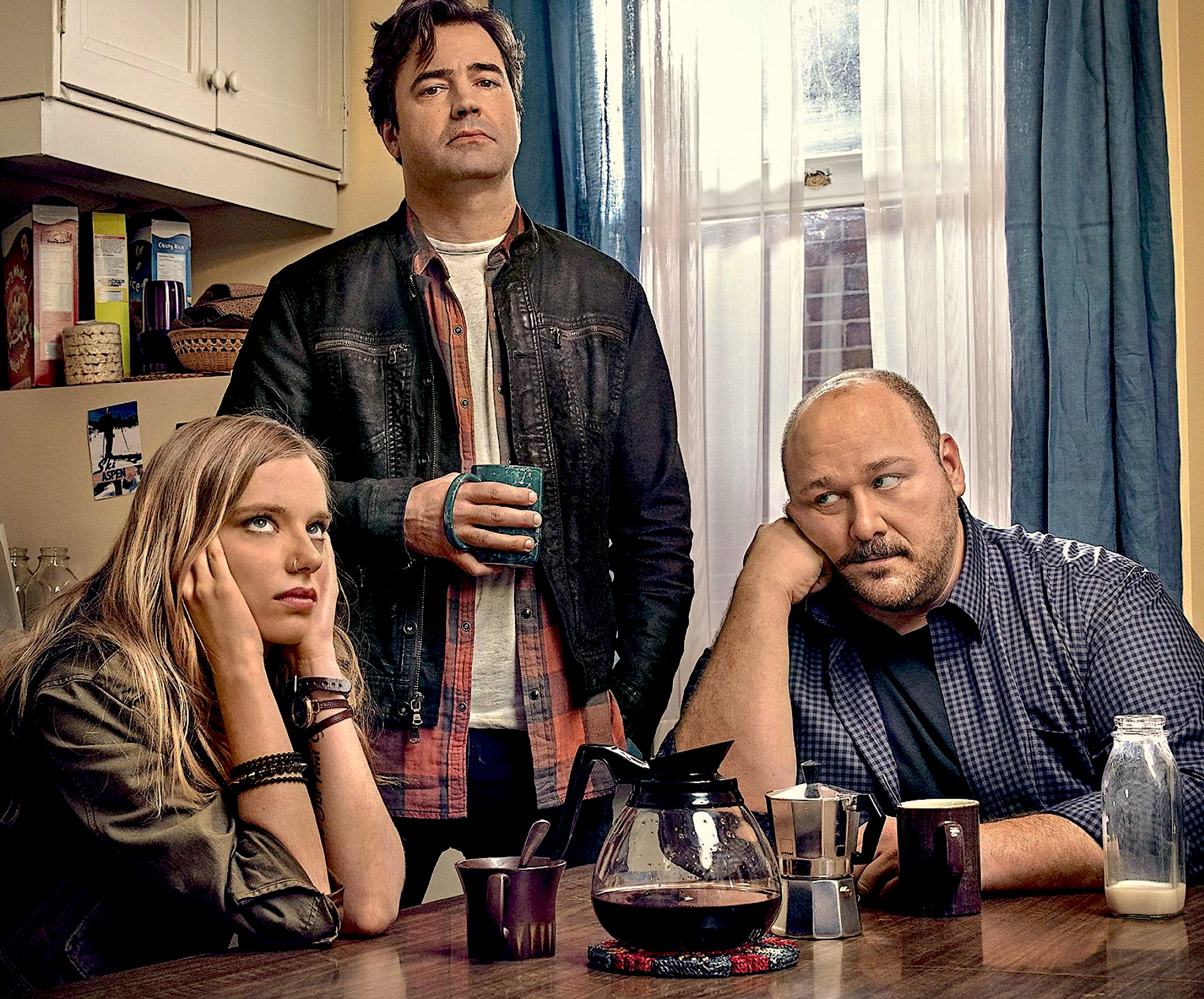
“LOUDERMILK” (Netflix): Addiction has long been the stuff of lacerating drama. But comedy?
Without having any info to back up my suspicions, I’m going to declare that “Loudermilk” could only have been made by people intimately familiar with addiction and recovery.
It’s as if the show’s creators (Peter Farrelly and Bobby Mort) jotted down every outlandish story ever shared in AA meeting and built a subversive comedy around them. It’s authentic. It’s weirdly touching.
And it’s funny as hell.
Ron Livingston gets what may be his finest role since “Office Space” as Sam Loudermilk, a fairly miserable example of humanity who runs an AA meeting in a Seattle church.
Sam is dour and cynical. A former rock critic who only listens to vinyl, he’s contemptuous of just about everyone else’s taste in music. He refuses work that requires a degree of responsibility (mostly he polishes the floors at a downtown bank). He loves picking fights, whether it’s with a lady in line at the coffee shop or the priest who gives Sam’s motley collection of alkies a place to gather.
Beneath the bitterness, though, he’s genuinely concerned about keeping his charges on the straight and narrow. It’s just that sometimes it’s hard to tell.
“Loudermilk” is on one hand a sort of pervy family sitcom. Sam shares an apartment with two other recovering addicts, his sponsor Ben (Will Sasso), who is secretly back on the sauce, and the twenty something Claire (Anja Savcic), who exudes millennial irony for the two old creeps with whom she is housed.
Over the course of three seasons other members of the AA group come to the fore. Usually these digressions are insightful and amusing. An exception is a long-running subplot about a glowering ex-cop who declares himself the tough-love sponsor of an ineffectual advertising copy writer; thing is, the writer isn’t an addict at all. No matter. Now he’s got this big thug watching his every move. Don’t be surprises when in the middle of their story arc these two characters vanish without comment.
For the most part, though, “Loudermilk” is so eye-rollingly good that I’m amazed I’d never heard of it before. I find that it debuted in 2017 on the AT&T Audience Network…yeah, that explains it.
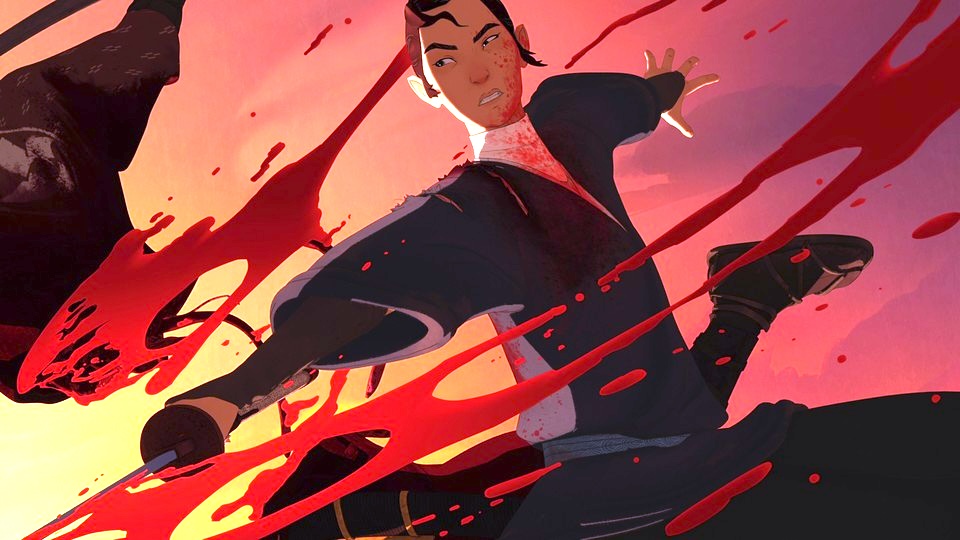
“BLUE EYE SAMURAI” (Netflix): Classic Mouse House-style animation meets decidedly un-Disney subject matter (blood-spurting violence, kinky sex) in the six-hour “Blue Eye Samurai.”
I’ve never been a big fan of Japanese anime. After about 40 minutes my eyes glaze over and I lose interest…largely because the human characters in anime seem so stiff and visually uninteresting. (Not to mention those semi-creepy big eyes.)
But here we have human figures that look, move and express facial emotions pretty much like live actors would. Place them in impeccably rendered environments and you’ve got magic.
The title character is Mizu, a blue-eyed outcast born of an unknown European interloper and a Japanese mother. Mizu becomes a self-trained samurai whose quest for revenge puts this skilled fighter on a collision course with a brutal British adventurer (voiced by no less than Kenneth Branagh) planning to use Western weaponry to overthrow the shogunate.
Oh, yeah…the series has a major plot twist which I won’t reveal here.
“Blue Eye…” is populated with archetypes clearly inspired by pop culture. There’s a fugitive princess slumming with the lower classes (“The Hidden Fortress,” “Star Wars”). Mizu’s sidekick is a handless small town oaf with dreams of heroism (very much like Sam in the Ring Trilogy). There’s an ancient blind sword maker (George Takai) who becomes a mentor to our heroes (nobody is actually addressed as “Grasshopper,” but you get the idea).
References to the cinema of Akira Kurosawa abound. Mizu’s physicality — tall, almost painfully thin, astonishingly graceful — is clearly patterned after Kyuzo, the swordsman portrayed by Meiji Miyaguchi in “Seven Samurai.” The Season One finale is an extended battle sequence mirroring the castle siege in “Ran.”
“Blue Eye Samurai” is a story that could have been done in live action…had anyone the money to undertake such a massive project. But things are made affordable when you only have to paint a picture of a castle instead of building one.
Of all there is to admire in this series, I believe it’s the action sequences that most grabbed me. I kept thinking of the term “blood ballet” that was used to describe Sam Peckinpah’s handling of mayhem in “The Wild Bunch.” “Blue Eye Samurai” lives up to that description.
| Robert W. Butler
 Butler's Cinema Scene