Feeds:
Posts
Comments

Posts Tagged ‘Margaret Qualley’

Kate Hudson, Hugh Jackman

“SONG SUNG BLUE” My rating: B (In theaters)

133 minutes | MPAA rating: PG-13

The phrase “audience pleaser” might very well have been coined to describe “Song Sung Blue,” a ridiculously entertaining comedy-drama-musical from the chameleonic Craig Brewer.

First off…this is not a Neil Diamond biopic, despite the trailers featuring a shaggy and sequined Hugh Jackman crooning hits from the Diamond catalog.

Jackman is playing a real-life character,  Mike Sardina, a Milwaukee native who in the ‘90s became something of a local celeb as a Neil Diamond interpreter (not an imitator…there’s a difference). 

With his wife Claire (played by Kate Hudson, who has snagged a Golden Globe nomination) Mike created an act called Lightning and Thunder. Their regional fame was such that one time they actually opened for Pearl Jam.

When we first meet Mike and Claire they’re part of a celebrity sound-alike show.  Claire does a Patsy Cline act, while Mike has been hired to sing Don Ho hits.  Except that once on stage he starts singing Neil Diamond, with whom he has been obsessed for years.

Brewer’s amusing screenplay follows the couple’s courtship (they’re both blue collar, divorced with teenage daughters) and the development of the act. (Playing members of their entourage are Michael Imperioli, Fisher Stevens and Jim Belushi.)

It’s pleasantly romantic and affectionately amusing…but things really come to life in the musical numbers.  Mike’s Neil Diamond addiction is so weighty that along with “Crackling Rosie” and “Sweet Caroline” he tosses in semi-obscure Diamond songs that many  of us have never heard.

Expect “Neil Diamond’s Greatest Hits” to climb the charts in the film’s wake.

In its latter passages “Song Sung Blue” takes a somber turn, first with a disfiguring auto accident and finally with something even more sobering. But somehow Neil Diamond’s music helps navigate the bumps in Mike and Claire’s lives.

Laughter, song and tears.  It’s a satisfying package.

Margaret Qualley, Ethan Hawke

“BLUE MOON” My rating: B+ (Various PPV services)

100 minutes | MPAA rating: R

Ethan Hawke has always been watchable, but in recent years his work (“First Reformed,” “Juliet, Naked” and the streaming series “The Good Lord Bird” and “The Lowdown”) has taken on near-legendary weight.

“Blue Moon” cements his rep as one of our best actors.

Here Hawke plays Lorenz Hart, the famed lyricist who with writing partner Richard Rodgers created his own chapter in the Great American Songbook (“Where or When,” “My Funny Valentine,” “Bewitched, Bothered and Bewildered,” “(I’ll Take) Manhattan” and of course “Blue Moon”).

Written by Robert Kaplow (and based in part on Hart’s correspondence) and directed by Richard Linklater (his second excellent film of the season after “Nouvelle Vague”), the film opens in 1943 with the debut of “Oklahoma!” on Broadway. 

 The show obviously is going to be  huge success, which utterly demoralizes one member of the audience. Lorenz Hart (Hawke) realizes his old collaborator Rodgers (Andrew Scott) is now joined at hip to a different lyricist, Oscar Hammerstein. And he’s sick about it.

“Blue Moon” unfolds mostly in the bar of Sardi’s restaurant, where Hart has fled to drown his sorrows while members of the “Oklahoma!” crew gather to read the reviews.  The film’s first 30 minutes are a virtual monologue as Hart bitches to the bartender (Bobby Cannavale) and cajoles his way into a drink or two (he’s supposed to be on the wagon — in fact, Hart’s boozing and unreliability contributed to Rodgers leaving for more stable pastures).

So Hart grumbles about how “Oklahoma!” caters to the audience’s sappiest instincts…he’s even pissed at the exclamation point in the title. He’s catty, whiney and sad…all while putting on a show of aloof indifference and intellectual superiority.

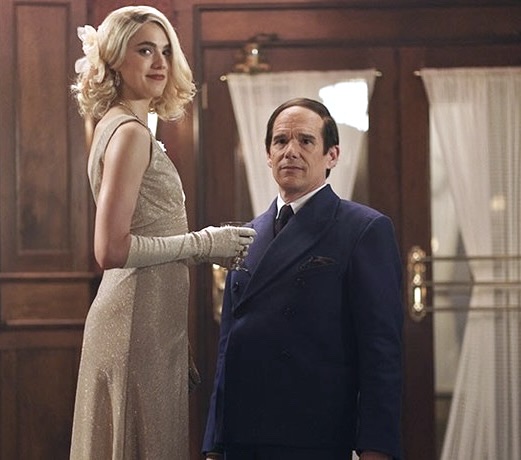
His harangue also gives us a chance to marvel at Hawke’s transformation. His Hart sports a desperate combover that isn’t fooling anyone.  And through some cinematic trickery the five-foot-ten Hawke has been reduced to Hart’s sawed-off five feet. Even women tower over him.

Hart spends a good part of the evening describing the college coed with whom he’s in love…which sounds like wishful thinking since he’s so obviously gay.  This dream girl (Margaret Qualley) only wants Hart as a friend and mentor. Yet more rejection.

A good deal of the pleasure of “Blue Moon” comes from its attention to detail. The cast of characters includes New Yorker writer E.B. White, the famed photographer Weegee, an adolescent Steven Sondheim, and college boy George Roy Hill (who would go on to direct films like “The World of Henry Orient,” “Butch Cassidy and the Sundance Kid,” “The Sting” and “The World According to Garp”).

The supporting perfs are all fine, but this is strictly Hawke’s show.  He fills every frame with anger and anxiety and yearning.  It would be easy enough to dislike his “Larry” Hart, but just when you think you’ve had enough he says something so witty, so pithy, so heart-breaking that you crumble.

He gets my vote for the year’s best performance.

| Robert W. Butler

Read Full Post »

Demi Moore

“THE SUBSTANCE” My rating: B (On Demand)

141 minutes | MPAA rating: R

Demi Moore’s much-deserved Oscar-nominated performance in “The Substance” is the film’s main selling point, but let’s not overlook the stunning (well, mostly) contribution from Coralie Fargeat, who has taken home noms in both the directing and original screenplay categories.

For its first hour, at least, “The Substance” is riveting stuff, a mashup of social commentary, a vicious satire of showbiz duplicity, an angry examination of feminine angst and a staggering truckload of Cronenberg-level body horror.

The premise is vaguely sci-fi — an aging actress (Moore) takes a new (and presumably illegal) drug that will allow her to “give birth” to a younger and more  beautiful version of herself.

Moore’s career-stymied character is Elisabeth; her drop-dead alter ego, whom she calls Sue, is played by Margaret Qualley.

Margaret Qualley

The “science” behind all this is hard to grasp…basically we have two female bodies, one old and one young.  Elisabeth can occupy Sue’s lithe body for seven days, then she must spend a week in her older form.  While one body is active, the other lies in a coma, feeding intravenously on liquid nourishment provided by The Substance’s unseen creators/distributors.

Despite the admonition “Remember, You Are One,” Sue is all about herself; she extends her active cycle beyond seven days.  Turns out abusing The Substance has grave (and alarmingly gross) consequences.

If “The Substance” relies on the familiar theme of a cure that isn’t all it seems (“Flowers for Algernon,” “Seconds,” “Awakenings”) it at least presents itself as a stylistic tour de force.  Fargeat effortlessly juggles the script’s various elements —  there’s horror, yes, but also some laugh-out-loud moments provided by Dennis Quaid as the most soulless producer in Hollywood.

The film’s look (though set in L.A. it was filmed in France and the U.K.) is dominated by chilly interiors, long claustrophobic corridors and Elizabeth’s white-tiled bathroom, which is the size of a small house.

“The Substance” demands considerable nudity from its two leading ladies, but there’s not a hint of eroticism.  Elisabeth apparently has no sex life, while Sue takes pleasure not from the act itself but from being an object of desire. As the Substance does its sinister body-warping work, you’ll find yourself hoping that the women keep their clothes on.

The downside is a running time of nearly 2 1/2 hours. The film scores most of its points early and then descends into a nightmare of ghastly visceral visuals. This might not matter if we actually cared about Elisabeth/Sue, but the film is as chilly as that white bathroom, observing with almost clinical detachment the older woman’s travails while never establishing her as a character worth caring about.

Sebastian Stan, Renate Reinsve and Adam Pearson

“A DIFFERENT MAN” My rating: B- (Max)

112 minutes | MPAA rating: R

A distaff version of “The Substance” is “A Different Man,” in which a deformed fellow is given a drug that dissolves his tumors and leaves him looking like a movie star…namely Sebastian Stan.

Stan’s character, Edward, suffers  from a Quasimodo/Elephant Man-level facial disfiguration. (The makeup is alarmingly convincing.) His condition has left him a social outcast who can only dream about befriending his new neighbor, the aspiring playwright Ingrid (Renate Reinsve).

Edward undergoes a new therapy that transforms him into a hunk. But his new situation also dramatically alters his personality; he changes his identity and dives into the happy (i.e. utterly selfish) life he has always dreamed of.

Writer/director Aaron Schimberg presents Edward’s story as a black comedy…although the laughs are few.  Irony is the dominant emotion.

After Edward’s disappearance, Ingrid writes a play about her misshapen neighbor. Now Edward (she doesn’t recognize him) lands the leading role, which requires him to don face-hiding prosthetics on stage.

Like I said…ironic.

Enter Oswald, a debonair, utterly charming Brit who has precisely the facial deformation the role requires. Oswald is portrayed by Adam Pearson, an actor who really has the character’s condition (he had a brief but memorable turn as one of the alien’s victims in “Under the Skin”).  

Before long the good-looking Edward is out, and his role taken over by Oswald. Is this just fate, or has Oswald been conniving to replace his fellow actor? Not just on stage, but in Ingrid’s bed as well?

The chilliness that kept me from wholeheartedly committing to “The Substance” affects “A Different Man” as well. Most films about misshapen outcasts ask us to empathize with those characters. Schimberg’s film suggests that Edward wasn’t a particularly likable individual before his transformation, and even less so after.

But you might very well consider going home with Oswald.

| Robert W. Butler

Read Full Post »

Brad Pitt, Leonardo DiCaprio, Brad Al Pacino

“ONCE UPON A TIME…IN HOLLYWOOD”  My rating: B+

161 minutes |MPAA  rating: R

Crammed with alternately bleak and raucous humor, a palpable affection for Tinseltown’s past and peccadilloes, and enough pop cultural references to fuel a thousand trivia nights, “Once Upon a Time…In Hollywood” is a moviegoer’s dream.

Here writer/director Quentin Tarantino eschews his worst tendencies (especially his almost adolescent addiction to racial name-calling) and delivers a story that despite many dark edges leaves us basking in the sunny California sunshine.

Each scene has been exquisitely crafted with every element — art direction, costuming, cinematography, editing, acting — meshing in near perfection.

In the process Tarantino rewrites history, blithely turning a real-life tragedy into a fictional affirmation of positivity. It’s enough to make a grown man cry.

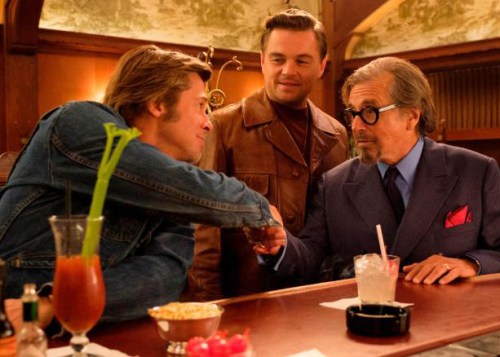
The heroes (??) of this 2 1/2-hour opus are Rick Dalton (Leonardo DiCaprio), a star of TV westerns who now (the time is 1969) sees his career circling the crapper, and his stunt double, the laconic tough guy Cliff Booth (Brad Pitt), who not only steps in to perform dangerous feats on the set but serves as Rick’s best bud, Man Friday and chauffeur (Rick’s had one too man DUIs).

Tarantino’s script finds the  alternately cocky and weepy Rick (DiCaprio has rarely been better) lamenting his fading status in the industry (he’s been reduced to playing villains in episodic TV) and contemplating the offer of a semi-sleazy producer (Al Pacino) to make spaghetti Westerns in Europe.

Margot Robbie as Sharon Tate

Cliff, meanwhile, picks up an underaged hitchhiker (Margaret Qualley) who takes him to one of his old haunts, the Spahn ranch, an Old West movie set now occupied by one Charles Manson and his family of hippie misfits.

Newly arrived at the home next to Rick’s on Cielo Drive is director Roman Polanski and his beautiful actress wife, Sharon Tate (Margot Robbie). Tate is a sweetheart, an all-American beauty radiating an almost angelic innocence and positivity. But we can’t help twitching in anxiety…after all, everybody knows that in ’69 she and her houseguests were the victims of a horrific murder spree by Manson’s brainwashed minions.

(more…)

Read Full Post »

Margaret Qually

“NOVITIATE” My rating: B 

123 minutes | MPAA rating: R

The movies rarely treat religion with anything like respect or even intelligent understanding.  Which makes “Novitiate” a welcome anomaly.

Writer/director Margaret Betts’ film — made with a predominantly female cast and crew — is a serious attempt to examine a religious vocation through the eyes of one young woman.

Cathleen (Margaret Qually…she played the daughter in HBO’s “The Leftovers”) is raised by her hard-case mother in the American South during the 1950s.  Mom Nora (Juliette Nicholson) is a drinkin’, smoking’ modern woman with a tart tongue and a disdain for much of Eisenhower-era society.

But she’s devoted to her daughter and one Sunday takes Cathleen to the local Catholic church. Though irreligious herself, Nora wants her child to be able to make up her own mind. Almost against her better judgment, she accepts a free scholarship for Cathleen at the local parochial school.

The girl takes to Catholicism like other teens glom onto Rod McKuen’s poetry.  As graduation nears she announces that she wants to become a nun. Mom is horrified, but what are you gonna do?

And so Cathleen becomes a postulant at a cloistered community run by the hard-ass Reverend Mother (Melissa Leo), who hasn’t left the premises in 40 years.

Revered Mother — the spiritual version of a Marine drill instructor — makes no bones about her intentions to weed out the unworthy.  Her methods are often brusque and borderline cruel, and part of the wonder of Leo’s performance is that the character’s ogreish behavior is, if not likable, then at least understandable. It’s a long-tested system to which she adheres. (more…)

Read Full Post »