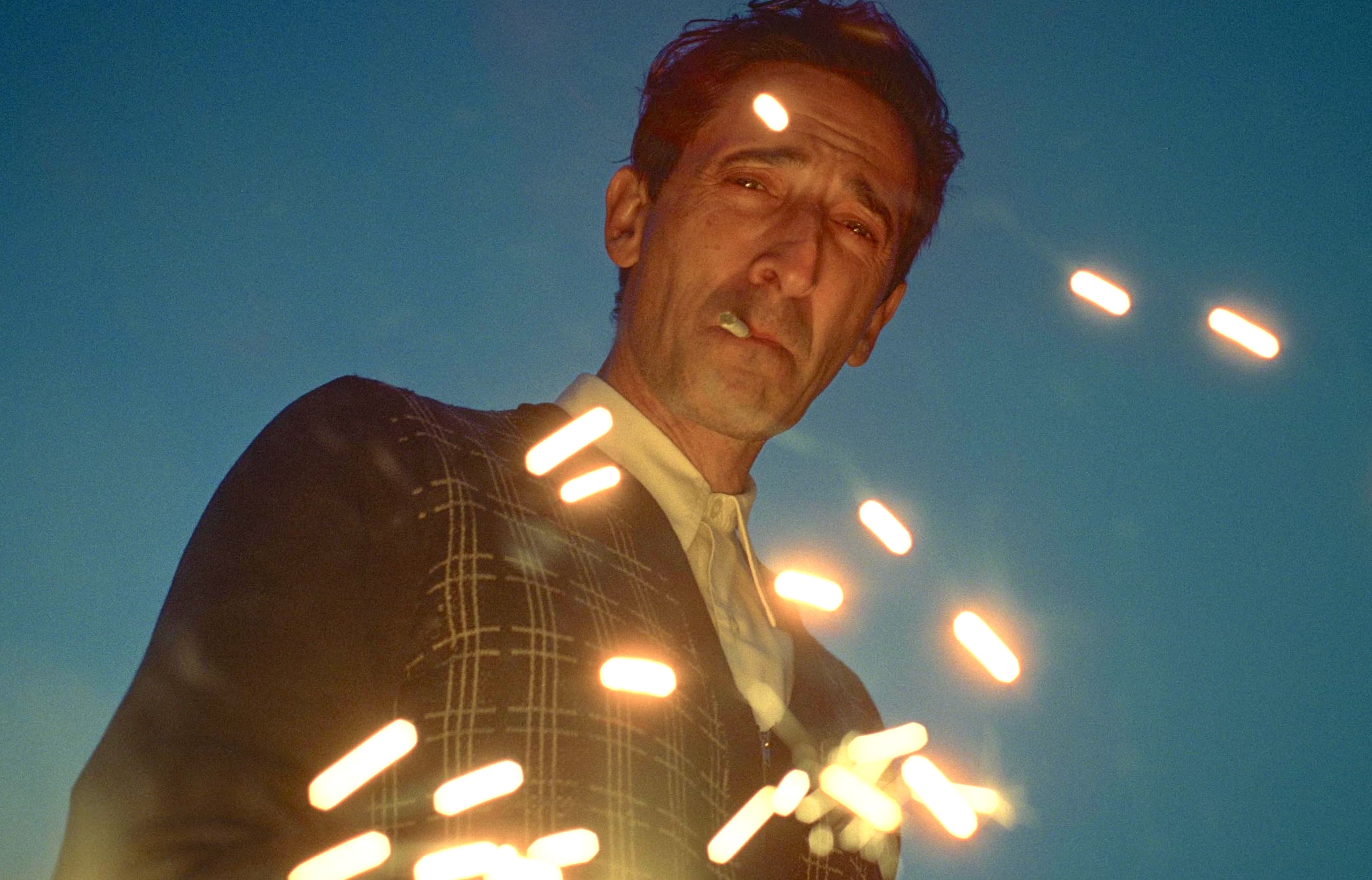
Adrien Brody
“THE BRUTALIST” My rating: B+ (In theaters)
205 minutes | MPAA rating: R
Some filmmakers spend a lifetime to become merely competent at their craft. With only his third feature Brady Corbet has delivered a masterwork.
We’re talking Orson Welles-level talent.
“The Brutalist” is the saga of a Holocaust survivor’s post-war life in the U.S.A. It features an indelible sense of time and place, two Oscar-worthy performances, a running time of more than 3 1/2 hours, and contains perhaps the fiercest indictment of capitalism ever proffered in an American film.
That Corbet and co-writer Mona Fastvold (they’re a couple) pull this off without resorting to strident polemics or soapbox grandstanding is nothing short of miraculous. The film doesn’t tell us. It shows us.
And it was shot in just 24 days on a budget that could hardly accommodate a chamber piece, much less an epic.
Adrien Brody is Lazlo Toth, a Hungarian architect who survived the Nazi death camps and has now been sent to live with an Americanized cousin (Alessandro Nivola) who operates a Philadelphia furniture store.
Lazlo’s transition to his new home isn’t easy. For starters, his wife Erzsebet (Felicity Jones) and niece Sofia (Rafael Cassidy), who were sent to a different camp, are still in Europe, tangled up in red tape. It will be several more years before they are reunited.
After an existence marked by imminent death, Lazlo is uneasy in this land and of security and plenty. Surely something bad will happen. Not to mention that everything about him quietly shouts “alien” and that in Eisenhower-era America his deeply-held esthetics are viewed as useless affectation.
His cousin’s wife (Emma Laird) is a Catholic uneasy with having a Jew under her roof.
And of course Lazlo is desperate to resume his architecture career, the one thing in which he is free to reveal his true essence.
Once the preliminaries are out of the way, “The Brutalist” (the word, never spoken in the film, describes a school of monumental modern architecture reliant on blocky forms and raw concrete construction) settles on its major theme, that of Lazlo’s relationship with an American millionaire who hires him to design a community center.
Guy Pearce gives the best performance of his career as industrialist Harrison Van Buren, a man so rich he has to work overtime not to come off as an entitled asshole. The film’s major theme is the minutely detailed power struggle between the man with the money and the man with a vision.
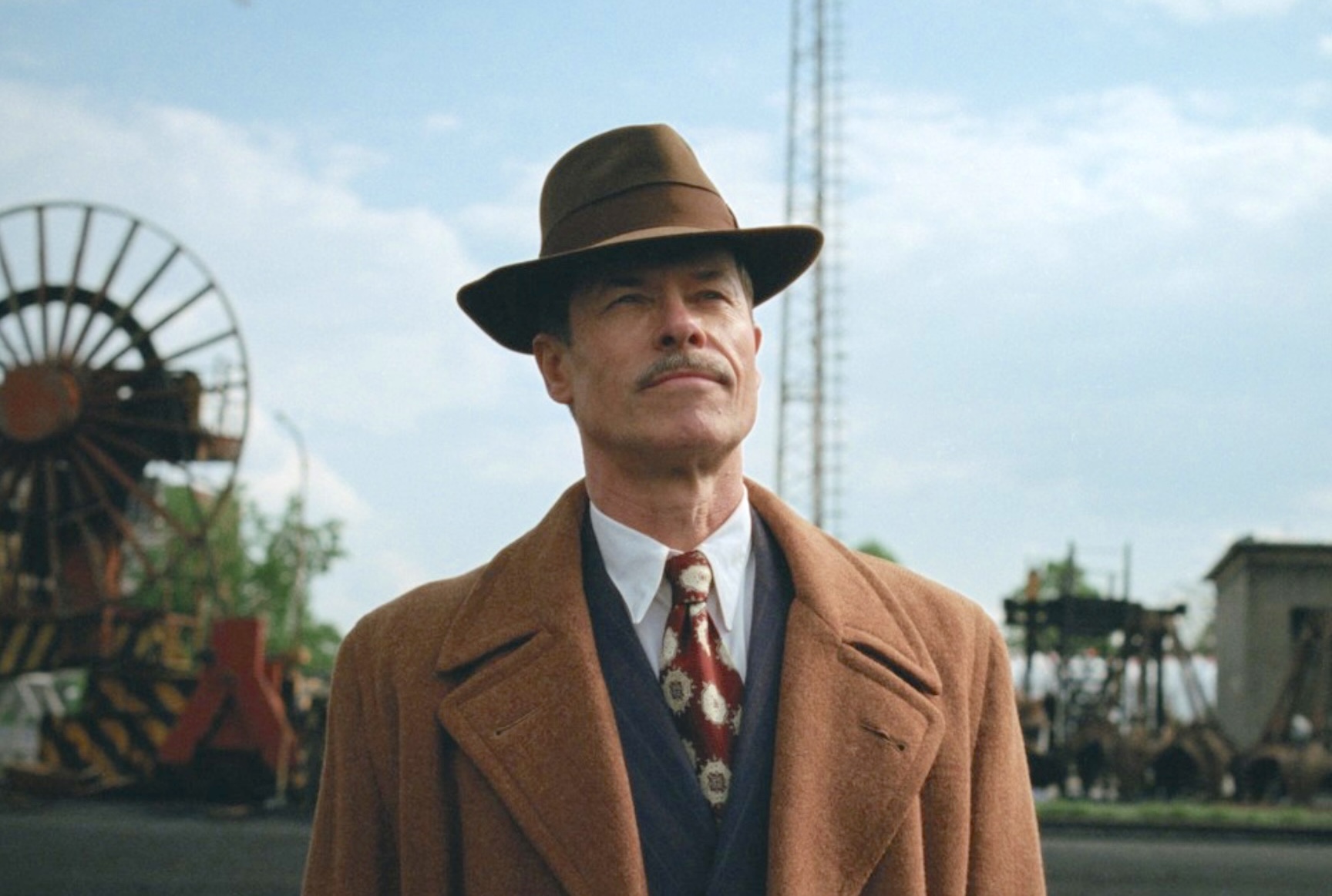
Guy Pearce
It’s an old saw that money corrupts (“Citizen Kane,” anyone?), but I’ve never seen a film — or a performance — that depicts that idea so succinctly or with such insight. Van Buren tries desperately to present himself as open minded and progressive. He makes of show of treating Lazlo as a friend — an honored guest, in fact — but the imbalance in their relationship (and it goes deeper than just employer/employee) is ultimately ruinous.
For starters, Van Buren is a mercurial character whose enthusiasm for the project waxes and wanes. He’s all too eager to make compromises on design and materials that violate the architect’s ambitions.
Brody’s Lazlo must walk a fine line between deference and assertiveness. How much personal dignity and professional standards can he cede to achieve his dream of concrete and glass?
The marvel of Brody’s work here is that we’re in Lazlo’s corner even when his actions are counterproductive and self-destructive (early on he discovers the potential for escape in heroin). I know of few performances that so perfectly distills the fire of artistic ambition in all its pain and triumph.
The film’s big flaw (it’s what keeps me from giving the movie an A rating) is a plot development well into the third hour that struck me as contrived and wholly unexpected. It involves a heinous act by Van Buren that feels totally out of whack with what we’ve seen up to that point. It’s as if Corbet and Fastbold were desperate to wrap things up with a shocker and pulled this one out of thin air.
(Yeah, I get it from a thematic point of view…the millionaire does to Lazlo literally what he does to the world figuratively on a daily basis…but it still feels like a weak Hail Mary effort.)
So “The Brutalist” isn’t perfect. But the very fact that it got made is a miracle. The movie is in a class by itself…the only other films I can compare it to are those of Paul Thomas Anderson.
I cannot wait to see what Brady Corbet comes up with next. But even if this is a one-shot deal, it will be regarded as a cinematic landmark.
| Robert W. Butler
 Butler's Cinema Scene