Feeds:
Posts
Comments

Posts Tagged ‘NASA’

“FOR ALL MANKIND”(Apple+):

Most of what we call science fiction is in fact science/fantasy.  But “For All Mankind” is sci-fi in its truest sense. The show, which recently dropped its fourth season, offers an minutely detailed alternative history of the space race.  

In this version the Soviets get to the moon first and the Americans must play catch-up. Communism more or less flourishes with a repressive regime in Moscow still railing against capitalism well into the 21st century.  Al Gore is elected President; so is a  woman—a closeted gay woman.

(“For All Mankind” sees women as key figures in the space program. One could almost call this feminist sci-fi.)

Meanwhile astronauts and scientists from all countries are working to explore the vastness of space, with international colonies established on the moon and Mars. Of course, our conflicts as human beings don’t magically go away when we relocate to distant planets. There are labor issues, rebellions, sabotage.

Basically the series explores where we might be now if only we hadn’t put space exploration on the back burner.

The special effects are utterly convincing and the science completely plausible.

I’m especially impressed at how well certain characters — an original NASA flyboy played by Joel Kinnaman, a genius engineer/supervisor played by Wrenn Schmidt — age over the course of several decades.

The series deals not only in space exploration but in the lives of its many characters.  There are failed marriages and affairs. Generational disputes. Political gamesmanship.

The has led some to complain that there’s too much soap gumming up the science. I must disagree…our humdrum human foibles do not evaporate just because we are confronted with the vastness of space.

Throughout, the series never abandons the idea of real science.  No laser guns, shape-shifting aliens or woo woo transcendentalism. Just people designing and making machines that reflect the real possibilities of our technology, imaginations and capacity to hope.
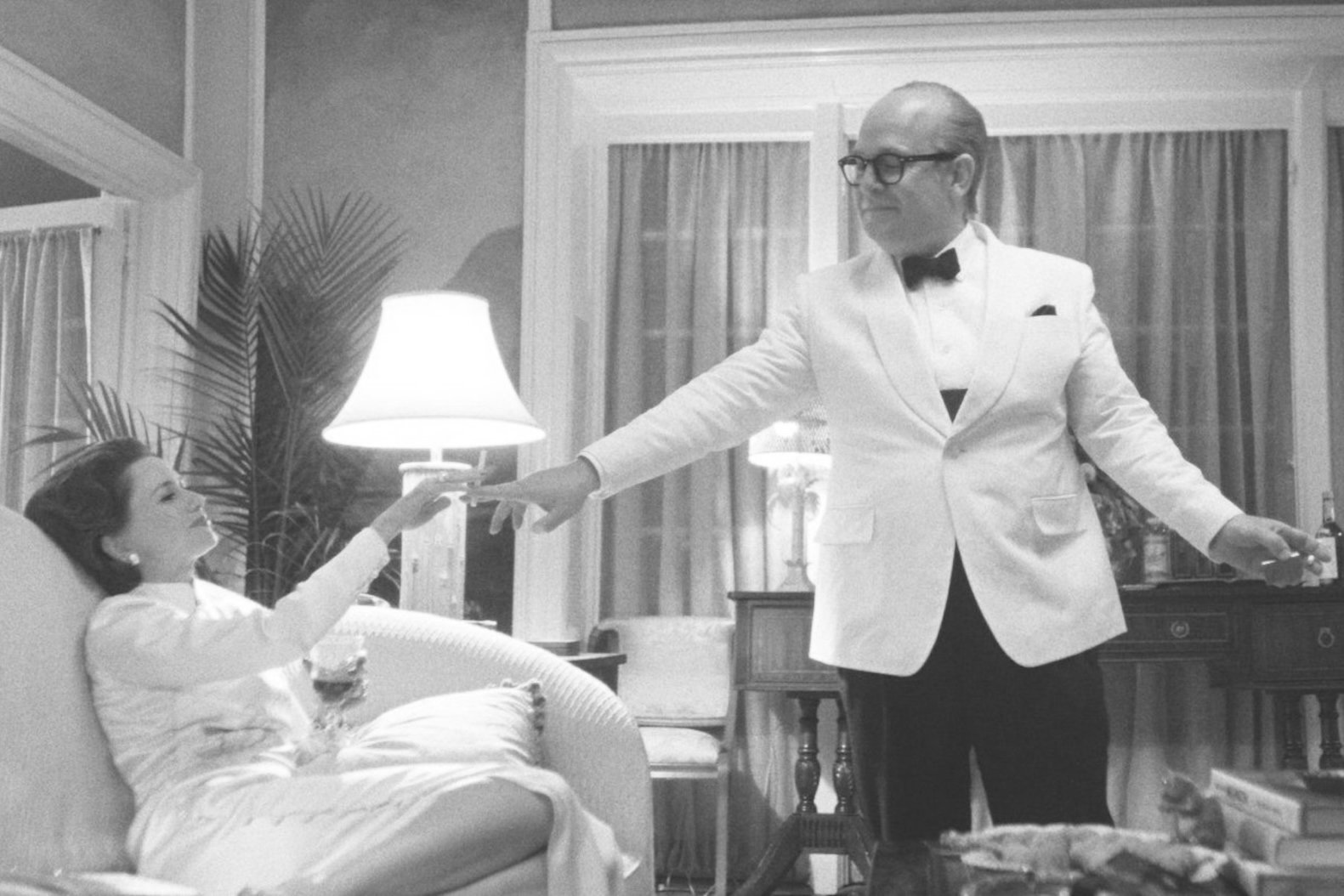
Naomi Watts, Tom Hollander

“FEUD: TRUMAN CAPOTE VS. THE SWANS” (Hulu):
For its second season (the first, in 2017, focused on the antipathy shared by Bette Davis and Joan Crawford during the filming of “Whatever Happened to Baby Jane?”) Ryan Murphy’s “Feud” concentrates on writer/raconteur Truman Capote.

Set in the 1960s and ‘70s, “Capote and the Swans” delves into the novelist’s relationships with a half dozen or so society wives, women married to powerful movers and shakers who, from the outside anyway, appeared to live lives of pampered opulence and studied hautiness.

Capote (portrayed by Brit Tom Hollander with a helium-and-molasses voice and fierce attention to his character’s fey mannerisms) calls his gal pals “the swans” because, he says, they seem so graceful on the surface, while below the water line they are desperately paddling. 

These ladies who lunch are portrayed by the likes of Naomi Watts, Diane Lane, Chloe Sevigny, Calista Flockhart and Demi Moore — all of whom appear to be having one hell of a good time mining the bitchiness.

Not that it’s all fun and games. For all their affluence these women are fairly miserable, saddled with philandering hubbies and thankless children.  The openly gay Capote becomes their best friend, shrink, confidant and shoulder to cry on.

“I play the part. It’s all a performance,:” he admits in an unusually honest moment. “They pick men who are rich but cannot act.”

Of course Capote —his creative juices dried up — also betrays these women by turning his intimate knowledge of them into a scandalous novel…thus the feud of the title.

Now I’m only halfway trough the season, but the fourth episode, “Masquerade 1966,” is so freaking good — and so beautifully sums up what the series is about — that it’s practically a stand-alone experience.

John Robin Baitz (who has scripted the entire series) has come up with a brilliant idea. He tells the story of Capote’s famous Black-and-White Masked Ball (one of the most memorable if overhyped society events in Manhattan history) by using “found footage” reputedly made by documentary giants Albert and David Maysles.

The entire episode — directed by the great Gus Van Sant — is shot with handheld cameras and captured in grainy black-and-white and in a classic square frame. The Maysles Brothers not only observe the preparations with fly-on-the-wall intimacy, but conduct interviews Capote and with the Swans…each of whom is convinced that she will be the secret guest of honor to be named at the big event.

Clearly, they can’t all be queen for a day, but master manipulator Capote knows how to exploit each woman’s insecurities and desires to his will.

The result is 60 minutes of absolutely brilliant television.  

| Robert W. Butler

Read Full Post »

“GOOD NIGHT OPPY” My rating: B (Prime Video)

105 minutes | MPAA: PG

The robot/computer that develops a human personality is a staple of science fiction. “Good Night Oppy” is an inspiring real-life twist on that cliche.

Launched in the summer of 2003, the roving robots Spirit and Opportunity were designed to explore Mars (the “twins” landed on opposite sides of the Red Planet). NASA scientists and engineers designed the robots to function for 90 Martian days; anything longer would be frosting on the cake.

Spirit kept operating — exploring and photographing the planet’s terrain, picking up and examining geological specimens and searching for signs of water — for six years.

Her sister Opportunity (known affectionately as Oppy) kept chugging along for an unbelievable 14 years, surviving massive dust storms, electrical strikes and the mechanical version of arthritis (shit wears out).

Ryan White’s documentary “Good Night Oppy” is an in-depth look at the Spirit/Opportunity mission, from early designs and testing to the day-to-day operation and maintenance of the rovers on the planet’s surface.

There is utterly convincing footage of Spirit and Oppy going about their work on Mars, courtesy of the visual artists at Industrial Light & Magic, and of course there are plenty of photos taken by the rovers of their environment.

We also meet a dozen or so of the individuals who created the program and kept the robots rolling along for years past their expiration dates. A popular cliche casts scientists and engineers as creatures of fact with little room for sentiment, yet the testimony of these slide-rule types suggests that over time they came to regard the rovers, especially Oppy, as a member of the family, at least as empathetic a being as a cat or dog.

Physically there is little human about the rovers. They look a bit like aircraft carriers on treaded wheels, with the “deck” a couple of feet above the ground. Towering over the body is a “neck” and “head” equipped with cameras…the rovers were deliberately designed so that the cameras’ POV would be that of a five-foot-tall human strolling across the Martian surface.

The humans’ affections for the rovers were built largely on the day-in-day-out routine established over the machines’ lifetimes. There were morning wakeup calls featuring popular songs blasted into space…apparently Spirit and Opportunity were programmed to react like a human being awakened by a clock radio.

Moreover, the robots had been programmed to act autonomously in certain situations (there was a lag time of 10 minutes between NASA sending an order and the machines receiving it), and this sometimes gave the impression that they were exhibiting free will.

The NASA folk recognize, of course, that these are machines. But who can blame them for projecting their parental impulses on these two metallic space babies? Or for mourning when at long last Oppy went to sleep during a long Martian dust storm and never again awoke?

The marvel of White’s film (co-written with Helen Kearns) is that we don’t sneer at this anthropomorphic proclivity. Rather, we buy into it,

Is it possible to love a chunk of metal and plastic? “Good Night Oppy” certainly makes the case.

| Robert W. Butler

Read Full Post »

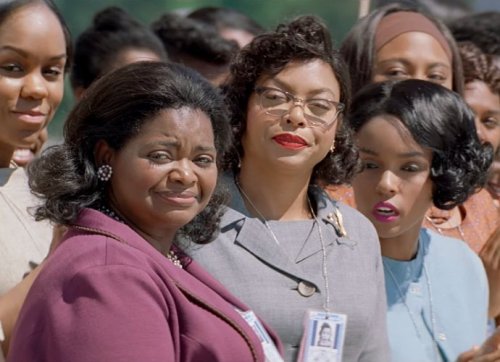
Octavia Spencer, Taranji P. Henson, Janelle Monae

Octavia Spencer, Taranji P. Henson, Janelle Monae

“HIDDEN FIGURES” My rating: B+

127 minutes | MPAA rating: PG

A piece of  fact-based historical uplift that flirts with sappiness but never succumbs, “Hidden Figures” is a late addition to the 2016 awards race.

The story it tells — largely unknown until the film’s publicity drive kicked in a few weeks ago — is kinda jaw dropping. And the three lead performances instantly land on the list of Oscar contenders.

During the early days of the American space program — back when a mechanical computer took up an entire floor of an office building — NASA hired two dozen mathematically gifted African American women to perform  complex calculations using nothing more than their brains and slide rules.

These women were referred to as “computers” — that was their official job designation.

Despite being second-class citizens both on and off the job, they made possible John Glenn’s breakthrough orbital flight and gave the U.S.A. a fighting chance in the space race.

Writer/director Theodore Melfi (he was behind the sublimely funny Bill Murray starrer “St. Vincent”) balances the private stories of three of these women against the grand historic sweep of those years. The film works equally well as a satisfying celebration of personal triumph and as a symbol of national pride.

The screenplay (with Allison Schroeder) wastes no time in illustrating the times.  Three “computers” are on their long daily commute to their jobs in north Virginia when their car breaks down.  The white highway patrolman who investigates their stalled vehicle at first exhibits the overt racism of the times.  Only when he learns that the three are helping Uncle Sam beat the Commies to the stars does he drop the attitude and ensure they are sent safely on their way.

Once at work, the women must put up with more crap.  The space program (it wouldn’t take the name NASA for several years) and its white management practice what might be called “racism with a tight smile.”

The African American women work in their own building separate from everyone else. There is minimal interaction between them and the engineers and scientists who daily shower them with mathematical problems.  Like the field hands of a Southern plantation, they produce the wealth but get none of the credit.

(more…)

Read Full Post »