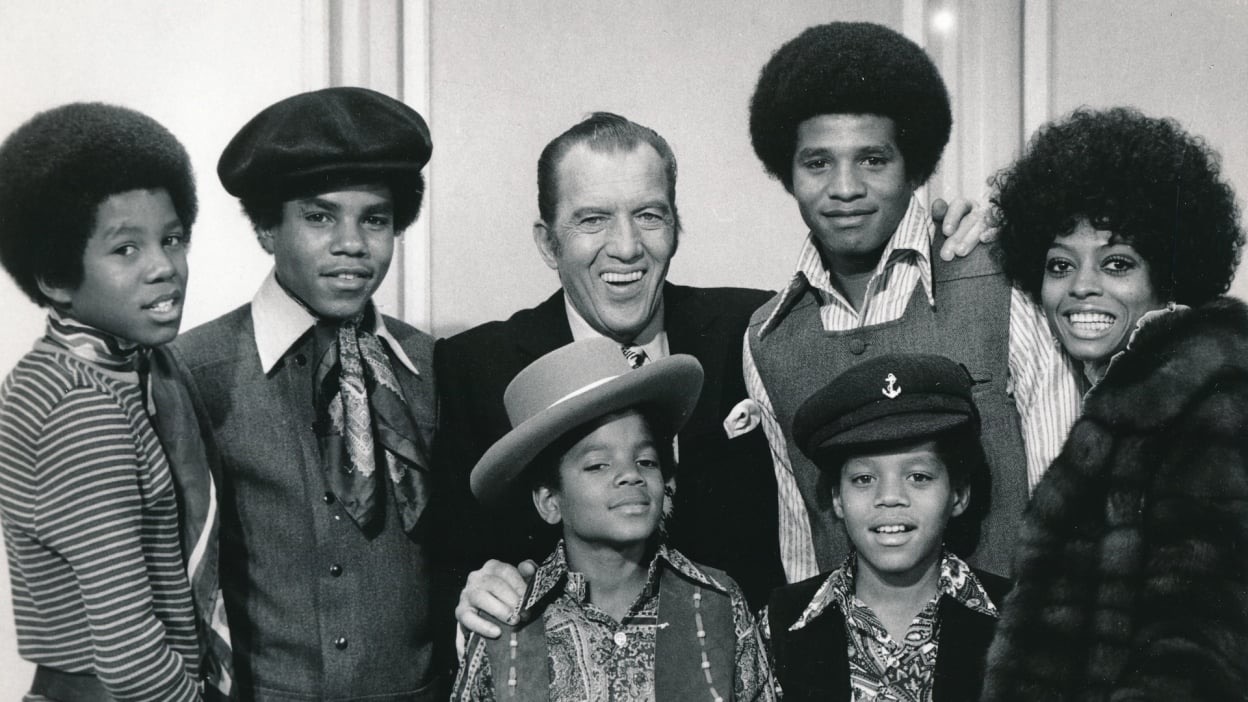
“SUNDAY BEST: THE UNTOLD STORY OF ED SULLIVAN” My rating: B+ (Netflix)
90 minutes | No MPAA rating
For millions of Americans in the 1950s and ‘60s, Sunday night meant gathering around the TV to watch Ed Sullivan’s variety show.
Sullivan was notoriously stiff on camera and dismissed by many a teenager as a hopeless square. Nevertheless he gave us our first glimpses of Elvis and the Beatles, no small thing.
But his greatest achievement, according to the new documentary “Sunday Best,” was defying the societal norms of his times to promote black entertainers in the face of widespread racism.
Directed by Sacha Jenkins (he’s done docs on Louis Armstrong, Wu-Tang Clan and the roots of rap), this surprisingly moving and thoroughly entertaining effort charts Sullivan’s early career as a newspaper sportswriter and, later, Broadway editor of the NY Daily News. He ended up on television almost by accident and in fact Sullivan’s lack of charisma had critics howling for his replacement.
But audiences got on his unconventional wavelength and he settled in to write more than 20 years of broadcast history.
The doc features several vintage TV interviews of Sullivan and testimony from dozens of entertainment figures (Harry Belafonte, Berry Gordy, Smoky Robinson, Oprah Winfrey), but the film’s greatest selling point is its jaw-dropping collection of great on-air performances.
We’re talking a teenage Stevie Wonder, Ike and Tina Turner, The Supremes, Nina Simon, Gladys Knight, Mahalia Jackson, Sammy Davis Jr., Bo Diddley, the Jackson Five, Nat King Cole…and that’s just scratching the surface.
What comes through loud and clear here is that Ed Sullivan truly loved show people. Race didn’t matter. Talent did.
Turns out that wooden exterior masked a great heart and a very good soul.

Simon Baker, Jacob Junior Nayinggul
“HIGH GROUND” My rating: B (Prime)
104 minutes | No MPAA rating
Civilization, observes a character in the Australian-lensed “High Ground,” is the story of bad men doing bad things to pave the way for the rest of us.
Among those “bad things” is blatant racism, a trait the Aussies historically share with us Americans. Here we enslaved black men and killed Native Americans; in Australia it was all about the destruction of Aboriginal culture.
Set in the decade after WWI, this visually devastating film from writer Chris Anastassiades and director Stephen Johnson depicts one small outlier in a greater race war and how two men — one white, one black — find themselves caught in the middle.
The film begins in 1918 with the massacre of a clan of Aborigines by white police officers. Among them is Travis (Simon Baker), a former army sharpshooter dismayed when his fellows go on a killing spree.
Only two Aborigines survive the mayhem. One is Gutjuk, 8 years old when he loses his family. More than a decade later we find Gutjuk (now played by an excellent Jacob Junior Nayinggul) living at a remote Outback mission where he has been renamed Tommy and reared in a more or less caring environment.
The other survivor is his uncle Bawara (Sean Mununggurr), left for dead but now staging retaliatory raids on white-owned ranches.
Travis is assigned to kill or capture Bawara; Tommy/Gutjuk accompanies him as a guide and interpreter. Neither man wants to be there.
Among the supporting players are Callan Mulvey as Travis’ old army buddy, now a squinty-eyed hater, and the great Jack Thompson as the local head of police; his mere presence provides a link to the glories of the Australian New Wave of the ‘70s.
This story could be plopped down in the American West (there are more than a few similarities to “Dancing with Wolves”). What makes it especially noteworthy is “High Ground’s” quiet respect for native culture and its awed admiration for the rugged yet beautiful topography, captured by cinematographer Andrew Commis in almost unbearably evocative images and not a few soaring drone shots that momentarily transform the viewer into a hawk floating above a “Lawrence of Arabia”-level landscape.
Several of the executive producers of the film are themselves Aborigine, and it shows. There’s no attempt to romanticize the tribe’s hunter/gatherer lifestyle; an almost documentary observation takes over certain scenes.
A pall of uncertainty and sadness hang over the yarn. We’re not sure who to root for; nor does there seem to be any easy answer to the long-simmering hatreds on display.
But I found myself unexpectedly moved by the film’s brutal yet inescapable conclusion.

“WARFARE” My rating: B (HBO Max)
95 minutes | MPAA rating: R
“Warfare” is an almost minute-by-minute depiction of an actual firefight that took place during the American occupation of Iraq.
It’s about as accurate a look at modern combat as we’re likely to see.
In fact, Ray Mendoza, who co-wrote and co-directed the picture with veteran Alex Garland, is a former Navy SEAL and was a participant in the action recreated here.
There’s no plot. No character development. Instead we spend a night with a group of SEALS who have taken over an Iraqi home to observe terrorist activity in the neighborhood.
The clan that lives there have been sequestered in a bedroom. The Americans haven’t threatened them, but it’s easy to understand the family’s anxiety and, as time passes, their outrage.
Not a word is wasted here. Most of the dialogue is radio chatter and ordered commands. The first half of the film displays the boring side of war…sitting around waiting for something to happen.
And when it does happen, the mayhem is anything but glorious.
The cast is peppered with familiar faces (Will Poulter, Joseph Quinn, Michael Gandolfini) but nothing here even remotely resembles a star turn.
Under the stress of combat these are less individuals than extremely well-oiled cogs in a killing machine.
At the film’s conclusion we see the actors with the real-life SEALs they portray. There could hardly be a more resounding endorsement of the movie’s truthfulness.
| Robert W. Butler
 Butler's Cinema Scene