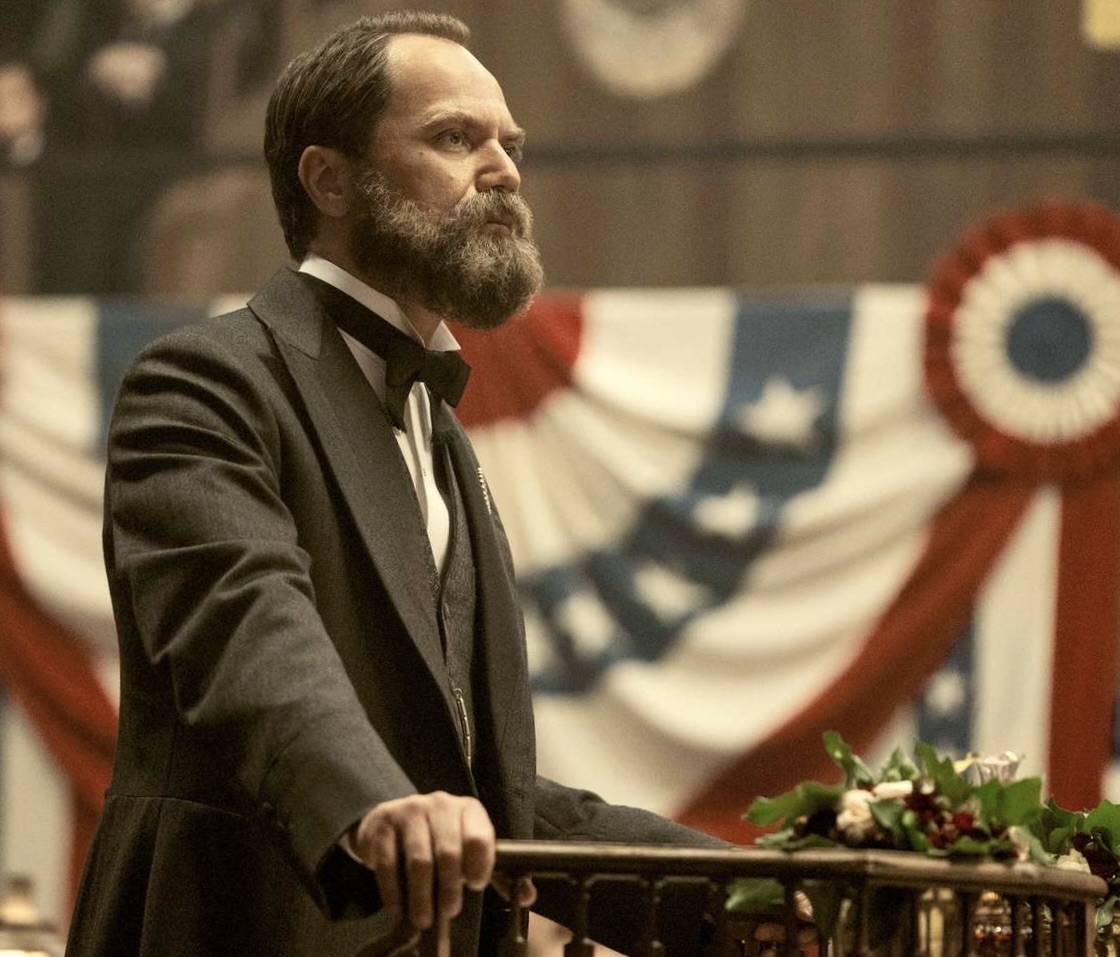
Michael Shannon
“DEATH BY LIGHTNING”(Netflix)
Historical drama gets no better than “Death by Lightning,” a recreation of one of the more obscure but weirdly resonant moments in our national history.
Based on Candice Millard’s superb history Destiny of the Republic, this retelling of the assassination of President James A. Garfield in 1881 has been spectacularly well acted and produced. It almost perfectly captures the same emotional and intellectual notes that made the book so memorable.
And it does it all in just four one-hour episodes.
It begins with Senator Garfield (Michael Shannon) leaving his Ohio farm for the 1880 Republican National Convention in Chicago . His hope is to prevent the renomination of incumbent president Ulysses S. Grant, the figurehead of a spectacularly corrupt administration.
In a twist of fate that seems more fairy tale than fact, it is Garfield himself who ends up the party’s nominee. It’s not that he seeks the presidency…but he’s the only candidate the warring anti-Grant delegates all can get behind.
In the process he makes an enemy of Grant supporter Roscoe Conkling (Shea Whigham), the U.S. senator from New York whose control of that state’s ports holds the American economy in a stranglehold. Conkling is a savvy pol…he’s also willing to employ pure thuggery to get his way. The comically boozy Chester Arthur (Nick Offerman) provides the muscle behind Conkling’s manipulations.
Garfield knows he cannot win without New York. So he does the unthinkable…he chooses as his running mate the hapless Arthur; basically it’s an end run around Conkling’s plan to sit out the election and pick up the pieces later.
The rise of Garfield runs parallel to the story of Charles Guiteau (Matthew Macfadyen), a failed lawyer and hustler with serious mental issues. Guiteau fantasizes that his support was vital in getting Garfield elected, and now he wants a reward. And when his pathetic entreaties are rejected, he plots to kill the President.
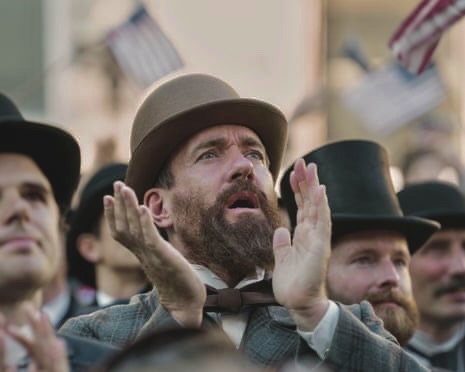
Matthew Macfadyen
As was the case with Millard’s book, this series leaves viewers ruminating over what might have been. In his three months as President, Garfield embraced a progressive agenda. A Civil War veteran, he reached out to African American leaders, especially black soldiers whose sacrifices were overlooked. He laid plans to replace the spoils system with a non-partisan Civil Service.
I doubt we’ll see better acting this year than what’s delivered here by Shannon and Macfadyen.
Shannon probably has the tougher job, given that Garfield was low-keyed, modest and generous. Not exactly a personality to set off dramatic fireworks. Yet the actor finds the heroic in Garfield’s calm reasonableness. Especially telling are the scenes with the Garfield family (Betty Gilpin is terrific as Mrs. Garfield), which bring to mind the domestic image of Abraham Lincoln and his brood.
The upshot is a genuine sense of loss.
Macfadyen, on the other hand, gets to play a crazy man…but with restraint. The key to his Guiteau is the disarming “normalcy” of his presentation. The guys often sounds reasonable but behind the fancy words there’s a crippling desperation at war with rampant narcissism. In any conversation there comes a moment, a tell if you will, that suggests something is seriously wrong with this guy. Maybe you can’t quite put a finger on it, but that creepy feeling on the back of your neck is inescapable.
The fourth and final episode unfolds in the aftermath of the assassination attempt. Garfield lingered in agony for a month while inept physicians tried to locate the bullet for extraction…even calling upon inventor Alexander Graham Bell to employ a primitive metal detector.
Weirdly enough, the reform movement Garfield put into motion survived him, thanks to an unlikely proponent we won’t name here.
Now this is all pretty heavy stuff, but director Matt Ross and writer/creator Mike Makowsky often put a bleakly funny spin on the material. The brutal cronyism of Conkling and Arthur gets the full satiric treatment (the parallels between their machinations and those of our current President are inescapable) and the characters often employ ear-burning language. I doubt that statesmen of the 19th century were that open with their profanity, but in dramatic terms it works…most of the really vile pronouncements come from the show’s heavies.
Even the smallest roles are deftly handled. Among the supporting players are Bradley Whitford, Vonnie Curtis-Hall, Paula Malcomson and Zeljko Ivanek.
When it’s all over, “Death by Lightning” leaves us marveling at the decency of good men and the unpredictability of fate.
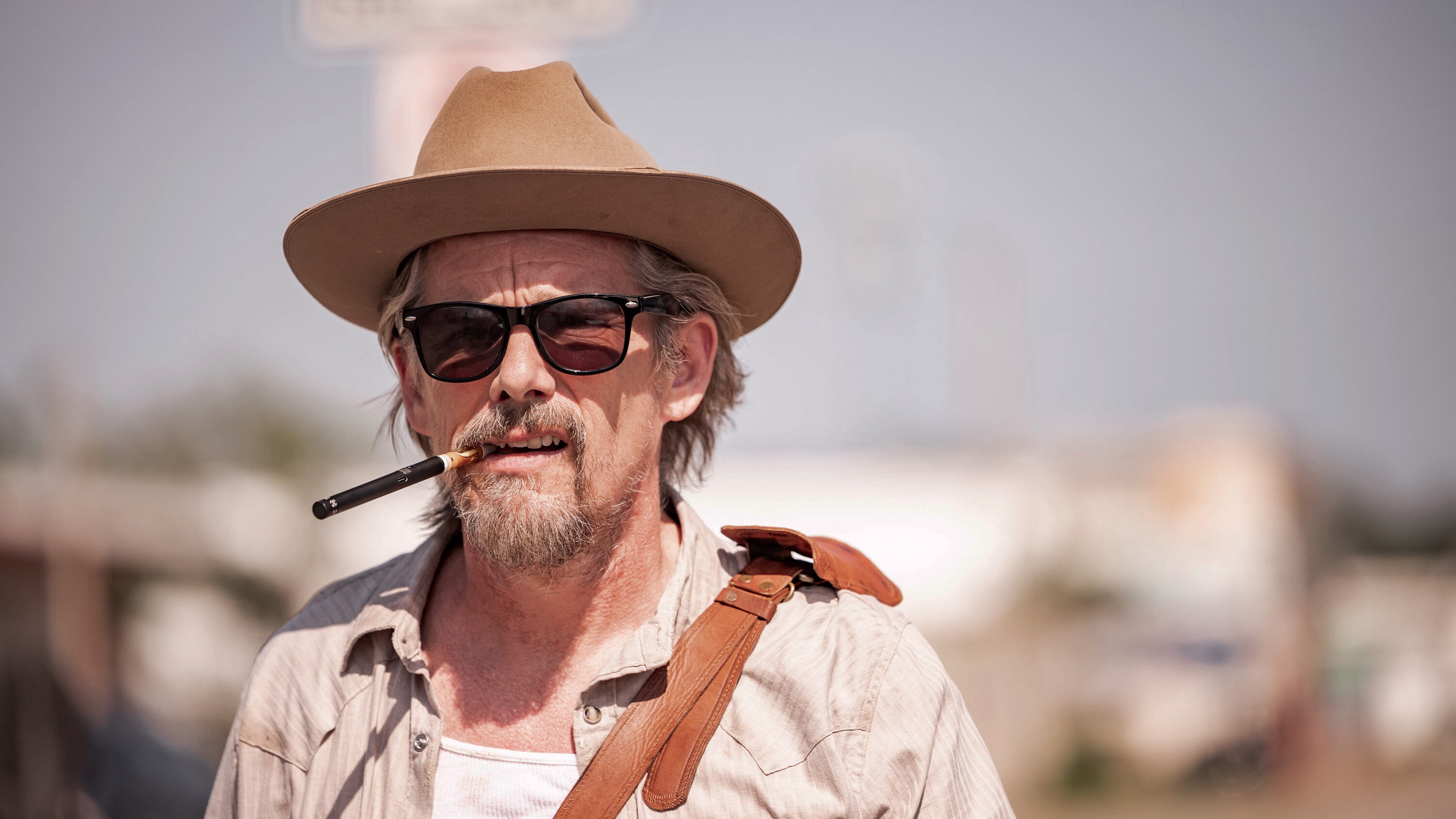
Ethan Hawke
“THE LOWDOWN” (Hulu)
I love, love LOVE this show.
Lee Raybon (Ethan Hawke) is a shabbily-clothed freelance journalist whose search for truth always has him in hot water with Tulsa’s movers and shakers.
In this funny and weirdly moving series from Sterlin Harjo (the man who gave us “Reservation Dogs”) Lee sets out to prove that the suicide of one of the local gentry is actually murder.
He runs up against the dead man’s brother (Kyle Maclachlan), who’s running for governor; the scheming widow (Jeanne Trijpplehorn), a neo-Nazi cult and a whole bunch of corrupt power brokers.
All while trying to keep his struggling used book store afloat and delivering questionable parenting to his teenage daughter (Ryan Kiera Armstrong).
Plus Lee gets beat up. A lot.
This sprawling noir comedy (think Jim Thompson on laughing gas) is crammed with eccentric and memorable characters, and the players (among them Keith David, Tracy Letts, Tim Blake Nelson, Killer Mike, Tom McCarthy, Peter Dinklage, John Doe and the late Graham Greene) take full advantage of the possibilities. Rarely have so many scene stealers been assembled in one place.
I was borderline bereft when “The Lowdown” reached its eighth and final episode. But I’ll tell you what…I’m gonna plop down and watch it all over again.
| Robert W. Butler

 Butler's Cinema Scene