“

Sylvester Stone
“SLY LIVES!” My rating: B (Hulu)
112 minutes | No MPAA rating
Among the highlights of Questlove’s Oscar-winning documentary “Summer of Soul” was performance footage of Sly and the Family Stone in their prime.
Now he has given us a full-length appreciation of Sly Stone (born Sylvester Stewart) and it’s both exhilarating and deeply troubling.
Almost from the get-go Sly exhibited musical genius. From his earliest years he performed nightly at his church, playing any instrument that needed playing. As a teen he was a successful radio deejay.
He began producing records in the Bay Area (“Laugh Laugh” by the Beau Brummels, the first version of “Somebody to Love” by Grace Slick and the Great Society).
He formed his own interracial band. At first they played covers of popular songs. Then Sly began writing his own funky tunes.
When his first album tanked he roared back with a song nobody could resist: “Dance to the Music.” (There’s astounding footage of Sly revving up the pasty white crowd on the Ed Sullivan show by wading into the audience and dancing in the aisle…the honkies couldn’t help but get swept up in the funk.)
Questlove has basically given us two movies here. First there’s the exciting rise…followed by the achingly depressing fall marked by paranoia and drugs.
Sly himself only appears in archival footage, including a television interview from what appears to be the mid-1980s. Mostly Questlove allows others — band members, producers, lovers — to tell the tale.
Even when nursing a crippling drug habit Sly could put on a show. One admirer recalls seeing the band in the late 70s: “I left thinking that he could run for President and win.”
But the decline was unmistakeable. He was late for shows or didn’t show up at all. His bandmates were slowly alienated and left one by one, especially as the heady collectivism of his early songs segued into self-referential navel gazing.
Many of the talking heads Questlove has interviewed see in Sly’s slow downfall an all-too-common story of self-inflicted wounds. In fact, the film’s subtitle is “The Burden of Black Genius.” The film is never angry, though — instead it seeks to understand.
Sly Stone, now 82. has mostly been out of the public spotlight for nearly 40 years. He seems to like it that way. One of his children describes him as “a standard old black man.”
But one leaves this fine documentary wondering not only at Sly’s body of work, but at the ripples his career sent through the musical world, paving the way for Janet Jackson, Prince, Parliament/Funkadelic and many others.
Black genius? For sure.
“PANGOLIN: KULU’S JOURNEY” My rating: B- (Netflix)
88 minutes | MPAA rating: PG
The shadow of the Oscar-winning “My Octopus Teacher” hangs heavily over “Pangolin: Kulu’s Journey.”
Both films have been directed by Pippa Ehrlich. Both unfold in South Africa and chronicle the relationship between a human and an exotic creature. Both aim for a synthesis of documentary discipline and intense emotion.
Except that lightning rarely hits twice in the same spot.
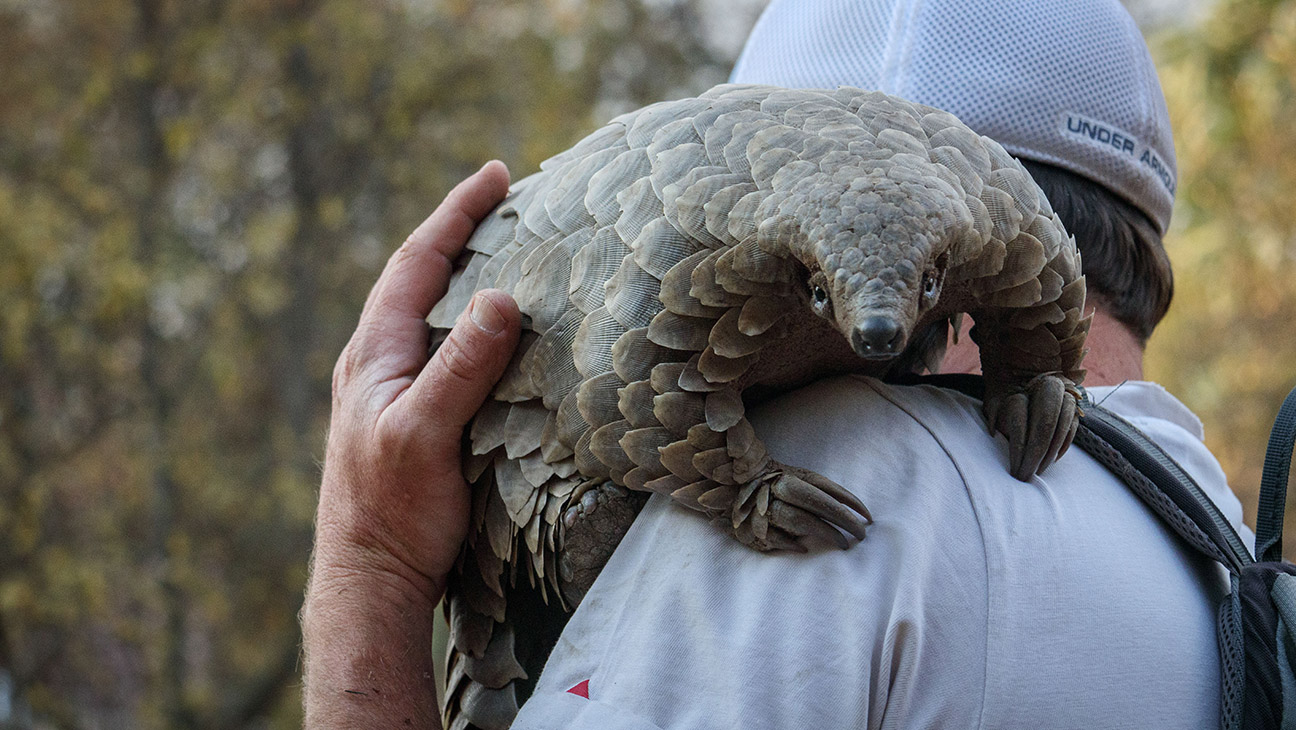
Let’s start with our animal hero. Little Kulu is an orphaned pangolin, a bizarre African mammal that seems more like a dino than a creature of our present world.
Pangolins are a bit like anteaters…only weirder. They are the only mammal covered in rigid protective scales. They walk on their hind legs holding their much smaller forelegs in front of them. One pangolin expert describes them as miniature T-Rexes.
The creatures are utterly harmless, able to open their mouths only enough to stick out a foot-long tongue that scarfs up termites, ants and their eggs. When threatened their only defense is to curl up into an armored ball. Currently they are endangered, since their scales are essential to many traditional Chinese medicines.
In fact our central character, Kulu, is rescued as an infant from poachers and turned over to Gareth Thomas, a volunteer (or is he an employee?) of a Pangolin rescue organization. His job is to spend months feeding and protecting Kulu until the creature is big enough to be released back into the wild.
Here’s the problem. Thomas isn’t a terribly interesting fellow. We really don’t learn much about him. His salient feature is his love of Kulu. And that is a one-way deal since Kulu expresses no emotions. No purring. No wagging tail.
In fact, the pangolin spends most of its time trying to ditch Thomas, who can only retrieve the wandering creature at the end of the day with the help of a radio transmitter attached to Kulu’s back.
So the human/animal love affair— one of the most amazing things about “My Octopus Teacher,” is something of a bust this time around.
At nearly 90 minutes “PangolilnL Kulu’s Journey” feels padded. Would have been much more effective as a 60-minute National Geographic entry.
Still. the artful photography of this otherworldly creature going about its business is captivating.
| Robert W. Butler

 Butler's Cinema Scene