Feeds:
Posts
Comments

Posts Tagged ‘Robert DeNiro’

Lily Gladstone, Leonardo DiCaprio

“KILLERS OF THE FLOWER MOON” My rating: B (In theaters)

306 minutes | MPAA rating: R

More than any film I’ve seen in a decade, Martin Scorsese’s “Killer of the Flower Moon” has left me at a loss for words.

Sometimes that’s a good thing, suggesting a cinematic experience so overwhelming that it defies easy summation.

In this case it means I left the film with mixed reactions. It’s taken days to sort them out and I’m still struggling to come to a neatly encapsulated conclusion.

The setup:

“Killers…” is a lightly fictionalized version of David Grann’s superb nonfiction study of the notorious Osage murders of the 1920s.  With the discovery of oil in Oklahoma, members of the Osage tribe who had been settled on this presumably worthless land became overnight millionaires.  

This made them targets for predatory whites who often married Osage women.  Frequently those women— and other members of their clans — died under mysterious or outright murderous circumstances, with the oil rights reverting to their white husbands.  It took a major investigation by the fledgling FBI to uncover a cabal of conspirators behind the murders of at least 30 tribal members.

Scorsese’s film (co-written with Eric Roth) is noteworthy in that it isn’t really about solving a crime (the first federal agent doesn’t show up until more than two hours into the 3 1/2-hour film, and the audience knows who the bad guys are almost from the get-go).  Its focus is split between one particular marriage. and a study of unapologetic corruption.

After serving in the Great War Ernest Burkhart (Leonardo DiCaprio) arrives in Oklahoma to work for his uncle, William Hale (Robert De Niro), the most powerful white man living in the Osage Nation.


Robert DeNiro, Leonardo DiCaprio

Hale is a mover and shaker who has been among the Osage for so long he speaks their language fluently.  He advises tribal leaders and maintains that the Osage are the finest people on the planet. But beneath his benevolent paternalism there’s sinister intent.

At his uncle’s urging, the slow-witted and morally anchorless Ernest marries Mollie (Lily Gladstone), an Osage woman who, for all of her family’s wealth, is a nurturing, down-to-earth individual.  They start a family.

But little by little Ernest is drawn into his uncle’s manipulative world. Early on he participates in the armed robbery of a wealthy Indian couple; before long he’s a middleman setting up the assassinations of individuals fingered by Hale. Among the targets are his own in-laws.

The yarn is thick with moral ambiguity. For even as he does his uncle’s murderous bidding, Ernest remains desperately in love with his wife. At some point he’s going to have to choose between love and his white family.

The film’s recreation of life in Oklahoma during this period is astonishingly authentic.  Tribal customs, language and attitudes have been scrupulously researched and depicted.  Some of the long shots of oil derricks and oil pools pocking the landscape are epic (Rodrigo Prieto is the cinematographer).  Costuming and set decoration are impeccable.  The late Robbie Robertson has created a haunting minimalist musical score heavy on native drums rhythmically thudding like a heartbeat.

My hangup is the film’s emotional neutrality.  I get it, intellectually.  But I felt more an observer than a participant.

Possibly it’s best to see the film without having read the book.  That way the perfidy of the “killers” comes as a shocking revelation with attendant moral revulsion. Maybe I knew too much going into the experience.

More problematic is the focus on Ernest, a stupid, easily manipulated oaf. As played by DeCaprio he is resoundingly unempathetic, a spineless sort whose only redeeming quality is that he grows to love his wife despite his many sins against her family. (I can’t recall another major actor so willing to alienate his character from the audience, so there’s that.)

Were “Killers…” only, say, two hours long, Scorsese’s sheer filmmaking bravado might well compensate for our having to spend so much time with this thick hick. But the film’s butt-numbing length stretches matters out while diluting the dramatic impact — the movie’s trailers are more effective in this regard than the film itself.

Scorsese and Roth find some grim humor in the killers’ desperate machinations as the net closes on them (Jesse Plemons portrays the main Fed doggedly digging into the murders), but the film is largely humorless.

The saving grace in all this is Gladstone, a Native American actress whose most compelling previous performance was in Kelly Reichardt’s “Certain Woman” from 2016. Her Mollie becomes the moral/emotional center of the film, a woman radiating empathy, quiet dignity, intelligence and a sort of stoic resignation as life piles on one tragedy after another. It’s damn near impossible to explain what she does here…it’s a kind of soulfulness rarely seem on the screen.

At the other end of the spectrum is DeNiro’s William Hale, a villain with a breathtaking ability to compartmentalize the conflicting aspects of his life.  In public he’s everybody’s uncle and friend; behind closed doors Hale becomes an amoral master manipulator with an unquenchable thirst for wealth and power. Anyone smarter than the thick-headed Ernest would recognize his pervasive malevolence right off the bat.

Advance word on “Killers of the Flower Moon” has the film pegged as a masterpiece, perhaps the highlight of Scorsese’s illustrious career.

Well, it’s good. It’s got its moments.  But in my opinion not enough to fill 3 1/2 hours.

| Robert W. Butler

Read Full Post »

Al Pacino as Jimmy Hoffa; Robert DeNiro as Frank Sheeran

“THE IRISHMAN” My rating: B 

209 minutes | MPAA rating: R

Martin Scorsese’s much-anticipated “The Irishman” is a good movie.

Not a great one.

It’s been described as the filmmaker’s ultimate gangster epic, yet it feels less like a conventional celebration of tough-guy ethos than a slow (3 1/2 hour’s worth), mournful meditation on sins unacknowledged and unforgiven.

In fact, Scorsese seems to have gone out of his way to avoid the sort of eye-catching set pieces (like the long nightclub tracking shot from “GoodFellas”) that marked many of his earlier efforts. “The Irishman” is almost ploddingly straightforward.

Steve Zaillian’s screenplay follows the title character, real-life contract killer Frank Sheehan (Robert DeNiro), from his early days as a truck driver with a taste for theft  to his residency in an old folk’s home.

(Now seems a good time to comment on the much-ballyhooed CG “youthening” of the actors…it’s so good you don’t even think about it. No waxy skin tones or blurry edges — damn near flawless.)

The bulk of the movie, set in the ’50s and ’60s, chronicles Frank’s association with the Teamsters  and his friendship with union president Jimmy Hoffa (Al Pacino), who in a phone call introduces himself to Frank with the statement: “I heard you paint houses.”  That’s code for acting as a hired assassin, a role Frank will perform for Hoffa and others for a quarter century.

The film centers on a long 1975 car trip in which Sheehan and his mentor, crime family boss Russell Bufalino (Joe Pesci), and their wives drive from Philadelphia to Detroit, ostensibly to attend the wedding of a colleague’s daughter.  At various stages in the journey Frank’s memory is jogged to recall past exploits. He doesn’t realize until late in the trip that Russell has another agenda — the assassination of Jimmy Hoffa who, after serving a four-year sentence in federal prison, is now upsetting the apple cart by attempting to reclaim the presidency of the Teamsters Union.

(more…)

Read Full Post »

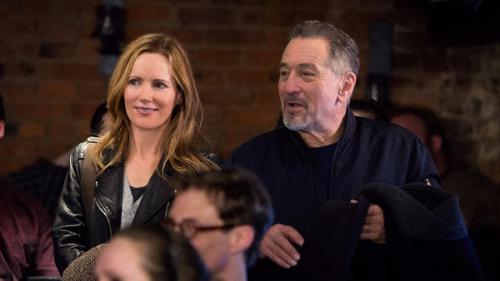
Leslie Man, Robert DeNiro

Leslie Man, Robert DeNiro

“THE COMEDIAN”  My rating: D

119 minutes | MPAA rating: R

While I can’t definitively say that “The Comedian” is the worst film of Robert DeNiro’s career, I can safely pronounce it one of the least enjoyable.

An alternately irritating and alienating effort that threatens to trash the reputation of everyone involved — and we’re talking lots of big names — “The Comedian” finds DeNiro playing Jackie Burke, a comic whose best days are long behind him.

Jackie’s claim to fame is a ‘70s TV sitcom called “Eddie’s Home.” Nearly a half-century later he’s still besieged by fans who call him Eddie instead of Jackie.  He’s got a thin skin — which is how he comes to punch out a heckler at a regional comedy club, followed by 30 days in the hoosegow.

Jackie is a pain in the ass to be around. An insult comic on the stage, he’s not much better in his personal life. He’s combative, angry and royally pissed at the miserable state of his career.

Now that might be palatable if we thought Jackie had some real talent. But this is one of those films where the comics in the movie tell jokes that would never get them a gig in the real world. And Jackie is the least among them.

Once out of stir, Jackie must fulfill 100 days of community service in a soup kitchen. There he meets  the ditzy Harmony (Leslie Mann), who is paying off her debt to society for assaulting her ex’s new girlfriend.

Their relationship…well, it’s not exactly love, but it’ll have to do.

(more…)

Read Full Post »

 ** as Roberto Duran

Edgar Ramirez as Roberto Duran

“HANDS OF STONE” My rating: C+

105 minutes | MPAA rating: R

“Hands of Stone” is  “Raging Bull” lite — a boxing biopic minus the genius of Martin Scorsese.

But it does have Robert DeNiro.

Written and directed by Venezuelan Jonathan Jacubowicz, the film takes on the troubled life and career of Roberto Duran, the Panamanian pugilist whose ring experiences were as much a product of his dysfunctional childhood and Third World resentments as they were of hard sweat and tremendous innate talent.

In a decade of championship fighting, Duran held the lightweight belt, engaged in a long-running war of words (and blows) with American champ Sugar Ray Leonard, and sometimes  behaved in private and in the ring like a spoiled child.

“Hands of Stone” feels like an attempt not to excuse that behavior but to put it in perspective.

Early scenes establish Roberto as the son of an American soldier who impregnated his mother and then vanished, setting  up in the future boxer a lifelong antipathy toward the United States.  That fury was only stoked by political upheaval in Panama over efforts to take back the Canal Zone from the gringos (the American-run canal, guarded by U.S. soldiers, effectively divided the country in half).

We see the young and charming (also unschooled and illiterate) Roberto (played as an adult by Edgar Ramirez) wooing a wealthy blonde schoolgirl, Felicidad (Ana de Armas), and starting a family even as his career is taking off.

In a sense “Hands of Stone” is a dual biography, its second subject being boxing trainer Ray Arcel (DeNiro).

When in 1971 he first saw Duran fight, Arcel had been out of boxing for nearly 20 years. In the early ’50s he had incurred the wrath of the mobsters (represented here by John Turturro) who ran the boxing business. He barely survived an assassination attempt and was allowed to live only if he steered clear of the fight game.

But he’s so moved by Duran’s potential that he gets the Mafia’s permission to train the kid with no pay.

Roberto is cocky and tough and at first resents the discipline Arcel demands. But slowly he begins to see his trainer’s genius, especially when it comes to mapping out the strategies that can win or lose a fight.


(more…)

Read Full Post »

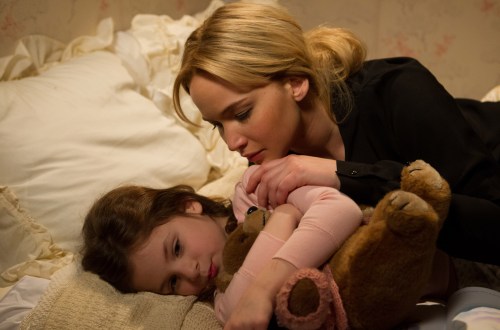
Joy (Jennifer Lawrence) comforts her daughter, Christy, in JOY.

Joy (Jennifer Lawrence) comforts her daughter, Christy, in JOY.

“JOY”  My rating: B

124 minutes | MPAA rating: PG-13

The rags-to-riches story, a key element  of American mythology, usually concludes with  dreams realized and a bright future ahead.

Leave it to David O. Russell and his perennial muse Jennifer Lawrence (they collaborated on “The Silver Linings Playbook” and “American Hustle”) to poke around in the dark aftermath of dreams that come true.

“Joy” is inspired by the true story of Joy Mangano, a single mother who rose from poverty to multimillionaire after inventing the self-wringing Miracle Mop.

But Russell uses Mangano’s “inspirational” story as a launchpad for a mostly fictional comedy of dysfunction. Then he follows it up with a near-tragic look at how success brings its own set of difficulties.

Joy (Lawrence) has a spectacularly messed-up family. For starters this young woman is perennially flirting with financial and personal disaster. She works as a ticket clerk for a big airline, a gig that results in daily insults from the flying public. And she’s about to be laid off.

Bradley Cooper

Bradley Cooper

At home she must deal with two children and a slew of bizarre relations. Her ex husband Tony (Edgar Ramirez), who aspires to be the Latino Tom Jones, lives in the basement where he endlessly plans the big break that will never come.

Joy’s mother Terry (an almost unrecognizable Virginia Madsen) refuses to leave her bedroom and spends most waking hours watching the TV soap operas she has carefully videotaped. (A running gag finds real former soap stars like Susan Lucci and  Donna Mills appearing in the absurdly awful shows to which Terry is addicted.)

Joy’s father Rudy (Robert DeNiro), operator of an auto repair shop and an Archie Bunker-ish racist, is once again on the romance market, his latest marriage having gone belly up. He is reduced to taking up an uneasy residence in Joy’s cellar with his former son-in-law.

Joy’s stepsister Peggy (Elisabeth Rohm) has all sorts of sibling issues.

The only person in the house who seems halfway normal is Grandma Mimi (Diane Ladd), who has always predicted greatness for Joy and narrates the story — even from the grave. (more…)

Read Full Post »