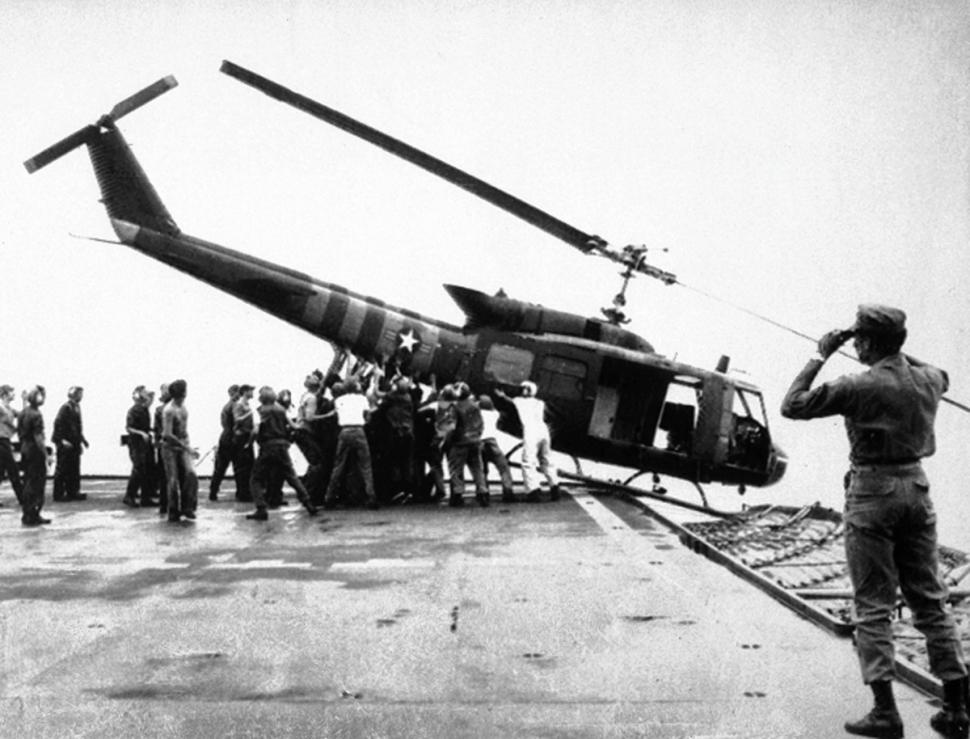
U.S. naval crews jettison helicopters to make more room for evacuees
“LAST DAYS IN VIETNAM” My rating: B
98 minutes | No MPAA rating
Rory Kennedy’s “Last Days in Vietnam” is a riveting and rather depressing bit of history.
For the last 40 or so years Americans have avoided taking too close a look at Vietnam, the first military conflict in our history in which the U.S.A. did not emerge victorious. Kennedy’s documentary brings to life the final closing chapter of that sad story, and even among the chaos and defeat finds moments of extreme heroism.
The 1973 Paris Accord was supposed to have ended the war in Vietnam, allowing American troops to withdraw as part of Richard Nixon’s “peace with honor” pledge to the nation. Secretary of State Henry Kissinger envisioned a situation not unlike that in Korea, with a Communist Vietnam in the north and a democratic government in the south, each staying to their side of a demilitarized zone.
The peace held, we learn, because the Communists were terrified that Nixon was looking for a provocation to go Medieval on the North — heavy bombing raids or perhaps even the nuclear option.
But when Nixon resigned in 1974, a victim of the Watergate affair, leaders in North Vietnam saw their chance. They launched a new invasion of the South.
President Gerald Ford asked Congress to authorize millions to shore up the South Vietnamese military. But after more than a decade of a hugely unpopular war, members of Congress weren’t about to throw more money into the maw.
As the Communist troops advanced southward, Americans still in Vietnam had to face the likelihood that there would be mass executions of locals who had worked for or with the United States. It was, says one former CIA operative, a “terrible moral dilemma…Who goes? Who stays?”
The first priority was the nearly 7,000 Americans still in the country, many of them with Vietnamese wives and children. Then there were the United States’ allies and collaborators — nearly a half million of them when you include their families.
 Butler's Cinema Scene