Feeds:
Posts
Comments

Posts Tagged ‘Sam Worthington’

Anya Taylor-Joy, Tom Burke, Chris Hemswoth

FURIOSA: A MAD MAX SAGA”  My rating: B (Max)

148 minutes | MPAA rating: R

For millions of Marvel geeks around the globe Chris Hemsworth will always be Thor, superhero/god/party animal.

His best performance, though, may very well be as the heavy in “Furiosa: A Mad Max Saga.”  

In this prequel to “Mad Max: Fury Road” Helmsworth plays Dementus, the latest in a long line of desert-roving barbarian gangster-kings who for four decades have populated writer/director George Miller’s post-apocalyptic landscape.

The difference is that Helmsworth’s Dementus — while just as brutal as any of these other troglodytes  — seems to have been a PhD candidate before the collapse of civilization.

He’s witty. Erudite. Appreciates irony and sarcasm. 

In short, he’s a hoot.

Of course, “Furiosa” isn’t really his story.   As played by Charlize Theron in “Fury Road,” Furiosa was a sort of female trucker/gladiator with one metal arm, a shaved head and a feminist’s disdain for the testosterone-fueled circumstances in which she finds herself.  This latest film chronicles her early years.

It begins with Furiosa as a young girl (Alyla Browne) living in a rare green paradise.  She’s kidnapped by marauders led by the muscled Dementus; when her mother is savagely executed after a failed rescue attempt, the girl starts laying plans for revenge.

It’ll take 20 years and the first hour of the movie before the role is taken over by Anya Taylor-Joy, who is given almost no dialogue but gets a lot out of her androgynous slow burn.

To be honest, I found the first 20 or so minutes of “Furious” to be a bit sub-standard.  The crude, one-dimensional villains are interchangeable; even the stunt work and special effects struck me as unconvincing.

But after a while things improve (or I finally clicked into the movie’s wavelength) and “Furiosa” comes to life with several extended action sequences that’ll have viewers rubbing their eyes in disbelief.

Several characters from “Furiosa” appear here in slightly younger incarnations (they’ve got great names like Fang, Smeg, Scrotus and Rictus); new to the scene is Tom Burke as Praetorian Jack, a leather-clad teamster who teaches our heroine how to drive those iconic big rigs.

“Furiosa” is a very elaborate revenge melodrama. But it’s done with such visual and, surprisingly, verbal aplomb that I could happily watch it again.

Kevin Costner

“HORIZON: AN AMERICAN SAGA – CHAPTER 1”  My rating: B- (Max)

181 minutes | MPAA rating: R

Only weeks after it flopped at the box office, the first of Kevin Costner’s four “Horizon” films is streaming.  It’s not bad.

Which isn’t to say it’s good. Not yet, anyway.

Watching Part I of “Horizon” is like reading the first few chapters of a novel and then losing your copy. It introduces characters and sets up potential developments…but feels scattershot and incomplete.

May I suggest that it never should have been planned as a theatrical release, that it would be much better served (and easier to digest) as 12 one-hour episodes on some streaming service?

Well, here’s what we’ve got so far.

The Horizon of the title is a town in Arizona. As the film begins in the late 1850’s a surveyor and his family are laying out the parameters of their proposed burg.  The local Apaches have other ideas.

Indeed the action highlight is a nighttime raid on Horizon — little more than a collection of tents — that leaves all but a handful of settlers dead and scalped.  

One of the few survivors is the newly widowed Frances Kittredge (Sienna Miller), who after the raid must be dug out of a collapsed escape tunnel from her family’s cabin. Her rescuer is Lt. Trent Gephart of the U.S. Cavalry (Sam Worthington); a romance may be in the works.

Another plot thread:  Old hand Hayes Ellison (Costner) finds himself protecting a young prostitute (Abbey Lee) and an infant who are being sought by the child’s murderous stepbrothers (Jon Beavers, Jamie Campbell Bower).

Meanwhile a wagon train wends its way across the prairie, with the wagon master (Luke Wilson) frustrated by a young woman from the East (Ella Hunt) whose entitled attitude threatens the survival of the entire party.

A teenage boy who lived through the opening massacre (Hayes Costner, the director’s son) ends up riding with a seedy bunch of scalp hunters led by a scuzzy killer (Jeff Fahey). Their M.O. is to raid Indian villages while the warriors are off on hunts; each scalp can be redeemed for cash.

Finally, we spend some time with Apaches warriors (Owen Crow Shoe, Tatanka Means) who disagree on how to deal with the white tide breaking over their lands.

That’s a lot of narrative elements, none of which come close to being resolved in this initial three-hour movie.  New characters are introduced with head-spinning regularity (Jena Malone, Danny Huston, Will Patton, James Russo); we barely get to know any of them.

This means what while “Horizon” is crammed with visual wonders (the cinematographer is J. Michael Muro) it has very little feeling beyond the terror of an unpleasant death.

Only a couple of times does the script (by Costner, John Baird and Mark Kasden) strike a satisfying emotional note.  One of these is delivered by Michael Rooker, the heavy of countless movies and T.V. shows, who has a brief, quietly heartbreaking moment as a crusty-but-kind Army sergeant recounting the death of one of his offspring.

As director, Costner gives us many a pretty picture but not a lot of narrative coherence.  He borrows freely from the John Ford playbook — there’s a community dance (a staple of just about every Ford Western), an army outpost and dozens of flat-topped mesas that evoke the Monument Valley outcrops so iconic from “The Searchers” and other titles.

But there is simultaneously too much story here…and not enough.

At this point Costner has already finished the second film and is working on the other two.  Indeed, “Horizon – Part I” ends with five minutes of scenes from the upcoming installments.

I’m looking forward to seeing them in quick succession. Perhaps then Costner’s master plan will become clear.

| Robert W. Butler

Read Full Post »

“AVATAR: THE WAY OF WATER” My rating: B (In theaters)

192 minutes | MPAA rating: PG-13

“Avatar: The Way of Water” is — no surprise here — a world-class display of high-end cinema technology. Not to mention a down-to-the-molecular-level example of imaginative world-building from writer/director James Cameron.

These triumphant elements are at the service of some largely underwhelming melodramatics marked by vast narrative digressions that push the film’s running time past the three-hour mark, a boatload of woo-wooish environmental attiitude, and some really tin-eared dialogue.

So the film is a tossup between eye-popping/mind-boggling thrills (the action sequences MUST be seen in 3-D…there’s no reason to watch the movie, otherwise) and (for me, anyway) duh-inducing narrative elements.

I’m satisfied to have seen it once.

“The Way of Water” unfolds approximately 15 years after the events of the first “Avatar” — which not so coincidentally is about how much time this sequel has been in production.

Hour One:

The film’s original hero, Jake Sullivan (Sam Worthington), has settled nicely into his avatar body, becoming a chieftain of the Na’vi, the blue-skinned cat-faced humanoids of the planet Pandora. He and his mate Neytiri (Zoe Saldana) now have four children ranging in age from wee one to adolescents.

Every day is just another day in paradise until — oh, crap — the skies light up with the return of the Sky People (homo sapiens, that is), most of whom were driven out at the end of the original movie. They’ve spent the last decade planning new ways to plunder Pandora’s rich natural resources.

The script (by Cameron, Rick Jaffa and Amanda Silver) dishes an intriguing element early on with the re-introduction of Quaritch, the gung-ho militarist played in the first film by Stephen Lang. Quaritch was memorably skewered at the end of “Avatar,” but now we learn that before leaving Earth to meet his demise on Pandora his consciousness was downloaded and has been rekindled in a brand new Na’vi avatar body.

So now he’s big, blue and able to move freely around the planet without the oxygen mask required by humans. And with a squad of avatar Marines he’s eager to follow the plan of his commanding officer (Edie Falco!?!?!?!) to “pacify” the locals and get on with the rape of the environment.

Quarich also practices a form of cliched military speak (“Outstanding!” ” Heads on a swivel, guys!”) that threatened to make my eyes roll back in my head.

“The Way of Water” regularly dishes telenovela-level plot twists. For example, before he died in the first flick Quaritch fathered a child who has grown up in the jungle with Jake and Neytiri’s offspring. This mini-Tarzan, called Spider (Jack Champion), has a head of dreadlocks, a surfer-boy physique and doesn’t seem to be at all handicapped by the need to wear an oxygen mask whenever he’s out and about.

Anyway, a weird father/son dynamic develops between the avatar Quaritch and his sort-of spawn; who will Spider choose…his “dad” or his adopted family?

The film’s first hour is devoted to setting up the situation, introducing Jake’s four kids (turns out puberty pretty much sucks among all species on all planets) and depicting a devastating Na’vi raid on the invading humans. Great action stuff.

(BTW: Sigourney Weaver, who in the original played human scientist Grace Augustine, here provides the voice and motion capture performance of Jake’s adopted teenage daughter, Kiri. Apparently Kiri is the child of Grace’s Na’vi avatar. If you’re a major “Avatar” devotee, that’s probably important information.)

Hour Two:

Unfortunatlely, Jake’s routing of the Earthlings makes him a marked man. Lest the wrath of the Sky People come down on his forest-dwelling tribe, Jake and his brood climb on their flying reptiles and relocate hundreds of miles away to an island chain where they hope to live in peace.

The locals there, led by Tonowari and his wife Ronal (Cliff Curtis, Kate Winslet), are Na’vi, but different. Instead of blue skin theirs is kinda greenish, and instead of five fingers they have only four…their hands are more like paddles, which comes in handy since they spend so much time underwater.

So the film’s second hour is a sort of “Swiss Family Robinson” adventure as the newcomers overcome resistance to be slowly accepted by their new community. And there’s lots to learn about surviving in a largely liquid environment, which gives Cameron plenty of opportunity to create an aquatic world filled with mind-blowing beauty.

However at this point the film threatens to bog down in a serious case of Wesley Crusher Syndrome. Remember the first season of “Star Trek: The Next Generation,” when every episode seemed to center on teenage ensign Wesley Crusher instead of something actually interesting? Same thing here. The kids, sorry to say, aren’t that interesting…even if one of them does befriend a rogue Tulkan, a whale-like creature with super-human intelligence. (If you’re going to cap your movie with an epic sea battle, doesn’t hurt to have a whale-thingie fighting on your side.)

Hour Three:

Quaritch and his goons finally track Jake down. Basically they commandeer a whaling vessel used to harvest a precious oil from the Tulkans…apparently this stuff halts human aging. An entire sequence is devoted to a Tulkan hunt, which looks awfully familiar if you’ve ever seen “Moby Dick.” And since the Tulkans are feeling, intelligent creatures it’s just one more example of human cruelty in the name of greed.

The film is capped by a huge battle at sea. You could call it “Titanic Redux” for all the watery lessons Cameron learned on that blockbuster which he puts to good use here.

Despite a draggy middle section, “Avatar: The Way of Water” is generally well-paced and there’s always something interesting to look at. Moreover, Cameron’s technology seamlessly incorporates real humans and computer-generated characters side-by-side. I can’t begin to differentiate between real physical sets and those constructed of bytes.

We’re told that Cameron has begun work on a third “Avatar” movie. I’ll probably go see that one, too.Avatar: The

| Robert W. Butler

Read Full Post »

Andrew Garfield

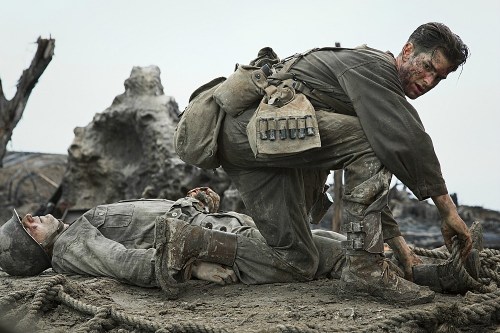
Andrew Garfield as Desmond Doss

“HACKSAW RIDGE” My rating: B+

131 minutes | MPAA rating: R

“Old fashioned” in the best possible sense, “Hacksaw Ridge” is a real-life World War II combat drama that has it both ways.

It may be the most violent film ever released by a major studio, being horrifyingly realistic in its depiction of combat in the South Pacific.

At the same time it is soul-shakingly inspiring.

Brutality and spirituality are unlikely bedfellows, which makes the ultimate triumph of “Hacksaw Ridge” all the more remarkable.

In fact, the film instantly elevates director Mel Gibson back to his one-time status as a major filmmaker. Say what you will about Gibson’s misbehavior and misplaced beliefs, the guy has got the stuff.

Like “Sergeant York,” the reality-inspired classic about the World War I hero, “Hacksaw Ridge” centers on a conscientious objector who ends up winning the Congressional Medal of Honor. It even follows that earlier film’s basic narrative, dividing its running time between our hero’s life Stateside and his grueling combat experiences.

The difference is that unlike Sgt. Alvin York — who finally put aside his C.O. status and became a one-man juggernaut, killing at least 28 German soldiers and capturing 132 others — Desmond Doss practiced non-violence even in the midst of the most ghastly carnage imaginable.

With bullets whizzing around him — quite literally up to his knees in blood and guts — this Army medic singlemindedly went about his business of saving his fellow soldiers.

We meet young Desmond (Andrew Garfield) in the Blue Ridge Mountains of Virginia. Dad (Hugo Weaving) is an unshaved alcoholic still tormented by the sight of his friends being blown to bits during the Great War. Mom (Rachel Griffiths) is often on the fist end of her husband’s anguish.

As a boy Desmond is traumatized after losing his temper and striking his brother  with a rock. Swearing to never again harm another human, he joins the the Seventh-day Adventist Church, whose pacifist doctrines prohibit its members from carrying weapons.

(more…)

Read Full Post »

Left to right: Hailee Steinfeld, ** and Britt Marling

Left to right: Hailee Steinfeld, Muna Otaru and Brit Marling

“THE KEEPING ROOM” My rating: B- (Opens Oct. 30 at the Alamo Drafthouse)

95 minutes | MPAA rating: R

The Civil War drama “The Keeping Room” opens with a quote from Gen. William Tecumseh Sherman to the effect that war is cruel — and that the crueler it is, the sooner it will be over.

Not a happy thought. Not a happy movie.

But despite a tendency toward preciousness, Daniel Bart’s period drama  effectively conveys the desperation, ugliness and moral vacuum of war — not by depicting the chaos of battle but by describing the plight of unfortunate civilians in its path.

Augusta and Louise (Britt Marling, Hailee Steinfeld) are sisters living on their once-prosperous family farm.  But all the men are off fighting for the Confederacy and things are slowly falling apart.  Their only companion is the slave woman, Mad (Muna Otaru).

In better days the sisters no doubt lived pampered lives — Louise, the younger, still exudes the attitude of a spoiled aristocrat — but the war has turned everything topsy turvey.  Now all three women must work the fields if they’re to keep eating.

Meanwhile a pair of  soldiers, Moses and Henry (Sam Worthington and Kyle Soller) are marauding their way around the countryside — raping, stealing and murdering with impunity. They claim they were sent by the Union Army to soften resistance, though it’s difficult to believe their murderous excesses are sanctioned.  Their clothing is a mishmash of civilian items and those scavenged from the dead of both armies. They may simply be deserters out to indulge their worst instincts.

A confrontation between the three women and the killers is inevitable — especially after Moses casts eyes on Augusta at a general store, determines to have her, and tracks her back to the homestead.

(more…)

Read Full Post »

A pre-Oscar Melissa Leo in "Streetwalkin'"

“STREETWALKIN’” (Available Aug. 2)

One of the downsides to winning an Oscar is that the home video industry starts digging through the movies you made early in your career, hoping to peddle some dross as gold.

That’s pretty much the story with “Streetwalkin’,” a 1985 innocent-in-the-big-city melodrama starring the then 25-year-old Melissa Leo.

This was, of course, before Leo registered with TV audiences as a member of the “Homicide: Life on the Streets” cast and, more recently, scored an Academy Award for her supporting performance in “The Fighter.” (more…)

Read Full Post »