
“FOR ALL MANKIND”(Apple+):
Most of what we call science fiction is in fact science/fantasy. But “For All Mankind” is sci-fi in its truest sense. The show, which recently dropped its fourth season, offers an minutely detailed alternative history of the space race.
In this version the Soviets get to the moon first and the Americans must play catch-up. Communism more or less flourishes with a repressive regime in Moscow still railing against capitalism well into the 21st century. Al Gore is elected President; so is a woman—a closeted gay woman.
(“For All Mankind” sees women as key figures in the space program. One could almost call this feminist sci-fi.)
Meanwhile astronauts and scientists from all countries are working to explore the vastness of space, with international colonies established on the moon and Mars. Of course, our conflicts as human beings don’t magically go away when we relocate to distant planets. There are labor issues, rebellions, sabotage.
Basically the series explores where we might be now if only we hadn’t put space exploration on the back burner.
The special effects are utterly convincing and the science completely plausible.
I’m especially impressed at how well certain characters — an original NASA flyboy played by Joel Kinnaman, a genius engineer/supervisor played by Wrenn Schmidt — age over the course of several decades.
The series deals not only in space exploration but in the lives of its many characters. There are failed marriages and affairs. Generational disputes. Political gamesmanship.
The has led some to complain that there’s too much soap gumming up the science. I must disagree…our humdrum human foibles do not evaporate just because we are confronted with the vastness of space.
Throughout, the series never abandons the idea of real science. No laser guns, shape-shifting aliens or woo woo transcendentalism. Just people designing and making machines that reflect the real possibilities of our technology, imaginations and capacity to hope.
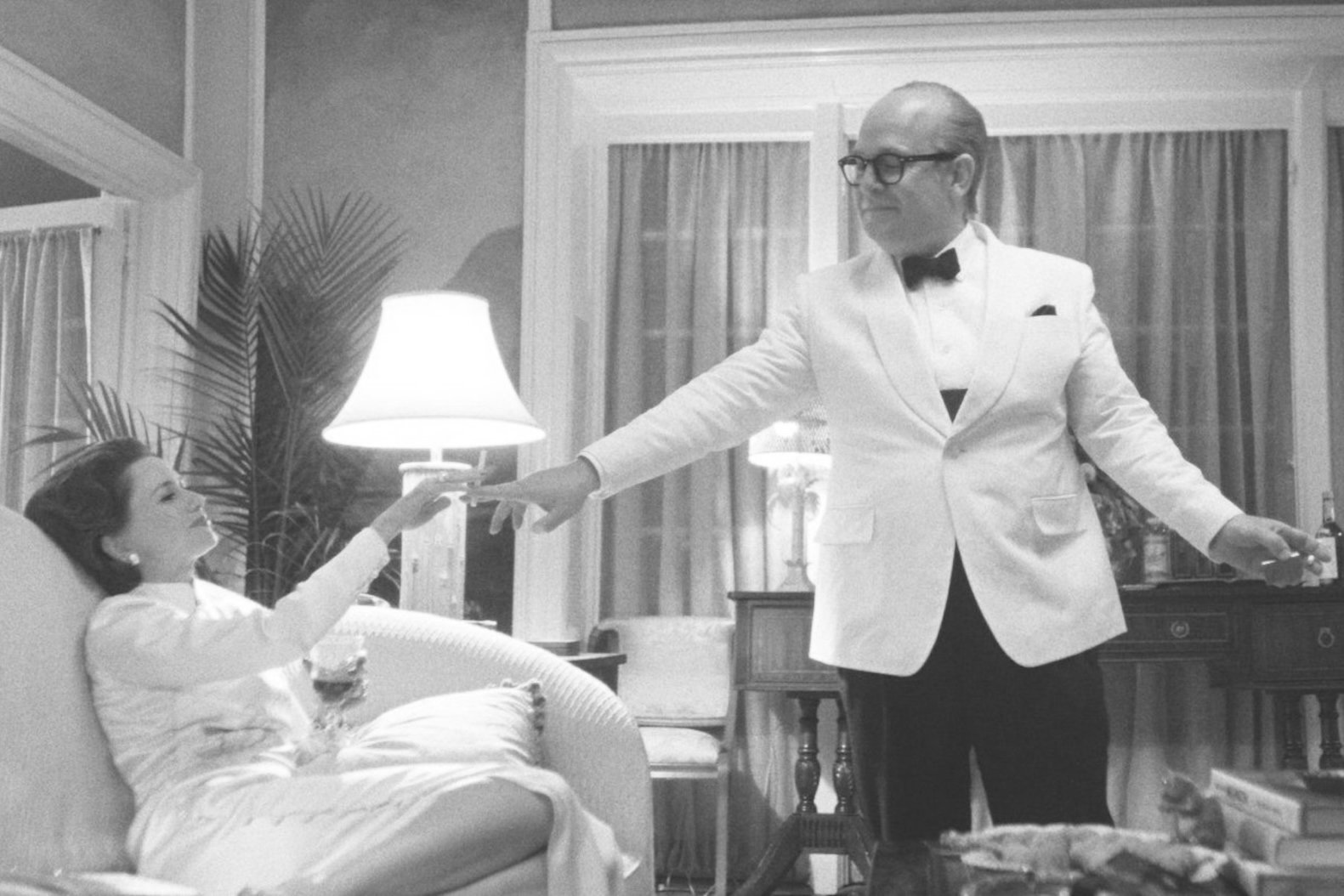
Naomi Watts, Tom Hollander
“FEUD: TRUMAN CAPOTE VS. THE SWANS” (Hulu):
For its second season (the first, in 2017, focused on the antipathy shared by Bette Davis and Joan Crawford during the filming of “Whatever Happened to Baby Jane?”) Ryan Murphy’s “Feud” concentrates on writer/raconteur Truman Capote.
Set in the 1960s and ‘70s, “Capote and the Swans” delves into the novelist’s relationships with a half dozen or so society wives, women married to powerful movers and shakers who, from the outside anyway, appeared to live lives of pampered opulence and studied hautiness.
Capote (portrayed by Brit Tom Hollander with a helium-and-molasses voice and fierce attention to his character’s fey mannerisms) calls his gal pals “the swans” because, he says, they seem so graceful on the surface, while below the water line they are desperately paddling.
These ladies who lunch are portrayed by the likes of Naomi Watts, Diane Lane, Chloe Sevigny, Calista Flockhart and Demi Moore — all of whom appear to be having one hell of a good time mining the bitchiness.
Not that it’s all fun and games. For all their affluence these women are fairly miserable, saddled with philandering hubbies and thankless children. The openly gay Capote becomes their best friend, shrink, confidant and shoulder to cry on.
“I play the part. It’s all a performance,:” he admits in an unusually honest moment. “They pick men who are rich but cannot act.”
Of course Capote —his creative juices dried up — also betrays these women by turning his intimate knowledge of them into a scandalous novel…thus the feud of the title.
Now I’m only halfway trough the season, but the fourth episode, “Masquerade 1966,” is so freaking good — and so beautifully sums up what the series is about — that it’s practically a stand-alone experience.
John Robin Baitz (who has scripted the entire series) has come up with a brilliant idea. He tells the story of Capote’s famous Black-and-White Masked Ball (one of the most memorable if overhyped society events in Manhattan history) by using “found footage” reputedly made by documentary giants Albert and David Maysles.
The entire episode — directed by the great Gus Van Sant — is shot with handheld cameras and captured in grainy black-and-white and in a classic square frame. The Maysles Brothers not only observe the preparations with fly-on-the-wall intimacy, but conduct interviews Capote and with the Swans…each of whom is convinced that she will be the secret guest of honor to be named at the big event.
Clearly, they can’t all be queen for a day, but master manipulator Capote knows how to exploit each woman’s insecurities and desires to his will.
The result is 60 minutes of absolutely brilliant television.
| Robert W. Butler

 Butler's Cinema Scene