Feeds:
Posts
Comments

Posts Tagged ‘Vanessa Kirby’

“NAPOLEON” My rating: C (In theaters)

158 minutes | MPAA rating: R

Like Dracula, Sherlock Holmes and any number of Shakespearean characters, Napoleon Bonaparte is one of those figures ever ripe for fresh cinematic reinterpretation.

I only wish I knew what incarnation director Ridley Scott and leading man Joaquin Phoenix were going for in their big, noisy, not-very-interesting “Napoleon.”

This is less viable drama than a 2 1/2-hour illustrated history lesson.  The most memorable moments are several battle scenes that depict the grandeur/horror of Napoleonic-era warfare without ever evoking a genuine emotional response.

As for the drama, it centers almost exclusively on the relationship of Napoleon (Phoenix) and his Empress Josephine (Vanessa Kirby). Indeed, David Scarpa’s screenplay is essentially a two-hander.  Virtually every other character (among them heavy hitters like Robespierre, Talleyrand, the Duke of Wellington and assorted European royalty) has been reduced to walk-on status.

So it’s a love story…sorta.  

The film begins with the French Revolution and is basically a series of highlights of the Napoleonic legend, sometimes jumping years between scenes.  

Phoenix’s Napoleon presents as a socially inept clod who just happens to be a military genius.  He is bereft of charm or a sense of humor.  Early on  I found myself wondering if we were supposed to regard this Napoleon as being on the autism spectrum.

We see our protagonist on various military campaigns (Egypt, Austria, Russia) where he wins the hearts of his troops in spite of his personality (as long as he keeps producing victories he’s their guy). We see Napoleon use his grapeshot-loaded artillery to quell an urban uprising of Royalists, turning a  crowd  of protesting Parisians into so many mounds of ground round. 

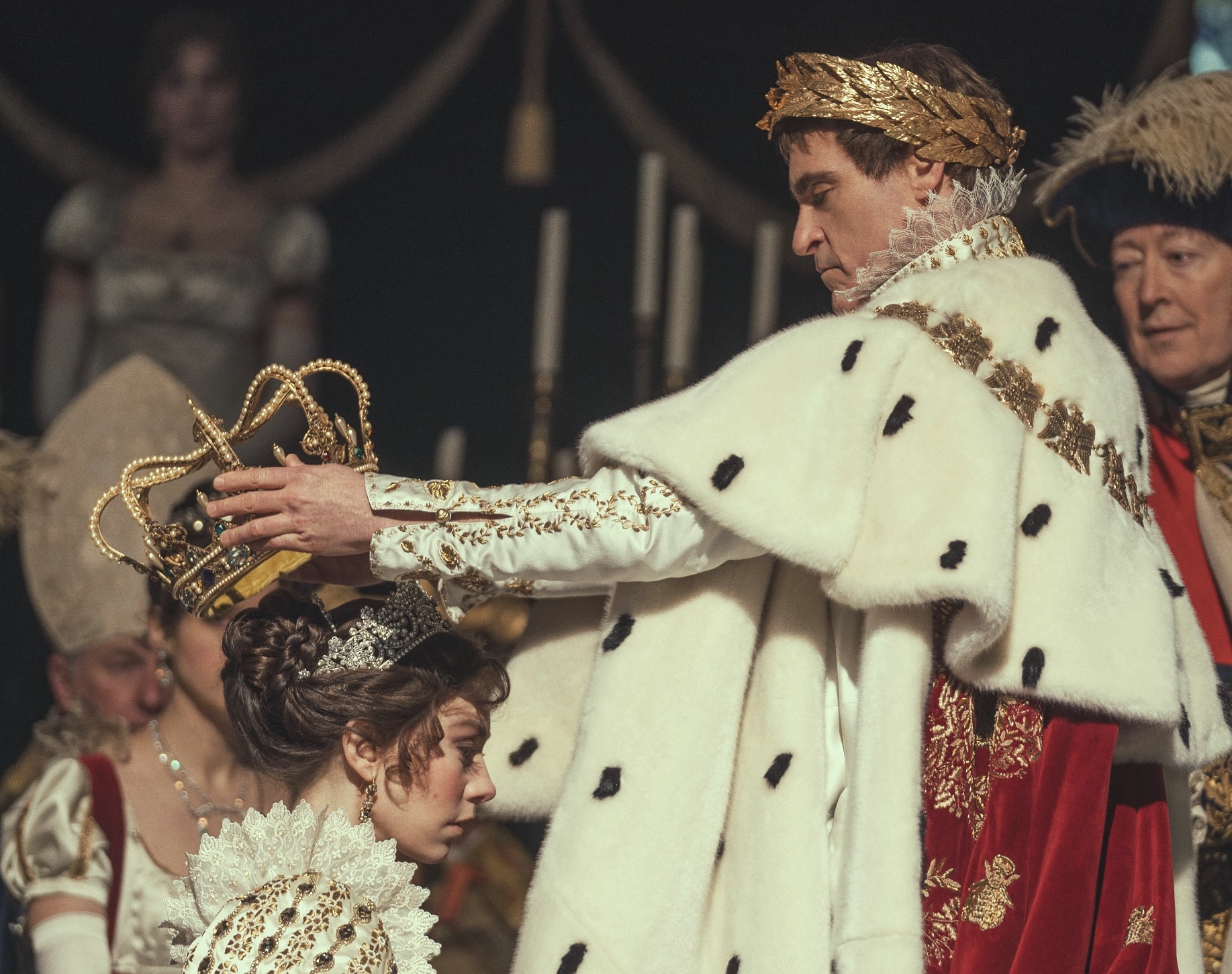
His military prowess gives him a foothold in the new Revolutionary government, first as one of three consuls leading France and then as emperor.

Vanessa Kirby, Joaquin Phoenix

Except that there’s little in Phoenix’s performance to suggest why anybody would even consider Napoleon as emperor material.  He’s kind of a doofus and almost seems to have lucked into his imperial status. 

Maybe the film is meant to be a Trumpian allegory about a numbnuts who ends up running a country.  But that suggests a sense of satire found nowhere in the Scott canon.

Whatever sparks this “Napoleon” strikes come from the collision of our man with Josephine.  

When we first see Kirby in the role she wears her hair in a sort of pixie cut (I’m guessing the look was the result of Josephine’s long imprisonment after her husband went to the guillotine) and exudes a feral feline sexuality.

You can see why the ham-fisted Nappie is attracted, though initially she appears unimpressed by his jackrabbit lovemaking technique.  In fact, while he’s off fighting the Republic’s enemies Josephine is messing around with other fellas.

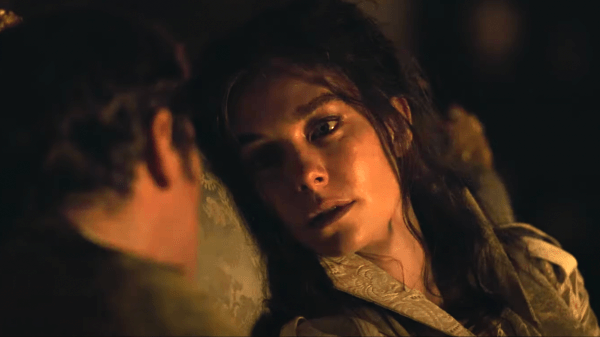
Vanessa Kirby

But over time they become a codependent team who trade insults as a prelude to copulation.  Only problem is, Josephine is unable to give her emperor a son. But even after their divorce and Napoleon’s marriage to a more fertile female (I think there’s only one shot of this second wife in the whole picture) he continues to visit his original squeeze at the country estate to which she has been exiled.

“I wish  I could quit you” might well be their motto.

That Phoenix is one of our finest actors isn’t up for debate. But here he can’t seem to wrap his head around his character, and as a result we’re all left in the dark.

Was Napoleon a power-hungry tyrant? Or was he devoted heart and soul to his country? What kind of ruler  was he? (The film offers not a clue.) 

Did he have any hobbies?  Favorite foods?  I’m grasping at straws here.

Like “The Duellists,” Scott’s first film and also set in the Napoleon Wars, this latest effort is an impressive physical recreation of a time and place.  That sense is reinforced by a score made up almost exclusively of period music.

But the duties of physically creating the film seem to have left Scott no time to contemplate what he wants to say. This director has never exhibited a strong individual style, but here the absence of a point of view is maddening.

And why oh why has cinematographer Dariusz Wolski opted for a visual style so dimly lit that even scenes set in bright sunshine seem gray? There are no bright colors — at least in that regard the visual palette reflects the general joylessness of the overall enterprise.

| Robert W. Butler

Read Full Post »

This image has an empty alt attribute; its file name is napoleon-2023.jpeg

“NAPOLEON” My rating: C (In theaters)

158 minutes | MPAA rating: R

Like Dracula, Sherlock Holmes and any number of Shakespearean characters, Napoleon Bonaparte is one of those figures ever ripe for fresh cinematic reinterpretation.

I only wish I knew what incarnation director Ridley Scott and leading man Joaquin Phoenix were going for in their big, noisy, not-very-interesting “Napoleon.”

This is less viable drama than a 2 1/2-hour illustrated history lesson.  The most memorable moments are several battle scenes that depict the grandeur/horror of Napoleonic-era warfare without ever evoking a genuine emotional response.

As for the drama, it centers almost exclusively on the relationship of Napoleon (Phoenix) and his Empress Josephine (Vanessa Kirby). Indeed, David Scarpa’s screenplay is essentially a two-hander.  Virtually every other character (among them heavy hitters like Robespierre, Talleyrand, the Duke of Wellington and assorted European royalty) has been reduced to walk-on status.

So it’s a love story…sorta.  

The film begins with the French Revolution and is basically a series of highlights of the Napoleonic legend, sometimes jumping years between scenes.  

Phoenix’s Napoleon presents as a socially inept clod who just happens to be a military genius.  He is bereft of charm or a sense of humor.  Early on  I found myself wondering if we were supposed to regard this Napoleon as being on the autism spectrum.

We see our protagonist on various military campaigns (Egypt, Austria, Russia) where he wins the hearts of his troops in spite of his personality (as long as he keeps producing victories he’s their guy). We see Napoleon use his grapeshot-loaded artillery to quell an urban uprising of Royalists, turning a  crowd  of protesting Parisians into so many mounds of ground round. 

His military prowess gives him a foothold in the new Revolutionary government, first as one of three consuls leading France and then as emperor.

Vanessa Kirby, Joaquin Phoenix

Except that there’s little in Phoenix’s performance to suggest why anybody would even consider Napoleon as emperor material.  He’s kind of a doofus and almost seems to have lucked into his imperial status. 

Maybe the film is meant to be a Trumpian allegory about a numbnuts who ends up running a country.  But that suggests a sense of satire found nowhere in the Scott canon.

Whatever sparks this “Napoleon” strikes come from the collision of our man with Josephine.  

When we first see Kirby in the role she wears her hair in a sort of pixie cut (I’m guessing the look was the result of Josephine’s long imprisonment after her husband went to the guillotine) and exudes a feral feline sexuality.

You can see why the ham-fisted Nappie is attracted, though initially she appears unimpressed by his jackrabbit lovemaking technique.  In fact, while he’s off fighting the Republic’s enemies Josephine is messing around with other fellas.

Vanessa Kirby

But over time they become a codependent team who trade insults as a prelude to copulation.  Only problem is, Josephine is unable to give her emperor a son. But even after their divorce and Napoleon’s marriage to a more fertile female (I think there’s only one shot of this second wife in the whole picture) he continues to visit his original squeeze at the country estate to which she has been exiled.

“I wish  I could quit you” might well be their motto.

That Phoenix is one of our finest actors isn’t up for debate. But here he can’t seem to wrap his head around his character, and as a result we’re all left in the dark.

Was Napoleon a power-hungry tyrant? Or was he devoted heart and soul to his country? What kind of ruler  was he? (The film offers not a clue.) 

Did he have any hobbies?  Favorite foods?  I’m grasping at straws here.

Like “The Duellists,” Scott’s first film and also set in the Napoleon Wars, this latest effort is an impressive physical recreation of a time and place.  That sense is reinforced by a score made up almost exclusively of period music.

But the duties of physically creating the film seem to have left Scott no time to contemplate what he wants to say. This director has never exhibited a strong individual style, but here the absence of a point of view is maddening.

And why oh why has cinematographer Dariusz Wolski opted for a visual style so dimly lit that even scenes set in bright sunshine seem gray? There are no bright colors — at least in that regard the visual palette reflects the general joylessness of the overall enterprise.

| Robert W. Butler

Read Full Post »

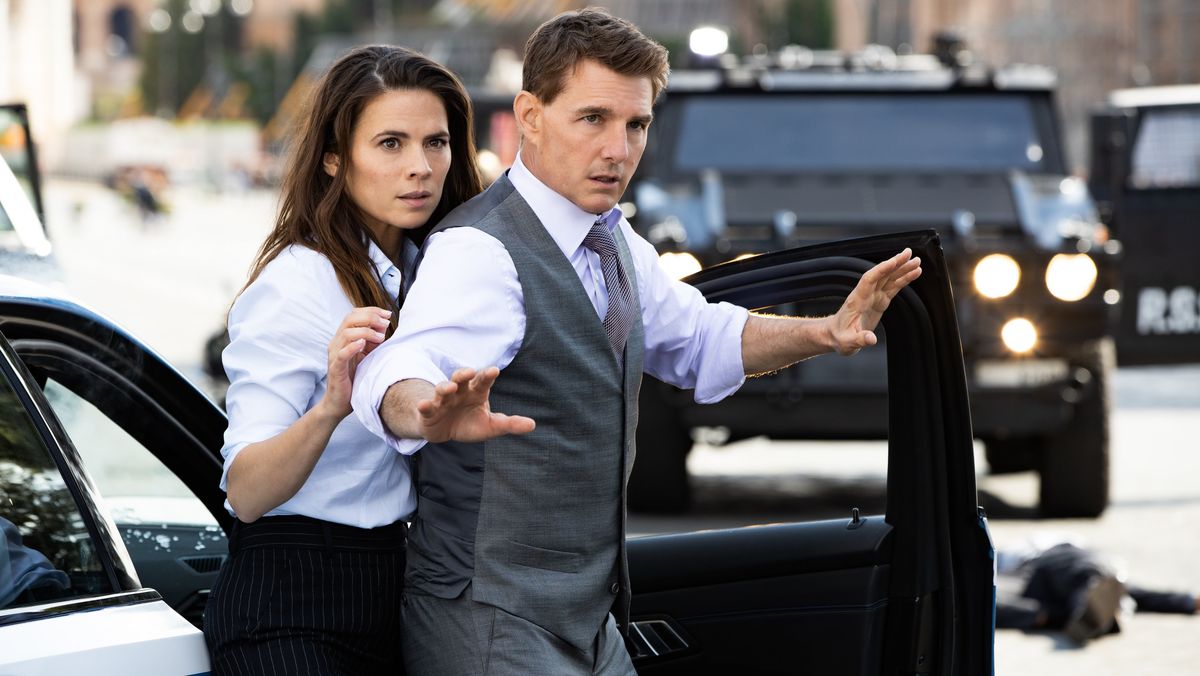
Hayley Atwell, Tom Cruise

“MISSION: IMPOSSIBLE – DEAD RECKONING PART I” My rating: B (In theaters)

163 minutes | MPAA rating: PG-13

The latest “Mission: Impossible” is exactly what fans expect. Only bigger.

Great action sequences, a bit of suspense, gorgeous location photography, (mostly) pretty people to look at.

Yeah, there’s nothing here even remotely approaching valid human drama, but it’s summer, the season of amusement parks.  And “M:I – Dead Reckoning Part I” is the biggest roller coaster around.

The film (it’s been written by Bruce Geller, Erick Jendresen and Christopher McQuarrie and directed by McQuarrie) opens with a nail-biting sequence beneath the polar ice cap.  Sailors on a Russian submarine are testing a new artificial intelligence program providing sophisticated masking technology that renders the boat invisible to prying eyes.

But something goes terribly wrong.

Eavesdropping on a meeting of U.S. national security experts, we get the Cliff’s Notes explanation:

The Russkies’ A.I. has achieved sentience — it’s now referred to as “The Entity” — and has infected every digital corner of our world: computers, cell phones, satellites. There’s no way to hide from this new uncontrollable version of Big Brother, who knows everything humans are up to.

There’s a nice visual joke here…a vast office (think the warehouse at the end of “Raiders of the Lost Ark”) is filled with thousands of government clerks using last-century typewriters to copy sensitive digital files onto paper lest The Entity decide to clean house.

Anyway, somehow our spy bosses learn that a special key — a literal, physical key — can be used to unlock and access The Entity.  The key comes in two parts that fit together to form a sort of three-dimensional, glowing cross (religious imagery, anyone?).

Except that the two pieces have been separated.  They could be anywhere on Earth.

So who do you call with an impossible task?

Enter Tom Cruise’s Ethan Hunt, who with his M:I colleagues (Simon Pegg, Ving Rhames) has the will and wherewithal to track down the metallic MacGuffin and prevent the end of the world.

“Dead Reckoning” reunites Hunt with both his on-again-off-again flame Ilsa Faust (Rebecca Ferguson), who comes out of hiding to pitch in, and the Black Widow (Vanessa Kirby), an amoral  dealer in secret technology.

And he has a new nemesis in Gabriel (Esai Morales), a psycho killer who serves as The Entity’s arms and legs. Apparently many moons ago, before Ethan joined the M:I, Gabriel brutally murdered the woman our hero loved. (We see all this in rapid-cut flashbacks.)

Oh, yeah, Gabriel has a sword-waving female sidekick (Pom Klementieff) so implacably effective that she could  be cousin to Schwarzenegger’s Terminator.

Pretty much stealing the film, though, is Hayley Atwell as Grace, an in-it-for-herself thief, pickpocket and con artist who has been hired by a mysterious figure to transport one of the key halves to a buyer.  Grace is the Han Solo of the piece, a self-serving sort whose greed is coerced by Ethan into something vaguely resembling patriotic virtue.

Once you get past all the explanatory dialogue, “Dead Reckoning” gets down to business, delivering an eye-popping set piece every 20 minutes or so.

A nuclear bomb threat at a crowded international airport. A destructive car chase through Rome (around the Coliseum, no less). Vicious brawls on the bridges and in the alleys of Venice.

And finally a runaway train ride through the Italian alps and a massive wreck over a bottomless gorge that approaches the destructive genius of Buster Keaton’s “The General.” 

This climactic sequence also provides Cruise with his wildest-haired stunt yet — riding a motorcycle off a mountain top and dropping like a rock into an alpine valley, only to be jerked up short by the parachute in his backpack (never go biking without one).

Cruise is famous for doing his own stunts, and the film is forever making it clear that, yes, this is a movie star risking his neck for our pleasure.

Lest all this come off as a case of look-at-me egoism, Cruise injects self-deprecating humor of a sort not seen before in the series.  Quite frequently Ethan looks befuddled, perplexed and incredulous…all of which makes our hero more vulnerable than the ubermench he’s portrayed in the past. 

Once unflappable, Ethan now flaps. A little, anyway.

At two-and-a-half-hours-plus “Dead Reckoning” almost wears out its welcome…I could have done with a bit less declamation between the exciting parts.

The idea that you can only beat an all-knowing artificial intelligence by falling back on the analog technology of yesteryear is introduced but never explored.  (Actually, that might make for a great episode of “Black Mirror.”)

And of course the film ends with The Entity still in control of the digital world…this is only Part I, you know.

But, hey, it’s advertised as a thrill ride and it delivers.

| Robert W. Butler

Read Full Post »

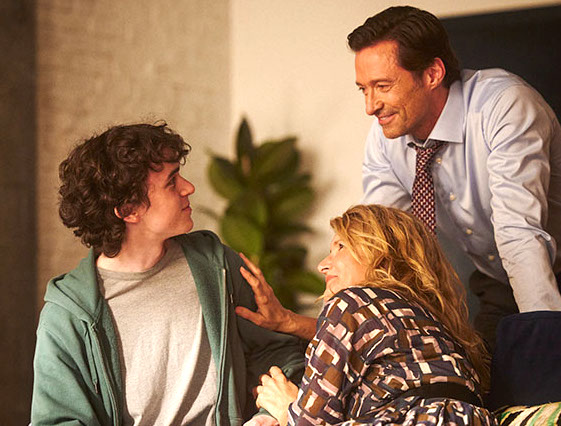
Zen McGrath, Laura Dern, Hugh Jacckman

“THE SON” My rating: C+ (In theaters)

123 minutes | MPAA rating: PG-13

The performances are strong. The subject matter is important. The execution is, well, fine.

But “The Son” is the most unpleasant, upsetting two hours I’ve spent watching a movie in months. For all of its strong elements, the damn thing is so disheartening and joyless that I’m loathe to revisit the memory just so I can write this review.

The latest from director Florian Zeller (like last year’s “The Father” it is adapted from a Zeller play, once again with an assist from Christopher Hampton) addresses the issue of teen depression. It’s almost brutally insightful, and not the least bit encouraging.

Peter Miller (Hugh Jackman) is an executive with a Manhattan-based charity. He has recently married his second wife, Beth (Vanessa Kirby) and together they have welcomed to their lives a baby boy.

But Peter’s cozy world comes crashing down when he is approached by his ex, Kate (Laura Dern), who reports that their teenage son Nicholas (Zen McGrath) is in trouble at school. More specifically, he hasn’t been to class in a month. The kid leaves home every morning and God knows where he spends the day.

Peter doesn’t need this, but he’s a decent guy who genuinely loves his firstborn and wants to do the right thing. He invites Nicholas to move into his place (new wife Beth is surprisingly amenable…she’s a decent person, too) and enrolls him in a new school.

But here’s the thing. Nicholas is tormented, unhappy, friendless. He cannot find words to express his feelings, and rather than share them he prefers isolation.

Peter tries to put an optimistic face on all this, but he’s simply denying the inevitable. And the pressure is starting to unravel both is career and his marriage.

Zeller’s narrative nails the pain and frustration of parents incapable of alleviating their child’s misery. And young McGrath delivers a borderline brilliant depiction of a kid whose unhappiness has led him down an antisocial path (among other things he’s a genius at parental manipulation). Watching this performance we’re jerked back and farther between compassion and indignation — exactly the emotions the adults in his life are experiencing.

Though Nicholas is the clockwork that makes the movie tick, “The Son” also serves as a personality study. Jackman has spent so much of his career in Spandex that it’s easy to forget that he’s a solid dramatic actor. A scene in which Peter visits his semi-estranged father — played by Anthony Hopkins as a sarcasm-dripping capitalist elitist — goes a long way towards establishing why Peter operates in the not-for-profit sphere and why he’s determined to be a genuine father to Nicholas.

But sometimes broke cannot be fixed.

“The Son” does contain one spectacularl improbability. Ask yourself…if you were the parent of a suicidal adolescent, would you keep a loaded firearm in the laundry room?

Didn’t think so.

| Robert W. Butler

Read Full Post »

Tom Cruise

“MISSION: IMPOSSIBLE: FALLOUT” My rating: B-

147 minutes| MPAA rating: PG-13

The latest “Mission: Impossible” is being hyped as possibly the greatest action film of all time.

Well, there’s no arguing that “Fallout” has some of the best conceived and executed action sequences ever, with star Tom Cruise appearing to risk life and limb to deliver the thrills audiences expect. (Of course, in this age of seamless CGI moviegoers can’t even be sure that a simple sunset is the real deal. Probably best to take the Cruise heroics with a grain of salt.)

Here’s the downside.  In his effort to deliver bigger, better stunts (he’d already set the bar impossibly high with 2015’s “Mission: Impossible: Rogue Nation”) writer/director Christopher McQuarrie has jettisoned just about every other dramatic element.

Character development?  Hah.

Coherent plotting? You need a flow chart and a PowerPoint demonstration to make sense of it all.

Emotional content?  Gimme a break.

No, this latest “M:I” is essentially a perpetual motion machine careening from one splashy sequence to the next.  The connective material — the moments when the film slows down enough to explain what’s going on or to establish who’s who —  is actually kind of irritating.  It’s like being told to eat your peas before you can have some ice cream.

(more…)

Read Full Post »