Feeds:
Posts
Comments

Posts Tagged ‘Wes Anderson’

Benedict Cumberbatch

“THE WONDERFUL STORY OF HENRY SUGAR”  My rating: A (Netflix)

37 minutes | MPAA rating: PG

At the risk of committing  cinematic apostasy, I’d like to suggest that in the future Wes Anderson limit himself to short films.

I have come to this conclusion after viewing Anderson’s “The Wonderful Story of Henry Sugar,” 37 minutes of visual and aural bliss emphasizing all that is great about the Anderson style without ever wearing out its welcome.

Hanging  around too long has been the major flaw of Anderson’s recent features like  “Asteroid City” and “The French Dispatch,” quirky whimsy being an elusive thing to sustain over 90 minutes.

But “…Henry Sugar,” based on a short story by the late Roald Dahl, is a pure delight. the ideal marriage of material and presentational form.

It’s not so much an adaptation of Dahl’s yarn as a word-for-word recitation, with the cast members (familiar faces from the Anderson screen universe)  speaking the author’s words directly to the viewer.

What’s it about?  Well, it begins in the yellow cottage in which Dahl (Ralph Fiennes) does his writing.  Dahl tells us the story of “The Man Who Sees Without Using His Eyes.”  

Through a delightful series of interlocking flashbacks (stories within stories within stories…a familiar Anderson device) we follow Imdad Khan (Ben Kingsley), who as a young man in the 1930s became a devotee of a holy Indian hermit and learned to identify objects — like playing cards — even though his eyes have been completely bandaged. 

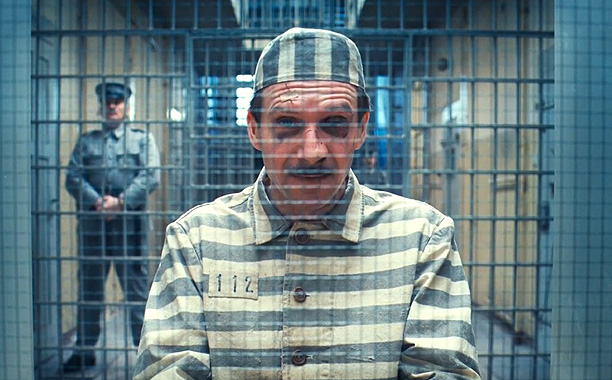
Ralph Fiennes

The adult Khan exploits this skill as one of the main attractions of a traveling vaudeville show. Along the way he becomes the obsession of a physician (Dev Patel) bent on understanding this phenomenon.

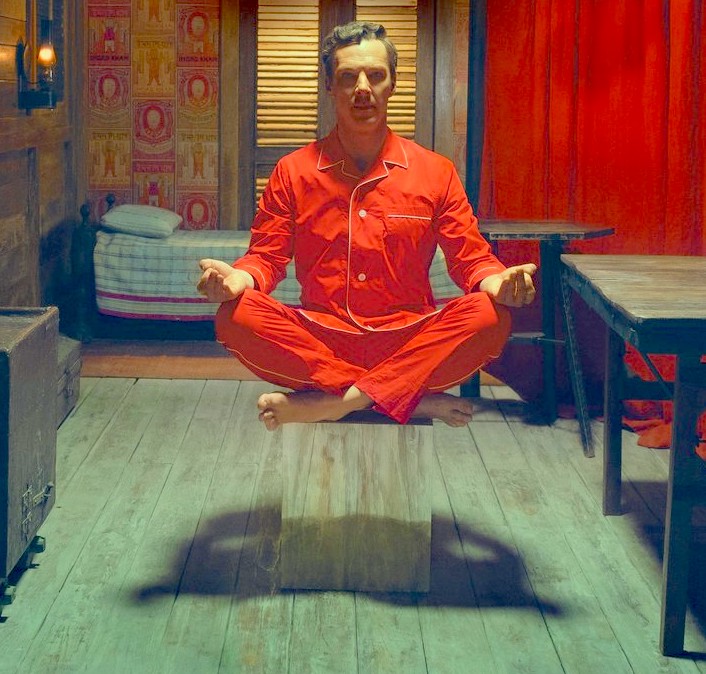
Eventually the yarn turns to wastrel Henry Sugar (Benedict Cumberbatch), an upperclass Brit ne’er-do-well addicted to gambling.  Sugar finds a journal written by Khan in a fellow rich twit’s library, steals it, and studies it for several years with singleminded intensity..

Sugar wants to employ Khan’s remote viewing system to read the cards held by his fellow casino denizens. He pulls it off…only to realize that gambling is no longer thrilling when you know you can’t lose.

The story is oddball charming and even has a nifty moral to it.

And the presentational style is, well, beautiful. The film is awash in pastel eruptions, with sets that often resemble huge doll houses and at other times fold up or open out like gigantic pop-up books.  

| Robert W. Butler

Read Full Post »

Scarlett Johansson, Jason Schwartzman

“ASTEROID CITY” My rain: C+ (In theaters)

105 minutes | MPAA rating: PB-13

“Asteroid City” may be the most Wes Anderson movie ever.

This is a mixed blessing.

Like his last outing, the fragmented New Yorker magazine parody “The French Dispatch,” this is a meta-heavy concoction that leaves the viewer tickled by its cleverly crafted literary conceits but waiting for some sort of emotional edge to emerge from all the whimsey splattered across the screen.

In the decade since his deliriously amusing and unexpectedly moving “Moonrise Kingdom,  Anderson has cleverly exploited a story-within-a-story format (reaching a high point with “The Grand Budapest Hotel”) but only at the expense of often turning his characters into cartoons rather than people we care about. 

“Asteroid City” begins with a 1955 TV broadcast.  An officious host (Bryan Cranston) informs us that this program (recorded in grainy black-and-white) will take us behind the scenes of the creation of a new dramatic work by one of America’s great playwrights. We see theater legend Conrad Earp (Edward Norton) pecking away at his typewriter, and then the scene shifts to full color.

Now we’re watching Earp’s play, “Asteroid City.”  Except that what we’re seeing is waaaaay too big to be contained by a theater stage.  The yarn unfolds in the middle of a vast desert peppered with cacti and the occasional animated roadrunner. Everything seems to be have been dusted with orange sand and bathed in Day-Glo colors  The town’s buildings (gas station, diner, cabin court) seem real enough, but the Monument Valley-ish buttes in the background look like something out of an elaborate pop-up book.

The plot — to the extent that the film has one — goes like this:  Dozens of travelers (drivers with car problems, a  busload of adolescent science nerds and their chaperone)  are stranded in Asteroid City when an alien spaceship descends over the burg’s main attraction, a meterorite crater. This close encounter of the third kind brings a whole lot of armed soldiers; everything goes into lockdown until the authorities can figure out what to do.

But here’s where the meta comes in:  The characters stuck in Asteroid City periodically wander out of the play and into the black-and-white backstage area; now they are actors discussing their performances or preparing to make their entrances.

It works the other way, too.  At one point Cranston’s narrator stumbles into the full color Asteroid City set, looks panicked and quickly sidesteps his way out of the film frame.

Yeah, clever. But we’ve got to care what happens in Asteroid City to fill in the other half of the equation, and we don’t. There are numerous characters whose stories might be compelling, but Anderson’s off-the-cuff style keeps us at arm’s length.

Still, it sometimes looks as if the entire membership of the Screen Actors Guild was hired for the project:  Jason Schwartzman (as a widowed war photographer on a trip with his brainiac teenage son and a trio of young daughters — like the “Sesame Street” version of Macbeth’s three weird sisters); Scarlett Johansson (as a glamorous but vacuous movie star vacationing with her adolescent daughter), Jeffrey Wright (an Army general),  Tom Hanks (the Schwartzman character’s wealthy father-in-law), Rupert Friend (a singing cowboy on tour with his band).

That’s just scratching the surface.  Look also for Hope Davis, Liev Schreiber, Maya Hawke, Matt Dillon, Steve Carell, Bob Balaban, Tilda Swinton, Fisher Stevens, Willem Dafoe, Margot Robbie and, in an inspired bit of casting I won’t give away here, Jeff Goldblum.

There’s some loopily lovely stuff — periodically a car chase between crooks and cops, guns blazing, rips down main street and out into the distance…apparently they’re on an endless loop. And every now and then a loud boom is accompanied by a mushroom cloud blossoming on the horizon.

But “Asteroid City” is eccentric without ever being truly engaging.

| Robert W. Butler

Read Full Post »

“ISLE OF DOGS” My rating: B

101 minutes | MPAA rating: PG-13

So much is going on in Wes Anderson’s “Isle of Dogs” that it’s hard to wrap one’s head around it.

Perhaps it’s best to let our eyes do all the work, for this is one astoundingly beautiful animated film.

Shot with the same stop-motion techniques as Anderson’s earlier effort, “The Fantastic Mr. Fox,” this new entry employs the filmmaker’s usual deadpan humor with gorgeous Japanense-inspired designs and a yarn about human/canine relations.

It’s part sci-fi, part “Old Yeller.”

In an introductory segment designed to look like Japanense screens and woodcuts and propelled by throbbing Japanese drumming, an unseen narrator (Courtney B.  Vance) relates how, after an outbreak of “dog flu” and “snout fever,” all canines in the city were banished by the cat-loving Mayor Kobayashi, head of the ruling Kobayashi clan.

The dogs were transported to an island of trash off the coast where they learned to dig through the refuse for sustenance.

But not all humans are anti-dog.  A few still long for the days of “man’s best friend”; a pro-pup scientist is even developing a cure for dog flu.

The plot proper (the screenplay is by Anderson, who developed the story with Roman Coppola, Jason Schwartzman and Kunichi Nomura) kicks in with the arrival of Atari, the ward of the Mayor who has stolen a plane and crash landed on the Isle of Dogs in search of Spots, his beloved guard dog, who was torn from him by the canine exodus.

The boy immediately teams up with a quartet of puzzled pooches (voiced by Edward Norton, Bob Balaban, Bill Murray and Jeff Goldblum) and the suspicious Chief (Bryan Cranston), who understandably nurses a bad case of anti-human sentiment. (more…)

Read Full Post »

Ralph Fiennes in Wes Anderson's "The Grand Budapest Hotel"

Ralph Fiennes in Wes Anderson’s “The Grand Budapest Hotel”

“THE GRAND BUDAPEST HOTEL”  My rating: B (Opens wide on March 21)

100 minutes | MPAA rating: R

Wes Anderson’s “The Grand Budapest Hotel” is a whopper of a shaggy dog story – or more accurately, it’s a series of shaggy dog stories that fit neatly inside one another like one of those painted Russian dolls.

The film’s yarn-within-a-yarn structure and a delightfully nutty perf from leading man Ralph Fiennes are the main attractions here. I had hoped that “Grand Budapest…” would scale the same emotional heights as Anderson’s last effort, the captivating “Moonrise Kingdom.”

It doesn’t. But there’s still plenty to relish here.

Describing the film requires a flow chart. But here goes:

In the present in a former Eastern Bloc country, a young woman visits the grave of a dead author and begins reading his book The Grand Budapest Hotel.

Suddenly we’re face to face with the writer (Tom Wilkinson), who is sitting at the desk in his study. After a few introductory comments and a brusque cuffing of a small boy who is proving a distraction, the author begins telling us the plot of his novel.

Now we’re in the 1990s in the formerly sumptuous but now dog-eared Grand Budapest hotel in the Eastern European alps. Staying there is a Young Writer (Jude Law) who befriends the mysterious Mr. Moustafa (F. Murray Abraham). An aged empresario who owns several of Europe’s most luxurious hotels, Moustafa keeps the Grand Budapest running for nostalgic reasons.

(more…)

Read Full Post »