 “THE WOODMANS” My rating: B (Opening June 17 at the Screenland Crossroads)
84 minutes | No MPAA rating
How do you compete with a ghost?
That’s the conundrum facing a family of artists in the wake of the suicide of their hugely talented and deeply disturbed daughter.
George and Betty Woodman struggled much of their lives to make it as artists. He was an abstract expressionist painter. She was a ceramicist whose credo was to make useful objects.
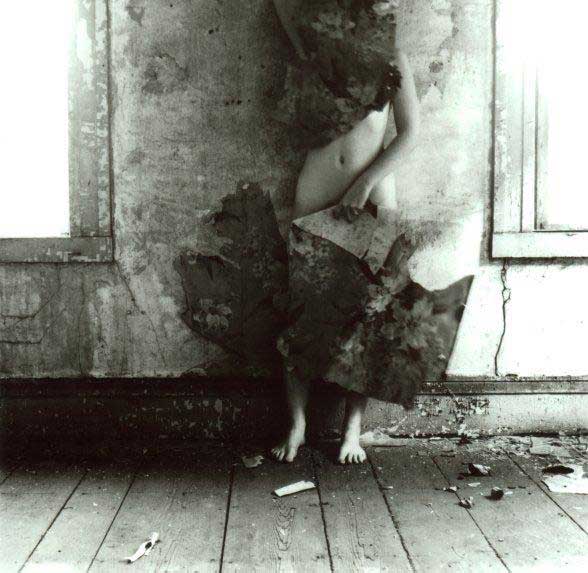
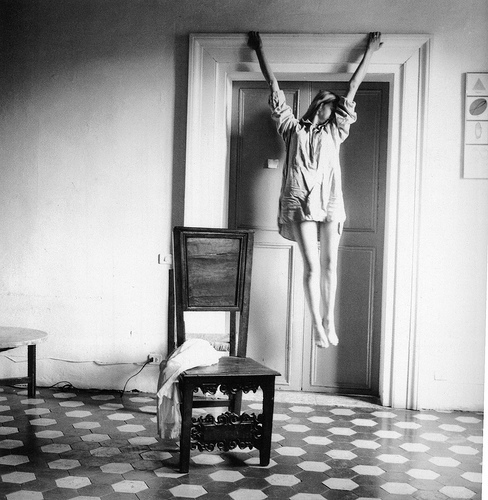
But they were easily eclipsed by their daughter Francesca, who picked up a camera in high school and by the time she was enrolled at the Rhode Island School of Design was already on the way to being one of the 20th century’s great photographers.
Her classmates recall a girl who didn’t come to learn so much as to refine her already established style. Francesca specialized in self-portraits, often nudes, taken in aging rooms with peeling wallpaper and worn floors.
Once seen, Francesca Woodman’s ghostly images are impossible to shake off. I was unaware of her work until seeing Scott Willis’ documentary; now I’m a big fan.
Granted, there’s something a bit “off” about a beautiful young woman who presents herself naked in shabby circumstances, and in fact Francesca was an unhappy person.
 She was emotionally insecure and, apparently, sexually demanding, and upon graduation from RISD quickly slipped into a depression that ended with her suicide (by jumping off the roof of a building) in 1981 at age 22.
Willis’ film allows members of her family — her parents and her artist brother Charlie — to talk about Francesca with 30 years of distance. They’re all well past tearing up over their loss, which makes their cool analyses of both Francesca’s art and her madness seem almost too analytical.
Of course, there may be elements of guilt still hovering over the Woodmans…they recognized too late just how miserable Francesca was.
After her death, though, her art seems to have trickled upward to affect her parents (Charlie deals in electronic new media and exhibits little of the the competitive drive of many artists).
Betty turned away from purely functional pots and other vessels and began making huge installations that incorporate various ceramic panels. Willis’ camera follows her to Beijing where she installs a massive work in the U.S. Embassy.
Truly creepy, though, is the transformation of George’s art. He segued out of abstract expressionism and began taking picture of young nude models in circumstances eerily similar to those captured by Francesca.
You could say he is continuing his late daughter’s work. Or you could say he’s ripping her off. Your choice.
Willis presents all this with a minimum of strum and drang. This is a very objective, non- judgmental film that lays it all out and lets us come to our own conclusions.
One inescapable conclusion: When Francesca Woodman threw herself off that roof, we lost a major talent.
| Robert W. Butler
 Butler's Cinema Scene
It really isn’t that “off” for a woman to examine herself, be this leading to, as you say, presenting “herself naked in shabby circumstances” if she is in fact an artist. An artist, at least in theory, attempts to look at the world in unique and unexpected ways. This would surely include the narrative we project onto supposedly beautiful women. Your comment reflects the prejudice of the male gaze.
I’d agree, except that in the film her parents say they viewed Francesca’s emphasis on focusing almost exclusively on her own body as a warning sign of possible mental/emotional problems.
thank you for saving me the trouble of defending her. it is not odd for an artistic person to do any of the things she did. i’ve DONE many of the things that she did. and it doesn’t have to mean mental illness either. ignorance is so enraging. as i suspect with francesca, she didn’t have a model handy so decided to use herself instead. that’s what i did. people who don’t have a creative point of view just don’t get it. it doesn’t have to mean narcissism or that you’re crazy. it was a pretty practical solution, actually. there is a more sinister interpretation which i’ll leave to the imagination. let’s just say that a lot of victims of child sexual abuse become overly fixated on their bodies and sexuality. “you laugh at me because i’m different, i laugh at you because you’re all the same.” i hope that’s how she felt because it’s true.
Her work reeks of sexual abuse – so sad. Who, when, where did this happen to her? She couldn’t tell except through her art. It’s screaming for justice. Phillips Academy, later found to be a nest of pedophiles? Her father with his creepy interest in nude young females? The influence of Man-Ray (Manny Rudnitsky) and his circle of sadistic misogynists on artists of the era (See Black Dahlia Avenger by Steve Hodel)?