For a Korean, Ken Paik was a very big guy…about six feet tall, I think.
I’m not sure about that. It’s possible that he was only, say, 5-9 and just seemed taller because of the way he filled the space around him.
Ken, who died a few years back after a long career in journalism, was one of the most outrageous personalities I’ve encountered in an industry that thrived on the outlandish.

Robert Butler and Ken Paik in Valdez, Alaska, 1974
He was already a staff photographer for the Kansas City Star when I started working there and over the years we were often teamed for big assignments. I always found these pairings…er, educational.
In those days newspaper photographers had a reputation for over-the-top behavior (it’s no coincidence that the photographer on the “Lou Grant” TV show was called “Animal”) and Ken lived up to the best traditions of his trade.
His father was a high mucky-muck in the Korean government — the minister of education, I’ve heard — and Ken grew up under fairly privileged circumstances. Nevertheless, he enlisted in the Korean Marines, which suggests he wasn’t using Daddy’s reputation to coast.
The Marines of any country are usually a tough bunch, but Korean Marines were something else entirely. They hated Commies and were widely regarded as brutal and ruthless. I’ve been told by Vietnam vets that the Viet Cong weren’t in awe of the Americans, but the thought of being captured by our Korean allies (there were several units from Seoul over there) put the fear of God in them.
Maybe that accounts for why Ken seemed so intimidating. Even on his best behavior he radiated danger. That’s what I mean about him seeming six feet tall even if he wasn’t.
Ken came to the U.S. in the early ‘60s to study at an American university where, he once told me, his first roommate was a former U.S. Marine drill instructor. Thus his primary influence in learning the English language was a guy who found a way to work “c**ksucker” into every sentence.
As in: “Ken, would you pass the c**ksucking ketchup, please?”
As a result of this internship, Ken casually dropped horrifying nuggets of profanity into otherwise bland conversations. I’m pretty sure that by the time I ran into him he was quite capable of controlling this Tourette-like behavior, but I think he got a kick out of watching people’s reactions. (Not that he gave anything away…Ken also loved playing the inscrutable Asian).
You did not want to cross Ken. Once on his shit list, you were doomed. If he thought you were cocky, pretentious or full of yourself, he could make your life miserable.
One of my fellow reporters who came from a long line of celebrated journalists made the mistake of sharing this information with Ken, who concluded this fellow was an egoistic asshole and promptly gave him a humiliating nickname.
When they were ordered out on an assignment together, Ken would stand at the doorway to the newsroom and bellow: “Vomit, get up here!”
My two best Ken Paik stories show his personality to full advantage.
One took place in the mid-70s in Alaska, where Ken and I were sent to do a story on the controversy over building a huge oil pipeline from Prudhoe Bay in the Arctic Circle to the fishing village of Valdez, where the precious stuff would be loaded onto tankers.
Ken was in his element in Alaska because at the time it was a favorite vacation spot for Koreans who wanted to visit the US but didn’t have enough money to swing a trip to the Lower 48. Anchorage was just a puddle jump from Seoul.
That meant that Alaska was full of Korean restaurants, where we ate many of our meals. Ken was crazy about kimchi, a condiment made of cabbage, radish, onion and spices which, he claimed, Korean housewives would put in an earthen pot and bury in the back yard until it fermented to a paint-peeling potency.
I couldn’t handle kimchi, but Ken lived on it.
“How does a Korean know it’s time to eat?” he asked in the middle of one meal.
The answer: “His ass stops burning.”
Anyway, this particular tale takes place on a Friday night in Valdez. We were in a bar full of local fishermen who had returned from the sea with loads of crab, salmon and other seafood delicacies. Now they were unwinding in the local dive.
I was drinking beer and playing the jukebox. Had a nice buzz on.
Then I passed the bar where Ken was talking to a fisherman. I know he was a fisherman because he still had on those big knee-high rubber boots and an untucked plaid shirt.
What I heard Ken saying made my blood run cold.
“So, when you’re out on the boat for two, three weeks,” Ken was asking earnestly, “how d’you know your wife’s not f**king somebody?”
Oh, God, I thought. I’m going to die in Valdez, Alaska.
That was pure Paik. They guy was both tactless and fearless, bringing up in casual conversation the worst nagging anxieties of these seafaring men and then rubbing their faces in it.
Here’s the thing: Ken was an ex-Korean Marine. He’d be just fine in a murderous bar brawl.
I fancied myself a lover. I’d be dead meat in a minute.
Without waiting to hear the fisherman’s reply, I put my half-drunk glass on a table and headed for the door, down the street and straight to our motel, occasionally looking behind me to see if I was being followed by a torchlit lynch mob of pissed-off fishermen.
Several hours later an inebriated Ken showed up and asked where I’d gone.
“Those fishermen are great guys,” he said before falling asleep.
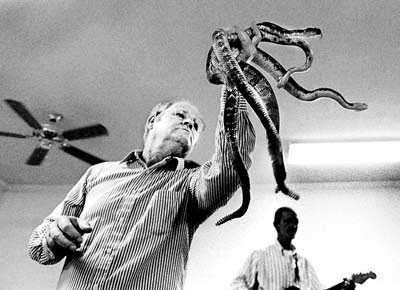
My other great Ken Paik story takes place in rural Tennessee outside Knoxville. The members of a snake-handing Pentecostal congregation made news headlines when the preacher’s brother, trying to prove he was anointed by the Holy Spirit, stirred up a cocktail of water and strychnine, drank it down during a service and dropped dead on the church’s steps.
As a result, the Tennessee attorney general said he was going to court to ban dangerous activities like fondling poisonous snakes or drinking corrosive substances during church services, thus setting up a church-vs.-state controversy.
Our editors thought Ken and I should fly down there and check it out.
Renting a car in Knoxville, we drove deep into the back country down narrow highways abutted by ditches in which old cars dating back to Model T days had been left to rust and sink into the muck. Finally we got to the tiny Holiness church atop a small wooded mountain.
 There we met the head of the congregation, a working-class guy who’d never been to college and told us he’d never said a prayer until he was in his 20s and attended a revival meeting that changed his life.
Now he was a snake handler. There’s a line in the Bible that says that persons anointed with the Holy Spirit can handle poisonous serpents without harm, and members of the Holiness Church believed that by doing so they would prove to non-believers the power of God. The preacher’s faith wasn’t the least bit shaken by the death of his own brother.
(For anyone interested in the subject, I highly recommend Dennis Covington’s Salvation on Sand Mountain: Snake-Handling and Redemption in Southern Appalachia. Covington approached the subject as an academic, got sucked into the life and soon found himself addicted to the spiritual high he got during revival meetings. That’s the controversial aspect of his work…he asserts that certain types of religious mania have all the hallmarks of conventional addiction.)
The preacher took us to an adjacent cemetery where a fresh grave was topped by a massive floral arrangement. Made up of hundreds of blue carnations, it was in the shape of a telephone. A placard announced that “Jesus called.”
I shot Ken a warning glance lest he laugh out loud. He managed to keep his game face and went about methodically photographing the scene.
That night with about 20 other people we attended a revival at the church. There was preaching and Scripture reading. A small band (guitar, organ, drums) pounded out a Gospel tune.
At a certain point in the festivities the assistant preacher — a young guy with greasy hair who looked like he might have come to church after stocking groceries at a local market — danced over to a wooden crate, lifted the lid, stuck his hands in and raised them to show three or four writhing copperheads. He shuffled around with the snakes for several minutes while Ken snapped away, then put them back in their box.
At the end of the service the preacher announced he was taking a special collection. Because of the publicity generated by the church’s situation with the attorney general, he said, it would be a good time to go the extra mile and create situations to further impress nonbelievers.
With that in mind, he was taking contributions with which to buy a blowtorch. At next week’s revival, he said, members of the congregation would take turns passing their faces and hands through the white-hot flame.
There was a pause, and then Ken Paik’s voice rang out from the rear of the church.
He was flapping a $20 bill and shouting: “You can have this if you buy it RIGHT NOW!!!”
Possibly his attitude was deemed too mercenary. In any case the preacher said that the blowtorch should be bought with money provided by church members.
Afterward Ken and I bought a couple of sixpacks with which to unwind and drove to the local drive-in movie theatre. The feature film, appropriately enough, was “Deliverance.”
Ken left The Star in the early ‘80s, becoming the graphics director for the Jacksonville, FL, paper and then director of photography at the Baltimore Evening Sun, where he rose through the ranks to become assistant news editor. In 1992 he became a columnist for the New York City edition of Korea Times.
Along the way he won a World Press Photo award for his coverage of a famine in Ethiopia. He was also given the J. Winton Lemen Fellowship Award by the National Press Photographers Association for his work in the interests of press photography and for outstanding technical achievement in photography.
Ken died in 2006.
| Robert W. Butler
 Butler's Cinema Scene
I really enjoy reading about your work experiences…interesting glimpses of a vocation most of us only dream about. Thanks for writing and posting them!
Thanks for another trip down memory lane … only your memories are better and even more entertaining than mine!
I just jumped on board your blog. This piece shows it’s going to be a great ride. I also recommend Salvation on Sand Mountain–fascinating!
Thank you, Bob, for your lovely eulogy. Would have been a pleasure to have known Ken Paik. Thank you for allowing us all a glimpse. Keep it up!
Enjoyed the reverie. . . and I love kimchi. Still not a fan?
This is a wonderful recollection. I knew Ken when he was in photojournalism at the University of Missouri. He hired me just a few months before he left the Star. His presence was as bold as his profanity. It’s sad that he is not with us any longer.
Thanks for the great story. I knew Ken and covered a few stories along side him. Photos of him that I shot are here http://home.everestkc.net/dejavu/paik/index.htm
Keep those memories coming via ink/paper/digital!
Nice piece! Newspapers, I’m sure, were interesting before photographers entered the scene. But, wow, they sure did add a lot when they came through the door.
I, too, really enjoy reading stories about your experiences in journalism!
Gotta say, I read the snake-handling book and hated it. Fits neatly into the fast-blooming genre of contrived memoirs of self-discovery.
That said, enjoying your blog, Bob.
Nice story Robert.
Kwannik Kenneth Paik was an interesting guy to work for and a terrific photo editor. Everytime I went to the Times photo desk with prints his standard comment was “Okay….what else do you have?”
Exactly like a silent film director he DEMANDED that the reader be able to understand the story from the pictures even before the story was read.
Ken was certainly not shy about telling a shooter they had missed something either.
He was a terrific teacher for a young photographer.
Robert has regaled me with these stories of Ken for the last several years and I still pee my pants when anyone ever says, “so, you out there for 2 or 3 weeks…” I wish I could have know Ken by what everyone else has said about him. Thanks Robert for telling this story because I tell EVERYBODY!!
Bob – nice picture of Ken Paik in Alaska. Who’s the young guy next to him?
It was my pleasure to count Paik as my peer, my boss and my adversary, all at the same time. He was a monumental photographic talent, far less so in his people skills, sublime his his subtle manipulation of his bosses at the Star. I miss him to this day and wonder what happened to his family.
Ken Paik told me he played rugby in college in Korea. When he was attending grad school down at Missouri, he walked by the rugby field and saw Mizzou’s club team practicing. I’m sure they must have sized him up as a rugby player and asked him to join them. He told me his response was “That’s not the rugby I learned to play. You c*&@suckers are crazy.” And he didn’t play rugby at Missouri. I don’t think I ever got on his bad side and I remember how refreshing it was to hear him speak the unvarnished truth about some of our fearless leaders at The Star and Times. Good times.
After reading this I fully understand Paik was a complete prick to his staff and other photojournalists. I think he endeavored to be like Edom or Gilka, fellows of the “educatinal elite” for photojournalism, but in fact compete assholes, all of them. Their ethos was to belittle every photojournalist. Dicks, all.
I worked for Paik for 2 years, the most miserable of my life since leaving staff to become an editor.
He was a political and manipulative boss, one I’d not like again.
He also died as Exec Editor of the Korean News, based in LA., a huge staff assignment because of the big Korean population in LA.
Due to his unending consumption of unfiltered Pall Malls and his over the top high B/P personality, it’s no wonder he died.
RIP old boss, you were a piece of workl
Robert, K. Kenneth Paik was my mentor and made me a photojournalist. I studied fine art photography in college and learned journalism and photojournalism on the job.
I remember going into his office with a National Geographic in my hand and saying to him that I should work for them because I could shoot the pictures in that magazine. – After he quit laughing and cussing me, he said that it was not a matter of whether I could shoot those pictures – the true test was WOULD you shoot those pictures. Would I know to be up at dawn for the right light, would I know the ship was going to be in exactly the right place, would I be standing in the right place, would I ask enough question to know what pictures to take. That is the day I started to understand what a photojournalist was and I am glad I had someone like him to help me learn!!
I worked with Ken in Jacksonville at the Jacksonville Journal and The Florida Times-Union, and I could add many stories to curl your toenails!
I first met him when I was in college as an art major. I knew that I wanted to be a photographer, but lacked direction. The lone photo instructor at Jacksonville University suggested that I try for an internship at the JJ (closed in the 80s) & TU. My brother knew the GM at the papers, then owned by Seaboard Coastline RR (where trains never hit cars, instead it was the cars that always hit the trains), and he put in a good word for me. When I met with Ken, he looked over my portfolio and, said “Denny, we don’t shoot much butterflies and mushrooms around here. But, if the GM says to hire you I guess we can figure something out.” I responded that I was not looking to get hired, just an unpaid internship for college credit. He got a perplexed look on his face and said, “When can you start?” So I did my free internship, and then staff photojournalist Gary Parker hooked me up with an internship with an old buddy at the Augusta Chronicle (owned by Morris Communications Corp., ‘er MOCO, who later acquired the TU from the RR). That was a wild three months, in one of the most hot and humid places I have ever been, not to mention extremely Twilight Zonish!
I returned to Jacksonville and met with Ken in search of more direction. He hired me for a paid internship, during which I learned every curse word in the book from Ken, soaked up all I could about journalism, photojournalism, and photo technique from an amazing group including, but limited to – Gary Parker, Walt Stricklin, Scott Robinson, Bo Rader, Gene Sweeney, Greg Smith, among many others. When Gary Parker left for Southern Living magazine he suggested to Ken and photo editor Foster Marshall that they hire me to replace him. My art background afforded me an edge in the photo studio shooting fashion, food and illustrations, all of which were improved by soaking up all I could from Gary. Ken and Foster agreed, and I spent twenty years as a staff shooter and then photo editor at the JJ & TU.
Many of the best stories involving Ken are more than a bit hazy, as I was as inebriated, or more so, than Ken at the time. Since I did not drink while in the office, I recall one instance when Ken let me have it. Not in his office, but smack dab in the middle of the photo department. I had shot some inane assignment involving a man who grew a record sized orange. No great photo, but still I received a call from the Weekly World News. Being exceptionally green, and not having been to journalism school I was not aware that that selling an image to them would be a BIG no no. After the photo ran, the WWN sent a tear sheet with my photo. Paik saw it and hit the roof. “God damn you Denny, get out of my sight. I don’t want to see you.” I scrammed and found out from more than one of my fellow photographers that they too had been a similar position. Ken did not talk to me for a week. I don’t think he was nearly as mad as he put on, but he was intent on teaching me a lesson.
After moving on to Baltimore he called and offered me a job. Being a small town kid, I was not ready for Baltimore, so I stayed and finished my career at the TU. I have no regrets about my time working with Ken, though I don’t know if I could, or would, be able to muster the energy to work for someone like him today!
Ken was bold, abrasive, egotistical, and gave me and a lot of other journalists an education – in more ways than you can imagine. I may not have agreed with all of his ways, but I always felt that – even when he was ragging me – he truly had my best interest at heart. Or, maybe it was just the fact that he called me “cute ass!” (with his Korean accent it came out koot ass) I still wonder if he had lived longer, if he would have mellowed.
I was attending a Photo-J seminar, in Atlanta, I think, in the 70’s. There had been a reasonable amount of drinking the night before. Everyone was in the auditorium and the main presenter had just started with Ken stumbled in with sunglasses on and carrying coffee and loudly announced, “anybody got any White-Out?”
That was absolutely wonderful! Great piece.
As my newspaper career is coming to an end, (buyout by the Baltimore Sun in 25 days) I have time to reflect on a great 37 years in the business; many of them with Ken Paik. I was sent your article by Bo Rader, who I worked with in Jacksonville and Baltimore. It was a great trip down memory lane. I first met Ken Paik at the 1976 Missouri Workshop, then worked for him in Jacksonville, FL until many of us left in 1983. He then hired me at The Baltimore Sun in July of that year which is where I have been ever since.
We had a unique relationship over the years, which ended on a sour note when he left The Sun. By fate, I was able to spend a wonderful afternoon with him just months before he passed away and the relationship was patched up.
He had a heart of gold, but as I tell people at The Sun who have only heard stories; he wouldn’t have lasted a day in today’s work climate. He was from a different time, but his skills and passion for photojournalism is what’s missing now. It’s all about publications getting hits on the web by whatever means possible, which rarely involve great photos.
We had a staff meeting before many of us left Jacksonville and he stated that “he hoped we all enjoyed the last few years, because they will never happen again.” With Ken at the head of the photo department, we ruled the paper. We had a great staff, (as Dennis mentioned earlier,) and he got the best out of us in very different ways.
I certainly owe him my career and over the last few decades I hope I made him proud with some of my work. I think of him often and I am better for working for him.
Gene Sweeney Jr
Sun Staff Photographer (for 25 more days)
Gene: his line – “We had a great staff, (as Dennis mentioned earlier,) and he got the best out of us in very different ways.” – reminds me of a Paik saying when he thought you had done something respectable: “You make my ass shine!”