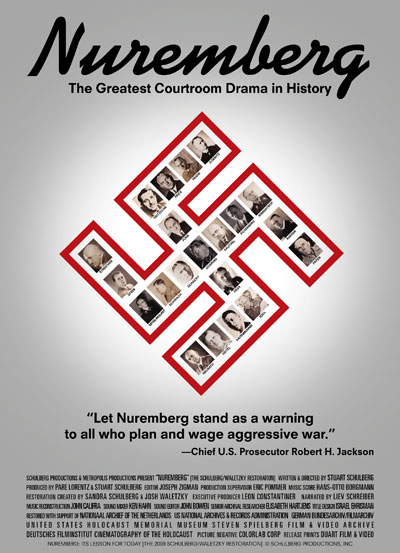
 “NUREMBERG: ITS LESSON FOR TODAY” My rating: B (Opening Nov. 11 at the Glenwood Arts.
76 minutes | No MPAA rating
You can’t really call it entertainment.
Instead, “Nuremberg: Its Lesson for Today” is best viewed as a vital historical document.
Produced shortly after the end of World War II by the U.S. government and shown exclusively to German audiences, the documentary attempted nothing less than a concise summation of Nazi crimes against humanity.
Simultaneously, it provided a look at Western-style justice as embodied in the Nuremberg tribunal where the Third Reich’s military and civilian leaders were tried for their war crimes.
Never intended for domestic audiences, the film was never publicly screened in this country. And almost immediately after its release in Germany it was withdrawn from circulation under mysterious circumstances.
One theory is that the U.S. government was concerned that the film would provoke our Soviet allies. Josef Stalin, after all, was engaging in his own war crimes against civilian populations.
Another theory takes just the opposite tack…that with growing Cold War tensions the film’s praise for U.S.-Soviet cooperation in prosecuting the Nazis was beginning to look like a political liability.
And a third take on the situation suggests that the victorious Allies realized they couldn’t get too high and mighty on the Germans when they were guilty of at least some of the behavior they condemned in the Nazis.
The film opening this week in Kansas City was recently restored by Sandra Schulberg, daughter of original writer/director Stuart Schulberg (she’ll be on hand this weekend at the Glenwood Arts Theatre…see item below). The German narration has been re-recorded in English by actor Liev Schreiber.
What emerges is a hugely effective one-stop history lesson that uses the Reich’s own propaganda films to lay out the madness that led to this worldwide conflagration. The intention was to show angry and demoralized Germans that their unhappy circumstances were not the fault of the Allies but of their own power-crazed leaders.
By spending much time on the Nuremberg trials — among the defendants were Hermann Goering, Rudolf Hess and Albert Speer — the film also highlighted the idea of international cooperation (prosecutors were U.S., Soviet, French and British) and pushed the concept of judicial impartiality. After all, this wasn’t just a kangaroo court: two of the accused Germans were acquitted and released.
Most compelling to modern viewers is the footage of the Nazi’s efforts to exterminate Europe’s Jews. This material — much of it shot by Allied units liberating the death camps, some from the Nazis’ own archives — is wrenching stuff. “Deeply disturbing” doesn’t begin to cover its devastating impact.
| Robert W. Butler
FILMMAKER VISIT
Filmmaker Sandra Schulberg will screen “Nuremberg” at a benefit for the Midwest Center for Holocaust Education at 7:15 p.m. Thursday, Nov. 10, at the Glenwood Arts Theatre in Overland Park. Tickets are $15.
She also will attend regular show times of the film on Friday and Saturday and will hold post-screening discussions.


Leave a Reply