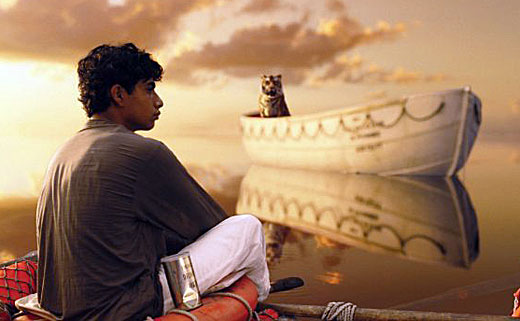
 “LIFE OF PI” My rating: A (Opens wide on Nov. 21)
127 minutes | MPAA rating: PG
If ever there was a novel that defied the journey to film, it is Yan Martel’s 2001 “Life of Pi.”
The narrative presents a daunting logistical nightmare for any filmmaker. Most of the story involves a shipwrecked teenager who spends months at sea sharing a lifeboat with a huge Bengal tiger. It’s the sort of setup that demands the utmost of film technology.
And, in the book’s final pages, Martel introduces the possibility that our young hero is an unreliable narrator, that he has invented this epic yarn to cover a much more tawdry, shameful and shocking reality.
How do you make that work on the screen? I thought it couldn’t be done.
I was wrong.
Ang Lee’s film version of “Life of Pi” is so good on so many levels that it’s unsettling.
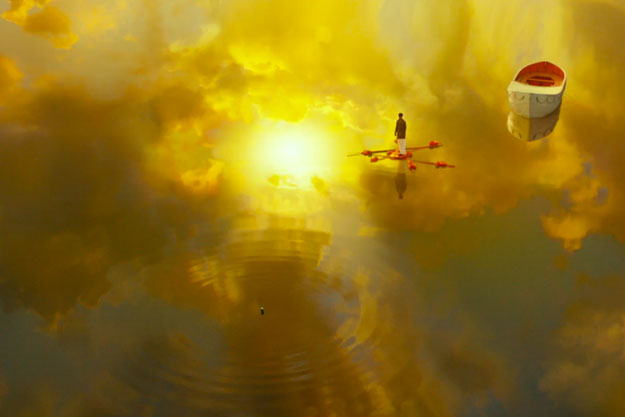
Not only does Lee capture the vast arc of this unconventional survival tale, but he renders it in the best 3-D I’ve ever witnessed (the only thing that comes close is “Avatar”). Moreover, the entire film is a visual tour de force, a panorama of such hallucinogenic beauty that words cannot do it justice.
For mind-blowing visuals it is rivaled only by the acid-trippy “star gate” sequence at the end of “2001: A Space Odyssey.” This film has that sort of impact.
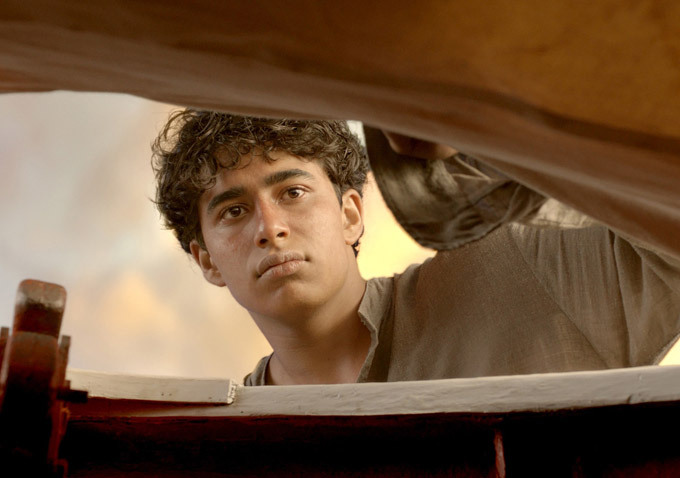 Screenwriter David Magee frames the body of the story as a flashback. In the present the adult Pi Patel (Irrfan Khan) is relating to a new acquaintance (Rafe Spall) the story of his adolescent adventures at sea.
It all begins in India where young Pi (Ayush Tandon) lives with his parents and older brother, the operators of a small but atmospheric zoo. Young Pi is something of a mystic, born a Hindu but also gravitating to Christianity and Islam, much to the chagrin of his atheist father.
 Years later the teenage Pi (the excellent Suraj Sharma) is uprooted when his father decides to shut down the zoo and emigrate to Canada. A few valuable animals are loaded aboard a freighter to be sold to American zoos; foremost among them is the fearsome tiger Richard Parker.
During a fierce storm at sea the freighter sinks and Pi finds himself on a lifeboat with an injured zebra, an orangutan, a fierce hyena, and Richard Parker.
One by one the animals become the tiger’s dinner. Pi survives by building a raft, safely floating a rope’s length away from the boat, carefully rationing the food and water stored aboard.
There are adventures with whales, with thousands of flying fish, with a massive tuna, with sharks. Rainwater is collected and consumed. Horrendous storms pummel the oceangoing refugees.
Most of what Pi is able to harvest from the sea goes to Richard Parker. You don’t want to be in close proximity to a hungry predator.
Through it all Pi struggles to retain some semblance of faith.
Lovers of the novel will find here a faithful film that with its spectacular cinematography (by Claudio Miranda) and astonishing digital effects matches and sometimes exceeds the printed page.
Let’s start with the tiger. Richard Parker is presented through a seamless, absolutely convincing blend of live action photography and computer graphics. When he roars in your face you can feel the heat of his breath. When he lies dying of hunger and Pi strokes his head, you can see each hair pressed down by the weight of the boy’s fingers.
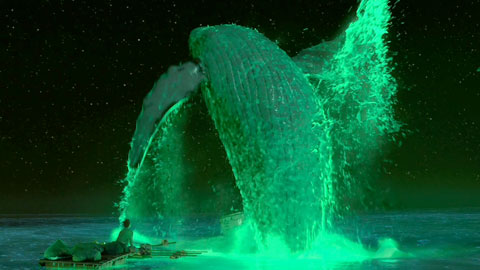 But that’s nothing compared to the ocean/water effects. Repeatedly “Life of Pi” moves beyond super-reality into something practically surreal. Everything is just a bit too bright, too dramatic…it’s almost as if the film had sprung from a Maxfield Parrish painting. Yet it remains totally believable and convincing.
The camera seems to plunge beneath the waves, then look up through circling sharks to caress the rippling surface and the sky beyond. Storm-tossed seas becomes a visual symphony of movement. In the depths phosphorescent sea creatures drift and bob.
Like I said, words can’t begin to express it.
Young Sharma is quietly spectacular as Pi. Think about it…this kid has to hold down a movie pretty much by himself, and for most of it he doesn’t even get to play against another actor. He’s dealing with green screens and digital bytes. And yet he gives us a terrifically strong, well-rounded character.
And then there’s Ang Lee. The guy is a human chameleon who manages to adapt himself to almost any story, any milieu. Here he tackles what is likely the most f/x-heavy project in Hollywood history and emerges triumphant.
This movies works visually, thematically, dramatically. Not only will “Life of Pi” clean up every technical award in Oscar’s house, but Lee should walk off with his second statuette for directing. This is a monumental achievement, one that mines tons of technology to tell a very human story.
Oh, yeah. Spring for the extra bucks to see “Pi” in 3-D. It’s worth every penny.
| Robert W. Butler
 Butler's Cinema Scene
Wow. Thanks. 3d it is. Can’t wait.