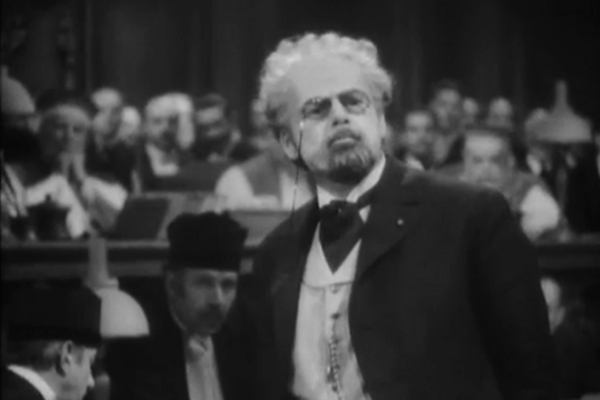
Paul Muni as Emile Zola
“THE LIFE OF EMILE ZOLA”screens at 1:30 p.m. Saturday, Dec. 28, at the Kansas City Central Library, 14 W. 10th St., as part of the film series Muni the Magnificent.
Its title notwithstanding,”The Life of Emile Zola” is anything but a conventional screen biography.
This Oscar winner for best picture could more accurately have been entitled The Dreyfus Affair, for that notorious case of military injustice is the film’s centerpiece.
We’re introduced to Émile Zola (Paul Muni) as a young man living in a freezing Paris garret in the 1860s (his roomie is painter Paul Cezanne) and trying to jump start his literary career.
Making the acquaintance of a weary prostitute, he interviews her, taking notes on her sad story and writing the best-seller Nana. He’s arrived.
The film then shoots forward several decades. Zola is now a well-established author whose naturalistic novels have scandalized many readers and revolutionized writing. As his old friend Cézanne notes, Zola has become fat and complacent.
And then the Dreyfus scandal hits the headlines in 1894.
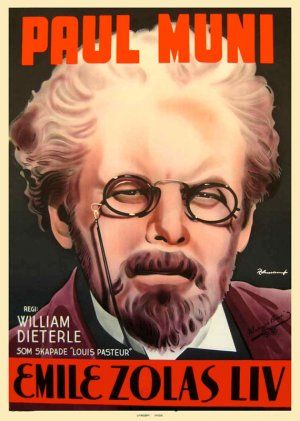 Alfred Dreyfus was a French artillery officer accused of passing military secrets to the Germans. In fact, the military hierarchy knew the identity of the real culprit, but selected Dreyfus to take the fall, largely because he was a Jew.
Unjustly convicted of treason, Dreyfus (Joseph Schildkraut) was drummed out of the service and condemned to a life sentence in the hellish Devil’s Islans penal colony off the coast of South America.
The military, reeling from setbacks on the battlefield, closed ranks to prevent the truth from ever getting out.
Approached by Dreyfus’ wife, Zola is reluctant to get involved. He’d much rather rest on his laurels and enjoy a comfortable dotage.
But his conscience gets the best of him and on the front page of a Paris newspaper he prints his famous essay J’Accuse, in which he takes to task the military, the courts, and the government.
His purpose is to push the perpetrators of the Dreyfus Affair into a corner from which they can only escape by charging Zola with libel. The graying writer hopes that at his trial for libel the truth about Dreyfus will come out.
Well, it didn’t quite work out that way. But eventually Dreyfus was vindicated and returned to his military rank.
Zola died in 1902 in his Paris apartment from carbon monoxide poisoning, apparently from a poorly ventilated heating stove. The movie presents it as an accidental death.
But nearly 20 years after the movie’s release evidence was uncovered that Zola may have been assassinated for his efforts on behalf of Dreyfus. According to the conspiracy theory – about which historians remain divided – a conservative stove-fitting contractor plugged the vent, then removed the blockage after Zola’s death.
Curiously, no character in the film talks about Dreyfus being Jewish, despite the fact that during the actual trial the authorities shamelessly played the anti-Semitism card, inflaming popular sentiments against the accused officer.
Film historians have long wondered about this oversight by the filmmakers, and in recent years some researchers have argued that the big studios practiced self-censorship so as to eliminate any material that might offend Nazi Germany, one of the biggest overseas markets for American movies.
Not only was The Life of Emile Zola named 1937’s best picture, but Schildkraut won a supporting actor Oscar for his performance as the disgraced Dreyfus. The movie also picked up an Academy Award for best screenplay.
In all, Emile Zola received 10 Oscar nominations, including those for best actor (Muni) and director (William Dieterle).
| Robert W. Butler
 Butler's Cinema Scene
Another terrific movie!