
Olivia DeHavilland, Errol Flynn
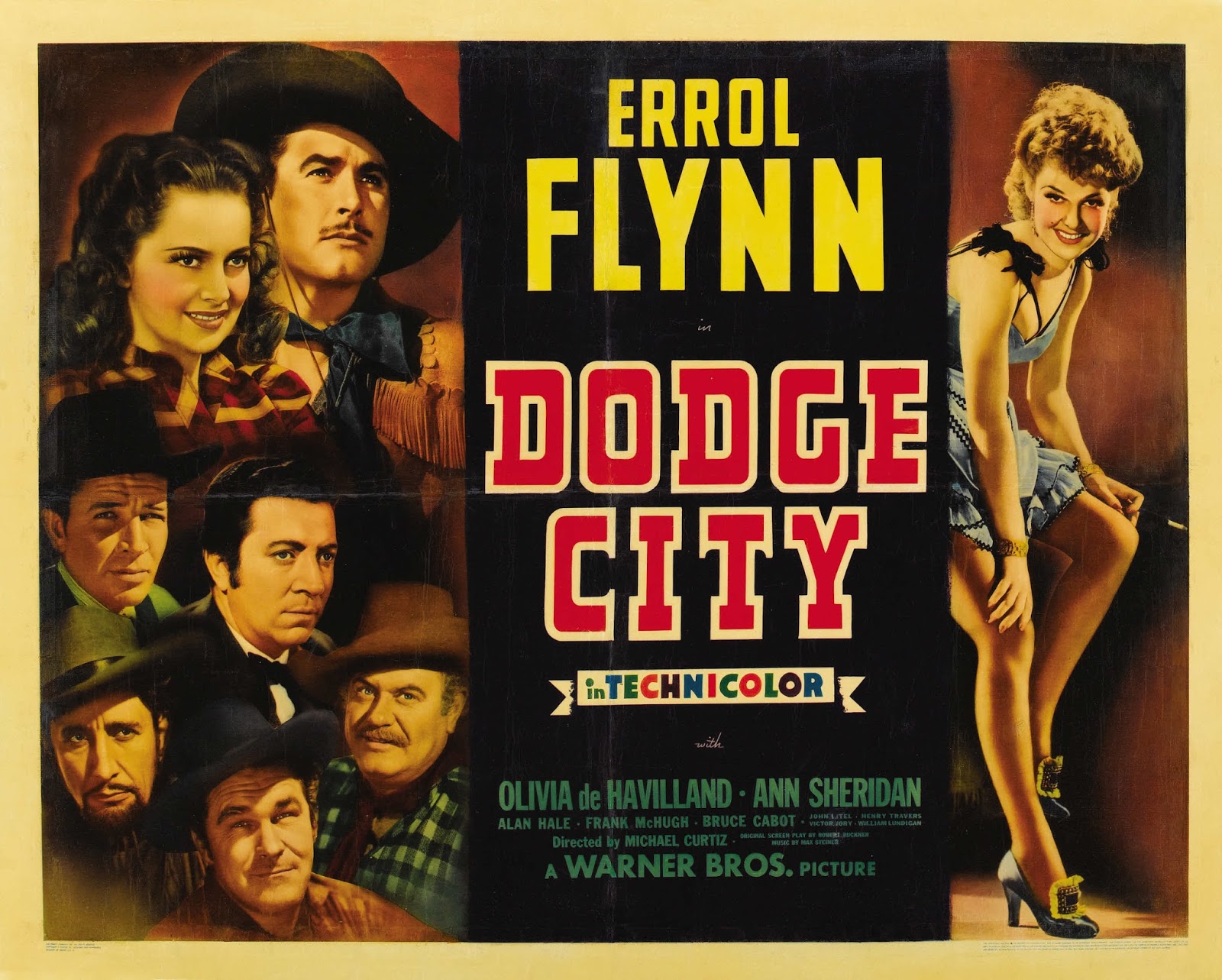
“Dodge City” screens at 1:30 p.m. Saturday, March 1, 2014 in the Durwood Film Vault of the Kansas City Central Library, 14W. 10th St. Admission is free. It’s part of the year-long film sereies Hollywood’s Greatest Year, featuring movies released in 1939.
Depending upon how you choose to view it, “Dodge City” is either a quintessential Western or a shameless collection of cowboy cliches.
It’s got a cattle drive, a stampede, fetching dance hall girls (the main one is played by Ann Sheridan), a wicked gambler (Bruce Cabot) who runs the town like a private fiefdom, a temperance meeting, a running gun battle on a steam-driven train, and a world-class barroom brawl … all of it captured in glorious early Technicolor.
Most of all it features the cinematic three-way of director Michael Curtiz and stars Errol Flynn and Olivia DeHavilland.
Flynn and DeHavilland had been successfully paired in “Captain Blood” (1935), “The Charge of the Light Brigade” (’36), and “The Adventures of Robin Hood” (’38). They would go on to share the screen in a total of eight features, including “Dodge City” (’39) and “They Died with Their Boots On” (’41).
It was widely assumed that the actor and actress were an item. But that was all publicity. DeHavilland was a fairly genteel sort, while the Australian Flynn was a notorious womanizer and drinker whose career barely survived a 1942 trial for statutory rape. His memoir was entitled My Wicked, Wicked Ways.
Still, DeHavilland was not immune to her co-star’s bad-boy charisma. “He was a charming and magnetic man,” she wrote years later, “but so tormented. I had a crush on him, and later I found he did for me.”
In the films they made together Flynn and DeHavilland invariably were directed by Curtiz, an Austrian immigrant who just a couple of years later would achieve screen immortality by giving us Bogie and Bergman in “Casablanca.”
 Despite their many film collaborations (including “The Private Lives of Elizabeth and Essex,” “The Sea Hawk,” “Santa Fe Trail,” “Dive Bomber,” and “Virginia City”), there was no love lost between Curtiz and Flynn. The director thought of his leading man as lazy, little more than an attractive puppet. Flynn saw Curtiz as a humorless slave driver who took all the joy out of the filmmaking process.
Somehow out of that barely tamped-down rancor they made terrific movies.
Getting a handle on the real Errol Flynn isn’t easy. His outward self-confidence and appeal masked some serious demons.
Sheridan, who appeared with Flynn in three films, said that “he was one of the wild characters of the world, but he also had a strange, quiet side. He camouflaged himself completely. In all the years I knew him, I never knew what really lay underneath, and I doubt if many people did.”
Others had a more charitable view of the actor. Patric Knowles, who played Will Scarlett in “Robin Hood” and thereafter was one of the star’s closest friends, described Flynn as “a puppy, an overgrown, healthy puppy…
“He hurriedly sniffed here, and then over there. Such a wide variety of things to do, wonderful and delightful things. He would run from pillar to post in a frenzy of eagerness, love, and laughter…”
Occasionally in his eagerness for new experiences, Flynn would find himself in hot water. But, according to Knowles, “Flynn never knowingly did anything vicious or hurtful to anyone in his life.”
Flynn seemed most determined to hurt himself. In the early 1950s, DeHavilland recalled, she was attending a Hollywood party when she felt someone kiss the back of her neck.
“I whirled around in anger and said, ‘Do I know you?’ Then I realized it was Errol. He had changed so. His eyes were so sad. I had stared into them in enough movies to know that his spirit was gone.”
Flynn was dismissive of his hit movies (he called them “mediocre vehicles”) and yearned to show his acting chops in “serious” films. He got his chance late in his career with productions like “The Sun Also Rises” and “The Roots of Heaven,” where his real life downward spiral dovetailed perfectly with the dissipated characters he portrayed.
But ultimately it was those “mediocre vehicles” like “Dodge City” that we remember because they caught Flynn at his most virile and charming. Also, because they were period pictures they have a certain timelessness. Unlike their star, they have grown old gracefully.
| Robert W. Butler
 Butler's Cinema Scene
I like Dodge City a lot. But, then again, I like the Flynn/DeHavilland movies that I’ve seen. Sadly, I haven’t seen all 8. I’m getting there!
I don’t think Errol Flynn was the best actor, but he sure was entertaining!
He was an underrated actor. He had potential for more. Just watching him in 1943 Warner spectacle “Thank Your Lucky Stars,” in which he sang and danced. He was a fun-loving and witty guy–a natural comedian. He should have done more comedies. Based on his remarkable autobiography, he was sensitive and had serious side.