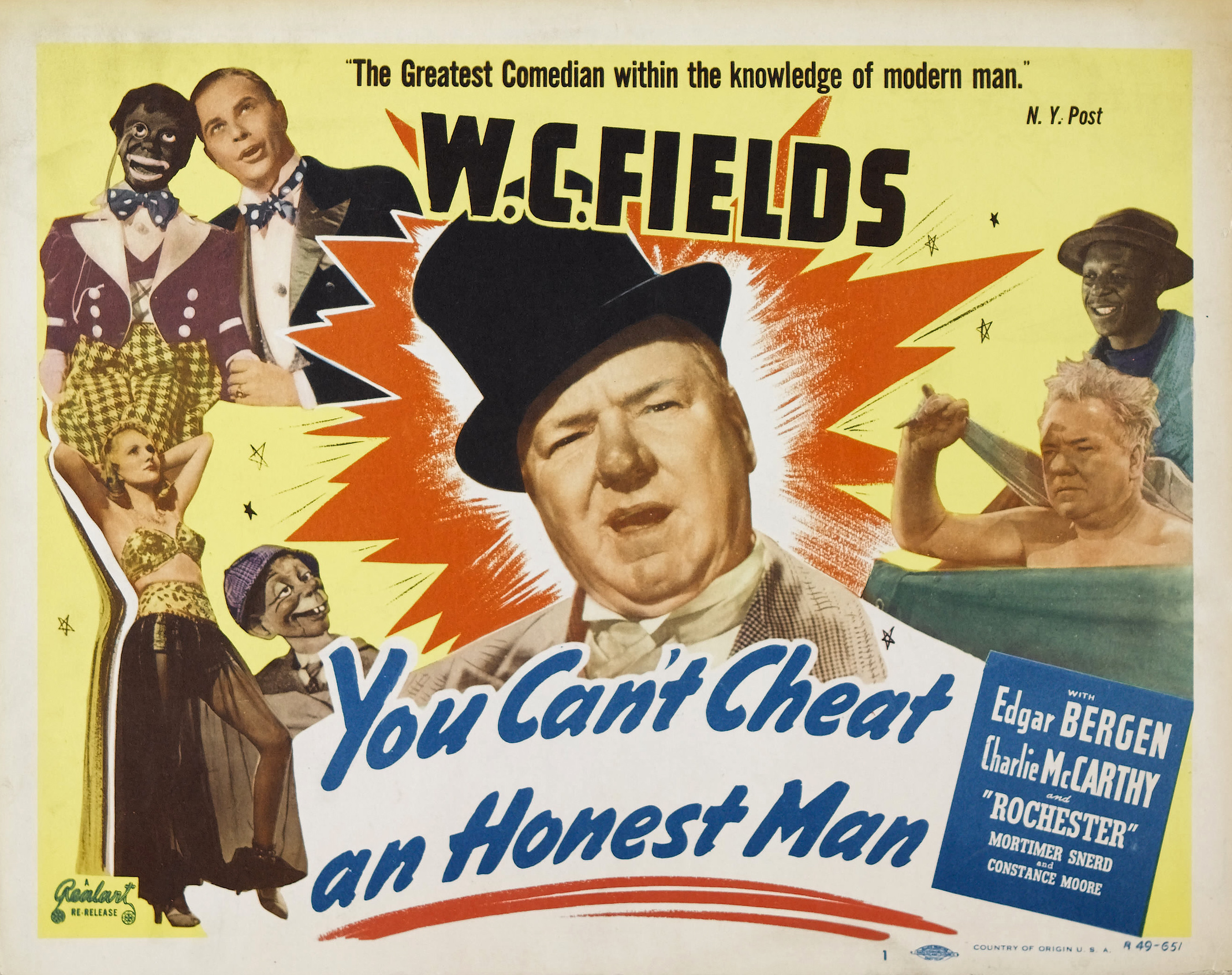
 “You Can’t Cheat an Honest Man” screens at 1:30 p.m. Saturday, June 7, 2014 in the Durwood Film Vault of the Kansas City Central Library, 14W. 10th St. Admission is free. It’s part of the year-long film series Hollywood’s Greatest Year, featuring movies released in 1939.
W.C. Fields didn’t make movies so much as he made extended comedy routines strung together on the flimsiest of narrative threads.
He was a product of vaudeville, after all, not the repertory theater. He was only any good at playing one character: himself, a cranky, often hen-pecked misanthrope and con artist who looked more like a cartoon than a real human being.
Fields’ hair was thinning, his red nose bulbous (in real life as in his films, he was a prodigious consumer of alcohol), his body pear-shaped, his legs skinny. He often wore an out-of-fashion top hat or straw boater, long-tailed coats, and spats.
Yet despite his ridiculous physique, his training as a variety hall juggler allowed him to move with remarkable grace and made him a natural for physical comedy.
(Check out his 1932 short The Dentist on YouTube…the bit where he tries to pull a female patient’s tooth suggests that beneath his pudgy form there lurked considerable strength.)
Especially there was Fields’ voice, a snide snarl that remains immediately identifiable more than 70 years after his death.
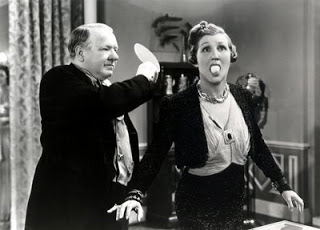
W.C. Fields…Ping Pong routine
Fields first appeared on film in 1915, and appeared in both shorts and features throughout the silent era. His early sound work was usually in shorts based on his hugely popular vaudeville routines or as a supporting player in ensemble efforts. He played Humpty Dumpty in Alice in Wonderland (1933) and Mr. Micawber in David Copperfield (1935).
In 1936 he headlined Poppy, a screen version of a Broadway hit in which he had starred more than a decade earlier.
At about the same time he began appearing regularly on radio, especially on the Chase and Sanborn Hour, a variety show in which he often squared off against ventriloquist Edgar Bergen and his wise-guy dummy, Charlie McCarthy.
Charlie’s persona was that of a droll, insulting brat – he was an early version of Bart Simpson. Radio audiences loved the sneering interplay between Fields and Charlie, and that led to Fields and Bergen/McCarthy sharing the screen in 1939’s You Can’t Cheat and Honest Man.
Scripted by Fields under the pen name “Charles Bogle” (Fields also would ghost write under the monikers Otis Criblecoblis and Mahatma Kane Jeeves), the film isn’t much for plot, but it’s rich in comic inventiveness.
Fields plays circus manager Larson E. Whipsnade. Larson E…..as in “larceny.” Whipsnade is always skipping town after failing to pay his bills and is perpetually avoiding lawmen with warrants for his arrest.
Edgar Bergen (father of Candace Bergen) plays Edgar, who has a sideshow magic act. Charlie is his assistant, cracking wise as he is sawed in half. (We’re meant to see Charlie as a real person…albeit a wooden one.)
But they are always at odds with Whipsnade, who never gets around to paying his employees.
Told by his daughter Vicky (Constance Moore) that he was fortunate in acquiring the services of Edgar and Charlie, Whipsnade shoots back, “They’ll be fortunate if we don’t attend their services.”
He never misses an opportunity to insult Bergen’s dummy: “Charles, I shall send a couple of beavers over to frolic with you.”
And there’s a running gag about how Whipsnade must fill in for any circus performer who is incapacitated.
“First the contortionist gets arthritis,” he complains. “Then the sword swallower gets tonsillitis. Hope nothing happens to that fan dancer … until I get rid of this cold, anyway.”
The threadbare plot has Vicky falling for Bergen. But recognizing her father’s imminent arrest for debts, she agrees to marry a moronic rich kid at her college. This leads to a marvelous confrontation between the groom’s stuffy parents and the vulgarian Whipsnade, a highlight of which is an insane high-speed Ping Pong match.
You Can’t Cheat an Honest Man led to a string of Fields classics: My Little Chicadee, a comic western with Mae West (1939), The Bank Dick (1940), and the surreal Never Give a Sucker an Even Break (1941).
After that, though, Fields’ health and performing powers decreased, largely because of his drinking. His part was cut from 1942’s Tales of Manhattan, and in Follow the Boys (1944) and Song of the Open Road (both 1944) he appeared briefly as himself to perform his old vaudeville routines, juggling and fooling around at a pool table.
By that point Fields’ drinking was so bad that he had to be institutionalized. He spent his last 22 months in a sanitarium, dying in 1946 of an alcohol-related stomach hemorrhage.
A possibly apochryphal tale from Fields’ last days has a friend visiting the performer’s bedside, only to find the life-long atheist reading a Bible.
Asked what he was doing, Fields drawled: “Looking for loopholes.”
| Robert W. Butler
 Butler's Cinema Scene
You gotta love a world where Mortimer Snerd receives higher billing than Constance Moore on the movie poster. — EP