Feeds:
Posts
Comments

Archive for October, 2024

Left to right: Aiden Tyler Patdu, Beauty Gonzalez, Sid Lucero, Marco Masa

“OUTSIDE” My rating: B+ (Netflix)

142 minutes | No MPAA rating

If Eugene O’Neill had written a horror script it would play like “Outside,” a Philippine production in which family dysfunction is even more terrifying than the flesh-chomping undead.

Think of it as “Long Day’s Journey into Zombie-ism.”

Writer/director Carlo Ledesma wastes no time on preliminaries. The film opens with a much-battered family van (it’s covered in bloody handprints) chugging down a country road.

Inside are father Francis (Sid Lucero), mother Iris (Beauty Gonzalez) and their two boys, teenage Josh (Marco Masa) and little brother Lucas (Aiden Tyler Patdu).

They’re fleeing the city, headed for the sugar cane farm on which Francis grew up.  Once there they discover Grandpa dead from a self-inflicted gunshot; Grandma is a rapidly decaying wraith.

Francis gets to work burying the bodies and turning the farmhouse into a fortress.  There are fewer zombies in the sticks (fewer people, yes?) but they’re fast and hungry and attracted by loud noises.

The problem is that Dad’s idea of a secure space feels a whole lot like a prison.

With his wire-rimmed glasses and soft tummy, Francis is the very embodiment of an unassertive suburban Dad.  But in a weird way the zombie apocalypse has transformed him into an alpha male. Now he gets to call the shots.

Turns out Francis is carrying a whole load of baggage.  As a boy he was frequently locked in a dank cellar and raped by his father, and being back in that environment has set his paranoia to tingling.

And then there’s his relationship with the Missus.  Iris comes off as shellshocked and innervated…it’s all she can do to cook rice for the family.  Later we’ll learn the clan’s darkest secret…Francis is sure the two boys are the result of his wife’s infidelity.

Dad’s rapidly advancing mania (in many aspects the plot echoes “The Shining”) has him rejecting Iris’ and Josh’s pleas to drive north to what is reputed to be a zombie-free zone.  He’s not above sabotage to keep them under his thumb.

Every now and then we get a close call with the zombies, but “Outside”  plays down the usual horror tropes in favor of psychological realism.  

It’s been spectacularly well acted — this sort of subtlety is almost unknown in horror — and the two-hour-plus running time zips by.
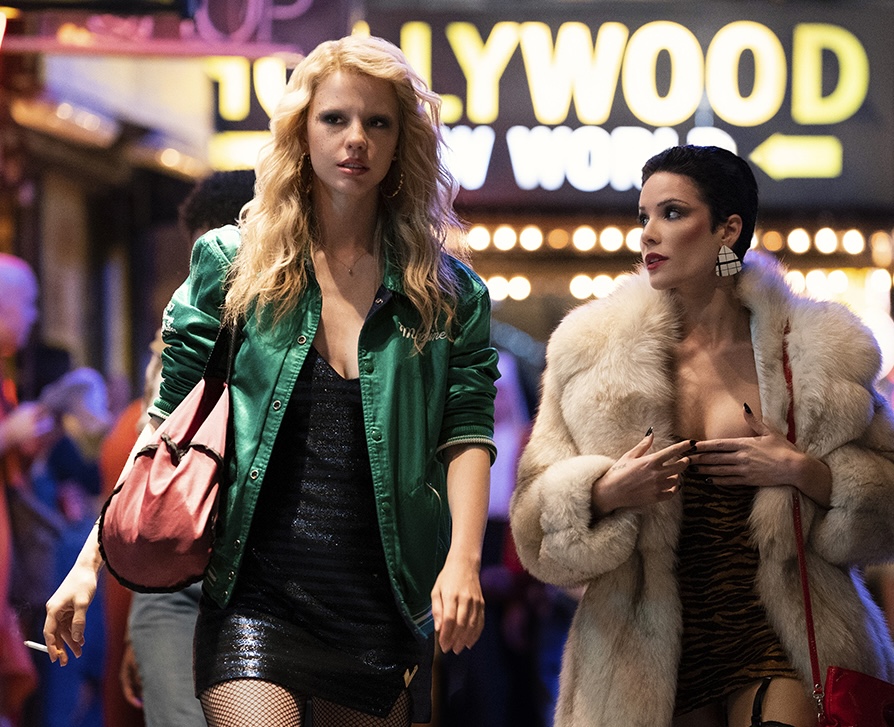
Mia Goth (left)

“MAXXXINE” My rating: C+ (Hulu)

101 minutes | MPAA rating: R

The collaborations of writer/director Ty West and leading lady Mia Goth (“Pearl,” “X”)  have been hailed in some quarters as as the new best hope for the horror genre.

I’m not so sure…and “MaXXXine” hasn’t convinced me.

This latest effort finds West working with some really big names (Elizabeth Debicki, Giancarlo Esposito, Kevin Bacon, Bobby Canavale, Michelle Monaghan, Lily Collins).  But all that talent is frittered away on a cheesy premise.

Maxine (Goth) is a Dixie chick who came to LA and ended up in porn.  Now past 30, she recognizes that her expiration date in the flesh industry is fast approaching. She needs to pivot to a “real” movie with a “real” director.

After giving a killer audition, this tart-talkin’ Southern gal seems poised to realize her dream. But even as she launches her new legit career  Maxine finds herself being stalked by an unseen killer who seems to follow her every move and begins picking off her friends and acquaintances.

Set int the late 1970s, “MaXXXine” is nothing if not ambitious.   West wants to comment on unbridled ambition and the whole star-making apparatus, and much of the movie unfolds on studio back lots familiar from other films. There’s a sequence set in the Bates house from Hitchcock’s “Psycho”; the final confrontation with the mysterious killer unfolds at night at the foot of the famed Hollywood sign.

But it doesn’t add up to much, largely because the character of Maxine feels painfully undernourished.  There’s not a smidgen of humor or even irony in Goth’s joyless performance. Maxine starts out thick-skinned and hard-assed and never evolves into anything more. 

C’mon. Watching a thriller is supposed to be fun, but there’s not much pleasure to be had from “MaXXXine.”

| Robert W. Butler

Read Full Post »

Tony Hale, Anna Kendrick, Daniel Zovatto

“WOMAN OF THE HOUR” My rating: B (Netflix)

95 minutes | MPAA rating: R

Actress Anna Kendrick makes a way-more-than-adequate directing debut with “Woman of the Hour,” a chilling retelling of one of American pop culture’s more bizarre incidents.

Kendrick’s subject is serial killer Rodney Alcala, who in the middle of a long murder spree appeared as a contestant on the “Dating Game” TV show.

Ian McDonald’s screenplay cleverly exploits two plot threads.  In one, struggling actress Sheryl (Kendrick) attempts to navigate the treacherous waters of 1970s Hollywood. The casting agents are asses, her semi-clumsy neighbor (Pete Holmes) is putting the moves on her, and she’s running out of money.

So when her agent lands her an “easy” gig on “The Dating Game” she can hardly refuse.

Interwoven with all this are incidents from the murderous career of Alcala (a skin-crawling Daniel Zovatto), who uses his camera and charming personality (he could give Ted Bundy lessons) to lure in insecure, homeless and otherwise vulnerable women.

The central chunk of the film is the “Dating Game” broadcast, in which Sheryl, figuring she has nothing to lose, infuriates the show’s host (Tony Hale) by ignoring the “script” and going rogue, asking of her three unseen suitors questions designed to explode their macho poses.

Guess which of the three is chosen by our leading lady.

If a scriptwriter had dreamt all this up you’d probably sneer. The fact that it is all based on fact gives “Woman of the Hour” skin-crawling intensity.

Alcala was finally caught, thanks to the smarts of one of his intended victims, a runaway  perfectly played by Autumn Best.

Rodney Acala died in 2021 after 40 years in prison.  Authorities believe he may have been responsible for more than 100 murders.

Ingrid Torelli, David Dastmalchian, Laura Gordon

“LATE NIGHT WITH THE DEVIL” My rating: B- (Hulu)

93 minutes | MPAA rating: R

Found-footage horror went global with “The Blair Witch Project” and has been a staple of the genre ever since. Now we have “Late Night with the Devil,” which purports to be the unedited videotapes of a TV talk show featuring an honest-to-God demonic possession.

Writers/directors Cameron and Colin Cairnes have come up with a fiendishly clever setup.  On Halloween night in 1977 a struggling late night network TV talk show (it can never catch up with Carson) has as its guests a debunker of the paranormal (think the Amazing Randi) and a teenage girl only recently rescued from the satanic cult that raised her.

The debunker (Carmichael Haig) is a sneeringly pompous rationalist.  The girl (Ingrid Torelli) exhibits no particular personality…at least until her psychologist guardian (Laura Gordon) attempts an on-air hypnosis session, at which point all hell literally breaks loose in the TV studio.

Overseeing the mayhem is host Jack Delroy (K.C. native David Dastmalchian), a man struggling not only with mediocre ratings but also with the recent death of his beloved wife.

Aside from a couple of jump scares “Late Night…” didn’t particularly terrorize me. But I was absolutely mesmerized by the filmmakers’ recreation of a time and place.  

Everything about this production — from the set’s pastel rainbow design to the interplay between the host and his second banana (Rhys Auteri), the attitudes of the on-stage band members, the onscreen graphics, the vintage equipment, the themesong — feels absolutely dead on. It’s like taking a trip in a time machine.

| Robert W. Butler

Read Full Post »

Nicolas Cage as Red in “Mandy”

“MANDY” My rating: A- (Hulu) 

121 minutes | No MPAA rating

“SYMPATHY FOR THE DEVIL”My rating: B- (Hulu)  

90 minutes | No MPAA rating

The prevailing wisdom is that Nicolas Cage will make any movie if the price is right, that you needn’t send him the script until the check has cleared.

And looking at his output over the last decade, that summation seems fairly accurate.  

For every noteworthy title on his resume (“Pig,” “Dream Scenario,” “The Unbearable Weight of Massive Talent”) there are a half dozen half-baked and utterly forgettable genre flicks (mostly revenge melodramas) that in a previous era would have gone straight to video.

Today, of course, they go straight to streaming.  

If the quality of Cage’s output is questionable, the quantity is staggering.  Since 2015 he has racked up more than 40 film credits, usually as the lead actor.  This would be regarded as Herculean for any performer, but Cage’s batting average is further enhanced by the fact that for nearly three of those years Hollywood was in a covid shutdown. 

Now I cannot claim to have seen all of Cage’s recent work (life’s too short, you know?) but I’ve been doing some surfing around the streaming services and have stumbled across a couple of titles that previously eluded me.

First off, from 2018, is “Mandy,” a revenge melodrama (check) that practically pulsates with human agony (thanks to Cage’s performance) while radiating a psychological/surreal intensity that is simultaneously seductive and repellant. 

This might be great filmmaking.  It might be trash. I could make a case for either.

The real star here is writer/director Panos Cosmatos, who creates a nightmare world rooted in the eccentric weirdness of Nicolas Winding Refn and accented with the surreal beauty of Lars Van Trier’s “Melancholia.” There’s even a nod here to Bergman’s “Persona.”

“Mandy” is crammed with laughable pulp fiction tropes, but even when it tosses in the odd playful  moment you’ll find yourself a prisoner of its somber intensity.

The setup:  Lumberjack Red (Nicolas Cage) lives in a comfy cabin in the north woods with his squeeze Mandy (Andrea Riseborough),

Linus Roache is Jeremiah, the bonkers head of a religious cult (he’s positively Koresh-ian) whose followers think only of satisfying his psychological and sexual needs.

Jeremiah spots Mandy on one of his drives and orders his minions to kidnap her. This they do, but not before torturing Red, whom they leave for dead.

They should have made sure.

There’s stuff going on here that just shouldn’t work…like a gang of bikers (are they human or demons?) whose costuming makes them look like the love children of “Hellraiser’s” Pinhead and “Pulp Fiction’s” Geek.

As the batshit crazy Jeremiah, Roache (who spent several seasons as a prosecutor on “Law & Order”) gets to dig into some mind-blowing bloviatory dialogue.  There’s a touch of Robert Mitchum’s killer preacher from “Night of the Hunter.” It’s totally unlike anything he’s ever done.

And that’s another unexpected thing. On top of its visual/aural splendors, “Mandy” has been fabulously well acted.  

The great Bill Duke makes a rare on-screen appearance as Red’s buddy, who keeps an impressive cache of weaponry in his mobile home. And as cult members the veteran actors Olwen Fouere, Richard Brake, Line Pallet and Ned Dennehy (you may not know the names but you’ll recognize the faces) give remarkably nuanced and unnerving performances.

But holding it all together is Cage.  It’s a pitiless performance…in one harrowing segment the camera zooms in on Red’s bloodied features and stays there for what seems like minutes as he screams in emotional (the love of his life has been taken) and physical pain (he awakens to find he’s been bundled in barbed wire and one hand has been nailed to the floor).

“Mandy” is exhausting and draining, but I’d happily watch it again.  

Nicolas Cage as The Passenger in “Sympathy for the Devil”

Then there’s “Sympathy for the Devil,” a 2023 drama in which Cage appears as a gun-toting killer who carjacks a suburban dad and forces him to cruise around nighttime Las Vegas.

When we first see Cage’s character (identified in the credits as The Passenger) he’s like the cartoon embodiment of Sin City’s underbelly.  With hair dyed to match the day-glo maroon of his tuxedo jacket and a Mephistophelean goatee, the guy comes off  like a cheesy stage magician who might keep a dead hooker in his car trunk. (He even forces his victim to participate in a card trick.)

The Driver (Joel Kinnaman) has just pulled into a hospital parking garage. His wife is upstairs giving birth to their second child — all he wants is to be at her side.

But, no, he’s forced at gunpoint to drive his captor out of town for…well, let’s not ruin anything.

Yuval Adler’s film is basically a claustrophobic two-hander.  There are encounters with other citizens — an unfortunate cop, the terrified travelers at an all-night highway diner — must mostly it’s just these two guys in a car surrounded by  the desert night.

Was the kidnapping arbitrary? A wrong place, wrong time thing? The Passenger is a smirking, taunting presence. The Driver claims there’s been a mistake, that he’s just a working jerk. 

But maybe there’s something in the pasts of these two that made this  evening inevitable?

Luke Paradise’s screenplay manages a magic trick of its own, turning the Passenger over time from a holy terror to a man with a painful past…which is how we end up sympathizing with this particular devil. (Viewers familiar with Cronenberg’s “A History of Violence” may guess where this is all going.)

Thanks to Cage it almost works.  The Passenger is a preposterous character who really doesn’t wash, psychologically speaking.  But watching Cage tear into this material it almost doesn’t matter.  The guy is out there sweating to turn straw into gold. In the end he turns that straw into brass, but it’s still a wonder to behold.

| Robert W. Butler

Read Full Post »

Harper Steele, Will Ferrell

“WILL & HARPER”  My rating: B+ (Netflix)

114 minutes | MPAA rating: R

“Will & Harper” is both a hugely emotional paen to friendship and a sobering/reassuring look at grassroots America.

It’ll have you sobbing one minute, furious the next.

The Will of the title is Will Ferrell, famous comic actor.  Harper is the former Andrew Steele, a long-time writer for “Saturday Night Live” who at age 61 decided to transition.

At the outset of Josh Greenbaum’s documentary, Ferrell recalls getting an email from Steele announcing her new status as a woman.  Farrell never saw it coming.

But Will Ferrell is a very good friend.  Knowing that as a man Harper had often driven across America, hanging out in seedy motels and nefarious watering holes, Ferrell suggested the two buds take a road trip. 

It would give them plenty of time to explore their new relationship while seeing how, if at all, Harper would be accepted  by the everyday folk being bombarded with anti-trans propaganda.

There’s good news and bad news. At an Oklahoma road house Harper is serenaded by a group of Native American men who employ a plastic tub as a tom tom to chant a welcoming song.  Awwww.

The next day, in Texas, the two travelers take center stage at a crowded highway restaurant.  Clearly, the local folk are impressed at having a celeb in their midst, but many fire off a slew of cruel anti-trans tweets aimed at the comic’s companion.

But perhaps the most devastating part of the journey is hearing Harper speak of the many years in which she fought against recognizing her true sexual identity. It’s sad and inspiring.

Which is not to say that “Will & Harper” is a downer.  Ferrell and Steele have earned their livings by making other people laugh, and their banter has plenty of drollery sprinkled among the truth nuggets.

I believe I’m a better person for having watched it.

Brad Pitt, George Clooney

“WOLFS” My rating: B (Apple+)

108 minutes | MPAA rating: R

It really doesn’t go anywhere, but you’ve gotta enjoy the ride provided by “Wolfs,” a lean, funny crime dramedy fueled by Tarantino-esque banter.

The premise of writer/director Jon Watts’ film:  Two mob cleaners (they are hired to discreetly remove evidence — like dead  bodies — after violent encounters) find themselves working on the same assignment.

It must be a mistake because these unnamed dudes (played by George Clooney and Brad Pitt) always work alone and are fiercely protective of their trade secrets. (They’re “lone wolfs.”)

Nevertheless, here they both are in an expensive hotel room to remove the body of a young man who, while cavorting with an older woman (Amy Ryan), bounced off the bed and into a glass coffee table.

These wolfs don’t play well with each other.  The older one (Clooney) is a brooding grump. The younger (Pitt) is a cocky wise ass.  

Oil and water.

And then there’s the vinegar. (Here comes a spoiler but I don’t know how to avoid it.)

That would be “the kid” (Austin Abrams), the supposedly dead body that returns to life mid-disposal.  He’s a goofy college student who got picked up by the cougar while running an errand for a friend…an errand that involves a backpack full of drugs.

Now the two fixers and the kid are trying to return the illegal pharmaceuticals to their criminal owners without getting killed.

But not before an awesome chase through NYC with the two wolfs pursuing the whacked-out kid, who is racing gazelle-like through a snowstorm in his tidy whities. 

Remember Nicolas Cage’s quest for baby diapers in “Raising Arizona”?  It’s that good.

The thorny plot twists of “Wolfs” may not stand up to close scrutiny, but viewer doubts probably won’t kick in until after the final credits.  For the most part the flick is just plain fun.

Natasha Lyonne, Elizabeth Olsen, Carrie Coon

“HIS THREE DAUGHTERS” My rating: B+ (Netflix)

101 minutes | MPAA rating: R

Getting married. Having a kid. Losing a parent.

These are three of the most impactful experiences in a human life. Azazel Jacobs’ “His Three Daughters” examines the third event through a pressure-cooker environment and three astonishing performances.

The daughters are Katie (Carrie Coon), Rachel (Natasha Lyonne) and Christina (Elizabeth Olsen). The siblings have gathered in the New York apartment of their father, who lies dying in his bedroom (we won’t actually see him until the final moments of the film).

Though all were raised by the same single dad, the women have radically different personalities.

Katie, the oldest, is a brittle, opinionated woman who tries to come off as helpful but actually is merely bossy. Katie has rarely visited her father in recent months but now wants to dictate how this whole business of dying will unfold. The problem, of course, is that death doesn’t operate on a convenient schedule.

Christina has a husband and young daughter back in Ohio. She’s painfully insecure, always sharing appallingly sappy phone calls with her kid and shying away from argument and controversy.

Rachel is the family bohemian. She’s been living with her father for years, taking care of him in his decline. She appears not to have a real job and frequently lets off steam with a joint or two, both life choices that infuriate the judgmental Katie.

“…Sisters” unfolds almost entirely in the living room and kitchen of the apartment, creating a claustrophobic intensity that magnifies the points of conflict among the women.

Every few hours a hospice worker (Rudy Galvan) checks in; at one point Rachel’s boyfriend (Jovan Adepo) shows up to give her a bit of moral support and to unload on Katie and Christina, whom he (rightly) believes have shirked their familial responsibilities while Rachel got stuck with the role of caregiver.

“His Three Daughters” could quite easily have been conceived as a stage play rather than a film. The dialogue is tight and polished and wastes little time in exposing the character’s conflicted essences. Sometimes it sounds a bit artificial and forced, but any misgivings are quiickly dispersed by the power and subtlety of the performances.

Most of the film is brutally realistic. But in the final moments, when we finally meet the women’s father (Jay O. Sanders), it becomes borderline metaphysical. I can’t say more without ruining the effect…let’s just say that despite often rubbing our noses in dysfunction, “His Three Daughters” leaves us with a whiff of hope.

| Robert W. Butler

Read Full Post »