Feeds:
Posts
Comments

Archive for the ‘Uncategorized’ Category


Sylvester Stone

“SLY LIVES!” My rating: B (Hulu)

112 minutes | No MPAA rating

Among the highlights of Questlove’s Oscar-winning documentary “Summer of Soul” was performance footage of Sly and the Family Stone in their prime.

Now he has given us a full-length appreciation of Sly Stone (born Sylvester Stewart) and it’s both exhilarating and deeply troubling.

Almost from the get-go Sly exhibited musical genius.  From his earliest years he  performed nightly at his church, playing any instrument that needed playing. As a teen he was a successful radio deejay.

He began producing records in the Bay Area (“Laugh Laugh” by the Beau Brummels, the first version of “Somebody to Love” by Grace Slick and the Great Society).

He formed his own interracial band. At first they played covers of popular songs.  Then Sly began writing his own funky tunes. 

When his first album tanked he roared back with a song nobody could resist: “Dance to the Music.”  (There’s astounding footage of Sly revving up the pasty white crowd on the Ed Sullivan show by wading into the audience and dancing in the aisle…the honkies couldn’t help but get swept up in the funk.)

Questlove has basically given us two movies here.  First there’s the exciting rise…followed by the achingly depressing fall marked by paranoia and drugs.

Sly himself only appears in archival footage, including a television interview from what appears to be the mid-1980s.  Mostly Questlove allows others — band members, producers, lovers — to tell the tale. 

Even when nursing a crippling drug habit Sly could put on a show.  One admirer recalls seeing the band in the late 70s: “I left thinking that he could run for President and win.”

But the decline was unmistakeable.  He was late for shows or didn’t show up at all.  His bandmates were slowly alienated and left one by one, especially as the heady collectivism of his early songs segued into self-referential navel gazing.

Many of the talking heads Questlove has interviewed see in Sly’s slow downfall an all-too-common story of self-inflicted wounds.  In fact, the film’s subtitle is “The Burden of Black Genius.”  The film is never angry, though — instead it seeks to understand.

Sly Stone, now 82. has mostly been out of the public spotlight for nearly 40 years. He seems to like it that way. One of his children describes  him as “a standard old black man.”

But one leaves this fine documentary wondering not only at Sly’s body of work, but at the ripples his career sent through the musical world, paving the way for Janet Jackson, Prince, Parliament/Funkadelic and many others.

Black genius? For sure.

“PANGOLIN: KULU’S JOURNEY”  My rating: B- (Netflix)

88 minutes | MPAA rating: PG

The shadow of the Oscar-winning “My Octopus Teacher” hangs heavily over “Pangolin: Kulu’s Journey.”

Both films have been directed by Pippa Ehrlich. Both unfold in South Africa and chronicle the relationship between a human and an exotic creature.  Both aim for a synthesis of documentary discipline and intense emotion.

Except that lightning rarely hits twice in the same spot.

Let’s start with our animal hero.  Little Kulu is an orphaned pangolin, a bizarre African mammal that seems more like a dino than a creature of our present world.  

Pangolins are a bit like anteaters…only weirder.  They are the only mammal covered in rigid protective scales.  They walk on their hind legs  holding their much smaller forelegs in front of them.  One pangolin expert describes them as miniature T-Rexes.

The creatures are utterly harmless, able to open their mouths only enough to stick out a foot-long tongue that scarfs  up termites, ants and their eggs.  When threatened their only defense is to curl up into an armored ball. Currently they are endangered, since their scales are essential to many traditional Chinese medicines.

In fact our central character, Kulu, is rescued as an infant from poachers and turned over to Gareth Thomas, a volunteer (or is he an employee?) of a Pangolin rescue organization.  His job is to spend months feeding and protecting Kulu until the creature is big enough to be released back into the wild.

Here’s the problem.  Thomas isn’t a terribly interesting fellow.  We really don’t learn much about him. His salient feature is his love of Kulu. And that is a one-way deal since Kulu expresses no emotions.  No purring. No wagging tail.

In fact, the pangolin spends most of its time trying to ditch Thomas, who can only retrieve the wandering creature at the end of the day with the help of a radio transmitter attached to Kulu’s back.

So the human/animal love affair— one of the most amazing things about “My Octopus Teacher,” is something of a bust this time around.

At nearly 90 minutes “PangolilnL Kulu’s Journey” feels padded.  Would have been much more effective as a 60-minute National Geographic entry.

Still. the artful photography of this otherworldly creature going about its business is  captivating.

| Robert W. Butler

Read Full Post »

Tilda Swinton, Julianne Moore

“THE ROOM NEXT DOOR” My rating: C+ (Netflix)

106 minutes | MPAA rating: PG-13

At a certain point in every artist’s life the old mortality bug starts nibbling away. Apparently filmmaker Pedro Almodovar has reached that stage.

“The Room Next Door” is typical Almodovar in that it concentrates on relationships among women.  But mostly it’s an atypical  contemplation of death.

Popular author Ingrid (Julianne Moore) learns that her old magazine colleague Martha (Tilda Swinton) has terminal cancer.  A visit to the hospital leads to much reminiscing (there are flashbacks to Martha’s early life and career as a war journalist) and a startling request.

Martha has obtained a “euthanasia drug” on the dark web.  She wants Ingrid to accompany her to a vacation rental in the Catskills where Martha plans to end her life. (“Cancer can’t get me if I get myself.”) She wants Ingrid simply to be on hand in an adjacent bedroom so she won’t feel she’s totally on her own.

Ingrid is reluctant (she hasn’t seen Martha in five years and, besides, her most recent book examines her own fear of death) but finally acquiesces when she learns that several other friends have already turned down Martha’s request.

The source material here is Sigrid Nunez’s 2020 novel What Are You Going Through, and there are times when the English dialogue (I believe this is the first all-English language movie in Almodovar’s resume) sounds like it has been strained through a translation app.

But the real issue here is one of tone. Almodovar is known for his wonderful wackiness (“Women on the Verge…,” “I’m So Excited”), his camp sensibilities and  his deep appreciation of over-the-top melodrama.

None of which is in evidence here.  Even Almodovar’s visual panache has been muted as if intimidated by the grim subject matter.  (Although the closer Martha comes to taking the pill, the more colorful the wardrobe she chooses.)

Clearly Almodovar wants to move us.  But I felt peculiarly unmoved.

It’s not the actresses’ fault.  Moore is solid as a reluctant participant in what is legally a crime, while Swinton, with her glacial pallor and skeletal physique certainly looks like she’s about to cash in.

Then, too, the screenplay has digressions that seem not to go anywhere.  John Turturro has a couple of scenes as the pessimistic writer both women have had relationships with.  Alessandro Nivola is a moralistic police detective who in an unnecessary coda grills Ingrid for her part in the death. 

And at the very end Martha’s estranged daughter briefly shows up. She also is played by Swinton, whose appearance has been subtly altered (either by makeup/prosthetics or CGI makeover).

Okay. Almodovar has gotten that out of his system. Let’s move on.

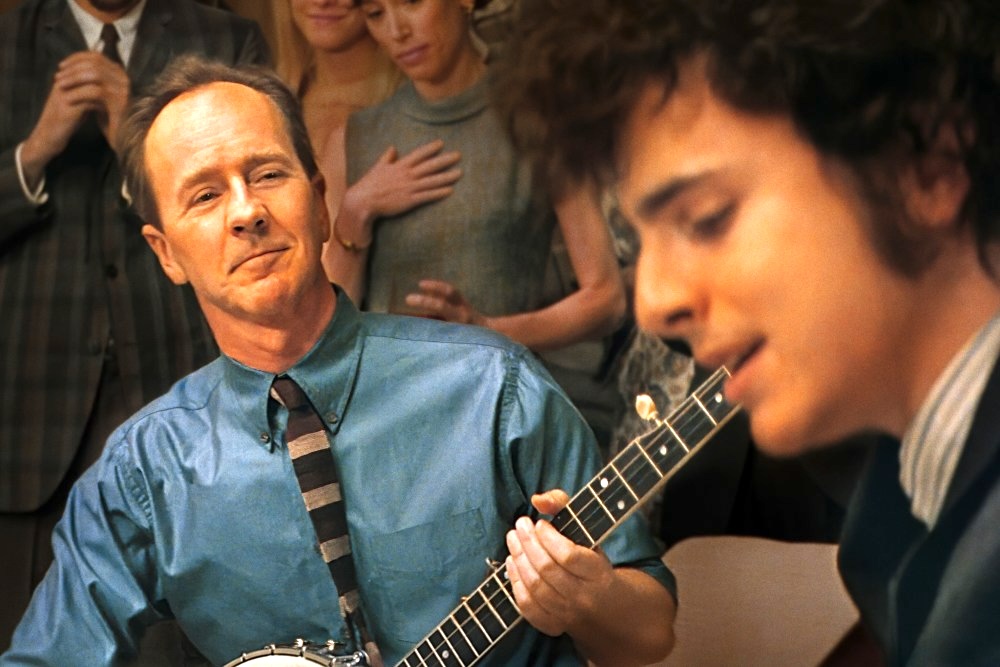
Edward Norton as Pete Seeger, Timothee Chalomet as Bob Dylan

A COMPLETE UNKOWN” My rating: B (Apple+)

141 minutes | MPAA rating: R

“A Complete Unknown” is about as good a Bob Dylan biopic as we’re likely to get.

First, it absolutely nails the where and when of the early 60s folk scene in New York City.

And second, it knows that no matter how hard it tries, its main character will remain an enigma.

I mean, I’ve been listening to Bob Dylan for more than half a century and I still couldn’t give you a reading on his personality.  Would I like him in person? Would he be a pain in the ass?  

Shut up and listen to the music.

Anyway, James Mangold’s film (the excellent screenplay is by Mangold, Jay Cocks and Elijah Wald) covers Dylan’s early years in the Big Apple, from his crashing the hospital room of the dying Woody Guthrie to his controversial (we’re talking “Rite of Spring” outrage) embrace of an electric guitar at the Newport Folk Festival.

Along the way Oscar-nominated Timothee Chalomet delivers a terrific central performance, capturing his subject’s physical and vocal quirks (the musical numbers were all recorded live on camera) while carefully concealing the innermost Bob. It shouldn’t work. It does.

Just as good is Edward Norton as folkie purist Pete Seeger, who takes Dylan under his wing, only to go ballistic when our man turns his attention to rock’n’roll.

Monica Barbaro is solid as folkie “it” girl and Dylan squeeze Joan Baez.  

You don’t need an excuse to drag out your old Dylan records, but don’t be surprised if after watching this  you do a deep dive into the catalogue.

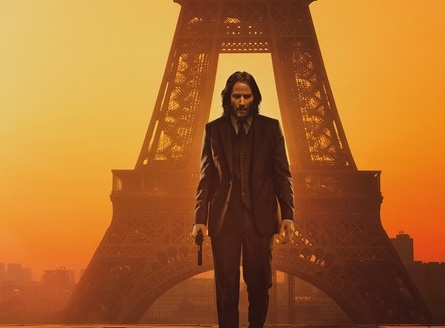
Keanu Reeves

“JOHN WICK: CHAPTER 4” My rating: B (Roku) 

169 minutes | MPAA rating: R

So far there have been four John Wick movies…although actually they’re the same movie with slightly different fight scenes.

“John Wick: Chapter 4” has the same story line as all the others.  Good-guy assassin John Wick (Keanu Reeves) once again finds himself in a one-man war against the numberless minions of The Table, the all-powerful international crime syndicate.

“Wick” regulars Ian McShane, Donnie Yen and Laurence Fishburne reprise their supporting roles…the main baddie this time around is played by Bill Skarsgard as a sort of sinister fop.

The story doesn’t matter.  It’s the fights that count, and “Wick 4” is crammed with them.

In fact, there’s so much to it  that midway through this nearly 3-hour bloodiest I found myself zoning out from too much good fight choreography. (It’s like movie nudity.  One naked woman gets your attention; 100 of them leaves you kinda ho-hum.)

Happily the film concludes with a doozie, a nearly 40-minute battle in which our man Wick must kill his way up a long outdoor staircase leading to Paris’ Sacre Coeur Cathedral where he is to engage in a final duel with his main foe.  

What’s interesting here is that director Chad Stahelski and his writers (Shay Hatten, Michael Finch, Derek Kolstad) finally accept the ridiculousness of it all and inject some humorous elements into the mayhem.  

After killing dozens of bad guys and nearly reaching his goal, Wick is sent tumbling back to the bottom of the stairs to start the whole thing over again.  It’s like that old two-reeler in which Laurel and Hardy are deliverymen attempting to carry a piano up an endless flight of stairs.

Reeves even allows a bit of comic exasperation to creep into his performance. He doesn’t quite roll his eyes at the silliness, but he comes close.

| Robert W. Butler

Read Full Post »

“HOLLAND” My rating: C (Prime)

Nicole Kidman

“HOLLAND” My rating: C (Prime)

110 minutes | MPAA rating: R

Three very good actors obviously saw interesting possibilties in “Holland.”

I can’t.

Mimi Cave’s film flounders in a stylistic miasma.  Not quite comedy. Not quite thriller. No edge. No commitment.

Andrew Sodroski’s screenplay unfolds in Holland, Michigan, a burg whose identity is centered in its Dutch heritage.Think Colonial Williamsburg only with a full-scale windmill, a tulip festival and lots of Hans Brinker cosplay.

Nancy Vandergroot (Nicole Kidman) is a mentally and emotionally fragile housewife and high school home ec teacher. Hubby Fred (the ever excellent Matthew Macfadyen) is the very image of midwestern blandness —an optometrist by trade, a civic booster and a model train enthusiast with an entire Lionel-scale world constructed in the garage.

Early on Nancy begins to suspect the Fred’s out-of-town travel to medical conferences is cover for an affair.  Driven by bizarre dreams, she teams up with lonely fellow teacher Dave (Gael Garcia Bernal) to catch hubby in the act; along the way the bumbling educators/amateur gumshoes fall into each other’s arms.

For a good hour “Holland” treads water. Perhaps what’s intended here is a sort of satiric “Blue Velvet” atmosphere of cozy domesticity masking buried perversion…but Cave is no David Lynch.

Finally, in its last quarter, “Holland” delivers a head smacking revelation about Fred.  No, not extramarital sex.  Something way worse.

But by then I was beyond caring.  If only “Holland” had really gone for it, pushed the weird buttons with a vengeance. I might have gotten with the program.

Sour Vane Brean

“NUMBER 24” My rating: B (Netflix)

111 minutes | No MPAA rating

Movies about the resistance to the Nazis during WW2 suddenly seem way too relevant.

“Number 24” chronicles the real-life adventures of Gunner Sonsteby, who while still a teen launched Norway’s most successful career of anti-German sabotage.

John Andreas Anderson’s film starts with the 90-year-old Sonsteby (Erik Hivju) addressing an assembly of high school students. 

The film then flashes back to the war years where young Gunnar (Sour Vane Brean), now idenfited as Number 24,  is recruited by the resistance. He helps publish an underground newspaper. He “borrows” plates from the federal mint with which to print currency. He assumes four separate identities and never spends more than two nights in any one place. He spies on German troop movements.

The secret to his success at least in part is due to his colorlessness.  Gunnar is bland, easy to overlook. Hard to imagine as a saboteur.  In fact, his longevity is so remarkable that at one point his handlers wonder if he isn’t a double agent.

Ultimately resistance work comes down to doing bad things for the right reasons. In this case Gunnar must plan the assassination of a childhood friend who has become a collaborator.

In the future he must justify his actions to the man’s great-granddaughter.

“Number 24” is a modest triumph, low-keyed but consistently effective.

“SATURDAY NIGHT” My rating: C+ (Netflix)

119 minutes } MPAA rating: R)

Furiously frantic but not particularly funny, “Saturday Night”appears on the 50th anniversary of NBC’s “Saturday Night Live” to depict the machinations surrounding the show’s first-ever broadcast.

Unfolding in two chaotic hours, Jason Reitman’s film is a veritable avalanche of familiar characters, situations, skits and backstage intrigue plucked from the show’s rich mythology.  For boomers who grew up on SNL it’s a cultural Where’s Waldo?

But even for them it quickly wears out its welcome. The film is populated not with characters but with caricatures. The only figure to hold center stage is Gabriel LaBelle’s Lorne Michaels, the young producer risking all on a new idea of TV comedy.

Some of the impersonations are dead on. Nicholas Braun is perfect as one of the first guests, wacko comic Andy Kaufman. J.K. Simmons chews scenery as Milton Berle (who I don’t think was there for the first broadcast but here shows up anyway to literally wave his dick). Jon Batiste has a nice turn as musical guest Billy Preston. Paul Rust is a dead ringer for Paul Shaffer.

Others are hit and miss. Matthew Rhys cannot channel opening night host George Carlin. The SNL regulars — Belushi, Aykroyd, Curtin, Newman, Chase, Morris, Radner —are adequate but none knocked me out (or got much of a chance to).

Given the slipshod way in which the first show came together it’s a miracle there was ever a second, but we all know how that worked out.

| Robert W. Butler

Read Full Post »

“FLOW” My rating: B+  (Apple TV +)

85 minutes | MPAA rating: PG

There is not one word of dialogue in the  Czech animation feature “Flow,” which is up for Oscars in both the Animated Film and International Feature categories.

Which means a viewer has to pay attention.  No looking out the window and expecting the soundtrack to carry you along.

Happily, concentrating on “Flow” is no problem, since creator Gints Zilbalodis packs his feature with so much intoxicating visual information and so many interesting characters and situations that our attention never wanders.

The film unfolds in a vaguely Asian landscape.  There are bamboo huts and Ankor Wat-style temples and even an exotic city.  These speak of human habitation, but we never do see an example of homo sapiens.

Instead we find ourselves on a grand adventure with a cat who initially survives a tsunami that floods the jungle, then hitches a ride on a drifting boat to be carried wherever the current takes him (or her).

Our feline protagonist is accompanied by a small menagerie of other animals seeking refuge from the waters. Among them a shuffling capybara (think large groundhog), a pack of dogs who put aside their cat-hunting proclivities for the sake of mutual survival, a magisterial crane, and a lemur obsessed with collecting items (he becomes frantic upon discovering one of his precious finds is missing…I call him Gollum).

We get to know them not from what they say (again, no dialogue) but by their actions, which have been brilliantly envisioned to be both sentient and animal.

“Flow” has no plot. It’s a series of episodes. There’s  no explanation of the disaster that befalls the characters, no clue as to where all the people have gone.  The movie doesn’t so much end as drift away.

So if you’re looking for a tidy package wrapped up with a bow, you’ll be frustrated.

If, however, you’re ready for something you’ve never seen before, dive into this brave new world.

Miles Teller, Anya Taylor-Joy

“THE GORGE” My rating: C+ (Apple TV +)

127 minutes | MPAA rating: PG-13)

“The Gorge” has a nifty premise and a really solid opening 40 minutes. 

After that it’s a bit of a mess.

Sniper Levi (Miles Teller) is tormented by the many people he has killed, both as a Marine and more recently as a paid mercenary.  Looking for a change, he’s intrigued by a offer proffered by an obviously high-ranking government mover and shaker (Sigourney Weaver).

How would Levi like to spend a year in isolation, getting his head together while employing  his skills as a marksman?  

It’s all very mysterious, and after a long plane ride during which he was drugged Levi ends up in a concrete sentry tower overlooking a vast fog-filled chasm.  His job is to use the resources he’s been given — long-range rifles,  explosive mines dangled over the precipice, automated machine guns — to keep whatever is making eerie noises down there from getting out.

Oh…and about a mile away on the other side of the canyon is another sentry tower, this one occupied by Drasa (Anya Taylor-Joy), who like Levi has enjoyed a career of long-distance assassinations…albeit her employers were Eastern Bloc types.

Despite orders not to fraternize, the two snipers begin communicating via binoculars and messages written on big sheets of paper.   It’s kind of a chaste courtship…at least until Levi uses a bazooka and metal cable to string a zip line above the roiling clouds.

So far so good.   But the meet-cute romance that develops doesn’t convince (these two are too hard core to get their kicks dancing to ‘80s pop) and the mystery of just what is happening down below is a whole lot of nothing.

We’re talking about a long-ago government experiment that went south, creating an environment filled with mutant creatures (kinda reminds of the Skull Island sequence in “King Kong”).

Teller and Taylor-Joy are both fine performers, but Zach Dean’s script and Scott Derrickson’s direction give them little to work with.

Production  values are solid, but “The Gorge” suffers from the great gaping hole that afflicts so many sci-fi/horror entries — a great buildup to a mediocre reveal.

| Robert W. Butler

Read Full Post »

Demi Moore

“THE SUBSTANCE” My rating: B (On Demand)

141 minutes | MPAA rating: R

Demi Moore’s much-deserved Oscar-nominated performance in “The Substance” is the film’s main selling point, but let’s not overlook the stunning (well, mostly) contribution from Coralie Fargeat, who has taken home noms in both the directing and original screenplay categories.

For its first hour, at least, “The Substance” is riveting stuff, a mashup of social commentary, a vicious satire of showbiz duplicity, an angry examination of feminine angst and a staggering truckload of Cronenberg-level body horror.

The premise is vaguely sci-fi — an aging actress (Moore) takes a new (and presumably illegal) drug that will allow her to “give birth” to a younger and more  beautiful version of herself.

Moore’s career-stymied character is Elisabeth; her drop-dead alter ego, whom she calls Sue, is played by Margaret Qualley.

Margaret Qualley

The “science” behind all this is hard to grasp…basically we have two female bodies, one old and one young.  Elisabeth can occupy Sue’s lithe body for seven days, then she must spend a week in her older form.  While one body is active, the other lies in a coma, feeding intravenously on liquid nourishment provided by The Substance’s unseen creators/distributors.

Despite the admonition “Remember, You Are One,” Sue is all about herself; she extends her active cycle beyond seven days.  Turns out abusing The Substance has grave (and alarmingly gross) consequences.

If “The Substance” relies on the familiar theme of a cure that isn’t all it seems (“Flowers for Algernon,” “Seconds,” “Awakenings”) it at least presents itself as a stylistic tour de force.  Fargeat effortlessly juggles the script’s various elements —  there’s horror, yes, but also some laugh-out-loud moments provided by Dennis Quaid as the most soulless producer in Hollywood.

The film’s look (though set in L.A. it was filmed in France and the U.K.) is dominated by chilly interiors, long claustrophobic corridors and Elizabeth’s white-tiled bathroom, which is the size of a small house.

“The Substance” demands considerable nudity from its two leading ladies, but there’s not a hint of eroticism.  Elisabeth apparently has no sex life, while Sue takes pleasure not from the act itself but from being an object of desire. As the Substance does its sinister body-warping work, you’ll find yourself hoping that the women keep their clothes on.

The downside is a running time of nearly 2 1/2 hours. The film scores most of its points early and then descends into a nightmare of ghastly visceral visuals. This might not matter if we actually cared about Elisabeth/Sue, but the film is as chilly as that white bathroom, observing with almost clinical detachment the older woman’s travails while never establishing her as a character worth caring about.

Sebastian Stan, Renate Reinsve and Adam Pearson

“A DIFFERENT MAN” My rating: B- (Max)

112 minutes | MPAA rating: R

A distaff version of “The Substance” is “A Different Man,” in which a deformed fellow is given a drug that dissolves his tumors and leaves him looking like a movie star…namely Sebastian Stan.

Stan’s character, Edward, suffers  from a Quasimodo/Elephant Man-level facial disfiguration. (The makeup is alarmingly convincing.) His condition has left him a social outcast who can only dream about befriending his new neighbor, the aspiring playwright Ingrid (Renate Reinsve).

Edward undergoes a new therapy that transforms him into a hunk. But his new situation also dramatically alters his personality; he changes his identity and dives into the happy (i.e. utterly selfish) life he has always dreamed of.

Writer/director Aaron Schimberg presents Edward’s story as a black comedy…although the laughs are few.  Irony is the dominant emotion.

After Edward’s disappearance, Ingrid writes a play about her misshapen neighbor. Now Edward (she doesn’t recognize him) lands the leading role, which requires him to don face-hiding prosthetics on stage.

Like I said…ironic.

Enter Oswald, a debonair, utterly charming Brit who has precisely the facial deformation the role requires. Oswald is portrayed by Adam Pearson, an actor who really has the character’s condition (he had a brief but memorable turn as one of the alien’s victims in “Under the Skin”).  

Before long the good-looking Edward is out, and his role taken over by Oswald. Is this just fate, or has Oswald been conniving to replace his fellow actor? Not just on stage, but in Ingrid’s bed as well?

The chilliness that kept me from wholeheartedly committing to “The Substance” affects “A Different Man” as well. Most films about misshapen outcasts ask us to empathize with those characters. Schimberg’s film suggests that Edward wasn’t a particularly likable individual before his transformation, and even less so after.

But you might very well consider going home with Oswald.

| Robert W. Butler

Read Full Post »

Bridget Everett, Jeff Hiller

“SOMEBODY SOMEWHERE” (Max):

Fans of humanistic comedy (i.e. “Ted Lasso,” “Shrinking”) should make a beeline for all three seasons of “Somebody Somewhere,” an endearing and rudely hilarious series about life’s losers.

Or are they?

Bridget Everett, famed (and infamous) for her raunchy cabaret act, stars as Samantha, a fortysomething single woman with a voracious appetite for beer and unhealthy food whose bawdy/blowsy persona masks personal hurts and deep longings.

(Is there a better title than “Somebody Somewhere” to describe romantic yearning?)

Samantha gets through life with a little bit of help from her friends…and what a collection of distinct personalities! 

Her sister Tricia (Mary Catherine Garrison) is the most conventional of the lot, dealing with the end of her marriage by opening a gift shop full of homey items embroidered with profane exclamations.

Best bud Joel (Jeff Hiller) is a gay man whose initial weirdness (who the hell cuts his hair?) is quickly eclipsed by his soulful decency.

Then there’s transexual Fred (Murray Hill), a university professor who seems to be an expert in just about everything.

“Somebody Somewhere” takes place in Manhattan KS, and while most of the series is shot in Illinois (aside from a few establishing shots of Kansas landmarks) there are enough references to K-State, K.U. and Kansas City to make Midwesterners feel right at home.

Laughter through tears.  My favorite emotion.

Preston Mota, Taylor Kitsch

“AMERICAN PRIMEVAL” (Netflix):

The Western, once a staple of American entertainment, has been saved from extinction by the rise of streaming services.

The latest to hit the small screen is “American Primeval,” an astonishingly bloody miniseries that stomps on plenty of toes.

The essential plot is far from novel.  A solitary and sulky mountain man (Taylor Kitsch) reluctantly finds himself guiding a woman from the East (Betty Gilpin) and her tweener son (Preston Mota) across the West for a rendezvous with the husband she hasn’t seen in many years.

Turns out the lady is more than she seems.  Back in civilization she’s wanted for  murder, and their journey is complicated by pursuing bounty hunters.

That’s just one aspect of the yarn cooked up by writer/creator Mark L. Smith (“The Revenant”) and director Peter Berg.

 As a background to all this there’s the  1857 Mormon War and the infamous Mountain Meadow Massacre in which an LDS militia — fueled by religious hysteria and political paranoia — disguised themselves as Native Americans to wipe out an entire wagon train whose leaders made the mistake crossing Utah on their way to Oregon.

The militia officers are painted with a painfully heavy brush…basically they are conscienceless psychos.  We also meet LDS prophet Brigham Young, played by Kim Coates, who has traded in his motorcycle from “Sons of Anarchy” for a horse and an eye-rolling display of duplicitous villainy. 

Needless to say, 21st century Mormons will take umbrage.  Historian have long wondered just how much Young had to do with the massacre, but Smith’s script actually shows the Mormon leader ordering the butchery.

There’s yet another plot, this time centering on a Mormon man (Dane DeHann) who loses both his scalp and his wife (Saura Lightfoot-Leon) to marauding Native Americans. He takes off after his missing spouse without bothering to wash his face of the blood that drips from his savaged hairline.

One of my favorites is the famous explorer and trapper Jim Bridger (Shea Whigham), who from his base in Wyoming’s Ft. Bridger interacts with most of the major characters. 

And there’s a U.S. army officer (Lucas Neff) whose diary entries, read as narration, help set the scene.

“American Primeval” has its share of historic incongruities (uh…there are no mountains outside St. Joseph MO). And while it shares with “Lonesome Dove” multiple characters and plot threads, its overall feel is more bleak and cynical than inspirational. Certainly there are no characters to enchant us in the way Gus and Woodrow did on their cattle drive.

Still,  this series has some kiiller scenery and the action is brutal and merciless.  Squeamish viewers will spend a fair bit of time staring down at their laps.

“SQUID GAME – Season 2” (Netflix)

Sometimes you can’t go home again.

So it is with Season 2 of “Squid Game,” the smash Korean series about a secret island where life’s unfortunates  play deadly games in the hope of walking away with a fortune.

Lee Jung-jae reprises his role as Song Gi-hun, who in the first season won the game (meaning he was the sole survivor). Tormented by what he experienced and determined to make the game’s organizers pay, he spends his fortune trying to find that mysterious isle.

Eventually he ends up back in the game, using his knowledge of the place to plan a takeover attempt.

This time around, though, something’s off. The characters are painfully  one-dimensional, less real people than symbols (trans woman, fugitive from North Korea, religious fanatic, etc.). 

In a new twist for this season, one of the players is a plant. Lee Byung-hun portrays one of the game’s organizers who befriends our hero and helps him foment rebellion — though why he does this is never explained.

It all ends with a cliffhanger and a wait of another two years for the third season.  I don’t think I’m up for it.

| Robert W. Butler

Read Full Post »

“NICKEL BOYS”  My rating: B ( In theaters)

140 minutes | MPAA rating: PG-13

That Colton Whitehead’s Pultizer-winning novel Nickel Boys is unfilmable is pretty much a given.  

The book, a first-person retelling of a young black man’s stay in a brutal reformatory in the early 1960s, has one of those “Sixth Sense:”-level “gotcha” endings that works on the printed page but defies visual representation.

(Sorry if I seem coy.  Those who have read the novel know what I’m talking about, and I don’t want to ruin the movie for those who haven’t.)

So I’m happy to report that first-time writer/director RaMell Ross has found a way to tell Colson’s story with the surprise intact.  The answer to the conundrum is the first-person camera.

First-person camera movies — in which the camera views the protagonist’s world  though his/her eyes — have a limited and not terribly successful track record. 

Back in 1946 Robert Montgomery directed the Raymond Chandler mystery “Lady in the Lake” using a first-person camera. Montgomery plays detective Phillip Marlowe, but we only see the actor when the character looks into a mirror.

A year later in “Dark Passage” Bogart played an escaped convict. We see the film through the character’s eyes until about halfway through, when he undergoes plastic surgery and emerges looking like, well, Humphrey Bogart.

Neither film works all that well.

Here writer/director Ross resurrects the technique and the results are simultaneously satisfying and unsettling.

The plot is fairly straightforward.  Elwood, a black teenager in Civil Rights-era Florida, is on his way to college when he hitches a ride in what turns out to be a stolen car.  He ends up sentenced to spend the next few years in the Nickel Institute.

Ethan Herisse, Brandon Wilson

Elwood’s early life — including the influence of his doting grandmother (Aunjanue Ellis-Taylor) — is depicted in a cataract of kaleidoscopic images.The effect is breathless yet lyrical, with editing (by Nicholas Monsour) that gives the entire film a sort of life-is-flashing-before-your eyes staccato sensation.

When the film began I assumed this creative but challenging approach would be retired after an opening sequence.  But  no…it’s there for the duration. 

“Nickel Boys” is  unique in that we almost never get a scene with a conventional beginning, middle and end. Rather we get snippets of scenes zapping by, and from these threads we have to assemble a tapestry.

If you can’t handle it (and many viewers won’t be able to) this movie will drive you nuts.

Teenage Elwood is played by Ethan Herisse, whose voice we hear but whom we rarely see (unless there’s a mirror in the room).

Since he’s black Elwood resides in a segregated wing of Nickel.  He and his fellow inmates must attend class, but the administration puts more emphasis on putting them to work, either on the grounds or hired out to local farmers and homeowners. (The parallels to slavery are unmistakeable.)

The bookish, utterly inoffensive Elwood also discovers that physical brutality — torture, in fact — is part of the curriculum.  One of the white teachers, Spencer (Hamish Linklater), is particularly fond of taking boys to the “white house,” a cottage on the edge of the property where their screams will not disturb the sleep of others.

Aunjanue Ellis-Taylor

Periodically a boy will vanish.  The teachers will claim he ran away, but there are little mounds of dirt on the grounds that look an awful lot like graves.

All this is filtered through Elwood’s relationship with another boy, Turner (Brandon Wilson).  Turner is as cocky as Elwood is retiring, but they watch each other’s backs.

When we first see Turner it is through Elwood’s eyes.  But a few minutes later Ross does something extraordinary.  He gives us a conversation between the two boys in which we’re in Elwood’s head.  And then he replays the whole scene, only this time we’re looking at Elwood through Turner’s eyes.

From that point on the film will shift points of view between the two youngsters.  The only time we see them together in the same frame is when they stand beneath a shop’s mirrored ceiling and look up at their reflections.

In the final third of the film we are introduced to Adult Elwood.  Thirty years have passed and Elwood lives in NYC and runs a moving business. He’s married and devotes his evenings to scouring the Internet for news about the now-defunct Nickel Institute, where investigators are sifting through dozens of unmarked graves.

Adult Elwood (as he’s listed in the credits) is played by Daveed Diggs of “Hamilton” fame, but we only see him from behind.  There’s a reason for this; readers of the book will understand.

Despite having to do most of his acting with his voice and the back of his head, Diggs has a marvelous scene where his character has a random encounter in a bar with another Nickel survivor. 

All of this leads up to the yarn’s head-smacking last-moment revelation, which comes as Adult Elwood recalls the night Elwood and Turner attempted to escape Nickel once and for all.

On many levels “Nickel Boys” is a brilliant piece of work.  So I feel somewhat churlish in stating that the thing that makes it work — the first-person camera — is also the thing that kept me at arm’s length emotionally.

I ended up admiring the film more for its ambience and message than for its dramatic palette.  

Even so, I cannot think of another movie quite like it.

| Robert W. Butler

Read Full Post »

Jesse Eisenberg, Kieran Culkin

“A REAL PAIN” My rating: B (Available on demand)

90 minutes | MPAA rating: R

Family. Neuroses. The Holocaust.

When it comes to his second film as a writer/director Jesse Eisenberg doesn’t shy from the big issues.

What’s amazing about  “A Real Pain” is the way he deftly balances the comedic and the dramatic (even the tragic).  It’s a nifty trick that has eluded even veteran filmmakers.

Moreover, Eisenberg also stars in the film…though he’s magnanimous enough to give the really showy material to co-star Kieran Culkin.

David (Eisenberg) is a New Yorker with a wife and young son who has invited his black sheep cousin Benji (Culkin) on a guided tour of Poland, the birthplace of their dearly beloved and recently departed grandmother.

It’ll be a chance for the boyhood buds to reconnect, not only with each other but with their family history.  

They’ve signed on for a Holocaust tour (their comrades on the journey will be American Jews);  at some point David plans to leave the tour so he and Benji can visit the house in which their grandmother lived.

From their first meeting in an American airport it’s obvious that they’re oil and water.  

David is uptight, OCD, emotionally muted. He has everything planned down to the minute.

Benji is an unkempt man child —garrulous, charming, spontaneous, He’s  the sort of guy unafraid to ask intensely personal questions of strangers, to nudge you out of your comfort zone. He has prepared for the trip by mailing a parcel  of marijuana to their Warsaw hotel.

Eisenberg’s script follows two tracks. First there’s the cousins’ experiences with the other members of the tour. 

Jennifer Gray has a nice turn as a middle-aged divorcee from LA; Kurt Egylawan plays an African convert to Judaism.  Will Sharpe has some good moments as the tour leader, whose running commentary of canned observations may be designed to mask the pain of regularly visiting sites where thousands of innocents were slaughtered.

Throughout, though, there’s a canny dissection of the young men’s relationship, the shared love often threatened by Benji’s barely-hidden manic depression. Still mourning his grandmother, Benji tries to mask his pain by playing a cocky hipster…but the facade is cracking.

I said Eisenberg gave the showy material to Culkin, and that’s true. But late in the proceedings David has a an absolutely wonderful monologue about family and responsibility that gives the film a transcendent moral core.

| Robert W. Butler

Read Full Post »

Lily-Rose Depp

“NOSFERATU” My rating: B(In theaters)

133 minutes | MPAA rating: R

Vampire movies are so ubiquitous that we’ve become inured to them. 

When was the last time a film about a bloodsucker actually scared you? 

 (For me it was seeing Bela Lugosi’s “Dracula” when I was 11. It happened again when I first viewed F.W. Murnau’s silent “Nosferatu” in my early 20s.  Since then it’s been mostly downhill.)

So how should we approach the new “Nosferatu” brought to us by writer/director Robert Eggers (“The Witch,” “The Lighthouse,” “The Northman”)?

It’s the third “Nosferatu,” after the 1922 silent German Expressionist classic and Werner Herzog’s  1979 remake. Though an obvious ripoff of Bram Stoker’s Dracula novel (Murnau renamed the characters in a vain attempt to avoid being sued for copyright infringement), “Nosferatu” introduced some interesting visual ideas which were picked up by Herzog and are now reamplified by Eggers.

Indeed, this “Nosferatu” works far better visually than it does dramatically.  

Much of the dialogue (the screenplay is by Eggers) has a flowery late Victorian melodramatic feel that borders on the laughable.  And the characters aren’t particularly compelling.

But the look of the piece is simply fantastic.  Eggars and cinematographer Karin Blaschke slide effortlessly between blue-tinged black and white and a pastel pallette not unlike an old-fashioned hand-colored postcard.

There are a couple of extended tracking shots that are mind boggling.

And Craig Lathrop’s production design — especially the fantastically rugged Carpathian mountains and forests and the vampire’s crumbling castle — is little short of spectacular.

Nicholas Hoult, Aaron Taylor-Johnson

The plot closely follows the original.  Estate agent Thomas Hutter (Nicholas Hoult) is sent to Romania on business, leaving behind his recent bride Ellen (Lily-Rose Depp…yes, Johnny’s daughter), who has long been plagued by “melancholia” and horrific dreams.

Thomas eventually finds himself in the weird castle of Count Orlok (Bill Skarsgard), who is…well, you know. He barely survives the encounter, then sets off in pursuit of Orlok, who is headed to Germany, drawn by an almost spiritual bond with the terrified/visionary Ellen.

Meanwhile Ellen’s mania is  throwing into turmoil the household of friends Friedrich and Anna (Aaron Taylor-Johnson, Emma Corbin). Their family physician (Ralph Ineson) suggests bringing in his old professor (Willem Dafoe) who has been thrown out of the university for his occult obsessions. This eccentric suspects that evil is on its way.

Well, duh.

In terms of plotting, then, this is standard-issue stuff.  But Eggers and company toss in some nifty variations.

For instance, there’s the look of Orlok.  The filmmakers have rigorously avoided letting any image of Skarsgard in costume reach the Internet…although they’ve posted some early makeup designs that were abandoned.

The Orkok of Murnau and Herzog was almost rat-like.  But this Orlok feels more, well,  human.  His bald head shows some patches of decay, and his face is dominated by a hooked nose and a droopy mustache.  Skarsgard delivers his lines in a sort of growl.

What’s surprising is the aura of inevitability as the vampire makes his way to his rendezvous with Ellen. The Count may be a monster, but he’s a surprisingly romantic monster, driven by forces even he cannot understand.

Depp’s performance is dominated by wide-eyed dread.  But she has a couple of scenes of demonic possession that are “Exorcist”-level freaky.  

And I haven’t even mentioned Simon McBurney as Knock, Thomas’ boss and this version’s equivalent of Renfield.  It’s a kick-out-the-jams performance  highlighted by the character’s devouring of a live pigeon.

There’s some grotesque blood-letting and brief nudity, and viewers with a rodent phobia are warned that there’s a supporting cast of several thousand rats.

At its best this “Nosferatu” suggests more than it shows. Particularly effective are scenes in which the Count appears only as a shadow. 

Now that’s creepy.

| Robert W. Butler

Read Full Post »

Harris Dickinson, Nicole Kidman

“BABYGIRL” My rating: B (In theaters)

114 minutes | MPAA rating: R

Films have for so long catered to male ideals of eroticism that“Babygirl” feels almost revolutionary.

Writer/director Halina Reijn’s examination of female frustration and desire offers a situation that we’ve seen many times before: A person in a position of authority gets sexually involved with a person in their employ.

Except this time around the individual in power is a woman and her lover a young man working as an intern at her robotics company.

When we first see Romy (Kidman) she’s having very noisy sex with her husband Jacob (Antonio Banderas). Looks like an ideal relationship — hot action in the bedroom, plenty of money, two teenage daughters, a posh NYC address.

As we’ll learn, Romy has been faking it.  She’s never had an orgasm, at least not one that wasn’t self-administered.

Enter Samuel (Harris Dickinson), an intern whose weird blend of assertive cockiness and laid back coolness Romy first finds maddening, then intriguing.  She reluctantly agrees to mentor Samuel during his stay at the firm…and things start to heat up.

Reijn pulls off the near impossible here by delivering a huge blast of eroticism while avoiding the whole male gaze thing. It’s the most overtly sexual performance of Kidman’s career, but it never veers into exploitation.

Samuel initially brings Romy to a noisy orgasm just with his hands (she’s lying on the floor, fully clothed); when he’s not playing the dominant lover he’s actually quite sweet and attentive.

The problem, of course, is that Romy’s infatuation — her growing recognition that she’s a sexual submissive — threatens her job (h.r. departments frown on this sort of thing) and her marriage.

And when another intern (Sophie Wilde) attempts to blackmail Romy over the affair, her life is turned upside down.

“Babygirl” (that’s Samuel’s nickname for his boss) ends on an upbeat note I’m not sure I buy.  And the film’s first 30 or so minutes felt brittle and off-putting.

 But eventually the plot, the performances and the aura of guilty pleasure click into focus.

Ryan Destiny, Brian Tyree Henry

“THE FIRE INSIDE” My rating: B- (In theaters)

109 minutes | MPAA rating: PG-13

“The Fire Inside” follows the usual arc of a sports movie, tracing the career of an athlete from childhood to triumph on the world stage.

But it throws a couple of changeups.

First, this is the true story of Claressa “T-Rex” Shields, the first woman to win an Olympic gold medal in boxing — at the tender age of 17.  Guys who want to fight are a dime a dozen, but a girl? And one that young?

Second, the film views the fights themselves as an afterthought.  They’re brief and not particularly violent; mostly they provide the background for a couple of solid character studies and for the emerging theme of female empowerment.

Claressa is played by Ryan Destiny, who nicely captures the drive and determination of a young woman determined to pull herself out of an oppressive domestic situation.

And she’s paired here with Brian Tyree Henry as Jason Crutchfield, the volunteer boxing coach who initially was reluctant to have a girl training in his Flint, Mich., gym, but went on to become Claressa’s mentor and de facto father. 

Henry can play just about anything (he was memorable as a oft-perplexed rapper in “Atlanta”), but his ace in the hole is his ability (we  saw it opposite Jennifer Lawrence in “Causeway”) to express  basic human decency without a trace of self-consciousness. A character like this one makes you want to be a better person.

“The Fire Inside” was written by Barry Jenkins (“Moonlight”) and directed by Rachel Morrison, and in addition to exploring a character’s physical and psychological development over several years, it also takes on the struggle of female athletes to achieve economic parity with their male counterparts.

Drew Starkey, Daniel Craig

“QUEER” My rating: B- (In theaters)

136 minutes | MPAA rating: R

The novels of William S. Burroughs have rarely been made into movies.  In part it’s the unapologetic subject matter. Also, there’s rarely anything like a conventional plot.

In tackling “Queer” director Luca Guadagnino (“Call Me By Your Name,” “Challengers,” “Bones and All” ) works hard to find a cinematic equivalent for Burroughs’ distinctive literary style.  And for the first hour or so he pulls it off.

The protagonist (and Burroughs’ alter ego) is William Lee, an American living in Mexico in the 1950s. Apparently Lee has family money. He doesn’t work. Mostly he cruises for young men.

Lee is portrayed by Daniel Craig, an unlikely choice since Craig is one of  the sexiest men in movies and William Lee is an embarrassingly transparent letch on the downside of desirability.  But Craig pulls it off, mining the pathetic yearning of an aging man for some sort of physical and emotional transcendence.

He finds it (he thinks) in Eugene Allerton (Drew Starkey), a  curiously non-committal American (is he gay? straight?) only recently discharged from the military. The guy oozes indifference, which only makes Lee’s clumsy attempts at seduction all the more wince-worthy.

But talk about creating an environment! As sumptuously photographed by Sayombhu Mukdeeprom, “Queer” is simultaneously dreamlike and grittily down to earth.  Moreover, it radiates “Under the Volcano”-level decadent dissolution.

There’s also an amazingly good supporting performance by Jason Schwartzman as Joe Guidry, a character clearly based on Alan Ginsberg. Overweight and astonishingly hairy, Schwartzman utterly loses himself. It’s some of his finest work.

The film’s second half finds Lee and Allerton trekking to South America to dabble in psychedelic plants. There they hang at the jungle research station of a renegade scientist (Lesley Manville, all but unrecognizable), getting ripped on ayahuasca. 

By this time the film’s lack of anything like a real plot becomes a drawback.  As does Starkey’s one-note performance. At well over two hours, “Queer” begs for some tightening.

Still, at various moments it’s a genuinely hallucinogenic experience.

| Robert W. Butler

Read Full Post »

« Newer Posts - Older Posts »