Feeds:
Posts
Comments
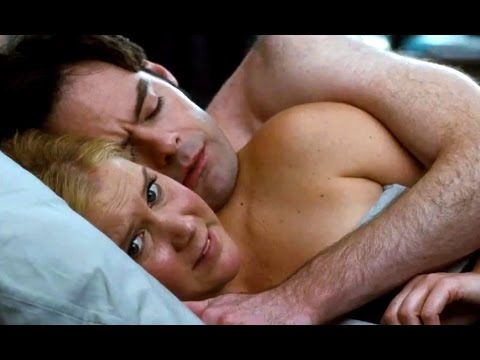
Amy Schumer, Bill Hader...terrified by romance

Amy Schumer, Bill Hader…terrified by romance

“TRAINWRECK”  My rating: B- (Opening wide on July 17)

125 minutes | MPAA rating: R

Amy Schumer, the hottest thing in comedy right now, makes a largely effortless transition to the big screen in “Trainwreck,” a dirty-minded laughfest with a warm fuzzy heart.

In addition to starring with Bill Hader, Schumer also wrote the screenplay.  Judd Apatow directs, and is usually the case with his efforts (“This Is 40”, “Funny People”), the results often are scattered and overlong.

But the mere presence of Schumer onscreen and the pervasiveness of her uniquely biting-bitter-bawdy comic sensibility makes “Trainwreck” a keeper.  It’s more like a collection of sketches than a narrative whole, but when you’re laughing this hard it’s hard to complain.

Things get off to a wonderfully sarcastic start with an opening scene from the childhood of Schumer’s character, Amy.  Amy and her little sister Kim are being told by their philandering father that the family is breaking up.  Dad (Colin Quinn) is a glorious sleazebag who asks his little girls how they’d feel if they were told they could only play with one doll for the rest of their lives.

“They’re making new dolls every year,” reasons their reprobate father.

The moral of this father-daughter meeting: Monogamy is unnatural.

And that’s a philosophy the grown-up Amy embraces. She chugs drinks and puffs pot. She’s a bit of a slut.  She sends her boy toys home after sex — no all-night cuddles.

She works for a scuzzy/hip men’s magazine.  Amy’s editor (a nearly unrecognizable Tilda Swinton) is a vampirish Brit beauty whose indifference to everyone save herself is breathtaking — and that attitude is reflected on the publication’s pages: “You’re Not Gay — She’s Boring.”  “A Guide to Masturbating at Work.”

Continue Reading »

Amy Winehouse...in better times

Amy Winehouse…in better times

“AMY” My rating: B+ 

128 minutes | MPAA rating: R

The documentary “Amy” spends its first hour making the case that the late Amy Winehouse was one of the great singer-songwriters of the new millennium, a British Jewish girl who channeled the smoky/slurred vocals of Sarah Vaughan and Billie Holiday and wrote searingly revelatory yet weirdly beautiful tunes.

Then Asif Kapadia’s film spends a second hour chronicling Winehouse’s rapid unraveling, her battles with substance abuse, and her 2011 death at age 27 0f alcohol poisoning.

The effect is heartbreaking.

Kapadia’s documentary is constructed exclusively of archival footage.  There are the usual TV broadcasts, concert footage, photos and news video (once she became famous and her shenanigans newsworthy, Winehouse was ruthlessly stalked by the paparazzi).

But what makes “Amy” so intimate and ultimately revelatory is the huge quantity of private videos — most shot on smart phones in private circumstances — that chronicle her transition from fresh-faced 15-year-old to up-and-coming musician to hunted, haunted cultural icon.

Dozens of Winehouse’s friends, co-workers and family members contribute their memories and thoughts, but there are no talking-head interviews.  Rather, these comments play under the compelling visuals. Continue Reading »

##and **

Linnea Saasen and Alex Holdridge

“MEET ME IN MONTENEGRO” My rating: C

90 minutes | No MPAA rating

You’d think that a movie that was so overwhelmingly autobiographical would be more interesting.

Alas, “Meet Me in Montenegro” is a bit of a shrug.

It was written by,  directed by, and stars real-life couple Alex Holdridge and Linnea Saasen and gives us — in  fictionalized form — the story of their romance.

Holdridge, whose “In Search of a Midnight Kiss” was an Independent Spirit Award winner back in 2007, has been trying for years to make another feature, and he’s incorporated that struggle as part of  his character’s back story.

Anderson(Holdridge) is a once-promising indie filmmaker now wasting away while trying to sell his new sci-fi script to a big studio.  Nobody’s biting.

Also, he’s moping over the collapse three years ago of a big affair with Lina (Saasen), a Norwegian dancer he met in Berlin and with whom he spent six glorious weeks in Montenegro.  It ended when she vanished without a fare-thee-well. Anderson returned to the States an emotionally bruised loser.

Now he’s back in Berlin. Actor Jason Ritter (playing himself) has expressed an interest in the script and at his own expense Anderson has flown to Germany to take a meeting. Wouldn’t you know it? He runs into Lina, and after some tentative maneuvering they pick up where they left off. Continue Reading »

Stuart, Scarlet Overkill, Kevin and Bob

Stuart, Scarlett Overkill, Kevin and Bob

“MINIONS”  My rating: C+  

91 minutes | MPAA rating: PG

It is the perennial dream of second bananas to become the star of the show.

Sometimes they’re better off as second bananas.

That’s the case with “Minions,” the new spinoff from the wildly successful “Despicable Me” animated franchise.

In the “Despicable” features the Minions are the banana-yellow, fireplug-shaped workforce of the evil mastermind Gru voiced by Steve Carell.  Outfitted with huge safety goggles and tiny overalls, they cheerfully  do their master’s bidding while babbling in a hilarious helium-voiced language.

Though loyal to their evil boss, the Minions are morally neutral.  More important, they’re inept, which means their efforts hinder as much as help the big guy’s agenda.

“Minions” follows the template set last fall by “Penguins of Madagascar,” elevating one movie’s sidekicks to leading men in their own stand-alone story. But where “Penguins” gave us chatty waddling birds with very specific personalities, the various “Minions” are pretty much interchangeable.

Equally frustrating, by eliminating the Carell role, co-directors Kyle Balda and Pierre Coffin and writer Brian Lynch give their sawed-off protagonists no worthy character to play off of.

“Minions” begins in prehistory, showing how the creatures evolved over the eons. According to Geoffrey Rush’s narration, the Minions always sought an evil boss to work for, be it a tyrannosaurus rex or an Egyptian pharaoh. Invariably they bring their leader to ruin and must seek out a new benefactor.

After living for centuries in a polar ice cave, three minions — Kevin, Stuart and Bob — strike out on a quest to find a new boss. They wind up in NYC circa 1968, an era of protest, long hair and bell bottoms (not to mention the sounds of The Who, The Doors, The Kinks, The Stones and other classic rock acts that pepper the soundtrack).

Continue Reading »

wolfpack-1024“THE WOLFPACK” My rating: B-

 80 minutes  | MPAA rating: R

“The Wolfpack” looks at six brothers who grew up as virtual prisoners of their father in NYC high-rise public housing. They learned about the outside world mostly from voraciously consuming movies on VHS and DVD.

Theirs is a once-in-a-lifetime story that deserves — demands — a brilliant documentary filmmaker to do it justice.

Well, director Crystal Moselle isn’t brilliant. Given all the gaping holes in her film, one hesitates to rate her higher than just competent.

Moselle discovered the six Angulo brothers — all of them tall, thin, with waist-length hair and dressed in black suits and ties like characters from “Reservoir Dogs” (one of their favorite films) — on the streets of the Lower East Side near their home.

Only a few weeks before the oldest son, Bhagavan, had defied his father by leaving the apartment on his own to experience life at ground level.  Now Bhagavan was leading his five awestruck brothers on a tour of their neighborhood.

Moselle, an aspiring filmmaker, was absorbed by this spectacle, got to know the boys, and was the first outsider invited into their home.  Over years she filmed their activities in and out of the cramped apartment.

One problem with “The Wolfpack” is that this backstory isn’t even mentioned in the film.  You’ll have to learn about it from other sources (the ABC show “20/20” recently did a major story on the Angulos that plugs lots of narrative holes).

The sticking point here is the strict cinema verite style Moselle employs.  No narration. No formal interviews. No graphics.  Not even onscreen titles that would identify the boys by name (they look so alike it’s hard to tell them apart).

In dribs and drabs we learn that the boys’ father, Oscar — a Peruvian who at one time gave tours of Inca landmarks — decided years ago to shield his brood from the sins of the world. Believing himself a mystic, Oscar gave his children Sanskrit names (Makunda, Govinda, Jagadosa) and kept their apartment door locked. He held the only key.

His American wife, the former hippie Suzanne, went along with this despite misgivings. She got a teaching license so as to home school the children (there’s a seventh child, a girl, who appears to have developmental issues).

And so — with the exception of perhaps a handful of excursions each year — the boys grew up in isolation.

Continue Reading »

Adam Scott, Taylor Schilling, Jason Schwarzman

Adam Scott, Taylor Schilling, Jason Schwarzman

“THE OVERNIGHT” My rating: B- 

80 minutes | MPAA rating: R

Nearly 50 years ago, in “Bob & Carol & Ted & Alice,” two seemingly hip couples dabbled  in wife swapping, only to find that despite the love beads and bell bottoms they remained hopelessly old school in sexual matters.

Things haven’t changed all that much.

In “The Overnight” married transplants to Los Angeles meet an intriguing couple and spend a night drinking, hot tubbing and flirting with disaster.

Writer/director Patrick Brice delivers an uncomfortable comedy that suggests that old-time morality still has us in its clutches and isn’t letting go any time soon.

Alex and Emily (Adam Scott and Taylor Schilling), only recently arrived from Seattle, are wondering if they will ever make new friends in the City of Angels.  They get their answer in a park playground where their young son hits it off with another little boy.

This kid’s dad is Kurt (Jason Schwartzman), a funny, suave and deeply eccentric fellow who invites the newcomers over to the house. The kids can play, the grownups can get to know one another.

Think of it as a long night’s journey into monogamy.  But not without some major temptations and digressions.

Continue Reading »

Blythe Danner

Blythe Danner

“I’LL SEE YOU IN MY DREAMS” My rating: B

92 minutes | MPAA rating: PG-13

There’s no other way to put this…at age 72 Blythe Danner seems more beautiful, more luminous, and more talented than at any time in her life.

And “I’ll See You in My Dreams” is an ideal vehicle both for this terrific actress and for exploring issues of age.

Death is never far off in director Brett Haley’s dramedy (co-written with Marc Basch).  In the first scene septugenarian Carol Peterson (Danner) must put down her canine companion of 12 years. While the pooch was around she could always rely on its undivided devotion, but now this widow of 20 years is starting to feet mortality’s tug.

Oh, Carol has what looks like a fairly full life.  Money’s not a problem. She’s got a group of gal pals (Rhea Perlman, June Squibb, Mary Kay Place) with whom she shares bridge, golf and gossip (one of the film’s strong suits is its dialogue, which sounds like real people jabbing rather than the usual moviespeak).  Her friends would like Carol to move into the retirement community where they all live, but she relishes the independence — and perhaps the solitude — of the home she shared with her husband.

“I don’t like life all complicated,” she says. Funny how complications seem to find her.

Despite her misgivings, Carol senses that she’s in a retirement rut. That may be why she reluctantly allows herself to be talked into a round of geriatric speed dating, a hilarious/appalling experience that only convinces her that solitude is preferable to the the male pickings after 65.


Continue Reading »

Olivia Cook, and

Olivia Cooke, Thomas Mann and R.J. Cyler

“ME AND EARL AND THE DYING GIRL”  My rating: B

105 minutes  | MPAA rating: PG-13

The dying teen film — last year’s “The Fault in Our Stars” being a prime example — typically wrings romance from the weepy nexus of young love and early death.

The Sundance hit “Me and Earl and the Dying Girl” takes a different approach, eschewing tearful swooning and emphasizing a snarky (almost too snarky) humor.

Oh, it’ll still have you groping for a tissue in the last reel, but it’s much more devious than its filmic brethren about getting us there.

The protagonist and narrator of director Alfonso Gomez-Rejon’s debut feature is Greg (Thomas Mann), a high school senior who like many a smart dweeb before him employs post-modern irony to shield himself from adolescence’s slings and arrows.

Greg oozes weary contempt for the inanities of both teen and adult society (the latter represented by his touchy/feely parents played by Connie Britton and Nick Offerman). He has navigated the shark-infested waters of a big-city school by becoming a human chameleon, ingratiating himself with various youthful castes. Everyone thinks he’s part of their club, but nobody really knows him.

Perhaps not even Earl (R.J. Cyler), Greg’s best friend since elementary school. They’re an odd couple — the nerdy white guy and an ultra cool black kid.

Greg and Earl are fans of art house movies — we can’t be sure if they really like highbrow films or are just determined to set themselves apart from their mass-consuming peers — and devote their spare time to making short movies parodying cinema classics.

These goofy amateur remakes have clever names (“Grumpy Cul-De-Sacs” is the boys’ take on “Mean Streets”: “MonoRash” spoofs Kurosawa’s “Rashomon”; “Senior Citizen Kane” and “My Dinner With Andre the Giant” speak for themselves) and they’re fun in a so-bad-they’re-good way. (Jesse Andrews’ screenplay, adapted from his novel, references Wes Anderson’s “Rushmore,” whose high school hero stages theatrical adaptations of his favorite films. )

Greg’s too-hip-to-be-bothered facade gets shaken up though, when his mother insists he pay a visit to Rachel (Olivia Cooke), a classmate recently diagnosed with leukemia.

Neither Greg nor Rachel have any illusions about why he shows up at her door. It’s mom-mandated community service, and since Rachel shares some of Greg’s suspicions about conventional sentimentality and socially appropriate behavior, she makes  no demands on her new friend (although Rachel’s needy single mom — Molly Shannon with endlessly replenished glass of white wine — is pathetically grateful for her daughter’s gentleman caller).

One reason Greg keeps coming back — though he’d never admit it — is that Rachel has his number.  She knows the teenage fear of putting oneself on the emotional line and drawing back a stump; she recognizes in Greg and Earl fellow committment phobes. Continue Reading »

Jean Dejardin

Jean Dejardin

“THE CONNECTION” My rating: B-

135 minutes | MPAA rating: R

Most of us are familiar with “The French Connection,” William Friedkin’s 1971 film about the NYPD’s efforts to stamp out a drug smuggling empire flooding American streets with top-grade heroin.

The French “The Connection” approaches that same situation from the shared POV of the cops and criminals who throughout the ’70s played a long game of cat and mouse in Marseilles, where Neapolitan and Corsican mobsters had set up labs to process opium smuggled in from the Middle East.

Whereas Friedkin’s film was fictionalized (among other things, the names were changed), this offering from writer/director Cedric Jimenez purports to more or less tell the true story of how the police finally broke the back of at least one particular drug operation.

Jean Dujardin, an Oscar winner for his turn as a silent film star in “The Artist,” portrays Pierre Michel, a juvenile magistrate who finds himself bumped upstairs to the organized crime unit. Michel hasn’t a background in criminal law but he has plenty of motivation — while hearing the cases of teenage delinquents he learned much about drug addiction and saw its grim results.

“The Connection” follows Michel as he learns on the run, figuring out how the complicated drug smuggling operation works and winning the confidence of the cops who must implement the anti-crime campaign he will create.

Michel’s story is intercut with that of Gaëtan ‘Tany’ Zampas (Gilles Lellouche), a powerful drug lord who also runs a lucrative protection racket and operates popular nightclubs along the Riviera. Zampas is a attractive/scary blend of sophisticate and thug.

Over nearly 2 1/2 hours “The Connection” follows these two men who, though on different sides of the law, are in many ways very much alike.  Both are devoted family men, both nurse an explosive temper beneath a cool exterior, both are willing to act ruthlessly to achieve their aims.

Over time Michel will bend the legal rules and act less like an administrator than an overzealous cop. Zampas may actually regret having to have his enemies killed — though it doesn’t stop him from seeing the job through.

In fact, actors Dejardin and Lellouche physically resemble one another…that can’t be a coincidence.

Continue Reading »

as Yves Saint Laurent

Gaspard Ulliel as Yves Saint Laurent

“SAINT LAURENT” My rating: C+

150 minutes | MPAA rating: R

Even this  fashion backwards film reviewer recognizes the late Yves Saint Laurent, the French couturier who pioneered classy ready-to-wear clothing and founded a wildly successful company that bears his name.

But if you want to understand exactly who Yves Saint Laurent was — well, you’re not going to get much help from “Saint Laurent,” writer/director Bertrand Bonello’s fragmented, impressionistic epic (like, 2 1/2 hours).

The film is great looking and at moments offers a near-documentary feel for the ’60s and ’70s when Saint Laurent was at his creative peak.

But it tells us surprisingly little about the man, his design ethos, or even the fashions he created.

Like a plate of spaghetti thrown against a wall, the film is scattered and splattered, frequently colorful but impossibly messy. Individual moments stick in the mind, but the overall impression is one of angst and hedonistic excess.

As the young Saint Laurent (who is portrayed in his dotage by Helmut Berger), Gaspard Ulliel is eerily believable — thin, high cheekbones, a shy smile, oversized glasses and a mop of Beatle-ish hair. But the film won’t let the actor explore the character’s inner life. This fellow may be a design genius (you’ll have to take that as a given, since the film makes no effort to actually make the case), but mostly he comes off as an idiot savant living a hermetically sealed life.

Continue Reading »