Feeds:
Posts
Comments

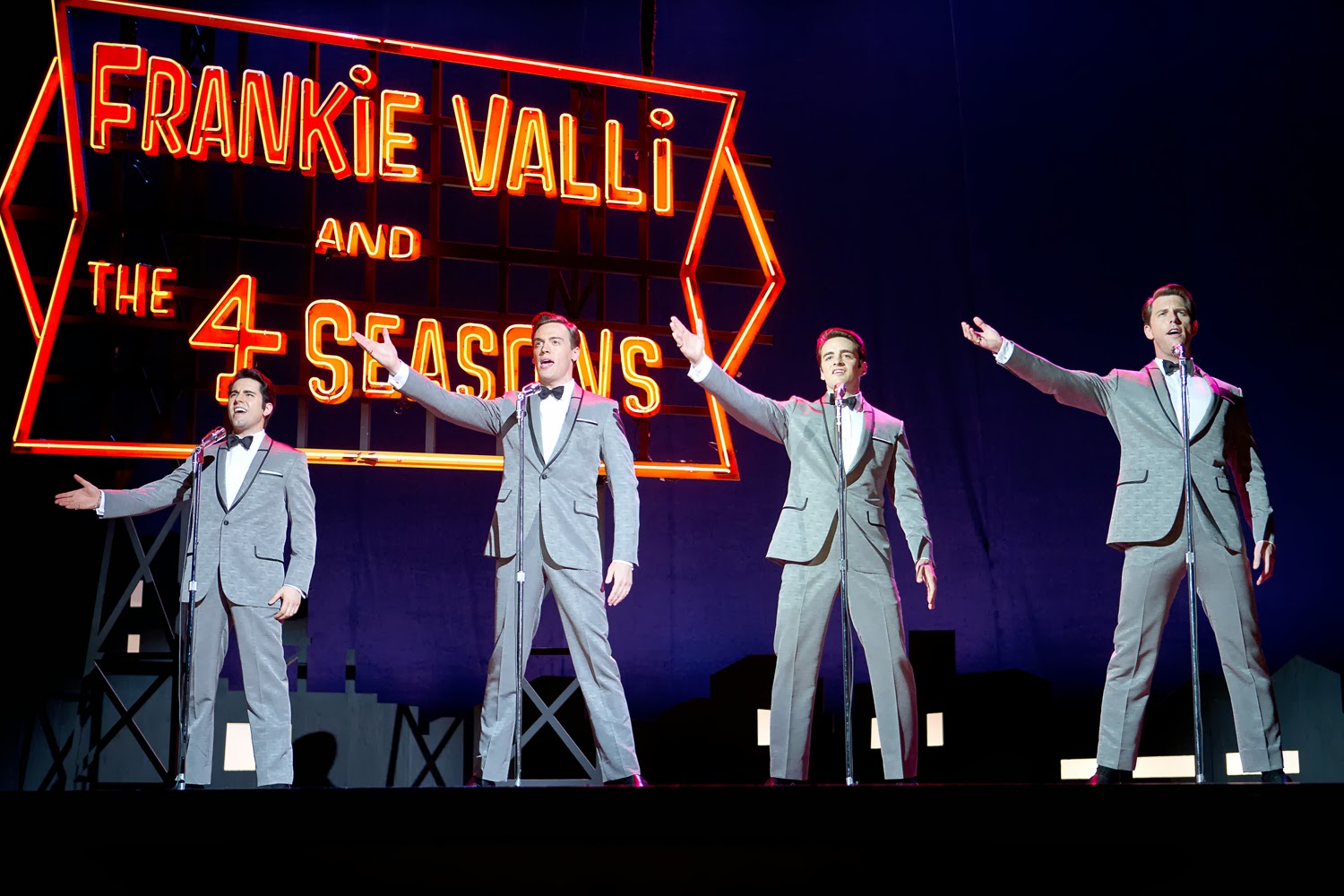
jersey“JERSEY BOYS” My rating: C+ (Opening wide on June 20)

Minutes | MPAA rating: PG-13

On stage, “Jersey Boys” was less a conventional musical than a jukebox, a time machine for baby boomers. The joy came not from the plot or the characters (which were riddled with show-biz clichés) but rather from the nostalgic rush of hearing the falsetto-heavy hits of Frankie Valli and the Four Seasons being performed live.

So how do you transfer that singular thrill to film?

You don’t. At least director Clint Eastwood hasn’t been able to.

We all know that movies are a liar’s game, that a musical number in a film has been pre-recorded, sonically sweetened and constructed from several individual performances cannily edited together.  Even with the knowledge that we’re hearing the actual voice of John Lloyd Young, the stage actor who reprises his performance as lead singer Frankie Valli, I found it all…well, underwhelming.

Eastwood is a musician and composer and he has in his resume the ambitous “Bird,” a biopic about jazz legend Charlie Parker. But here he seems to have been hamstrung by a creative team drawn largely from the stage production and committed to not allowing too much divergence from what was seen on Broadway and in countless touring companies.

Scripted by Marshall Brickman and Rick Elice, who also wrote the book for the stage musical, “Jersey Boys” is the story of four Italian American kids who rise from the mean streets around Newark to making hit record after hit record throughout the 1960s.

The elements are familiar. There are early brushes with the law (the opening hour feels like ersatz Scorsese), struggles to get gigs and a recording contract, the eventual triumph on the pop music charts followed by revelations of financial shenanigans, marital discord and personal tragedy, not to mention the debilitating effects of constant touring and personalities rubbed raw by too much proximity.

Continue Reading »

Guy Pearce, Robert Pattinson in "The Rover"

Guy Pearce, Robert Pattinson in “The Rover”

“THE ROVER”   My rating: B- (Opening Jan. 20 at the AMC Town Center)

102 minutes | MPAA rating: R

There must be something about the wide open spaces of Australia’s outback that drives its filmmakers to post-apocalyptic nihilism.

George Miller and the “Mad Max” films.   John Hilcoat with “The Road” and “The Proposition.”

And now David Michôd with “The Rover,” a sweaty, dusty saga about a man in search of his kidnapped car.

Michôd scored a minor coup in 2010 with “Animal Kingdom,” an intimate portrait of a low-level Aussie crime clan that introduced to American audiences the great Jackie Weaver (who nabbed an Oscar nomination). It  was a dark, generally hopeless look at the ties that bind its characters to an evil enterprise.

Now  Michôd goes full-tilt dystopia. The opening credits of “The Rover”  informs us that the story takes place 10 years after “the collapse,” a worldwide economic meltdown that has left most of humanity struggling with chronic poverty.

Continue Reading »

Johnny Depp and Ralph Steadman

Johnny Depp and Ralph Steadman

“FOR NO GOOD REASON” My rating: B  (Opens June 13 at the Tivoli)

89 minutes | MPAA rating: R

For many of us it is impossible to separate the savagely witty, nightmarish, splattery cartoons and illustrations of Ralph Steadman from the gonzo journalism of the late Hunter Thompson.

In 1970 the American Thompson and the Brit Steadman formed a partnership to write and illustrate a story about their trip to the Kentucky Derby. They hit the big time two years later with  Fear and Loathing in Las Vegas,  Thompson’s drug-saturated novel inspired by his Rolling Stone assignment to cover a convention of police chiefs in Sin City.

Steadman’s bizarre, jagged, horrific illustrations were the perfect visual counterpart to Thompson’s words. The pair seemed to have been made for each other.

There’s a bit of  vintage footage in Charlie Paul’s “For No Good Reason” showing Thompson’s indignant reaction to Steadman’s assertion that his jump-off-the-bookshelf cover art is the main reason Fear and Loathing became a best seller.  The public only began reading the book, Steadman teases, after being attracted by his art.

It’s a moment that in many ways encapsulizes the relationship.  Steadman and Thompson (who committed suicide a few years back) needed each other. The artist calls the writer “the one man I needed to meet in America.”  Together they were an unbeatable team. Then they spent decades as near rivals, trying to establish their own independent identities.

As you’d expect, that love/hate partnership takes up a good chunk of Charlie Paul’s documentary.  But the film also shows that Ralph Steadman is a man of many parts: a political satirist in the spirit of Daumier, Nast, and Goya; a social activist; a visual experimenter. He also seems like a genuinely nice fellow.

Continue Reading »

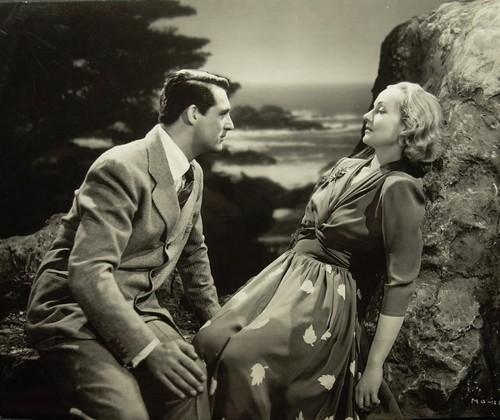
Cary Grant and Carole Lombard

Cary Grant and Carole Lombard

“In Name Only” screens at 1:30 p.m. Saturday, June 21, 2014 in the Durwood Film Vault of the Kansas City Central Library, 14W. 10th St.  Admission is free. It’s part of the year-long film series Hollywood’s Greatest Year, featuring movies released in 1939.


Movie studios messed with the Hollywood Production Code at their own peril.

The code – in place from the early 1930s through the early ‘60s — was a guideline of do’s and don’ts that were to be followed by any motion picture released by one of the major studios.

Some of the code’s rules seem absurd today. Like the idea that evil must always be punished before the lights come up. Or that even married couples must sleep in twin beds. Or that movie audiences should never see a – gasp! – toilet.

Long before the cameras rolled the studios submitted their screenplays to be vetted by the Production Code’s staff. Offensive dialogue was eliminated. Certain plot points might have to be tweaked. Occasionally the code folk pronounced an entire film unfit for moral reasons.

Why would the studios handcuff themselves artistically by submitting to such a system?

Well…money. Before the Production Code, hundreds of censorship boards in cities, counties, and states around the U.S. were in the business of watching films and demanding changes. It was a royal pain, since a scene that was OK with the censors in Ohio might be banned by the censors in Alabama. The studios had neither the time nor the inclination to re-edit their movies for different locales.

The Production Code solved that problem by setting standards that would be acceptable everywhere in the U.S. The idea was that a film could play in any city or state, to any sort of moviegoer (old or young, male or female), without causing offense.

And it worked. Once the code was in place, most local censorship boards were shut down. The movies were now a one-size-fits-all proposition.

1939’s “In Name Only” was made under the Production Code, of course. But somehow it managed to bend the usual rules out of shape.

It’s about a husband who falls for another woman – and ends with him happily leaving his wife for his new love.

That plot line should have put “In Name Only” on the code’s naughty list. Marriage was sacrosanct under the code, yet here was a movie that argues that under some circumstances, destroying a marriage is a good thing.

How did they get away with it? Continue Reading »

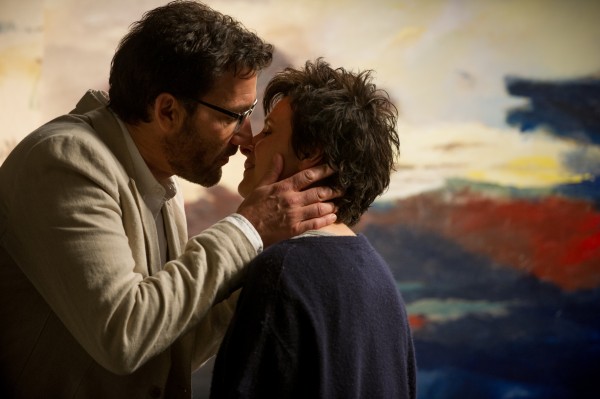
Clive Owen, Juliette Binoche

Clive Owen, Juliette Binoche

“WORDS AND PICTURES” My rating: C+ (Opens  June 13)

111 minutes | MPAA rating: PG-13

If “Words and Pictures” is about as deep as your average college entrance essay, at least it’s more entertaining.

Directed by veteran Aussie filmmaker Fred Schepsi,  “W&P” is like “Dead Poets Society” risen from the grave. There’s a bit of the zombie about it.

In a posh suburban prep school, an honors English teacher and an honors art teacher wage a love/hate feud over which has the most power and importance: words or visual images.

In this corner, Jack Marcus (Clive Owen), a once-promising poet/novelist who hasn’t written anything in years. Frustrated by his inability to share his love of literature with his indifferent students (if these entitled jerks in blue blazers are the school’s intellectual elite, I fear for our republic), Jack’s idea of preparing a class plan is to fill a thermos with ice-cold vodka.

The other brawler is a newcomer to the school. Dina Delsanto (Juliette Binoche) is a moderately-famous painter whose career has been cut short by crippling rheumatoid arthritis. Now she teaches  art to students who don’t appear particularly gifted or dedicated. Still, she tells the kids, pictures provide truth while words offer nothing but lies.

Continue Reading »

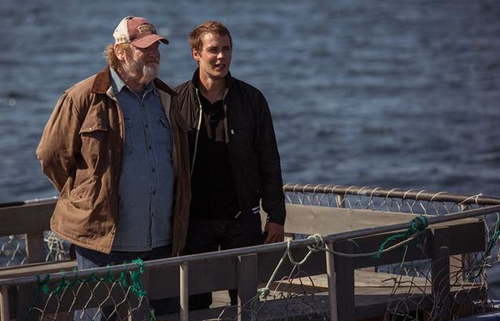
Jesse Eisenberg, Dakota Fanning, and Peter Sarsgard...eco-terrorists

Jesse Eisenberg, Dakota Fanning, and Peter Sarsgaard…eco-terrorists

“NIGHT MOVES” My rating: B+ (Opening June 13 at the Cinetopia and AMC Studio)

112 minutes | MPAA rating: R

For want of a better description, Kelly Reichardt’s films are often called “minimalist.” They are made simply, without a lot of technical razzle dazzle, and they concentrate on characters, not big effects.

But just because Reichardt eschews the big melodramatic moment doesn’t mean her films are emotionally barren. Her “Old Joy” was an aching study of two men on the brink of middle age who have outgrown their friendship. “Wendy and Lucy” will resonate with anyone who has loved a pet. And her Western “Meek’s Cutoff” was a harrowing tale of settlers lost on their journey through the Great American Desert.

“Night Moves” may be her most conventional film to date.  It’s a thriller, a genre with whose tropes we’re all familiar. And yet the gentle Reichardt touch is evident everywhere, with an emphasis on atmosphere and slowly building tension rather than big action set pieces.

In fact, the film’s biggest moment takes place off screen.

Continue Reading »

Bob Hope and Paulette Goddard

Bob Hope and Paulette Goddard

“The Cat and the Canary” screens at 1:30 p.m. Saturday, June 14, 2014 in the Durwood Film Vault of the Kansas City Central Library, 14W. 10th St.  Admission is free. It’s part of the year-long film series Hollywood’s Greatest Year, featuring movies released in 1939.


Baby boomers who grew up watching Bob Hope (1903-2003) on television – on his many U.S.O. specials, hosting the Oscar telecast, and appearing as a guest on various variety shows – may not realize that Hope was a major movie star as well.

Granted, Hope’s heyday on the silver screen had pretty well petered out by the mid-1950s, when most boomers were in elementary or junior high school. But by that time this British-born funnyman – who showed uncanny wisdom in his financial and career choices (he was among the biggest landowners in Los Angeles) – had established himself as a regular presence on the boob tube.

Born in London in 1903, Hope was only five when his family emigrated to the U.S. (which explains his lack of an English accent). He spent a few years in Cleveland, Ohio, before moving to Los Angeles, where he devoted much of his adolescence to earning money as a street performer. He spent five years on the vaudeville circuit, but the movies proved a hard sell. When Hope failed a 1930 screen test, he made one of his smart moves, turning to radio, where he won fans for his quick wit.

Finally, in 1934, Hope began appearing on the big screen in a series of shorts for Warner Bros. These audience pleasers allowed him to hone his self-deprecating screen persona, that of a wise-cracking coward who was full of bravado until push came to shove, at which point his instinct was to run away.

In his first few feature films he shared the screen with other comic performers like W.C. Fields, Martha Raye, and George Burns and Gracie Allen. As part of large comic ensembles, Hope was able to put his “brand” in front of moviegoers without taking the risk of being a star who could be blamed for a film’s failure.

Which brings us to 1939’s ” The Cat and the Canary.” It’s an ensemble effort as well, but here Bob Hope clearly emerges as the star, the most interesting thing on the screen.

Continue Reading »

edge“THE EDGE OF TOMORROW” My rating: B- (Opening wide on June 6)

113 minutes | MPAA rating: PG-13


“The Edge of Tomorrow,” a big-budget sci-fi action epic that melds elements of “Starship Troopers” with “Groundhog Day,” has been earning the sort of reviews usually reserved for Shakespeare adaptations.

This says less about “The Edge of Tomorrow” than about the generally dismal state of the action movie.

Still, the film does have a few things going for it, starting out with Tom Cruise as we’ve never before seen him (playing a physical coward), and extending through the dry humor with which director Doug Liman (“The Bourne Identity,” “Mr. and Mrs. Smith”) approaches his offbeat tale.

But for all that, it’s still a big-budget action movie in which crashbangboom trumps all other considerations.

In the near future, Earth is under attack by an alien species we humans have nicknamed the Mimics. These are tentacled creatures (they look a bit like the Sentinels from the “Matrix” flicks) that roll around like tumbleweeds, shooting off sparks and tearing up those unfortunate enough to stand in their path.

The Mimics pretty much own Europe, having plowed across the continent. Now they are preparing to jump the English Channel to overrun Britain.

Major William Cage (Cruise) is a U.S. Army public relations specialist stunned to learn that he’s been ordered to shoot combat footage of the first wave of troops to storm the beaches at Normandy. Cage protests that he’s a word man, not a gun guy, that he’s never been trained for combat, that he’ll only get in the way, that he faints at the sight of blood.  In fact, like any sane individual, he’s terrified of the horrors that await him.

Continue Reading »

Agata Kulesza, Agata Trzebuchowska in "Ida"

Agata Kulesza, Agata Trzebuchowska in “Ida”

“IDA”  My rating: A (Opening June 6 at the Tivoli)

80 minutes | MPAA rating: PG-13

The simple description of “Ida” is that it’s about two women on a road trip.

Yeah, and “Citizen Kane” is about sledding.

Pawel Pawlikowski‘s film – the first feature he has made in his native Poland, having at age 14 fled the country’s Communist regime for a life in the West — is a low-keyed masterpiece.

“Ida”  succeeds brilliantly as the personal story of two very different but inescapably linked women. But it also provides an examination/indictment of Poland’s troubled past, from the endemic anti-Semetism that found many Poles happily helping out with Hitler’s “final solution” to the drab amorality of the post-war Communist years.

And while it’s doing all that, “Ida” does something even more astounding. It achieves a sort of meditative state, thanks to languid pacing, some of the most beautiful black-and-white cinematography you’ve ever seen, and a performance by newcomer Agata Trzebuchowska that is so saint-like it seems to have been plucked from the canons of Dryer and Bresson.

In 1961 young Anna (Trzebuchowska) is about to take her vows as a Roman Catholic nun when she’s called into the Mother Superior’s office and told that before joining the order she must spend time with her only living relative – an aunt that Anna didn’t know existed.

Wanda (Agata Kulesza) is a fortysomething atheist and alcoholic.  When Anna shows up at her doorstep, Wanda is sucking on a cigarette and waiting for her one-night stand to clear out of her bedroom. This cynic seems to take pleasure in informing Anna that her name is actually Ida Lebenstein.  What’s more, Anna/Ida – an orphan whose entire life has been spent in the convent — is a Jew.

“A Jewish nun,” Wanda snorts.

Continue Reading »

cheat“You Can’t Cheat an Honest Man” screens at 1:30 p.m. Saturday, June 7, 2014 in the Durwood Film Vault of the Kansas City Central Library, 14W. 10th St.  Admission is free. It’s part of the year-long film series Hollywood’s Greatest Year, featuring movies released in 1939.


W.C. Fields didn’t make movies so much as he made extended comedy routines strung together on the flimsiest of narrative threads.

He was a product of vaudeville, after all, not the repertory theater. He was only any good at playing one character: himself, a cranky, often hen-pecked misanthrope and con artist who looked more like a cartoon than a real human being.

Fields’ hair was thinning, his red nose bulbous (in real life as in his films, he was a prodigious consumer of alcohol), his body pear-shaped, his legs skinny. He often wore an out-of-fashion top hat or straw boater, long-tailed coats, and spats.

Yet despite his ridiculous physique, his training as a variety hall juggler allowed him to move with remarkable grace and made him a natural for physical comedy.

(Check out his 1932 short The Dentist on YouTube…the bit where he tries to pull a female patient’s tooth suggests that beneath his pudgy form there lurked considerable strength.)

Especially there was Fields’ voice, a snide snarl that remains immediately identifiable more than 70 years after his death.

Continue Reading »