Feeds:
Posts
Comments

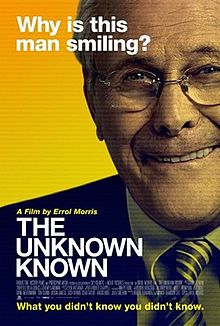
220px-The_Unknown_Known_poster“THE UNKNOWN KNOWN” My rating: B (Opening April 11 at the Screenland Crown Center)

103 minutes | MPAA rating: PG-13

Who the hell is Donald Rumsfeld, anyway?

I mean, I know he has been a career public servant since the Nixon administration, a bureaucrat with unmatchable survival instincts. I know he’s served as Secretary of Defense under two presidents, that he was one of the major creators of the War on Terror.

I remember being in awe of Rummy for his passive/aggressive handling of journalists during the Iraq war – he could engage in a seemingly affable conversation while giving the unmistakable impression that he considered all reporters to be idiots bent on wasting his time.

Was I amused at his disdain for a free press? Outraged? Both, actually.

But, inside, who is this guy?

I had hoped for answers from “The Unknown Known,” the latest documentary from Errol Morris. A few years back in “The Fog of War” Morris turned his camera on Vietnam war architect Robert McNamara, and the result was an Oscar-winning study of a once-powerful man haunted by his mistakes.

So perhaps Morris would work the same sort of magic on Donald Rumsfeld?

Dream on. For starters, the word “mistake” may not even exist in Rumsfeld’s vocabulary. His admitting to one would be a sure sign of the End of Days.

Continue Reading »

Joan Crawford, Norma Shearer, Rosalind Russell

Joan Crawford, Norma Shearer, Rosalind Russell

“The Women” screens at 1:30 p.m. Saturday, April 12, 2014 in the Durwood Film Vault of the Kansas City Central Library, 14W. 10th St.  Admission is free. It’s part of the year-long film series Hollywood’s Greatest Year, featuring movies released in 1939.

No good parts for women?

Not in 1939. That was the year director George Cukor gave us “The Women,” an alternately satiric and heartstring-tugging  comedy featuring an all-female cast. (No man is seen on screen…not even depicted in a photo hanging on the wall.)

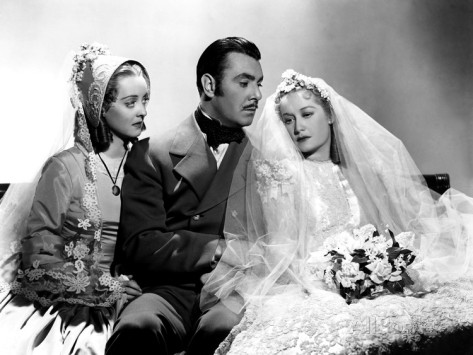
Our heroine is well-to-do Mary Haines (Norma Shearer), who learns from a gossiping beautician that her husband has been gallivanting with a slutty perfume counter girl (Joan Crawford). As if that wasn’t upsetting enough, the catty rumor monger Sylvia Fowler (Rosalind Russell) is having a field day spreading the news of Mary’s dilemma through the Park Avenue grapevine.

That’s the basic setup, but the film has an endless supply of subplots and supporting characters. Among the actresses you’ll see here are Mary Boland, Paulette Goddard, Joan Fontaine, Marjorie Main, Virginia Grey, Ruth Hussey and Hedda Hopper (who was an actress before becoming one of Hollywood’s most power gossip columnists).

The film was based on the hit Broadway play by Clare Booth Luce, who in addition to being an accomplished woman of letters was the wife of the powerful Henry Luce, publisher of Time, Life and Fortune magazines. Later she would be elected to the U.S. House of Representatives from Connecticut and would become a U.S. ambassador.

Luce was a notorious wit whose axioms have entered our common language: “Widowhood is a fringe benefit of marriage.” “A hospital is not the place to be sick.” “No good deed goes unpunished.”

Continue Reading »

cap 3“CAPTAIN AMERICA: THE WINTER SOLDIER” My rating: C+ (Opening wide)

136 minutes | MPAA rating: PG-13

There are few moments early in “Captain America: The Winter Soldier” that suggest what the film might have been.

Fans of the Marvel Universe will recall that at the end of 2011’s “Captain America: The First Avenger,” the Cap (Chris Evans) was thawed out after a half-century of suspended animation and was recruited by Nick Fury (Samuel L. Jackson) and his super-secret spy organization S.H.I.E.L.D.

Put yourself in the Captain’s shoes. You grew up in the 1930s a 98-pound weakling. You were transformed into a muscled hunk of extraordinary power by some government-brewed elixir. You fought the Nazis in World War II.

And now you’re in 2014. Overnight you went from a world where “high tech” meant an AM radio to one of cell phones and the worldwide web. Of course, you must contend with more than just technical advancements. You’re bombarded by modern morals and sensibilities that run counter to your squeaky-clean upbringing.

When you were frozen the word “teenager” didn’t exist. Now you’re in a civilization that caters to teens as the most desirable demographic (this movie being Exhibit A).

Credit Christopher Markus and Stephen McFeely’s screenplay for this much at least: It tries to say something about the dislocation that good-guy Cap – aka Steve Rogers – feels, to explore the angst of a man from a genteel past trapped in a crass present.

That’s a movie I would have enjoyed.

Continue Reading »


Irene Dunne, Charles Boyer in "Love Affair"

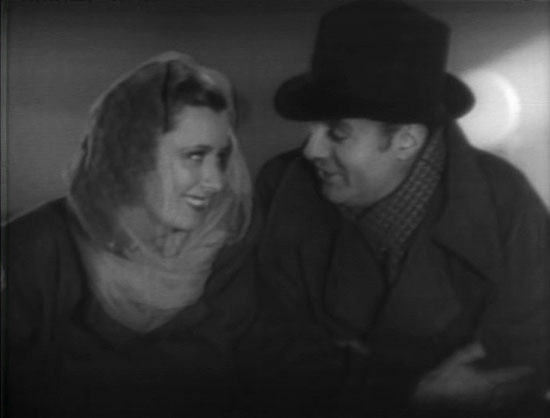
Irene Dunne, Charles Boyer in “Love Affair”

“Love Affair” screens at 1:30 p.m. Saturday, April 5, 2014 in the Durwood Film Vault of the Kansas City Central Library, 14W. 10th St.  Admission is free. It’s part of the year-long film series Hollywood’s Greatest Year, featuring movies released in 1939.

Directors don’t often get do-overs.

Oh, Hollywood loves remakes. They come with a built-in audience…or so it’s thought.

But a director  making the same movie twice? Not so often.

Hitchcock made “The Man Who Knew Too Much” twice (in 1934 and in 1956). Beyond that I know of only one other such re-do.

In 1939 Leo McCarey directed “Love Affair” with Charles Boyer and Irene Dunne. In 1957 he remade it as “An Affair to Remember” with Cary Grant and Deborah Kerr. (There was even a third version, 1994’s “Love Affair” with Warren Beatty and Annette Bening.)

“The difference between ‘Love Affair’ and an ‘Affair to Remember’ is very simply the difference between Charles Boyer and Cary Grant,” McCarey recalled.  “Grant could never really mask his sense of humor – which is extraordinary – and that’s why the second version is funnier. But I still prefer the first.”

Both screenplays were written by McCarey and follow more or less the same plot.  A notorious playboy and a woman (she’s a nightclub singer) meet on a boat chugging from Europe to America. Both are engaged to other people, but they fall in love.

Arriving in New York, they make a pact. They’ll spend time apart and then, if they still feel that romantic tug, they will meet in exactly six months at the top of the Empire State Building (“The nearest thing to heaven that we have in New York”).

If one of them fails to show, they’ll know their affair wasn’t meant to be.

Continue Reading »

Charlotte Gainsbourg in "Nymphomaniac"

Charlotte Gainsbourg in “Nymphomaniac”

“NYMPHOMANIAC” My rating: C (Opening April 25 at the Screenland Armour)

241 minutes | No MPAA rating

You can’t ignore a film by Lars von Trier. No matter how much you might want to.

The guy’s a genius, but a twisted one. He’s a first-class visual artist and a narrative anarchist who presents himself  as a cinematic provocateur. (I sometimes view him as a child playing with his own feces.) The beauty often on display in his films must be balanced against the inescapable fact that he’s awesomely misanthropic.

In his last movie, the spectacularly good “Melancholia,” von Trier destroyed our planet and everyone on it…but he did it with such artistic high style that we are seduced nonetheless.

His latest, “Nymphomaniac” (how’s that for a punch-in-the-mouth title?), is a much rockier affair. It’s the story of one woman’s tormented sexual history, complete with nudity, erect penises, and even a few fleeting shots of real sex acts. It’s almost as if von Trier is daring us to keep watching the screen.

Yet the film isn’t the least bit erotic (just another sign of von Trier’s perversity). One leaves this four-hour experience with the feeling that sex is hell.

Of course, in von Trier’s world most everything is hell.

(“Nymphomania” currently is available on Time-Warner on-demand. It’s presented as two 2-hour films, each of which must be purchased separately. Vol. I costs about $7; Vol. II costs nearly $10. In some cities it’s being shown theatrically, but none of Kansas City’s art theaters have it listed as an upcoming attraction.)

Continue Reading »

Ed Harris, Annette Bening

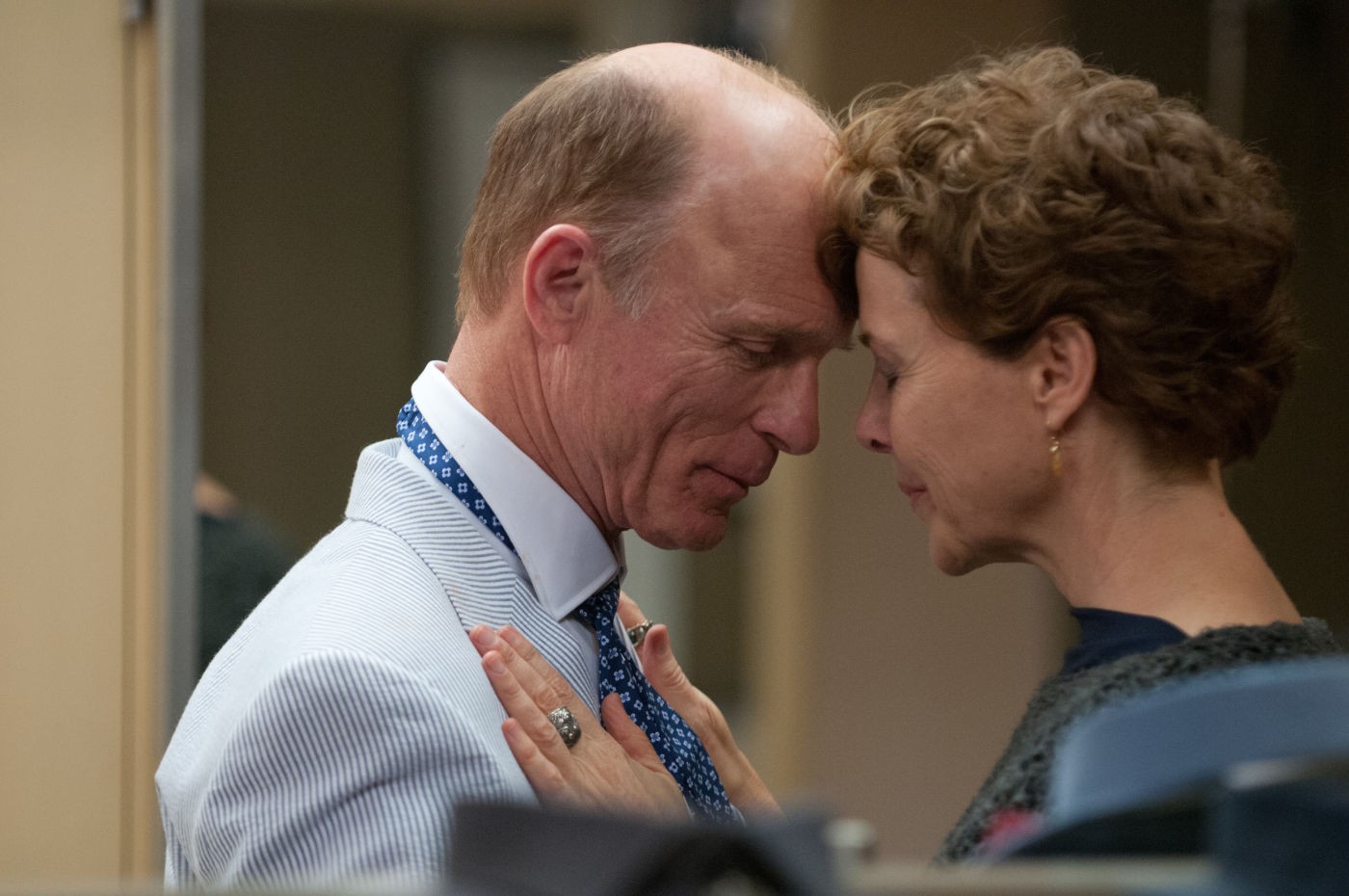
Ed Harris, Annette Bening

“THE FACE OF LOVE” My rating: B- (Opening March 28 at the Rio)

92 minutes | MPAA rating: PG-13

Great performances can trump great pretentiousness.

That’s the story on “The Face of Love,” an eye-rollingly improbable yarn that, thanks to some very fine acting and terrific dialogue, rises above its contrivances and gets under your skin.

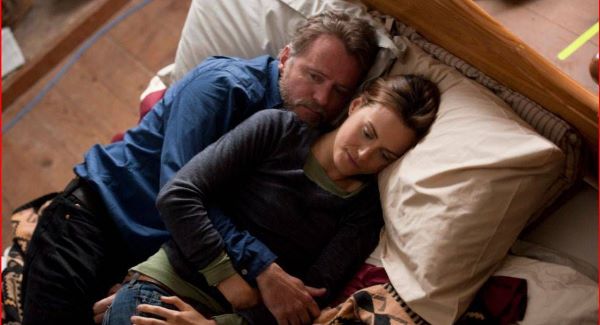
In the opening moments of Arie Posin’s film we get scenes from the life of married couple Nikki (Annette Bening) and Garrett (Ed Harris). Theirs appears to be a perfect relationship…although we may be getting an overly rosy view.

Because before too long Garrett drowns while vacationing at a Mexican resort and Nikki is left to rebuild her life. Those flashbacks may represent her idealized view of her marriage.

Five years later Nikki is visiting an L.A. art musuem when she spots a man who looks exactly like Garrett (Harris again). At first she’s stunned, then curious.

She returns to the museum hoping to see him again, then begins stalking him. Discovering that the man — his name is Tom — teaches art at a local college, she approaches him about taking some private art lessons. One thing leads to another and soon they’re dating — although Nikki never lets Tom know that he’s her late husband’s doppelganger.

Continue Reading »

James Stewart as Tom Destry Jr.

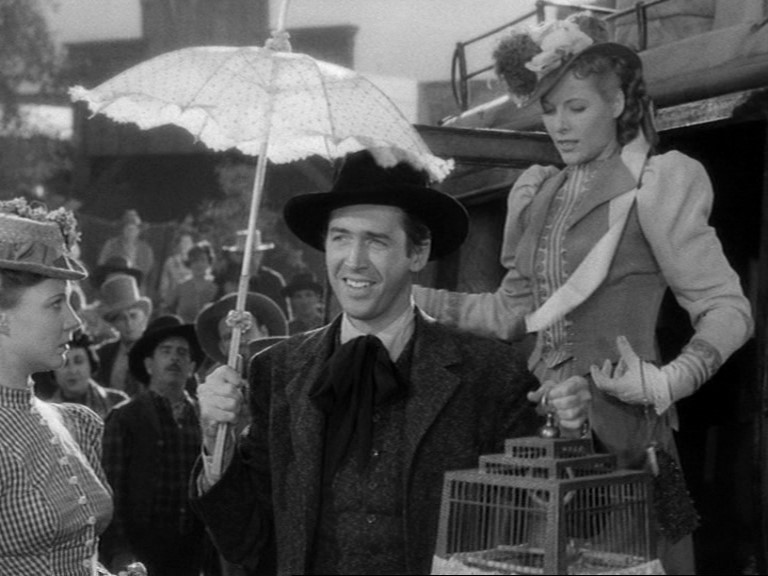
James Stewart as Tom Destry Jr.

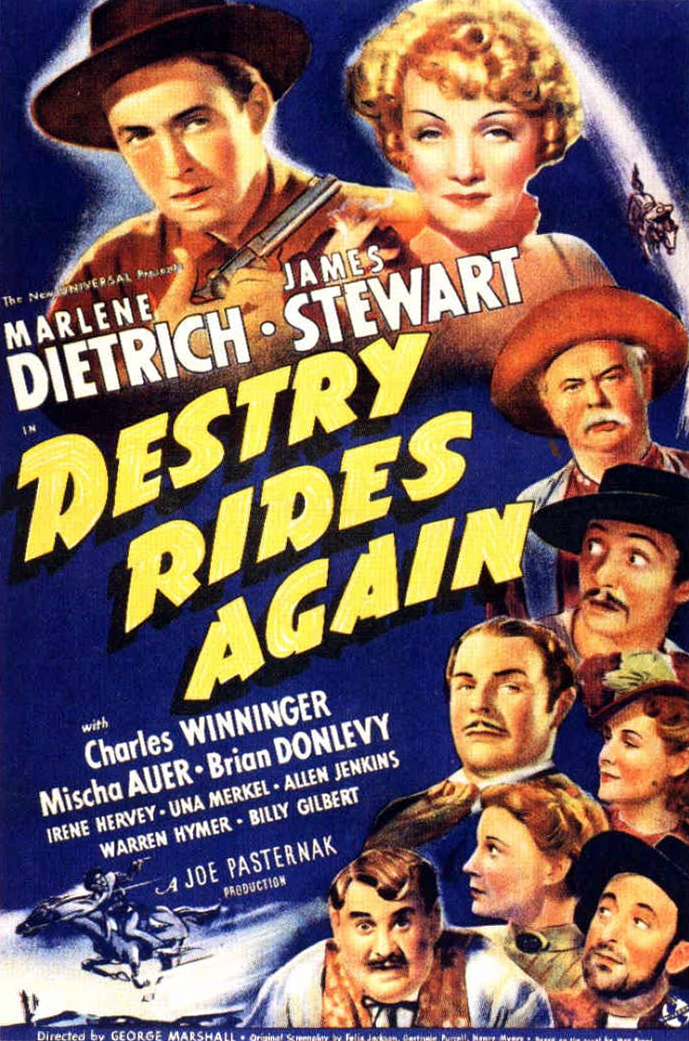
“Destry Rides Again” screens at 1:30 p.m. Saturday, March 29, 2014 in the Durwood Film Vault of the Kansas City Central Library, 14W. 10th St.  Admission is free. It’s part of the year-long film series Hollywood’s Greatest Year, featuring movies released in 1939.

Max Brand’s 1930 novel Destry Rides Again is about a short-tempered cowboy who is framed for a robbery, sent to prison, and upon his release goes gunning for the crooked jurors who put him away.

destry posterIt’s pretty grim stuff.

Which is exactly the opposite of the 1939 film version directed by George Marshall and written by Felix Jackson, Gertrude Purcell, and Henry Myers.

In many regards, “Destry Rides Again” is a boilerplate oater. A crooked gambler (Brian Donlevy) runs the town of Bottleneck with his gang of thugs, abetted by his barroom singer girlfriend, Frenchy (Marlene Dietrich). That is, they run things until a new deputy sheriff named Tom Destry (James Stewart) arrives to set things straight.

Okay, so that’s not terribly original plotting.

But “Destry” is a hugely enjoyable film for one reason: James Stewart in the title role.

When he made this movie, Stewart was just starting to move up from the ranks of supporting actors to star status. “Destry” represents the first time most moviegoers had been immersed in the actor’s trademark aw-shucks comic style, and they fell hard for the lanky actor.

Without Stewart, this film would be pretty weak tea. The movie only really comes alive 30 minutes in when Destry makes his first appearance. From that point on it’s all smooth sailing.

Continue Reading »

Aiden Quinn, Taylor Schilling

Aiden Quinn, Taylor Schilling

“STAY” My rating: C+ (OpeningMarch 21 at the Glenwood South)

99 minutes | No MPAA rating

“Stay” is a well-acted, minor-key Irish love story that is probably too minor-key for its own good.

Dermot (Aidan Quinn) is a sixtysomething retired history professor now living in a small burg on the coast near Galway, Ireland. As “Stay” begins, he’s happily cohabiting with Abby (Taylor Schilling, star of Showtime’s prison dramedy  “Orange Is the New Black”), a woman half his age.

All seems blissful until Abby realizes she’s preggers. Dermot has never hidden his antipathy toward fatherhood and Abby’s condition aggravates whatever cracks are in their relationship.

She heads back home to Montreal and her blue-collar father (Michael Ironside) to decide whether to have an abortion or go through with the pregnancy.

Continue Reading »

Clive Owen, Billy Crudup

Clive Owen, Billy Crudup

“BLOOD TIES” My rating: C (Opening March 21 at the Leawood)

127 minutes | MPAA rating: R

The crime drama “Blood Ties” has a hell of a pedigree.

The cast boasts of Clive Owen, Marion Cotillard, Billy Crudup, Mina Kunis, Zoe Saldana, James Caan and Lili Taylor. Behind the camera is the French director Guillaume Canet, whose 2006 “Tell No One” was one of the most satisfying thrillers of recent years.

And yet the movie is a mutt.

Marion Cotillard

Marion Cotillard

Okay, so maybe that’s a bit extreme. “Blood Ties” is  competent. It’s just totally uninspired. There’s more oomph in five minutes of, say, “Goodfellas,” than in two hours of this effort.

The setup isn’t exactly original. Two brothers. One is a cop. The other is a crook.

Chris (Clive Owen) is finally released from prison after doing time for murder. He’s greeted at the gates by his sister (Lili Taylor) and younger brother Frank (Billy Crudup), an NYPD detective. They take Chris home for a reunion with their dying father (James Caan).

Chris claims he wants to go straight, but he has lots of baggage to deal with.  His ex-wife, Monica (Marion Cotillard) is a call girl and periodic junkie. She has managed to raise their two kids, who are now young teens and virtual strangers to Chris. But she wants money, lots of it.

Continue Reading »

Ralph Fiennes in Wes Anderson's "The Grand Budapest Hotel"

Ralph Fiennes in Wes Anderson’s “The Grand Budapest Hotel”

“THE GRAND BUDAPEST HOTEL”  My rating: B (Opens wide on March 21)

100 minutes | MPAA rating: R

Wes Anderson’s “The Grand Budapest Hotel” is a whopper of a shaggy dog story – or more accurately, it’s a series of shaggy dog stories that fit neatly inside one another like one of those painted Russian dolls.

The film’s yarn-within-a-yarn structure and a delightfully nutty perf from leading man Ralph Fiennes are the main attractions here. I had hoped that “Grand Budapest…” would scale the same emotional heights as Anderson’s last effort, the captivating “Moonrise Kingdom.”

It doesn’t. But there’s still plenty to relish here.

Describing the film requires a flow chart. But here goes:

In the present in a former Eastern Bloc country, a young woman visits the grave of a dead author and begins reading his book The Grand Budapest Hotel.

Suddenly we’re face to face with the writer (Tom Wilkinson), who is sitting at the desk in his study. After a few introductory comments and a brusque cuffing of a small boy who is proving a distraction, the author begins telling us the plot of his novel.

Now we’re in the 1990s in the formerly sumptuous but now dog-eared Grand Budapest hotel in the Eastern European alps. Staying there is a Young Writer (Jude Law) who befriends the mysterious Mr. Moustafa (F. Murray Abraham). An aged empresario who owns several of Europe’s most luxurious hotels, Moustafa keeps the Grand Budapest running for nostalgic reasons.

Continue Reading »