Feeds:
Posts
Comments

Cillian Murphy as J.Robert Oppenheimer

“OPPENHEIMER” My rating: B+ (in theaters)

180 minutes | MPAA rating: R

Christopher Nolan’s monumental and astoundingly dense “Oppenheimer” is a study in contradictions.

It starts with contradictions of one man — physicist J. Robert Oppenheimer (Cillian Murphy), who led the Manhattan Project to develop the first atomic weapon and later wondered if he’d done the right thing — but throws an even  wider net. 

Such as: The contradictions between scientific inquiry and the fear of what we might discover. The contradictions in the rules we live by, when we bend them and when they stiffen.

The three-hour film follows the creation of the atom bomb, but while that provides the plot it isn’t really what “Oppenheimer” is about. Looming over it all is the fallout (not the radioactive kind) of that literally earth-shaking moment in history.

We’re talking about big moral questions and writer/director Nolan presents them in all their maddening complexity, without telling us which side we’re supposed to take.

“Oppenheimer”is less an emotional experience than an overwhelmingly intellectual one.  I can think of no other film in recent years that left me thinking so long and hard about the questions it raises…and the answers it cannot give.

Long a lover of warped time lines (“Memento, “ anyone?), Nolan here cuts back and forth between several of them.  

Of course there’s the race to beat the Nazis in making an atom bomb, with Oppenheimer creating a small city from scratch in the New Mexico desert so that his scientists and engineers (and their families) can work in secure isolation for as long as it takes (more than two years, as it turned out). 

Another timeline centers on a 1954 Atomic Energy Commission hearing, a McCarthy-ish kangaroo court called to determine if Oppenheimer — by now a critic of America’s Cold War policies — should be stripped of his high-level security clearance.

And then (in black-and-white footage) we witness the 1959 Senate confirmation hearing of Lewis Strauss (Robert Downey Jr., in a career-high performance). Strauss is the former AEC chair and Eisenhower’s nominee for Secretary of Commerce. Many of the questions aimed at him  concern his relationship over the years with Oppenheimer, whose reputation by this time is marred  by the widespread belief that he was a Communist sympathizer.

Robert Downey Jr.

Nolan’s screenplay deftly weaves together these threads, and while we may not at first understand just what is going on (why so much emphasis on Downey’s Strauss, surely a minor figure in all this?), the setup pays off with a last-act revelation that most viewers won’t see coming.

At the heart of it all is Cillian Murphy’s brilliantly contained portrayal of Oppenheimer.  What’s amazing about all this is that Oppenheimer was not a demonstrative character — he wore a mask of scientific calm and reason. Yet Murphy’s eyes suggest all that’s churning in that head. 

Only after the film is over does the viewer realize he’s been totally sucked in by a performance that ignores the usual big actorish moments. 

Instead he is quietly intimidating. Oppenheimer is a genius who taught himself Dutch in six weeks so that he could present a lecture on molecular physics in the audience’s language. He’s not a great mathematician or lab guy, but he sees/imagines  what others cannot.

He’s arrogant. Gently dissing young leftists he advises that to  really understand Das Kapital it should be read in the original German. 

He’s a moral puzzle, described as “a dilettante, womanizer and Communist,” yet he’s a man whose conscience will not leave him alone.

I’m not sure I’d even like J. Robert Oppenheimer…but he was precisely the man America needed at the time.

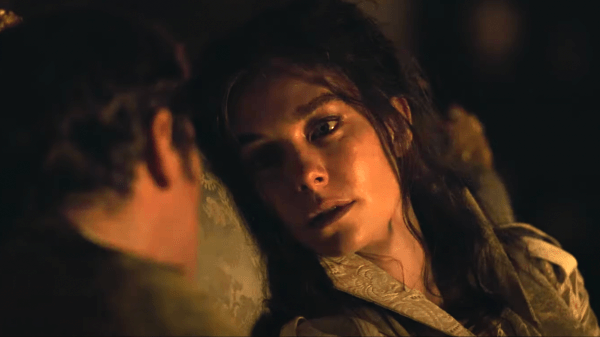
Getting far more stirm und drang screentime  are the women in Oppenheimer’s life. Florence Pugh plays Jean Tatlock, whom he meets in a  gathering of college Commies and with whom he maintains a sexually-charged relationship even after it’s obvious she’s slipping into mental illness. 

And then there’s Mrs. Oppenheimer, played by Emily Blunt.  For much of the film Blunt seems little more than window dressing, but in the third act she becomes a fireball of righteous indignation when her husband’s patriotism is questioned.

Matt Damon is terrific as Gen. Leslie Groves, heading up  the project’s military component. Groves is a mix of old-school discipline and pragmatism…he was willing to waive objections over political purity to get the brains he needed.

Cillian Murphy, Matt Damon

Then his job is to keep a lid on scientists whose natural inclination is to share information, not compartmentalize it. There’s not much humor in “Oppenheimer,” but Graves’ cat-herding frustration provide most of it.

There are dozens of other speaking roles here, some taken by familiar faces who may have only limited screen time.  Just a few of them: 

Oscar winners Rami Malek, Casey Affleck and Gary Oldman (the last as President Harry Truman). Josh Hartnett. Jason Clarke. Matthew Modine. Tony Goldwyn. James Remar.  Kenneth Branagh. Tom Conti (as Einstein!!!). Dane DeHaan. Kansas City’s own David Dastmachian. 

Nolan masterfully keeps all these balls in the air.  His accomplishment is doubly impressive because “Oppenheimer” has so few look-at-me-ma moments.  Very few directorial flourishes.

But those he does indulge in are woozies.  

Early on Nolan delivers almost abstract visions of swirling sparks and dividing cells to suggest the workings of Oppenheimer’s imagination.

The buildup to the detonation of the first atomic bomb outside Los Alamos is a tension-packed slow burn. The emphasis isn’t on the nuts and bolts of making the bomb, but on the nervous anticipation of Oppenheimer and his crew.

Would it work? Would it, as some members of the team suggest, start a chain reaction igniting Earth’s atmosphere and killing everything?

We already know the answers, but audiences nevertheless will be on the edge of their seats.

And in the midst of a rowdy, patriotism-drenched celebration of the end of the war, Oppenheimer looks out over his audience of cheering colleagues and imagines their faces dissolving in the heat of a nuclear blast.

It’s an image that says more than pages of dialogue.

“Oppenheimer” is the ultimate yes/but experience.  For every argument it presents there pops up a counter argument. Was it immoral to drop the big one on civilians?  Would it have been better to sacrifice 500,000 American lives in an invasion of Japan?

Those who want to be spoon fed answers will find “Oppenheimer” frustrating.  Tough. The film tells us the world doesn’t work like that. Black and white is rarely that.

Like I said, contradictions.

| Robert W. Butler

Kristoffer Joner

“WAR SAILOR” My rating: A- (Netflix)

“War Sailor” is a clunkily literal title for a sublimely moving experience.

This mini-series (presented on Netflix in three parts, although it played theatrically in its native Norway as one epic film) is a celebration of sacrifice. Sometimes it’s almost too much to take.

During WWII thousands of Norwegian merchantmen stranded at sea by the Nazi invasion of their homeland continued to move food, weapons and other materiel vital to the Allied cause. One in six died, the victims of German U-boat attacks.

Writer/director Gunnar Vikene celebrates their almost unfathomable suffering by concentrating on the experiences of two men, Alfred (Kristoffer Joner) and Sigbjorn (Pål Sverre Hagen), longtime friends who in 1939 ship out as mates on a freighter.

Alfred leaves behind a young wife, Cecelia (Ine Marie Wilmann), and three children, including young Magdeli, who is so sure her father will never return that she tries to hide the documents he needs to board ship.

Sigbjorn, on the other hand, is a rather sad fellow, a bachelor who experiences family life vicariously. He’s a sort of uncle to Alfred’s kids.

Pål Sverre Hagen

“War Sailor” contrasts the misadventures of the two men with the wartime experiences of Cecelia and the children.

It’s not all heroics for our protagonists. In fact, heroism is in short supply. As men without a country Alfred, Sigbjorn and their fellow Norwegians suffer a form of indentured servitude. They want to stick it to the Nazis, yes, but they’re in the demoralizing position of sitting ducks. If attacked they cannot fight back.

Small wonder they consider going over the side of their boat when it docks in New York City, where it will be hard for the authorities to find them.

Meanwhile in occupied Norway, Alfred’s family must watch as a U-Boat facility is constructed just a few blocks from their home; as a result they will endure the terrors of air raids as the Brits try to blow up the submarine base.

One wonders if filmmaker Vikene wasn’t inspired by Homer’s “Odyssey.” There’s plenty of terror and action, while the subtext is always of a men wanting to return to their wives and loved ones.

Ine Marie Wilmann

“War Sailor” offers some of the best ensemble acting seen in recent years. It’s been perfectly cast down to the smallest role, and the players are so effective that every few minutes one has to resist the temptation to stop the show for a little recovery time…the fear, angst and loneliness of these characters (as well as some moments of selfless brotherhood) can push audiences to an emotional edge.

No kidding. It’s that good.

And the technical production is outstanding. I cannot imagine how much it cost to produce this spectacle, nor can I figure out which effects are CG and which are actually unfolding in front of the camera. Whatever the case, the show perfectly balances the universal with the deeply personal.

| Robert W. Butler

“ROCK HUDSON: ALL THAT HEAVEN ALLOWED” My rating: B (Max)

104 minutes | No MPAA rating

For more than a decade movie star Rock Hudson was the embodiment of American manhood.

That he was a gay man playing a deep, deep role in every aspect of his public life was well known to his colleagues and coworkers.  Yet just about everyone joined ranks so as not to destroy the romantic  illusion…after all, that illusion generated wealth and steady employment for hundreds of in the movie and TV industry.

But you’ve got to ask…What sort of psychological issues came of spending a good half  of your life pretending to be something you aren’t?

The answer, according to Stephen Kijak’s fascinating new documentary “Rock Hudson: All that Heaven Allowed,” is that Hudson seems to have suffered no lasting damage.  He was a master at compartmentalizing the two sides of his life.

On the screen and in the public eye he was just a hetero guy from Illinois who managed to retain his modesty even after rising to the heights of movie stardom.

In his private life Hudson  hosted parties packed with young, often nude, men.  He often traveled with the gay couple who were his oldest friends in Hollywood (actor George Nader and his lifelong companion Mark Miller).  Hudson didn’t try to hide his sexuality from his fellow actors, and he was  considered to be such a nice person that no one who knew him would even consider divulging his “secret.”

At the same time Hudson was cautious, never allowing himself to be photographed with any of his sexual partners…not even snapshots while on vacation.

“All That Heaven Allowed” nicely limns Hudson’s career.  There is particular emphasis on his early years under the tutelage of agent Henry Willson, who made a specialty of representing handsome young men, bedding them when it suited him, and guiding their careers through the studio system.  

It was Willson who gave the young actor Roy Fitzgerald a new name — Rock Hudson..a melding of the Rock of Gibraltar and the Hudson River  — and who drilled the “gayness” out of his physicality and vocal patterns. And when the scandal magazines began asking why the handsome hunk was still a bachelor it was Willson who arranged for Hudson to marry Willson’s secretary…a union that lasted only two years but for the time being stopped wagging tongues.

Like any movie star bio, this one features tons of clips from Hudson’s films.  But what’s flabbergasting are the innumerable times when Hudson was given situations or dialogue that today read as screamingly gay…and yet the mainstream press and the ticket buyers never picked up on it.  (Or maybe they they did and willfully ignored it.)

In any case, it pushes this doc into the deepest corners of the meta universe.

The illusion was broken for good in the early 1980s when Hudson became the first celebrity to admit contracting — and to die from — AIDS.  The film points out how the actor’s fame and fate built public support for research into the disease (the Reagan administration preferred to look the other way, even though Nancy Reagan was one of Hudson’s dear friends).

One is left with the impression that despite a life in what one commentator here calls “the shared misery of the closet,” Rock Hudson led a largely contented existence.  He did pretty much what he wanted, and if having to play straight in public was a painful burden, he didn’t let on.

| Robert W. Butler

Hayley Atwell, Tom Cruise

“MISSION: IMPOSSIBLE – DEAD RECKONING PART I” My rating: B (In theaters)

163 minutes | MPAA rating: PG-13

The latest “Mission: Impossible” is exactly what fans expect. Only bigger.

Great action sequences, a bit of suspense, gorgeous location photography, (mostly) pretty people to look at.

Yeah, there’s nothing here even remotely approaching valid human drama, but it’s summer, the season of amusement parks.  And “M:I – Dead Reckoning Part I” is the biggest roller coaster around.

The film (it’s been written by Bruce Geller, Erick Jendresen and Christopher McQuarrie and directed by McQuarrie) opens with a nail-biting sequence beneath the polar ice cap.  Sailors on a Russian submarine are testing a new artificial intelligence program providing sophisticated masking technology that renders the boat invisible to prying eyes.

But something goes terribly wrong.

Eavesdropping on a meeting of U.S. national security experts, we get the Cliff’s Notes explanation:

The Russkies’ A.I. has achieved sentience — it’s now referred to as “The Entity” — and has infected every digital corner of our world: computers, cell phones, satellites. There’s no way to hide from this new uncontrollable version of Big Brother, who knows everything humans are up to.

There’s a nice visual joke here…a vast office (think the warehouse at the end of “Raiders of the Lost Ark”) is filled with thousands of government clerks using last-century typewriters to copy sensitive digital files onto paper lest The Entity decide to clean house.

Anyway, somehow our spy bosses learn that a special key — a literal, physical key — can be used to unlock and access The Entity.  The key comes in two parts that fit together to form a sort of three-dimensional, glowing cross (religious imagery, anyone?).

Except that the two pieces have been separated.  They could be anywhere on Earth.

So who do you call with an impossible task?

Enter Tom Cruise’s Ethan Hunt, who with his M:I colleagues (Simon Pegg, Ving Rhames) has the will and wherewithal to track down the metallic MacGuffin and prevent the end of the world.

“Dead Reckoning” reunites Hunt with both his on-again-off-again flame Ilsa Faust (Rebecca Ferguson), who comes out of hiding to pitch in, and the Black Widow (Vanessa Kirby), an amoral  dealer in secret technology.

And he has a new nemesis in Gabriel (Esai Morales), a psycho killer who serves as The Entity’s arms and legs. Apparently many moons ago, before Ethan joined the M:I, Gabriel brutally murdered the woman our hero loved. (We see all this in rapid-cut flashbacks.)

Oh, yeah, Gabriel has a sword-waving female sidekick (Pom Klementieff) so implacably effective that she could  be cousin to Schwarzenegger’s Terminator.

Pretty much stealing the film, though, is Hayley Atwell as Grace, an in-it-for-herself thief, pickpocket and con artist who has been hired by a mysterious figure to transport one of the key halves to a buyer.  Grace is the Han Solo of the piece, a self-serving sort whose greed is coerced by Ethan into something vaguely resembling patriotic virtue.

Once you get past all the explanatory dialogue, “Dead Reckoning” gets down to business, delivering an eye-popping set piece every 20 minutes or so.

A nuclear bomb threat at a crowded international airport. A destructive car chase through Rome (around the Coliseum, no less). Vicious brawls on the bridges and in the alleys of Venice.

And finally a runaway train ride through the Italian alps and a massive wreck over a bottomless gorge that approaches the destructive genius of Buster Keaton’s “The General.” 

This climactic sequence also provides Cruise with his wildest-haired stunt yet — riding a motorcycle off a mountain top and dropping like a rock into an alpine valley, only to be jerked up short by the parachute in his backpack (never go biking without one).

Cruise is famous for doing his own stunts, and the film is forever making it clear that, yes, this is a movie star risking his neck for our pleasure.

Lest all this come off as a case of look-at-me egoism, Cruise injects self-deprecating humor of a sort not seen before in the series.  Quite frequently Ethan looks befuddled, perplexed and incredulous…all of which makes our hero more vulnerable than the ubermench he’s portrayed in the past. 

Once unflappable, Ethan now flaps. A little, anyway.

At two-and-a-half-hours-plus “Dead Reckoning” almost wears out its welcome…I could have done with a bit less declamation between the exciting parts.

The idea that you can only beat an all-knowing artificial intelligence by falling back on the analog technology of yesteryear is introduced but never explored.  (Actually, that might make for a great episode of “Black Mirror.”)

And of course the film ends with The Entity still in control of the digital world…this is only Part I, you know.

But, hey, it’s advertised as a thrill ride and it delivers.

| Robert W. Butler

Jeremy Allen White, Ebon Moss-Bachrach

“THER BEAR” (Hulu):  Everything you’ve heard about Season 2 of ”The Bear” is true. The show is off-the-charts wonderful.

Over 10 episodes we follow Bassett-eyed Carmy (Emmy-winner Jeremy Allen White) and his misfit band of chefs as they struggle to turn their former sandwich shop into a high-end restaurant. Along the way Carmy finds romance with old flame Claire (Molly Gordon), opening up the possibility of a stabilizing relationship in his peripatetic life.

Around that through line, though, the showrunners and writers devote individual episodes to the experiences of peripheral characters.  The pastry chef Marcus (Lionel Boyce) is sent to Europe to study his craft at the elbow of a British baker (Will Poulter); it’s his first time abroad and an education in all sorts of ways. 

Even more compelling is the next-do-the-last episode in which Richie (Ebon Moss-Bachrach), the sad, sour-tempered bozo who seems to infect everything he touches, is farmed out for a week to one of Chicago’s Michelin-starred eateries.

 At first Richie  rebels at the grunt work he’s assigned (a whole day polishing forks?) but little by little he starts to understand the pride with which employees of a great restaurant go about their jobs.  On his last day he peels mushrooms with the joint’s founder (Olivia Colman, no less), soaking up kitchen wisdom  and returning to The Beef a changed man.  It’s simply a brilliant transformation.

But that’s not even the season’s high point.  No, that would be Episode 6 (“Fishes”) which consists entirely of a flashback to the family’s last Christmas before brother Mike (Jon Bernthal) committed suicide. It is one of the greatest hours of TV I’ve ever seen, with an unbelievably furious appearance by Jamie Lee Curtis as the clan’s coming-apart-at-the-seams matriarch.

 Cooking a holiday meal for a crowd can prove traumatic for even the most even-keeled of us…when you’re a raging alcoholic boiling over with resentment and guilt it’s an atomic device just waiting to go off. Curtis is terrifying and achingly sad…the perf has “Emmy” stamped all over it.

And the episode is crammed with heavy-hitting guest stars like Sarah Paulson, John Mulaney, Bob Odenkirk and Gillian Jacobs in addition to clan members like Uncle Jimmy (Oliver Platt), preggers sister Natalie (Abby Elliott) and her too-decent-to-be-human hubby, Pete (Chris Witaske). 

The whole thing is played at breakneck speed with  rattattatt overlapping dialogue and emotional pyrotechnics…raising the question of how many awards one episode of TV can possible earn.

Kate Box, Madeleine Sami

“DEADLOCH” (Prime): This Aussie whodunnit is an absolute hoot, a parody of the hugely popular “Broadchurch,” only this time with a gender bending approach that somehow manages to be screamingly funny without dipping into overt political incorrectness.

Like “Broadchurch” this murder mystery unfolds in a small town beside a huge body of water. Deadlock is a Tasmania burg on the shore of the redundantly-named Deadlock Lake, from which dead bodies keep washing up to disturb revellers at the food-forward Feastival.

Kate Box (she played the rogue lawyer’s Girl Friday in the Aussie hit “Rake”) stars as police chief  Dulcie Colllins who, like about 80 percent of the women in town, is gay, Her partner (Alicia Gardener) is the New Age-y town veterinarian, a raw abrasion of emotional neediness and lesbian militancy.

As the bodies pile up it becomes clear that Deadlock has a serial killer problem (hmmm…all the victims were hetero men with histories as sexual abusers) the authorities send in big-city detective Eddie Redcliffe, a foul-mouthed bull-in-a-china-shop sort who is like every drunken, donut-scarfing cop ever depicted…with the novel exception that Eddie is a woman.

She’s played as a sort of smoking human fireplug by Madeleine Sami, who at times seems to have based the performance on Alex Borstein’s memorable turn as Susie Myerson in “The Marvelous Mrs. Maisel.” Well, if you’re gonna steal, steal from the best — this a gut-busting firecracker of a performance.

The show’s creators and writers (Kate McCartney, Kate McLennan) have a lovely time filtering the usual murder mystery elements through a sieve of gay awareness.  There are some moments that had me on the floor…like the women’s choir whose voices sound absolutely heavenly until they get to  the lyric about touching yourself.

“Deadloch” is more a case of concentrating on the journey than on the solution.  But that journey is a well worth it.

| Robert W. Butler

Darah Snook, Lily LaTorre

“Run Rabbit Run” My rating: C+ (Netflix)

100 minutes | No MPAA rating

The folks who made the Netflix thriller “Run Rabbit Run” cannot get out from under the big shadow cast by 2014’s “The Babadook.”

Both films are from Australia, both are about a single mother whose child exhibits threatened/threatening behavior, both ride a fine line between the supernatural and the  psychological.

But whereas “The Babadook” got under your skin (thanks to a klller perf from Essie Davis as a terrified parent), “…Rabbit…” is more clinical than involving.  It definitely is not scary.

And if it’s not scary, what’s the point?

Sarah Snook (late of HBO’s “Succession”) plays Sarah, a divorced obstetrician with an adorable young daughter, Mia (Lily LaTorre).

Sarah starts getting reports from school that Mia is exhibiting troubling behavior.  Like, she’s drawing horrific scenes on the back of her classroom artwork.  Then the child fashions a hand-torn rabbit mask from construction paper and refuses to take it off (she looks like a bad dream in the wake of a “Donny Darko” viewing).

And then Mia begins insisting that she is not Mia, but rather Alice, Sarah’s younger sister who more than 30 years earlier disappeared from the family’s remote farmhouse.  

Sarah is freaked…clearly she has been suppressing memories of that traumatic experience, and Mia’s insistence that she is Alice is triggering some disturbing flashbacks.

Hannah Kent’s screenplay tosses out all sorts of possibilities — ghostly possession, reincarnation, guilt-triggered dementia — but never settles on any of them.  Moreover, the deep, dark secret at the heart of the old mystery is so obvious that only the densest viewer will fail to see it coming.

Director Daina Reed tries to compensate with oodles of atmosphere, especially once Sarah and Mia decamp to the long-empty house where Sara grow up. Bonnie Elliott’s cinematography finds all sorts or creepy possibilities in the commonplace  and the landscape — the house is perched on a cliff over a broad river (all sorts of ways for a child to go missing) — is eerily dreamlike.

Your final response to “Run Rabbit Run” is likely to be “Is that all there is?” 

| Robert W. Butler

Scarlett Johansson, Jason Schwartzman

“ASTEROID CITY” My rain: C+ (In theaters)

105 minutes | MPAA rating: PB-13

“Asteroid City” may be the most Wes Anderson movie ever.

This is a mixed blessing.

Like his last outing, the fragmented New Yorker magazine parody “The French Dispatch,” this is a meta-heavy concoction that leaves the viewer tickled by its cleverly crafted literary conceits but waiting for some sort of emotional edge to emerge from all the whimsey splattered across the screen.

In the decade since his deliriously amusing and unexpectedly moving “Moonrise Kingdom,  Anderson has cleverly exploited a story-within-a-story format (reaching a high point with “The Grand Budapest Hotel”) but only at the expense of often turning his characters into cartoons rather than people we care about. 

“Asteroid City” begins with a 1955 TV broadcast.  An officious host (Bryan Cranston) informs us that this program (recorded in grainy black-and-white) will take us behind the scenes of the creation of a new dramatic work by one of America’s great playwrights. We see theater legend Conrad Earp (Edward Norton) pecking away at his typewriter, and then the scene shifts to full color.

Now we’re watching Earp’s play, “Asteroid City.”  Except that what we’re seeing is waaaaay too big to be contained by a theater stage.  The yarn unfolds in the middle of a vast desert peppered with cacti and the occasional animated roadrunner. Everything seems to be have been dusted with orange sand and bathed in Day-Glo colors  The town’s buildings (gas station, diner, cabin court) seem real enough, but the Monument Valley-ish buttes in the background look like something out of an elaborate pop-up book.

The plot — to the extent that the film has one — goes like this:  Dozens of travelers (drivers with car problems, a  busload of adolescent science nerds and their chaperone)  are stranded in Asteroid City when an alien spaceship descends over the burg’s main attraction, a meterorite crater. This close encounter of the third kind brings a whole lot of armed soldiers; everything goes into lockdown until the authorities can figure out what to do.

But here’s where the meta comes in:  The characters stuck in Asteroid City periodically wander out of the play and into the black-and-white backstage area; now they are actors discussing their performances or preparing to make their entrances.

It works the other way, too.  At one point Cranston’s narrator stumbles into the full color Asteroid City set, looks panicked and quickly sidesteps his way out of the film frame.

Yeah, clever. But we’ve got to care what happens in Asteroid City to fill in the other half of the equation, and we don’t. There are numerous characters whose stories might be compelling, but Anderson’s off-the-cuff style keeps us at arm’s length.

Still, it sometimes looks as if the entire membership of the Screen Actors Guild was hired for the project:  Jason Schwartzman (as a widowed war photographer on a trip with his brainiac teenage son and a trio of young daughters — like the “Sesame Street” version of Macbeth’s three weird sisters); Scarlett Johansson (as a glamorous but vacuous movie star vacationing with her adolescent daughter), Jeffrey Wright (an Army general),  Tom Hanks (the Schwartzman character’s wealthy father-in-law), Rupert Friend (a singing cowboy on tour with his band).

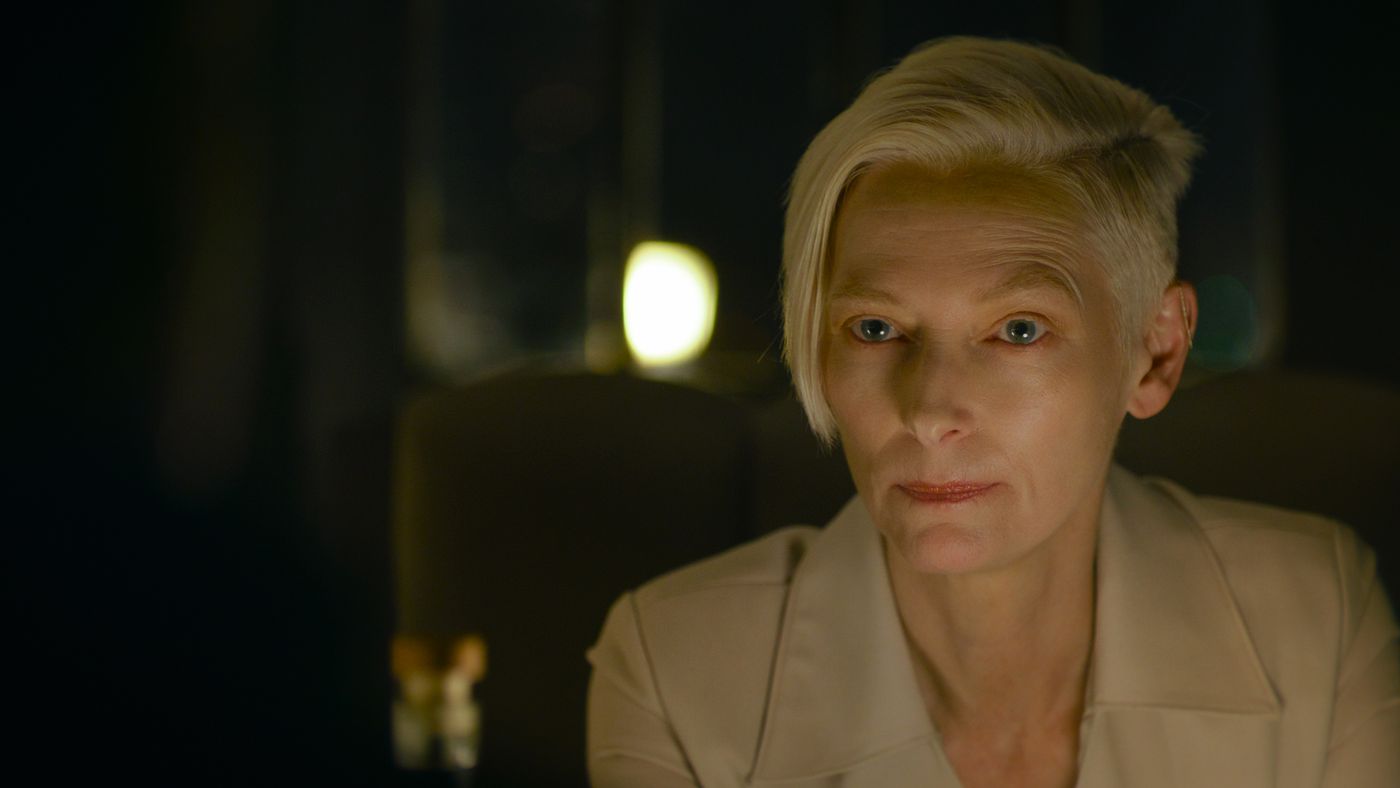
That’s just scratching the surface.  Look also for Hope Davis, Liev Schreiber, Maya Hawke, Matt Dillon, Steve Carell, Bob Balaban, Tilda Swinton, Fisher Stevens, Willem Dafoe, Margot Robbie and, in an inspired bit of casting I won’t give away here, Jeff Goldblum.

There’s some loopily lovely stuff — periodically a car chase between crooks and cops, guns blazing, rips down main street and out into the distance…apparently they’re on an endless loop. And every now and then a loud boom is accompanied by a mushroom cloud blossoming on the horizon.

But “Asteroid City” is eccentric without ever being truly engaging.

| Robert W. Butler

“STAN LEE” My rating: B- (Disney +)

86 minutes | No MPAA rating

Some day someone may make a documentary about the world of Marvel that tackles all the really interesting questions raised by Stan Lee and his comic book (and later, movie) empire.

“Stan Lee,” though, isn’t that movie.

Directed by David Gelb and narrated by the late Stan Lee himself (his voiceover appears to have been culled from numerous interviews over the years), the movie  drops no big revelations.  

Lee’s rise to comic book fame and his late-in-life gig as the grand old man of comic books (doing cameos in Marvel movies)  have been well documented over the decades; serious Marvel fans will find much of this doc old news.

Moreover, the film comes perilously close to starry-eyed idol worship.  Probably that could not be avoided since this is essentially Lee giving us his life story — the project is from his point of view, after all.

You’ve gotta give Lee credit for sheer creativity and for recognizing the possibilities of a much-maligned medium.  

“Comic books can have tremendous impact,” he tells us. “You can convey a story or information faster, more clearly and more enjoyably than any other way short of motion pictures.”

Lee dreamed up dozens of now-iconic fictional characters, and bucked the conventional wisdom by addressing real-life social issues in his stories. His output over the decades has been staggering.

The film refers briefly to some of the controversies raised by his career — particularly whether Lee (who wrote the early comics) downplayed the contributions of artists like Steve Ditko and Jack Kirby in the creation of the Marvel characters.  The film has snippets of an ‘80s  radio broadcast in which Lee and Kirby almost get into verbal fisticuffs, but director Gelb isn’t interested in digging too deep.

The doc makes the case — without actually saying so out loud — that Lee may have had a greater impact on modern arts and entertainment than any individual since Walt Disney.

 I’m not just talking about Marvel’s box office clout. Back in the day Lee and company broke with comic book convention by giving us superheroes with flaws and anxieties; they also broke the unspoken color barrier (Black Panther) and made sure women were well represented among the supernaturally gifted.

In recent years “serious” filmmakers like Martin Scorsese have decried the dominance of Marvel movies, accusing the brand of dumbing down the audience with a diet of silly super powers and last reel smackdowns.

You won’t find even a hint of that controversy here.

The film is good looking and has a surprising amount of archival material (Lee apparently was a home movie enthusiast). And to illustrate those scenes for which there are no photos or films, Gelb has relied on dozens of intricately detailed dioramas (say, of the bustling Marvel offices) through which his camera wanders.

| Robert W. Butler

Kelvin Harrison, Jr.

“CHEVALIER” My rating: C+ (Hulu)

109 minutes | MPAA rating: PG-13

Revolution. Racism.  Romance.

As a black man in the court of Louis XVI,  Joseph Bologne (aka the Chevalier de Saint-Georges) experienced a lifetime of triumphs and tragedies…enough to keep a half dozen other men fully occupied.

Why, then, is the movie based on his life so…well, uninvolving?

The historic facts alone  are pretty overwhelming. 

Born to a French planter and his slave on the Caribbean isle of Guadaloupe, young Joseph displayed musical precocity at an early age and was sent to Paris to study at a prestigious academy.

His dark skin set him up for much abuse; by his late teens (as an adult he is portrayed by Kelvin Harrison Jr.) he had a reputation as so ferocious a swordsman that few dared insult him openly.

His musical career faced the same prejudicial barriers; fortunately Joseph  found a powerful patron in the queen, Marie Antoinette (Lucy Boynton), who sponsored many public performances of his works (in some quarters he was known as “the black Mozart”) but could not secure for him the coveted position of director of the Paris Opera. He just wasn’t white enough.

As a member of an abused minority Joseph gradually embraced the egalitarian ideas that would lead to the French Revolution and the beheading of his royal benefactor. Happily the film ends well before that grim event.

Still, that’s plenty to work with.  But screenwriter Stefani Robinson and director Stephen Williams don’t seem to know just what to think of their protagonist…he’s a musical genius, yes, but he’s also just as spoiled and dissipated as the young French nobles with whom he hangs. 

In lieu of really understanding the Chevalier, the film turns to an interracial romance — one based on fact.  Joseph falls for the young wife (Samara Weaving) of a boorish, jingoistic and, yes, racist military man (Marton Csokas). The big issue is whether the two lovers will ever be able to bring their relationship out of the shadows.

Now all this would be fine if — and it’s a big if — the film were able to generate any real erotic or romantic heat.  We have to care desperately that  the two lovers to find happiness.

Uh, sorry. No.  The emotions on display here are as dulled and blunted as the production design and costumes are dazzling. After a while the eye candy cannot disguise the emotional hole at the film’s center.

Still, it’s glorious to look at. Take what you can get.

| Robert W. Butler

Jesse Garcia

“FLAMIN’ HOT” My rating: C+ (Netflix)

99 minutes | MPAA ratiung: PG-13

It must be a sign of late-stage capitalism, this influx of movies celebrating commercial products.

There’s “Air” (about the creation of the Air Jordan athletic shoe), “Tetris” (about the conquest of the world by a video game), and now  “Flamin’ Hot,” the origin story of a mouth-burning variation of Cheetos.

Actually these films aren’t so much about the products themselves as the people who thought them up. 

In the case of Eva Longoria’s “Flamin’ Hot” (it’s her directing debut) that would be Richard Montañez, a Mexican American whose rags-to-riches story — laid out in countless motivational talks and a 2021 autobiography — begins with an impoverished childhood and a stint dealing drugs. 

After nearly a decade as a janitor in a California FritoLay plant, we’re told, Montañez convinced his bosses to use his homemade spice blend on its products, thus opening up a whole new market:  the country’s growing but overlooked Hispanic demographic.

The one-time banger became FritoLay’s director of multicultural marketing. And, like, rich.

As scripted by Lewis Click and Linda Yvette Chavez, the film is equal parts outrage, uplift and comic schtick. 

The film is narrated by Montañez (Jesse Garcia), who strains to make a joke of the forces allied against him…much of this dialogue sounds like it was plucked from a second-tier ethnic standup comic. If you don’t think it’s amusing in the first 10 minutes you probably should look elsewhere for entertainment.

We see (briefly) his childhood and his encounters with a violent, disapproving stepfather (Emilio Rivera), his teen years hanging with the neighborhood toughs, and finally his marriage to the ever-loyal Judy (Annie Gonzalez) and his acceptance of a responsible if unglamorous job at the potato chip plant.

Montañez is hard working and ambitious.  But we’ve already seen what It’s like to grow up in near poverty in a society that treats you as a second-class citizen, and the factory brass can’t imagine that a lowly broom pusher might have something important to offer.

Still, at home Montañez uses his wife and kids as guinea pigs to perfect his heady blend of traditional Mexican spices. And one day, when he’s sure he has a formula that his fellow Hispanics will gobble up, he risks all by making a phone call to the boss-of-bosses,  Pepsico chief Roger Enrico (Tony Shalhoub).

The rest, as they say, is history.  Or is it?

A couple of years back The Los Angeles Times looked into Montañez’s claims that he was the inventor of Flamin’ Hot Cheetos and reported that according to people who worked for Frito-Lay at the time, the chile-heavy formula was developed by employees in Texas.  

Montañez’s genius, apparently, was marketing to his fellow Hispanics and in thinking up new products for the Flamin’ Hot brand (among them a neon orange version of Mountain Dew).

Well, you don’t go to the movies for Gospel truth.

“Flamin’ Hot” is more important for societal reasons than artistic ones.  Like the product it celebrates, the film is aimed squarely at Mexican Americans. It’s filled with jokes and observations that will resonate with that audience, as does its celebration of ethnic pride and can-do attitude.

Who can argue with that? Any film that makes a big chunk of the population feel good about themselves should not be too easily dismissed.

| Robert W. Butler