“RUST AND BONE” My rating: B- (Opening Jan. 18 at the Glenwood Arts ????)
120 minutes | MPAA rating: R
As much as there is to enjoy in the lead performances of Marion Cotillard and Matthias Schoenaerts, Jacques Audiard’s “Rust and Bone” labors under a surfeit of overkill.
At its core it’s a down-to-earth story. A womanizing man uncomfortable with his role as a single father befriends a young woman disfigured in a terrible accident. Little by little he pulls her out of her shell of depression, while she helps him discover his paternal instincts and his less-selfish side.
Cue the violins.
But wait. That’s too simple. Too cut and dried.
How about this: The guy becomes a champion of illegal underground gladiatorial combats. And the woman loses her legs to a killer whale.
Yeah, that’s much more believable.
So you see what I mean about overkill. And yet Audiard (maker of the epic prison drama “A Prophet”) and his stars have almost enough skill – almost – to sell “Rust and Bone’s” hyperbole. Continue Reading »
“DIANA VREELAND: THE EYE MUST TRAVEL” My rating: A-(Opening Jan. 18 at the Tivoli)
86 minutes | MPAA rating: PG-13
“A new dress doesn’t get you anywhere,” Diana Vreeland says in the new documentary about her life.
“It’s the life you live in the dress.”
That attitude is what made Vreeland (1903-1989) not only the most important fashion editor ever (she spent most of her career at Harper’s Bazaar and Vogue)but one of the major cultural forces of the 20th century.
As someone who knew Vreeland by name only (I knew she was big in fashion but couldn’t tell you why), “Diana Vreeland: The Eye Has to Travel” is a major revelation. Vreeland wasn’t a designer – she didn’t create fashion — but on the pages of her magazines she presented it in such a way that fashion became more than just clothes. It became a philosophy of life.
This terrific documentary was made by Lisa Immordino Vreeland, Vreeland’s granddaughter-in-law. Perhaps it is that intimacy that makes the film work…the director knew the best of her subject but she also knew where the bodies were buried. The resulting film is complex, insightful and (Vreeland herself would demand this) thoroughly entertaining.
Much of that is due to Vreeland herself. She was an ugly woman (sorry, there’s no getting around it) but she was so smart and had such a fabulous sense of style that looks didn’t matter.
She was a wit, an eccentric (who late in life began applying flaming rouge not only to her cheeks but to her ears), a lover of the arts, a denizen of Harlem nightclubs. When she went to work for Harper’s Bazaar in 1937 (after spending a decade in London, where she befriended Coco Chanel and ran her own lingerie store) she began writing a regular column called “Why Don’t You?” After a few years she became the magazine’s fashion editor.
She discovered Lauren Bacall (then a young model) and helped Jackie Kennedy achieve her “look.” But more than anything else the photographs and layouts she oversaw for the magazine changed the way people viewed and thought about clothes. Vreeland was to fashion was Ayn Rand was to pompous selfishness.
The film doesn’t hide the fact that the hard-working, fashion-obsessed Vreeland usually was an absentee wife and mother (her sons seem hardly to have known her). She could exasperate her employees and colleagues with her demands (which more often than not were right on, aesthetically speaking).
And, like Oscar Wilde, she valued style far above substance. Indeed, it’s difficult to say whether she had any political, moral, religious or social convictions beyond her admiration for beauty and pleasure.
But she had an outsized personality that was impossible to ignore.
“Diana Vreeland: The Eye Has to Travel” benefits hugely from archival interviews its subject conducted over the years. And the filmmakers cannily have taken the written transcripts of a series of conversations between Vreeland and George Plimpton and had sound-alike actors bring them to life. These become the documentary’s narrative underpinnings.
“BROKEN CITY” My rating: C (Opens wide on Jan. 18)
109 minutes | MPAA rating: R
Yawn.
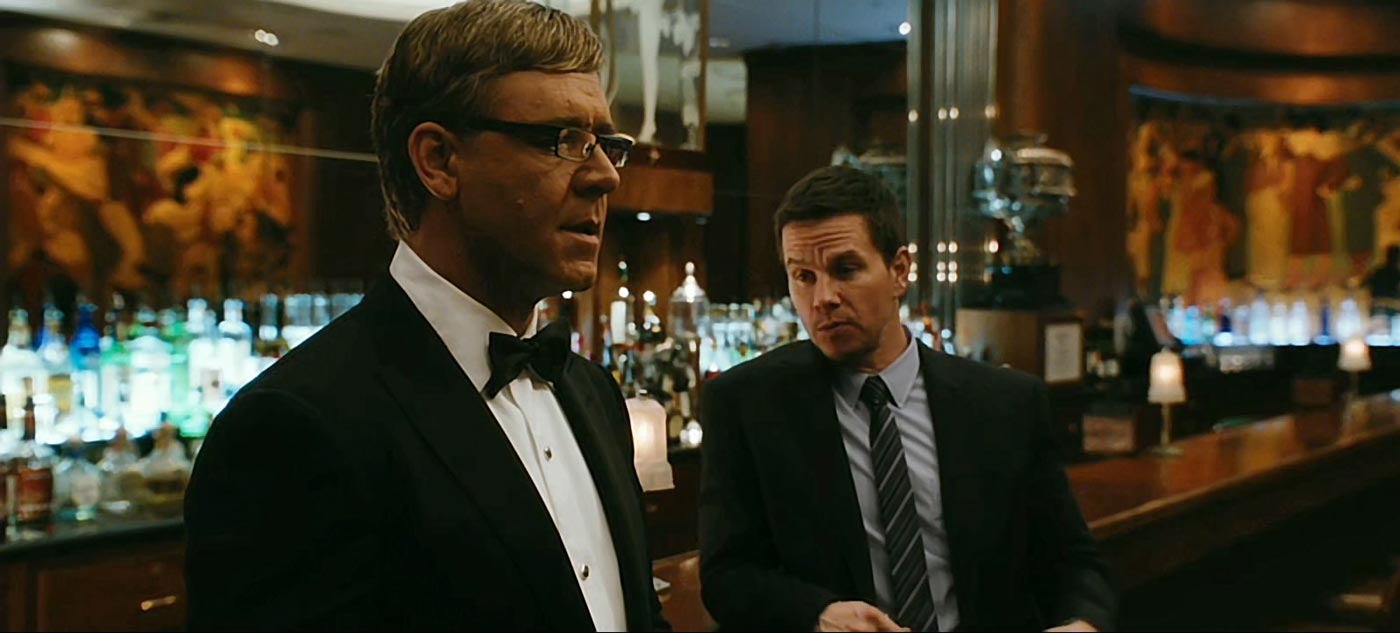
Not even an A-list cast can do much with “Broken City,” this year’s indifferent released-in-January thriller from Mark Wahlberg.
Written by first-timer Brian Tucker and directed by Allen Hughes (half of the directing Hughes Brothers who gave us “From Hell” and the solid doc “American Pimp”), this overcomplicated mashup of film noir elements and Big Apple misdeeds never finds its voice or presents a story compelling enough to grab our interest.
Private eye Billy Taggart (Mark Wahlberg) used to be a cop — until he shot to death a homeboy who raped and murderd the sister of Billy’s girlfriend. Billy beat the rap but at the insistence of NYC’s garroulous Mayor Hostetler (Russell Crowe) and Police Commisioner Fairbanks (Jeffrey Wright) resigned from the force.
Now, years later, Billy specializes in chasing cheating husbands.
Still, he’s surprised when Hostetler offers him $50,000 to follow the Mayor’s wife (Catherine Zeta-Jones) and prove she’s having an affair. Billy finds that New York’s First Lady is indeed hanging around with another man (Kyle Chandler, late of “Friday Night Lights”). Not just any man, but the campaign director of a city councilman who hopes to unseat Mayor Hostetler in a fiercely contested election. Continue Reading »
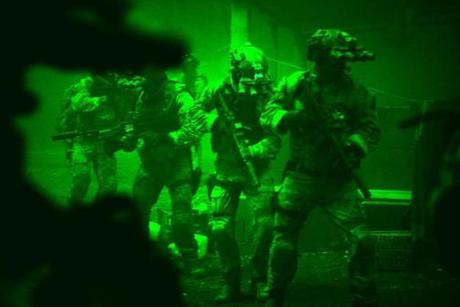
“ZERO DARK THIRTY” My rating: A-(Opens wide on January 11)
157 minutes | MPAA rating: R
Kathryn Bigelow’s “Zero Dark Thirty” opens to a black screen and real sound recordings from 9/11: Desperate people trapped in the twin towers and telephoning out, police and fire department radio chatter. It’s eerie and sad and scary, and it sets the tone for a real-life drama that is also by turns eerie, sad and scary.
Bigelow’s film is, of course, the story of the hunt for Osama bin Laden, the mastermind of the 2001 attacks. It’s a sort of intimate epic, one that spans a decade during which our government’s search for the terrorist figurehead flagged and would probably have been dropped if not for the driven efforts of one particular CIA analyst.
This agent, a woman who has never been identified, doggedly kept at it even when her superiors were telling her to apply her efforts elsewhere. She finally got her man.
“Zero Dark Thirty” reminds me very much of David Fincher’s “Zodiac.” Both films chronicle over many years one individual’s obsession (possibly self-destructive) with solving a crime and obtaining justice (or revenge). In both cases the search becomes almost more important than the outcome.
The woman who cracked the case – here she is called Maya – is played by Jessica Chastain with a quiet intensity and a general lack of anything like movie glamor. The film’s first 40 minutes find Maya in a foreign country – probably Pakistan – where she teams with a CIA interrogator named Dan (Jason Clarke) working to break the resolve of a captured Al Qaeda member.
As determined as she is to get answers, the “enhanced” interrogation of Ammar (Reda Kateb) is almost more than the cubicle-dwelling Maya can handle. Dan – a nice enough guy when he’s not being a torturer – is a ruthless psychological manipulator. And when pure intimidation, logic, and bribes of food and water don’t bring results, there’s always physical pain – waterboarding, confinement in a box only half the size of a coffin. The idea is to convince Ammar that there will be no comfort, no relief until he cooperates.
“In the end everybody breaks,” Dan says. “It’s biology.”
“THE HOUSE I LIVE IN” My rating: B(Opening Jan. 11 at the Tivoli)
108 minutes | NO MPAA rating
Whatever its noble intentions, the so-called War on Drugs isn’t any closer to ending than it was forty-some years ago when President Richard Nixon took up the cause.
If anything it has proven itself to be a self-perpetuating circus, one that enriches very bad, violent people, while imprisoning hundreds of thousands who should be receiving treatment instead of jail sentences.
Eugene Jarecki, whose documentary output includes “The Trials of Henry Kissinger,” “Freakonomics” and “Why We Fight” (he’s also the brother of Andrew “Capturing the Friedmans” Jarecki), has spent the last five years crisscrossing America to create this powerful, fact-filled and deeply disturbing non-fiction film.
There are plenty of statistics (a telling one: the U.S. imprisons a higher percentage of its population than any other industrialized country, with most of those serving time for drug violations), but “The House I Live In” is remarkable for the personal stories it brings to the table.
Jarecki begins the film on a highly personal note by introducing us to Nannie Jeter, an elderly black woman who was the housekeeper for the Jarecki family when Eugene was young. He played with Nannie’s children; now he checks back in with the family to find it shattered by drugs.
Our nominal guide throughout the movie is TV producer David Simon, a formers journalist who covered the War on Drugs and went on to create the fictional HBO series “The Wire,” which over several seasons explored the dangerous, complicated, exasperating labyrinth of drug use, drug peddling, and drug enforcement in his hometown of Baltimore.
(This was a TV show that during one season had a high-ranking police officer create a no-arrest zone in which drug dealers and users could conduct business in safety; the precipitous decline in street crime wasn’t enough to save the cop from a tidal wave of Calvinism-fueled moral outrage.)
“BROOKLYN CASTLE” My rating: B(Opens Jan. 11 at the Tivoli)
101 minutes | MPAA rating: PG
The cool kids at Brooklyn’s I.S. 318 aren’t football players or cheerleaders. They’re chess nerds.
For more than 20 years the adolescent chess enthusiasts from this middle school have dominated the game, winning national championship after national championship.
Katie Dellamaggiore’s documentary follows these kids – the vast majority from impoverished families — over a couple of years, getting into the ethos that has made the 318’s chess team so successful while chronicling the NYC public school budget crunch that threatens not just the chess players but virtually all after-school activities.
Like “Spellbound” (about kids preparing for the national spelling bee) and “Mad Hot Ballroom” (New York small fry gearing up for a ballroom dance competition), “Brooklyn Castle” benefits from young, amusing, enthusiastic subjects, built-in suspense (who’ll walk away with the trophies?), and a conviction that our future rests with our young people.
I don’t think it’s as good as film as those other two examples of the genre. Perhaps I’ve been down this cinematic road a few too many times already…or maybe it has something to do with my own lack of interest in the game.
“SISTER” My rating: B(Opens Jan. 18 at the Tivoli)
97 minutes | No MPAA rating.
What is it about French movies and children?
In film after film the French give us bare-bones, soberly non-manipulative portraits of children at risk who end up quietly breaking our hearts.
“Sister” isn’t French, but it’s Swiss, and that’s close enough. Ursula Meier’s unforced character study was Switzerland’s nomination for this year’s foreign language Oscar (it didn’t make the cut to the final five).
In this lean narrative, we meet young Simon (Kacey Mottet Klein) at a posh ski resort. Suited up for a downhill slalom and carrying a backpack and skis, this 12-year-old moves comfortably among the vacationing families and well-heeled snow bunnies (do they still call them that?), deftly picking out the most expensive equipment and walking off with it.
He hides these pilfered treasures beneath a building housing a restaurant and ski-lift machinery and, in mid-afternoon when the trams are empty, he descends the mountain to an ugly highrise apartment building where he resells his ill-gotten gains to the local kids. Sometimes he even stands beside a highway proffering his wares.
Simon lives with Louise (Lea Seydoux), whom he introduces as his older sister. Not that she takes care of him…quite the opposite, in fact.
“HYDE PARK ON HUDSON” My rating: B(Opens wide on Jan. 4)
94 minutes | MPAA rating: R
The natural reaction upon learning that comedy legend Bill Murray is portraying Franklin Roosevelt is to expect some sort of farce, perhaps a feature-length version of a “Saturday Night Live” skit.
Nope. Murray’s carefully-contained performance in “Hyde Park on Hudson” is the real deal, an attempt to present an historically plausible FDR. This does not mean that Murray and the film are solemn and humorless; merely that they story they tell is bigger than one star turn.
Actually, this piece of history from director Roger Michell (“Notting Hill,” “Changing Lanes”) is several stories mashed together (not unpleasantly).
It begins with Daisy Suckley (the ever-superb Laura Linney), spinsterish sixth cousin of the President, receiving an invitation – a plea, actually – to leave her wooded rural home in upstate New York and visit the summer Presidential compound in nearby Hyde Park.
Franklin, she is told, is restless (actually he’s driving his staff nuts) and could use some fresh companionship.
Through Daisy’s eyes we are introduced to the President’s near and dear. Most of them are very strong women: The First Lady, Eleanor (Olivia Williams, looking very horsey with a mouthful of prosthetic teeth), who spends most of her time at a sort of all-woman commune. Also FDR’s assistant Missy LeHand (Elizabeth Marvel), who knows her boss so well she can anticipate his whims. And the President’s mother (Elizabeth Wilson), whose main job is to serve as official hostess (Eleanor’s rarely around) and nag her son about drinking and his health.
Though surrounded by women devoted to him, Franklin makes Daisy feel like a co-conspirator in defying their dictates. He proudly shows off his stamp collection (he has found it useful in repelling blowhards). He engages Daisy in long conversations. He takes her racing down country roads in an open-air touring car equipped with hand controls (the president was paralyzed from the waist down after a bout with polio).
And, on one such ride, after ditching his Secret Service escort, Franklin parks in a flower-dappled meadow and places Daisy’s hand on his crotch. Evidently he’s not entirely paralyzed.
“ANY DAY NOW” My rating: C+(Opening Jan. 4 at the Tivoli)
97 minutes | MPAA rating: R
As a showcase for the not-inconsiderable talents of Scottish actor Alan Cumming, “Any Day Now” is quite successful.
Travis Fine’s movie allows Cumming to wrap his tongue around an utterly convincing Queens accent, lets him sing several songs (including the Dylan standard “I Shall Be Released” that spawned the film’s title), and provides opportunities for him to dance it up as a female impersonator.
The film also lets Cumming juggle just about every emotion known to humanity save, perhaps, the joy of childbirth. He’s falmboyant, giddy, hilarious, catty, sad, weepy, etc. etc. etc.
Problem is, his knockout perf is in the middle of a gay-themed soap opera that left me feeling emotionally used and abused.
“PROMISED LAND” My rating: B+(Opening Jan. 4 at the AMC Studio 30 and Barrywoods 24)
120 minutes | MPAA rating: R
Matt Damon is this generation’s Jimmy Stewart. The guy rarely looks like he’s acting and yet we believe everything that comes out of his mouth, every gesture his characters make.
Certainly it’s hard to imagine any other contemporary actor pulling off what Damon accomplishes in “Promised Land,” a film that could easily have become a shrill pro-environmental screed but which, in Damon’s capable hands, becomes something far more challenging and subtle — a character study of an individual who may have convinced himself that wrong is right.
In the latest from director Gus Van Sant, Damon plays Steve Butler, a hotshot aquisitions man for a natural gas company. Steve’s job involves traveling around the country to purchase drilling rights from farmers and other property owners. He can take a failing ranch or a economically-strapped town and turn it into a cash cow.
As he unassumingly notes, he makes people millionaires. Clearly, Steve loves his job. He gets to hand out big chunks of money, turn around lives, leaves the world a better place.