Feeds:
Posts
Comments

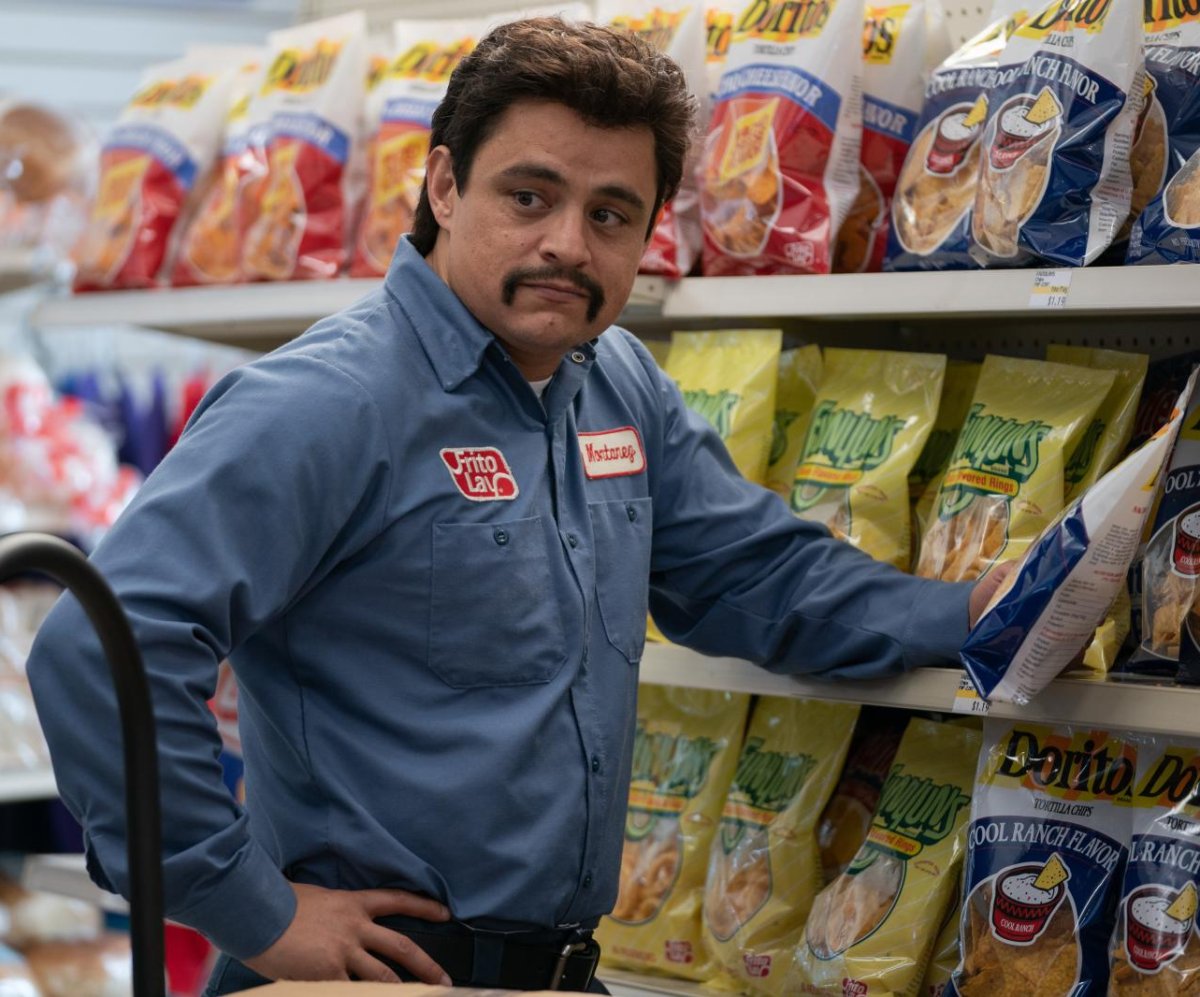
Matt Damon, Ben Affleck

“AIR”  My rating: B  (Prime Video) 

111 minutes | MPAA rating: R


“Air” describes itself as “a story of greatness,” but exactly whose greatness is up for grabs.

Ostensibly the latest directing effort from Ben Affleck is  referring to the greatness of Michael Jordan, arguably the finest basketball player of all time and the namesake of Nike’s famous Air Jordan athletic shoe which debuted in 1984.  Except that we never see Michael Jordan in the film, save for some archival footage of him in action on the court.

Given Jordan’s physical absence as a character, one must go looking for other recipients of the “greatness” crown.

Well, there’s Nike founder and chief Phil Knight, portrayed by Affleck as a sort of Zen egoist who spouts woo woo philosophy while driving a bright purple sports car that cost more than what the average Joe earns in several years. Knight is an interesting oddball — practically an idiot savant — and good for some unintended laughs. But great? Nah. At best he’s a supporting character here.

A more likely candidate is Matt Damon’s Sonny Vaccaro, whose job is to sign up rookie NBA players with Nike sponsorships.  

Sonny — who apparently has no life beyond sneakers and sports — is an underdog visionary determined to recruit NBA newbie Michael Jordan to the Nike camp, beating down fierce competition from Adidas and Converse. Everyone tells Sonny that  his quest is Quixotic, that Jordan is an Adidas fan and that Nike’s measly budget for basketball shoe promotion (the company’s fortune lies with running foot ware) is embarrassingly limited.

Sonny may have a pot belly and puffy jowls, but he exhibits some signs of greatness.  He’s the little engine that could, who uses grit, determination and smarts to pull off a marketing miracle.  A prime example of good ol’ American capitalist can-do spirit.

And then there’s the Air Jordan itself, an eye-catching explosion of red leather and rubber. Can a shoe have a personality?  Maybe.  But it can sure generate cash…in 2022 more than $5 billion. By this film’s definition, that’s pretty damn great.

You’ve got to credit director Affleck and screenwriter Alex Convery with this at least — they elevate Sonny’s quest beyond the merely mercenary to the nearly mythic. Against our better judgment we find ourselves rooting for Sonny to pull off the marketing coup of the century.

Convery’s savvy screenplay features much Mamet-ish high-speed shop talk (various Nike conspirators are portrayed by the likes of Jason Bateman, Christ Tucker and Matthew Maher as the cellar-dwelling dreamer who actually hand crafts the first Air Jordan);  Chris Messina practically chews up the screen as David Falk, Jordan’s silkily venomous agent.

But the key to the movie may be the great Viola Davis as Michael Jordan’s mother, Deloris.  Early in the film Sonny is advised that “The mamas run stuff…especially in black families.”

Davis’ Deloris is both intimidating and huggable…a loving matriarch with a tough-as-nails business sense and an unshakeable faith in her boy’s value.  She makes Sonny improve his game.

There’s a beat-the-clock intensity at the heart of the film — Sonny and his colleagues must dream up and create an Air Jordan prototype in just one exhausting weekend — and the whole enterprise has been so cannily timed and bracingly acted that even those of us who care little about sports and even less about sports capitalism will find ourselves caught up in Sonny (and Nike’s) impossible dream.

|Robert W. Butler

“MOONAGE DAYDREAM”  My rating: B+ (HBO MAX)

135 minutes | MPAA rating: PG-13

I was always aware of David Bowie, but never a fan, exactly.  Saw him perform during the Ziggy Stardust tour of ’72, but as the years passed found myself more of a Springsteen guy.

Still, Bowie has lurked on the periphery of my cultural consciousness, occasionally moving in to take a place of some prominence before receding once more.

The doc “Moonage Daydream,” though, has given me a new appreciation of the self-described Thin White Duke.  It may be time for a fresh  immersion in all things Bowie.

Written and directed by Brett Morgan (“The Kid Stays in the Picture,” “Cobain: Montage of Heck”), this is not your conventional documentary bio.

The two-hour-plus film pretty much ignores Bowie’s personal life.  It’s not particularly chronological.  There’s no omniscient narrator guiding us through, no cultural critics rhapsodizing about Bowie’s contributions. The only narration is provided by Bowie himself, culled from dozens of private recordings and public interviews. 

There are, of course, a load of musical performances, but this isn’t a concert film. In fact, Morgan’s guiding premise is that Bowie (who died in 2916 at age 69) was consumed with artistic expression, no matter what the format or packaging.

By “art” I mean not just pop music but also acting, writing, painting, fashion…the guy viewed his entire life as one big act of creation (“I never wanted to appear onstage as myself”). Small wonder he described himself as a “generalist.” 

What Morgan has given us here is a sort of visual/aural acid trip, an impressionistic deluge of images and sounds (Morgan provides the brilliant light-speed editing) that defy rational analysis and asks viewers simply to open up and to absorb the waves of Thin White Dukedom that come percolating out of the screen.

This means that “Moonage Daydream” is not for first-timers looking for a David Bowie survey course.  It’s aimed at fans of longstanding who will immediately recognize  and resonate with key moments from their man’s career, and who will synthesize all this new material into their mental/emotional caches of Bowie-dom.

| Robert W. Butler

Keri Russell, Rufus Sewell

“THE DIPLOMAT”  (Netflix): “West Wing”-quality political intrigue snuggles up to “Veep”-level satire in “The Diplomat,” a torn-from-the-headlines effort that functions simultaneously as real-world drama and nifty sexual comedy.

Keri Russell stars as Kate Wyler, an American diplomat whose speciality is bringing humanitarian relief to Middle Eastern hot spots.  As this eight-episode first season gets underway, she’s called to the Oval Office where the Prez (Michael McKean) tells her she’s going to be the new Ambassador to Great Britain…like right now.

What Kate doesn’t know is that the Big Guy, in cahoots with her charming/rule-breaking diplomat husband Hal (Rufus Sewell in what may be his best role ever), has tapped her to replace the current Vice President, a woman who’s about to get the boot because of her spouse’s financial improprieties.  A high-profile gig at the Court of St. James should pump up Kate’s bona fides.

What the President doesn’t know (because Hal is such a slick schemer) is that the Wylers are planning to split…and a recently divorced woman as Veep is out of the question. So Hal has another reason to rekindle the marital bonfire (aside from the fact that he’s impotent with any woman who is not Kate).

And that’s just the background. Most of this season unfolds in London where Kate and Hal are plopped down in the midst of an international crisis.  A British warship has been attacked in the Gulf of Arabia.  The Prime Minister (Rory Kinnear), eager to reverse his wimpish image, is ready to rain hellfire on Iran for the deaths of English sailors…except that maybe Iran is being framed by some other nation. 

It’s up to Kate to bring some sanity and caution to the situation…all the while getting extremely sexy vibes from the recently widowed British foreign secretary (David Gyasi).

The pacing is brisk, with plenty of sideshows for supporting characters and some nifty plot twists. The dialogue is some of the best out there.

And the perfs are, well, perfect.  Russell excels as an all-business statesperson who prefers plain black pants suits to ball gowns; half the time she appears not to be wearing any makeup and her hair is an afterthought. Of course when she does gussie up, it’s worth the wait.

Sewell is so good you don’t mind Hal’s occasional mansplaining session (it’s part of his allure), and McKean and Kinnear find ways to reference such figures as Joe Biden, Donald Trump and Boris Johnson without slipping into caricature or overt imitation.

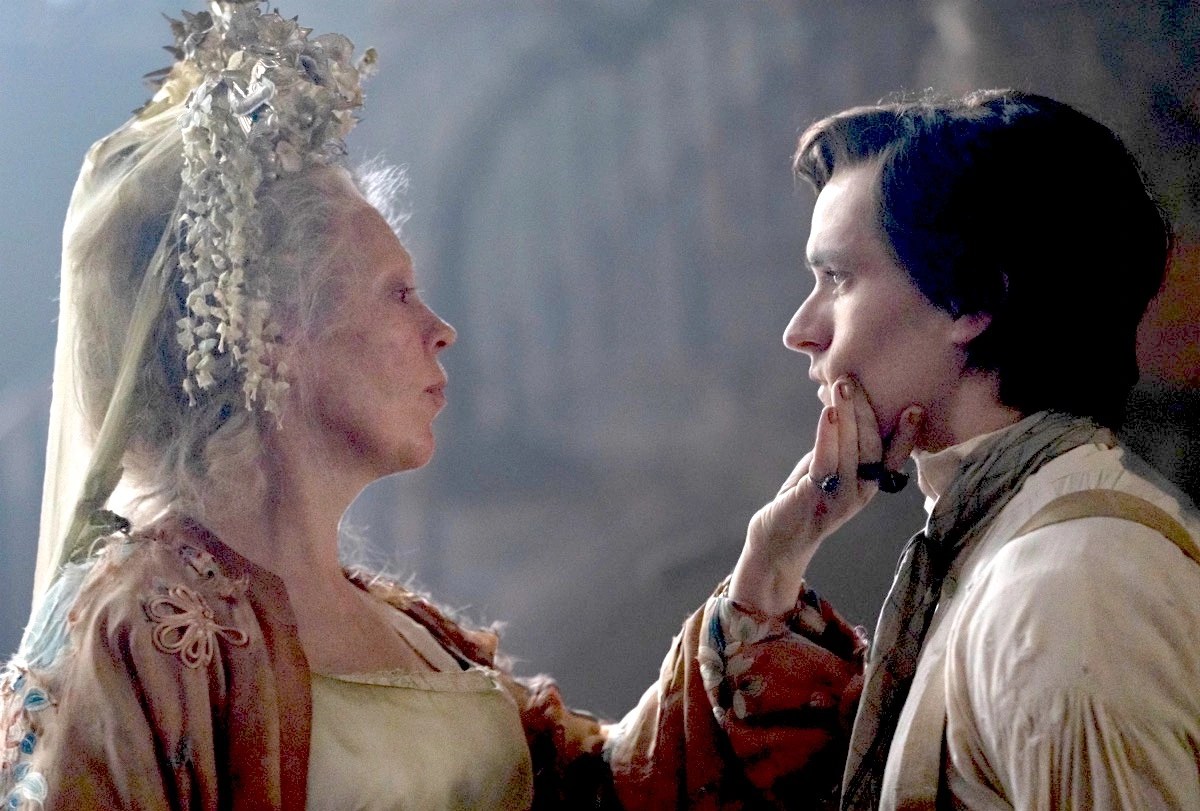
Olivia Colman, Fionn Whitehead

“GREAT EXPECTATIONS” (Hulu): Well, it’s not your father’s Charles Dickens.

Last time I read the great Brit author I apparently missed the sado-maso whorehouse scene, the opium puffing, and the frequent use of the “f” word.  Oh, wait, that’s all stuff the creators of this miniseries cooked up to make their “Expectations” appeal to jaded modern viewers.

Also they’ve gone for multiracial casting (Estella and several other characters are played by black actors or those of Middle Eastern heritage).  

Dickens purists will find this a somewhat curdled re-enactment.  

I’m on the fence.  I’m bored stiff by our two young protagonists (Fionn Whitehead as Pip and Shalom Brune-Franklin as Estella), but I’m loving Olivia Colman’s eye-rolling/venom-dropping turn as the crazed man hater Miss Havisham.

And as is so often the case with Dickens, some of the supporting players steal the show.  I’m particularly taken with Ashley Thomas’ turn as Jaggers, the utterly amoral and endlessly scheming lawyer who takes our impressionable young hero under his wing and slickly leads him into one moral and illegal dead end after another.

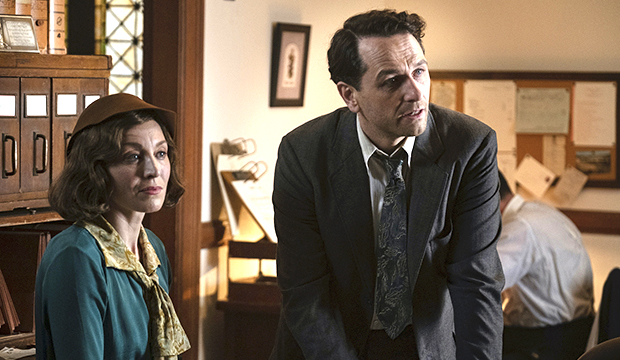
Juliet Rylance, Matthew Rhys

“PERRY  MASON” (HBO Max): The second season of “Perry Mason” continues its radical retelling of its characters’ origin stories. 

Perry (Matthew Rhys) is a former drunk just embarking on an uncertain legal career; Girl Friday Della Street (Juliet Rylance) and D.A. Hamilton Burger (Justin Kirk) are closeted gays.  Investigator Paul Drake (Chis Chalk) is an African American ex-cop fighting for dollars and some dignity in world that willingly gives up neither.

But the real star of the series is the way in which the show’s creators have established an atmosphere of Depression Era desperation and corruption.  This “Perry Mason” is like an eight-hour take on “Chinatown,”  a seething world of arrogant haves and scrambling have-nots, presented with a visual and aural authenticity (my God, Terence Blanchard’s jazz score!!!) unmatched in current streaming.

The plot finds Perry defending two young Mexicans charged with murdering the son of a supremely powerful (and despicable) oil magnate, but the courtroom stuff is secondary to the world established beyond the courthouse doors.

| Robert W. Butler

Taron Edgerton

“TETRIS” My rating: B  (Apple+)

118 minutes | MPAA rating: R

Capitalist opportunism goes nose-to-nose with Communist purity in “Tetris,” a based-on-fact comedy-thriller about the origins of what may very well be the world’s most ubiquitous video game. 

Spoiler: The Commies lose.

In Jon S. Baird’s diverting recreation of events, Taron Edgerton stars as Hank Rogers, a real-life video game developer and marketer who in the late ‘80s was introduced to Tetris, a computer game in which players had to manipulate falling geometric forms to create solid lines that generated points.  

Rogers realized the game was utterly addictive and foresaw a huge market.  Just a few problems.

Rights to the game in the West were, well, unclear.  Several companies claimed them, but apparently none had actually finalized a deal with the USSR, where the game was born.  The  Soviet state claimed ownership of every invention of any of its citizens, among them the genius behind the game, programmer Alexey Pajitnov (Nikita Efremov).

Noah Pink’s screenplay follows Hank Rogers as he travels to Moscow to buy Tetris from the government.  His quest is complicated because there are other Westerners bidding on the game, among them fly-by-nighter Robert Stein (Toby Jones), Brit media mogul Robert Maxwell (Roger Allam)  and Maxwell’s insufferable (think Donald Trump Jr.) son Kevin (Anthony Boyle).  

Things are no less frantic among the Russians.  The honest bureaucrat ostensibly in charge of negotiations (Oleg Stefan) is continually undermined by politicians and their KGB minions expecting the collapse of the Soviet state; they are determined to build their own nest eggs on the back of Tetris.

The film is at its best when Hank must rely on his instincts and wits to penetrate the quagmire of Soviet bureaucracy. (At one point Soviet premiere Mikhail Gorbachov steps in deus ex machine-style.) It’s less effective when dealing with his domestic situation (wife and kids who want Daddy back home).

Also noteworthy is the film’s mirroring of plot points in the Oscar-winning “Argo,” especially the notion of a Westerner on a dangerous mission in a totalitarian state and a last-minute escape on a commercial aircraft.

Despite its slow-building tension, “Tetris” is often drolly funny. But making the show irresistibly playful are the many nods to first-generation video gaming.  The film’s various chapters are introduced with the same chunky graphics that marked early ‘80s video games; at one point during a car chase through Moscow the vehicles begin pixellating and become cartoon versions of themselves.

Nothing earth-shaking here. Just a good time.

| Robert W. Butler

Nigel Thatch as Malcolm X, Forest Whitaker as Bumpy Johnson, Giancarlo Esposito as Rep. Adam Clayton Powell

“GODFATHER OF HARLEM” (Hulu): The great thing about our current streaming situation is that if you’re willing to wait, just about everything you want to see eventually pops up on one of your subscription sites.

So it is with “Godfather of Harlem,” which debuted in 2019 on Epix (I wasn’t going to subscribe for just one show). Now the first two seasons have migrated to Hulu.

Based on the career of real-life gangster Ellsworth “Bumpy” Johnson, the show’s title deliberately  references that greatest of American crime movies, “The Godfather.”

Like that Francis Ford Coppola landmark this is a sprawling saga that contrasts its protagonist’s bloody profession against the shifting currents of his family situation. What makes “Godfather of Harlem” special is its setting — the early 1960s — and its emphasis on Civil Rights and the black experience.

Bumpy is portrayed by Forest Whitaker, whose onscreen charisma helps sell a character who, let’s face it, is getting rich off the suffering of his own people. Bumpy used the notorious French Connection to funnel heroin into the inner city; he seems to have had no qualms about this, even when his own daughter became an addict.

Indeed, my biggest beef with Season 1 is that it totally blows off the moral implications of its hero’s choices.  I’m happy to report that Season 2 finally digs into Bumpy’s moral ambivalence.

What makes the show noteworthy is not its gangster cliches but its rich depiction of an era.  

Bumpy’s main nemesis is Mafia crime boss and dyed-in-the-womb racist Chin Gigante (a marvelously loathsome Vincent D’Onofrio). His two greatest allies are a U.S. Congressman, the womanizing, heavy-drinking Rev. Adam Clayton Powell (portrayed with palpable glee by Giancarlo Esposito) and the Nation of Islam maverick Malcolm X (Nigel Thatch), perhaps the most ethically grounded character in sight.

Season One also features a Romeo & Juliet love affair beetween Gigante’s daughter (Lucy Fry) and a black r&b singer (Kelvin Harrison Jr.). Race relations being what they were, the description “star-crossed” is wholly appropriate.

The performances are top notch.  Especially loved Chaz Palminteri as mob bigewig Joe Bonanno and the late Paul Sorvino as boss of bosses Frank Costello. Look also for Deric Augustine’s turn as young Cassius Clay.

Jason Segel, Harrison Ford

“SHRINKING” (Apple TV):  How’s this for a pedigree?  

“Shrinking” was created by actor Jason Segel, screenwriter/actor Brett Goldstein (“Ted Lasso”) and veteran TV producer Bill Lawrence (“Scrubs,” “Cougartown,” “Ted Lasso”)…and as you might guess from that lineup, it is wickedly funny with a big ol’ heart.

Segel stars as Jimmy, a recently widowed psychiatrist struggling to serve his patients (among them KC’s Heidi Gardner) while bringing up a teenage daughter (Lukita Maxwell) who sees through his every pathetic ruse.

Sadsack Jimmy shares the mental health suite with his mentor Paul (Harrison Ford…way funnier than I thought possible) and the adorably chatty Gaby (Jessica Williams). Those who maintain you have to be a bit crazy to succeed in the psychology racket will find ample confirmation.

(Just occurred to me…”Shrinking” is the old Bob Newhart-as-psychologist show on steroids…with a Viagra chaser.)

Jimmy’s circle also includes his sardonically-inclined neighbors (Christa Miller, Ted McGinley),  a War on Terror veteran with anger issues (Luke Tennie) and Jimmy’s enthusiastically out attorney (Michael Urie).

As was the case with both “Scrubs” and “Ted Lasso,” I’ve fallen in love with the show’s characters — not to mention its vaguely stressed-out  humanism and its intriguing look into the behind-the-scenes nuts and bolts of psychiatry.

Mark Addy (center)

“THE MURDERS AT WHITE HOUSE FARM” (HBO Max): The 1985 murders of five members of an Essex farm family are the basis for this six-episode series featuring the great Mark Addy (Robert Baratheon for you “GoT” geeks) as a rumpled police detective who bucks his superiors and public opinion to dig into the case.

In real life things were resolved with the conviction of a family member, but the series has just enough flexibility to leave us wondering if, in the end, they got the right guy.  

In any case, the show offers a pantry full of interesting characters and a whole slew of good perfs.

| Robert W. Butler

“WOMEN AT WAR”(Netflix):  Four French women — a prostitute, a nun, a fugitive from the law and a well-to-do wife and mother — find their world upended with the outbreak of World War I in this impeccably produced eight-parter.

“Women…”  (in French the title is “Les Combattantes,”  which I much prefer) seamlessly blends brutal realism with soap opera-ish plotting;  the results are wildly entertaining.

Set in the Vosges region of France in the early days of the conflict (this was before things bogged down in the awful limbo of trench warfare), the series gives us female protagonists struggling to survive in the absence of their menfolk.

Caroline (Sofia Essaidi) is left to run the family’s truck factory while her husband goes off to war. Plus she struggles to hide her disreputable past from his disapproving family.

Nurse Suzanne (Camille Lou) is on the run from the law after a patient dies during an illegal abortion; she takes the identity of a dead woman and begins treating wounded soldiers at the convent/hospital run by the tormented Mother Agnes (Julie De Bona), who finds herself questioning her vows when she falls for a shellshocked patient.

Meanwhile prostitute Marguerite (Audrey Fleurot) silently watches over the son she abandoned twenty years earlier…the kid is now a soldier stationed nearby. 

The series is crammed with intrigue, romance, close calls and some very well staged battle scenes. What you’ll remember most is the ghastly parade of mutilated bodies.

Staunchly feminist without making any big speeches, the series gives us menfolk who range from a decent army surgeon to a skin-crawling pimp, a predatory priest, a revenge-obsessed police detective and a dissipated rich boy. Even the villains are presented as complex characters.

Toss into the mix French cinematic royalty like Tcheky Karyo and Sandrine Bonnaire, and you have an absorbing historic piece that blends the epic and the intimate.

Itzuiar Ituno

“INTIMACY” (Netflix): Also carrying a feminist cudgel is the Spanish eight-parter “Intimacy.”

Part political thriller, part angry dissection of contemporary male privilege, the show centers on Malek (“Money Heist’s” Itziar Ituno), deputy mayor of Bilbao. She’s a tough, talented woman aiming to run the city, but her plans are threatened with the release of a video showing her having sex on a French beach with a man not her husband.

The crisis has implications for both her career and her family, but is only the starting point for a half-dozen subplots centering on wronged women.

A high school teacher (Patricia Lopez Arnaiz) looks for answers to the suicide of her sister (Veronica Echegul), who was humiliated when a years-old sex video goes viral among her coworkers at a factory.

Malek’s teen daughter (Yune Nogueiras) is dealing with a jerk boyfriend who has shared their sexting photos with classmates.

And a female police detective specializing in sex crimes (Ana Wagener) — smells a bigger conspiracy in Malek’s sexual outing.

“Intimacy” offers some great roles for women.  The guys — not so much.  The male characters are much less nuanced, ranging from outright thuggery to bland nice guys.

At least there’s Malek’s husband Alfredo (Marc Martinez), torn between anger at his newfound status as poster boy for cuckoldry and his rueful continued support of his wife’s ambitions.

“Behind every great woman,” he shrugs, “is an emasculated man.”

“THE INVESTIGATION”(Hulu):  That old reliable the police procedural gets an inspired overhaul in this Danish miniseries, a docudrama recreation of one of that country’s most notorious murder prosecutions.

2017’s “submarine case” centered on the death of Kim Wall, a journalist who was last seen getting onto a homemade submarine owned and operated by a Copenhagen industrialist.  Days later her torso — sans head and limbs — was found floating in Koge Bay.

The six episodes from writer/director Tobias Lindholm center on the efforts of a homicide detective and a public prosecutor  (Soren Malling and Pilou Asbaek, both veterans of the excellent “Borgen”) to find enough evidence to indict the rich creep.

But “The Investigation” departs from every other crime drama in never depicting either the criminal or the victim.  We hear about the cops grilling the suspect…we never see it. As for the dead woman, we meet her grieving parents, but only see a photograph of her during the closing credits of the final episode.

Mostly the show zeroes in on the nuts and bolts of police investigation and the case’s flabbergasting million-to-one payoff:  the cops placed cadaver-smelling dogs on boats that crisscrossed the bay for days until they picked up the telltale gases of human body parts decomposing beneath the waves.

Driving the whole enterprise is the dogged determination of the homicide detectives, who fight through numerous reversals and dead ends — along the way risking their own mental/emotional stability — to get justice for the dead woman.

| Robert W. Butler

Charlbi Dean, Harris Dickinson

“TRIANGLE OF SADNESS” My rating: B+ (Hulu)

147 minutes | MPAA rating: R

In 1974’s “Swept Away”  filmmaker Lena Wertmuller  pondered the romantic and political implications of two wildly dissimilar individuals — a spoiled rich woman and a proletarian sailor — becoming castaways on an uninhabited Mediterranean isle.

Ruben Ostlund’s Oscar-nominated “Triangle of Sadness” (it’s competing in the best picture, best original screenplay and best directing categories) takes that idea and expands it tenfold.

Instead of just two individuals representing different castes we get a dozen characters whose societal prejudices and economic backgrounds collide in a heady mashup of satiric comedy… and no small amount of seasickness-induced vomit.

It takes a while before we get a handle on what “Triangle…” is all about.  

It starts with dozens of shirtless male models gathered to audition for a major advertising campaign. Among these desperate hopefuls (all of whom are working desperately not to to look desperate) is Carl (Harris Dickinson), who tries to remain upbeat and positive even after one of the agents doing the hiring comments on his features exhibiting a “triangle of sadness,” whatever the hell that might be.

Anyway, Carl doesn’t get the job.  Later the depressed hunk is joined at dinner by his gorgeous model girlfriend Yaya (Charlbi Dean).  The pair get to bickering…Carl points out that Yaya, despite having the more successful career, always finds ways not to pick up the check. It’s pretty clear that she’s always looking out for No. 1.

Ostlund’s film only kicks into truly comic mode when the couple are invited to cruise on an ultra-high-end yacht. The other passengers  are a mix of old and new money — one genteel British couple turn out to be international arms dealers with much blood on their hands. But, hey, it’s a chance for our young protagonists to eat well and soak up rays on somebody else’s tab.

But clearly something’s off.  The boat’s captain (Woody Harrellson) is undergoing a mental breakdown; he refuses to leave his cabin and appears to be on a world-class drug-and-drink bender. He’s joined in these dissipations by one of the passengers, a rags-to-riches  Eastern European entrepreneur (Zlatko Buric). Between shots and snorts the two carry on a friendly socialism-vs.-capitalism debate.

Woody Harrellson

Ostlund takes immense pleasure in quickly reducing the pampered passengers to wretched wraiths. A raging storm turns the ship into a roller coaster awash in puke; an attack by pirates sends the boat to the bottom of the sea and a handful of survivors flopping on a deserted beach like so many washed-up fish.

It’s in this castaway sequence that the film really pulls out its knives.  The only person with any survival skills is middle-aged Abigail (Dolly De Leon),  a crew member whose specialty was  cleaning the passengers’s toilets. Now, by virtue of being able to catch and cook fish, Dolly ascends to the status of tribal queen.  If the others want to eat, they’d better satisfy her whims…including her sexual demands.

“Triangle of Sadness” might be dismissed as misanthropic; it takes for granted that we’re all self-deluding and selfish fools, no matter where we stand on the economic spectrum.

But it takes such obvious glee in bringing its characters down to the same miserable state that we cannot help but get caught up in the proceedings.  Even a non-ending that tends to dribble away with little closure can’t undo the malevolent pleasures here exhibited.

| Robert W. Butler

My rating: A- (Opens Feb. 18 at the Glenwood Arts)

Once upon a time an animated short needed to do nothing more than make you laugh.

This year’s batch of Oscar-nominated shorts may make you chuckle now and then, but for the most part they’ll leave you gasping in admiration at their intellectual/emotional breadth.

AN OSTRICH TOLD ME THE WORLD IS FAKE AND I THINK I BELIEVE IT” (Australia; 11 minutes)

This world-class mind molester from writer/director Lachlan Pendragon is like a “Twilight Zone” version of “The Matrix,” only animated in the stop-motion style made familiar by the folk at Aardman.

In a colorless office telemarketer Neil suffers through his soul-killing job as a toaster salesman. Actually we’re watching Neil on a video monitor that fills much but not all of the frame. You see, around the monitor’s edge we can see things moving. They’re out of focus but, yes, it appears to be an animation studio…we can see the animator moving his toy figures a fraction of an inch between shots to create the illusion of life.

Whoa…Neil thinks he’s living in reality (just like Neo in “The Matrix”) but he’s actually occupying a fictional space created by a filmmaker.

Mind blown yet?

About halfway through Neil falls asleep at his desk and awakens in the darkened office to find himself dealing with a chatty ostrich who informs him that he is living a lie: “Question everything, young man. The world is not quite what it seems.”

Now when Neil looks closely at his existence he sees evidence of the animator’s previously unseen hand. It’s freaking him out.

The meta-rich “An Ostrich Told Me…” is about as clever as a short film can be.

“ICE MERCHANTS” (Portugal; 14 minutes)

From a chalet perched high on the side of a mountain glacier, a man and his young son take advantage of the frigid air to make ice. Every day they load up a back pack with the frosty stuff and base jump to the valley floor below. Down there folks are happy to pay for crystal clear ice.

Just one problem. Things are starting to melt.

Joao Gonzalez delivers this wordless global warming parable in a spectacular graphic style. His images are simultaneously simple and sophisticated. Dominated by the colors orange and blue, the film looks like a silkscreen come to life. Ultimately “Ice Merchants” becomes a touching story of parental love and loss.

MY YEAR OF DICKS” (USA; 25 minutes)

Pamela Ribon’s memoir about the year she tried desperately to lose her virginity has been fashioned by director Sara Gunnardsdottir into a mini-epic of teen angst and social discomfort. Over a half hour we meet the various boys to whom our heroine is drawn…and, yeah, most of them are dicks.

Like the skateboarding lout David; the moody skinhead she meets at a party, and the movie theater employee who in her fevered imagination comes off as a Gallic lover out of a foreign film. Fact is, none of them are worthy of her…except maybe her best bud Sam, who serves as Pam’s emotional wingman and yearns to be something more.

Pam also has a sex talk with her father that is bleakly hilarious, not to mention so embarrassing as to put a girl permanently off carnality.

“My Year…” is both deliciously literary (much of the narration is a parody of flowery/bad romance novel prose) and astonishingly visual (at certain romantic moments our heroine turns into a manga version of herself, all big eyes and rounded features). Director Gunnardsdottir employs a plethora of visual styles, with each segment getting its own special look.

“THE FLYING SAILOR” (Canada; 8 minutes)

A sailor witnesses the explosion of a ship carrying a load of dynamite. The blast tears off his clothes and sends him flying through the sky head over heels, all the while reliving moments from his life. It’s both dreamlike and deeply disturbing.

A final credit informs us that the film was based on the actual experience in 1917 of a seaman who was blown more than a mile by an explosion and lived to tell about it.

“THE BOY THE MOLE THE FOX AND THE HORSE” (Great Britain: 32 minutes)

Peter Baynton and Charlie Mackesy’s animated adaptation of Mackesy’s 2019 children’s book is the sort of thing that can turn hobnailed tough guys into blubbering messes. It’s a simple story — heck, there’s hardly any story at all — with the emotional kick of a Clydesdale.

A tow-headed boy wanders a gorgeous winter landscape. He encounters a chatty mole (voiced by Tom Hollander), who senses the boy is lost and wants to provide assistance. The boy says he doesn’t know who he is or how he got there — only that he wants to go home.

His cross-country quest will bring him into contact with a sly fox (Idris Elba) who wants to chow down on the mole…at least until the mole does him a major favor. Later on a beautiful white horse (Gabriel Byrne) allows the other three to ride his broad back as they make for the distant lights that suggest a human settlement.

The simple yarn is crammed with moral uplift and emotional wisdom; it’s presented with such poetic polish that the viewer’s cynicism evaporates before it can do any damage.

Visually “The Boy The Mole…” is so gorgeous you want to hang every frame on the wall. The backgrounds are like exquisite water colors, while the characters have been rendered in a pencil-like style that recalls E.H. Shepard’s illustrations for the original Winnie-the-Pooh books.

The film is a marvel that returns the viewer to a childlike state of charity and openness…not bad for a short film.

| Robert W. Butler

Bill Nighy

“LIVING” My rating: A- (Theaters)

102 minutes | MPAA rating: PG-13

Just about every element of “Living” works perfectly…which one half expects given that it’s a Brit remake of the brilliant Akira Kurosawa film “Ikiru (To Live).”

To that 1952 humanist triumph (about a gray civil servant whose life finds focus only when he faces death), screenwriter Kazoo Ishiguro and director Oliver Herman add a funny/sad study of a singularly English form of emotional constipation. There are actually some chuckles in this tale of a man with a fatal disease.

And the fact that the man in question is portrayed by the great Bill Nighy kicks “Living” into the emotional stratosphere. Nighy has won an Oscar nomination for his work here…I’ll be rooting for him to take home the golden boy.

“Living” opens with vintage color footage of post-war London, then cuts to a suburban train platform populated by identically-clad office workers (three-piece suits, bowler hats, briefcases and umbrellas) on their way to their jobs in the city. Director Herman has a good time framing and choreographing their movements to remind us of the zombie proles in Fritz Lang’s “Metropolis.”

We are introduced to Wakeling (Alex Sharp), a new hire at the public works office overseen by Nighy’s Mr. Williams. The kid learns quickly that the office is a place of Scrooge-ish joylessness; he and his colleagues are expected to shuffle much paperwork while accomplishing very little.

Woe be the citizen who enters this daunting bureaucratic maze, as Wakeling discovers when assigned to assist three housewives seeking to have a children’s playground built in the rat-infested bomb crater near their tenement.

Early on the sepulchral Williams visits a physician’s office where he gets bad news. The normally uncommunicative widower considers revealing his grim diagnosis to his live-in son and daughter-in-law, but can’t quite bring himself to open up.

Instead he plays hooky for the first time in his life. Rather than commuting to his desk Williams takes the train to a seaside resort where he is befriended by a rather seedy young intellectual (Tom Burke) and led on a Nighttown-style tour of disreputable cellars, jazz venues and strip-tease shows. It may be the closest thing to a holiday the stiff scarecrow has allowed himself in decades.

Back in London he befriends a young woman (Aimee Lou Wood) who recently left his employ; it is slowly dawning on Williams that while he is surrounded by other people, he actually knows none of them.

Bill Nighy, Aimee Lou Wood

“Living” effortless adapts the unusual narrative of the Kurosawa film — the second half is devoted to Williams’ co-workers reflecting on how he chose to spend his final months — and we’re once again reminded of the original’s stroke of genius, the ways in which it mines emotions without stooping to stridency or heavy-handed bathos.

That savvy sense of restraint also permeates Nighy’s performance. His Williams at first presents as a human chalk stick — dry, white and brittle. Small wonder his newfound female friend describes him as “dead but not dead.”

But little by little we see the character grow aware of sensibilities that have been long dormant. Some actors would aim for the big moment, but Nighy gives a performance of astonishing subtlety. He knows a little goes a long way; he can make us feel more with a straight face than other players could evoke with howls and breast beating.

The resulting movie is a quiet triumph and an unexpected paradox: a feel-good film about dying.

| Robert W. Butler

“EO” My rating: B (In theaters)

89 minutes | No MPAA rating

What you get out of the donkey-centric “Eo,” I suspect, depends upon what you bring to it.

The latest from veteran Polish director Jerzy Skolimowski (“Moonlighting,” “The Lightship”) is an acknowledged nod to Robert Bresson’s 1966 “Au Hazard Balthasar”…both follow a donkey as the animal encounters a diverse variety of human beings whose behavior runs the gamut from loving to indifferent to cruel.

Neither film attempts to Disney-fy its subject. Both Balthazar and Eo are animals, pure and simple. They don’t do cute things, they are not ascribed the same emotions as people. Stare into their eyes and find what you can there.

This neutrality makes the movies challenging, for the filmmakers don’t tell us what we’re supposed to be feeling at any given moment. Rather we observe and, ultimately, impose on the donkey our own sensibilities. It’s not so much about the animal as our reactions to it and its plight.

“Eo” begins in a traveling circus where under a fierce red light Eo goes through his repertoire of simple tricks with his trainer Kasandra (Sandra Drzymalska). This young woman is clearly devoted to the animal, showering it (is it a he or a she? I don’t know…) with affection and kisses.

But in short order things go south. The circus goes bankrupt at the same time it’s assailed by animal rights activists. Eo and the other four-footed performers are shipped off.

Over the film’s 90 minutes we’ll follow Eo through a series of misadventures. He/she ends up in a high-end horse breeding stable, pulling a cart loaded with feed and other necessities. Eo spends time at a farm that serves as a sort of petting zoo for special needs children.

Sandra Drzymalska, Eo

These interludes are presented as neither good nor bad. Is requiring an animal to haul our stuff or be ridden a form of exploitation? Is it cruel? You decide.

It could always be worse, as we’ll soon learn. Wandering off the farm Eo stumbles across a village whose soccer-crazy residents adopt him as their club mascot. Even the minimum pampering he receives from the beery celebrants has a downside; when the skinhead hooligan fans of a vanquished team show up to break heads, they decide to beat poor Eo as well.

Eventually Eo finds himself the companion of a young man (Mateusz Kosciukiewicz) who takes the donkey home to meet his rich mother (played by none other than the great Isabelle Huppert). Seems like a pretty nifty place to wind up, but Eo’s sense of wanderlust kicks in yet again, and he’s off.

Periodically the film reverts to crimson-soaked flashbacks to Eo’s days with Kasandra. This is as close as “Eo” comes to suggesting that the animal has an inner life, memories, yearnings.

We never really get to know the human characters, most of whom are treated with the same neutrality as Eo. Some have a mean streak, some are jerks, most are just schlepping through life.

In truth, “Eo’s” neutrality will strike many as its own form of indifference. Happily the film is a technical tour de force, with sumptuous photography by Michal Dymek and a powerful orchestral score from Pawel Mykietyn that imparts an eye- and ear-catching grandeur to the proceedings.

There’s a good deal of Christian symbolism percolating throughout “Eo,” though one needn’t glom onto it to appreciate the film.

I suspect a certain variety of animal lover — the folk who can handle humans killing each other but blanch when someone shoots a dog — will find in Eo’s story a heart-tugging tragedy.

Others — present company included — will see here a pretty standard-issue life: work, food, sleep, a few moments of pleasure and hopefully fewer of pain, all leading up to that big abattoir in the sky.

| Robert W. Butler