Feeds:
Posts
Comments

Margot Robbie

“BABYLON” My rating: B (In theaters)

188 minutes | MPAA rating: R

“Babylon” is filmmaker Damien Chazelle’s recreation of Hollywood in the last days of silent movies and the dawn of the sound era.

It is a riot of excess and ambition, a trip to a La La Land where Prohibition-era parties devolve into Roman-style orgies, where an elephant erupts in a diarrhea gusher and a beautiful woman projectile vomits on a rich man’s priceless carpet.

With nearly a dozen major characters whose careers are tracked over a raucous decade, the film has a running time of more than three hours and is packed with mind-blowing set pieces, some of which work on the viewer’s sensibilities like a dose of LSD.

It is simultaneously too much and just right, though as it enters its third hour you might wish for something resembling an actual plot.

At its core, “Babylon” is a tale of unrequited love. Manny Torres (Diego Calva) is a Mexican kid who serves as a fixer for a Hollywood bigwig. On one memorable night of bacchanalian excess circa 1926 he makes the acquaintance of Nellie LaRoy (Margot Robbie), a beautiful substance-fuelled party girl from the poor side of town.

These two outsiders are on parallel tracks to fame and fortune, Manny as a studio exec who excels at cleaning up messes, and Nellie as a steaming hot star whose off-the-charts sex appeal is matched only by her effortless acting (in one memorable scene she asks her director if she should produce a tear with her left eye or her right one).

Manny — essentially a sweet guy despite the dark side of his employment — is doomed to worship Nellie from afar. She’s too in love with her vices (drink, drugs, gambling, sex) to notice his adoration, though Manny’s the guy she turns to whenever she gets in over her head.

Meanwhile everywhere you look in this film there’s a colorful character shouldering his/her way into our awareness.

Foremost among them is Brad Pitt’s Jack Conrad, a Hollywood leading man in the Douglas Fairbanks/Errol Flynn mold who remains charming and erudite even when plastered…which is most of the time. He becomes young Manny’s mentor and our favorite on-screen presence, a wildly attractive bon vivant with an undercurrent of resigned self-awareness and a roster of ex-wives.

Brad Pitt

We get a Hedda Hopper-ish gossip columnist (Jean Smart), a black jazzman (Jovan Adepo) who finds limited fame a not a little racism starring in musical shorts, a Chinese actress (Li Jun Li) who exudes exotic other-ness, a creep called The Count (Rory Scovel) who seems to provide all Hollywood with drugs and an even creepier gambler (Tobey Maguire) who takes us subterranean slumming in a segment right out of Dante.

Interspersed with Chazelle’s fictional characters are real-world figures like Irving Thalberg and William Randolph Hearst.

“Babylon” is roughly divided between the movie-making segments (including a fascinating look at the maddening unreliability of early sound technology) and behind-the-scenes cavorting.

In many ways the film is scrupulously realistic, yet it’s overflowing with fantastic elements, not least of which is a musical score more redolent of the boppin’ late ’40s than the 1920’s.

There are a few laugh-out-loud moments (many provided by Pitt), but the overriding tone is one of seen-it-all cynicism. Chazelle (“Whiplash,” “La La Land,” “First Man”) clearly is fascinated by the early history of the movies, but he draws the line at sentimentality.

At a certain point “Babylon” becomes a victim of its own diminishing returns. For all its eye and ear candy and its insider’s dissection of the Hollywood machine, and despite some really fine performances the film remains emotionally neutral. We may be diverted by these characters, but we’re not moved by them; their downfalls seem less tragic than a case of just desserts.

It’s probably fitting that a film depicting a world without morals should itself lack a moral. Still, in the final analysis we’re left feeling a bit empty.

Entertained, but empty.

| Robert W. Butler

“GOOD NIGHT OPPY” My rating: B (Prime Video)

105 minutes | MPAA: PG

The robot/computer that develops a human personality is a staple of science fiction. “Good Night Oppy” is an inspiring real-life twist on that cliche.

Launched in the summer of 2003, the roving robots Spirit and Opportunity were designed to explore Mars (the “twins” landed on opposite sides of the Red Planet). NASA scientists and engineers designed the robots to function for 90 Martian days; anything longer would be frosting on the cake.

Spirit kept operating — exploring and photographing the planet’s terrain, picking up and examining geological specimens and searching for signs of water — for six years.

Her sister Opportunity (known affectionately as Oppy) kept chugging along for an unbelievable 14 years, surviving massive dust storms, electrical strikes and the mechanical version of arthritis (shit wears out).

Ryan White’s documentary “Good Night Oppy” is an in-depth look at the Spirit/Opportunity mission, from early designs and testing to the day-to-day operation and maintenance of the rovers on the planet’s surface.

There is utterly convincing footage of Spirit and Oppy going about their work on Mars, courtesy of the visual artists at Industrial Light & Magic, and of course there are plenty of photos taken by the rovers of their environment.

We also meet a dozen or so of the individuals who created the program and kept the robots rolling along for years past their expiration dates. A popular cliche casts scientists and engineers as creatures of fact with little room for sentiment, yet the testimony of these slide-rule types suggests that over time they came to regard the rovers, especially Oppy, as a member of the family, at least as empathetic a being as a cat or dog.

Physically there is little human about the rovers. They look a bit like aircraft carriers on treaded wheels, with the “deck” a couple of feet above the ground. Towering over the body is a “neck” and “head” equipped with cameras…the rovers were deliberately designed so that the cameras’ POV would be that of a five-foot-tall human strolling across the Martian surface.

The humans’ affections for the rovers were built largely on the day-in-day-out routine established over the machines’ lifetimes. There were morning wakeup calls featuring popular songs blasted into space…apparently Spirit and Opportunity were programmed to react like a human being awakened by a clock radio.

Moreover, the robots had been programmed to act autonomously in certain situations (there was a lag time of 10 minutes between NASA sending an order and the machines receiving it), and this sometimes gave the impression that they were exhibiting free will.

The NASA folk recognize, of course, that these are machines. But who can blame them for projecting their parental impulses on these two metallic space babies? Or for mourning when at long last Oppy went to sleep during a long Martian dust storm and never again awoke?

The marvel of White’s film (co-written with Helen Kearns) is that we don’t sneer at this anthropomorphic proclivity. Rather, we buy into it,

Is it possible to love a chunk of metal and plastic? “Good Night Oppy” certainly makes the case.

| Robert W. Butler

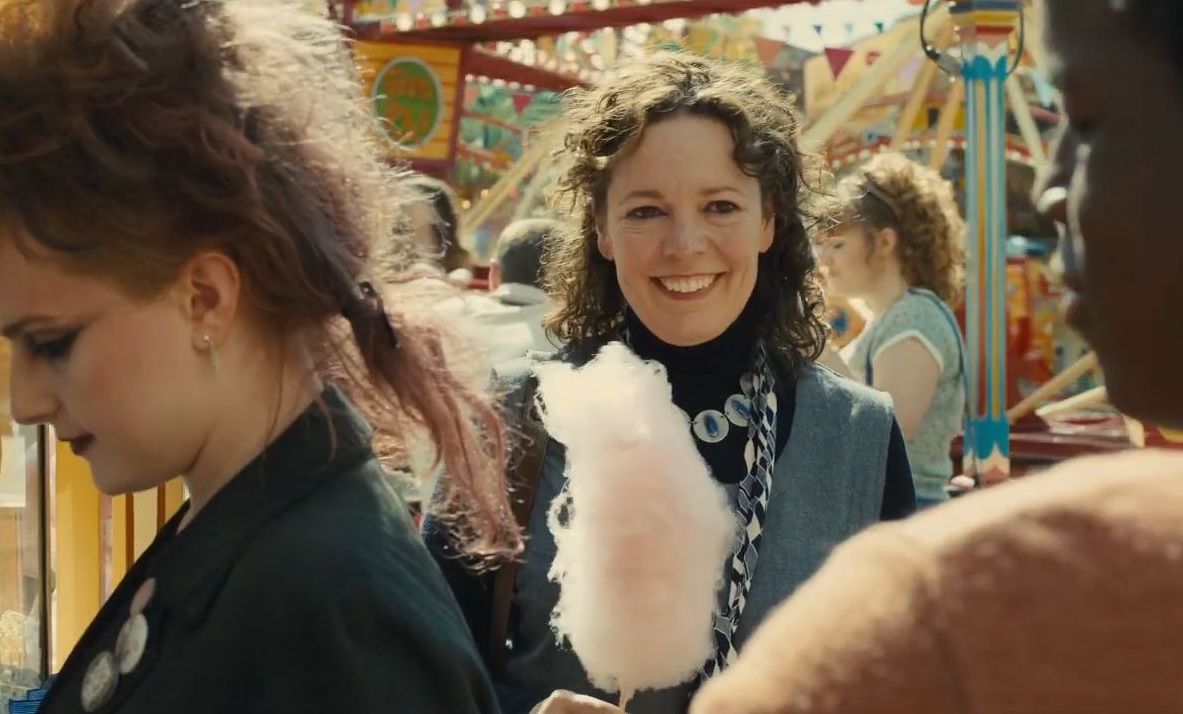
Olivia Colman

“EMPIRE OF LIGHT” My rating: B (In theaters)

119 minutes | MPAA rating: R

Here’s a conundrum: Olivia Colman gives a world-class performance in a film that isn’t up to her standards.

Well, you take what you can get. And getting Colman at full throttle is nothing to dismiss.

In Sam Mendes’ “Empire of Light” Colman plays the assistant manager of a British cinema circa 1980.

Like the Empire Theater where she works, Colman’s Hilary has seen better days. There are references to a mental breakdown and hospitalization; currently she’s providing sexual favors to the movie house’s owner (Colin Firth), a middle-aged married man who thinks the other employees (mostly twentysomethings) don’t know what it means when he calls Hilary into his office to “discuss business.”

Mendes’ screenplay follows Hilary over the course of several months during which she initiates an affair with a new co-worker, Stephen (Micheal Ward), who is kind and caring and whose youth (he’s maybe 20 years her junior) lifts Hilary out of her her doldrums. Of course, this newfound zest for living may simply be an all-too-predictable upward swing of her manic-depressive condition.

And what goes up is bound to come down. Spectacularly.

Oh, one more thing. Stephen is black, a fact that bothers Hilary only inasmuch as the rise of Thatcher-inspired fascism puts her young lover in perennial jeopardy. Skinheads roam the streets of the seaside resort town in which the film unfolds, and late in the proceedings “Empire of Light” explodes into a full-throttle race riot.

In addition to the film’s social/racial elements, we cannot ignore that this story unfolds mostly in a movie theater. And a good old-fashioned movie palace makes for a pretty heady metaphor.

Still…I cannot be the only viewer anticipating a “Cinema Paradiso”-style wallow in the transcendent glories of the medium, in the movies’ ability to lift us out of our troubled reality and send us off on a journey of love, adventure and laughter.

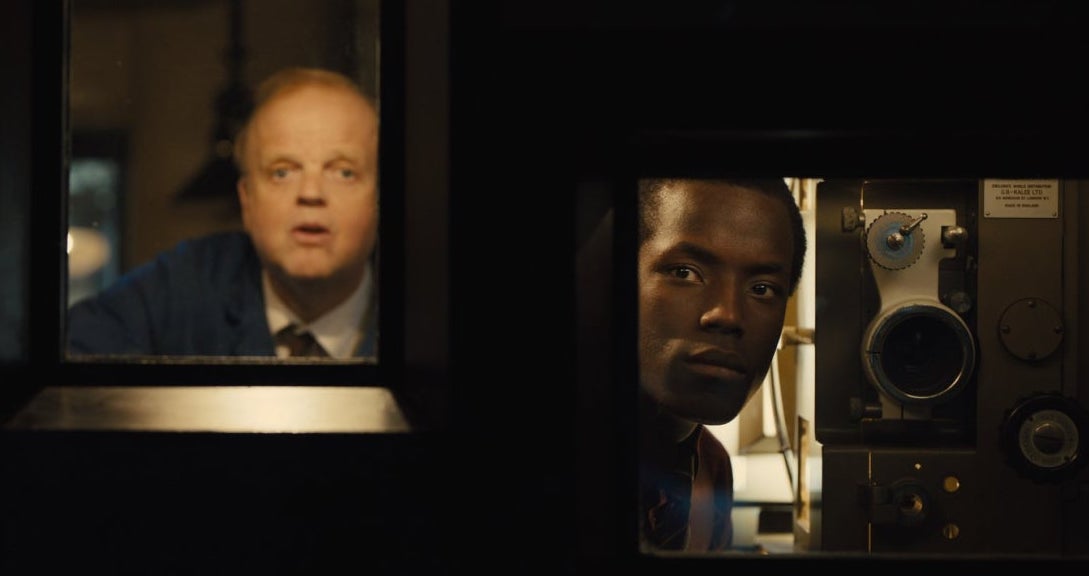
Toby Jones, Micheal Ward

Except that it never materializes here. The closest we get are scenes with the semi-reclusive projectionist (Toby Jones, predictably great) who takes newcomer Stephen under his wing to explain the workings of the booth; clearly the man is obsessed with the whole cinematic process.

“Empire…” is always threatening to go flying off in different directions. It’s kept more or less on track by Colman, whose transition from drone to eager lover to basket case is heartbreakingly effective. My God, this woman may have the saddest eyes in movie history…yet when she’s called upon to express a girlish giddiness she radiates joy like a movie premiere klieg light.

Watching Hilary’s rise and fall, one is astounded by Colman’s jaw-dropping range and soulful presence. She can do sexy. She can do sad and pathetic. She’s a freakin’ miracle.

Given this, why didn’t I like “Empire of Light” more? Perhaps it is because it has been so obviously calculated to achieve its dramatic effects. The film is self-consciously morose and bereft of humor. By the last reel I found myself getting a bit P.O.’d.

It’s an uncharacteristically heavy-handed effort from Mendes (“American Beauty,” “Road to Perdition,” “1917” and two Bond flicks). Here he’s like an architect who declares the job done while the workers’ scaffolding is still surrounding the building; the film’s intentions and narrative tricks could use some camouflage…a bit more finesse, please.

| Robert W. Butler

“AVATAR: THE WAY OF WATER” My rating: B (In theaters)

192 minutes | MPAA rating: PG-13

“Avatar: The Way of Water” is — no surprise here — a world-class display of high-end cinema technology. Not to mention a down-to-the-molecular-level example of imaginative world-building from writer/director James Cameron.

These triumphant elements are at the service of some largely underwhelming melodramatics marked by vast narrative digressions that push the film’s running time past the three-hour mark, a boatload of woo-wooish environmental attiitude, and some really tin-eared dialogue.

So the film is a tossup between eye-popping/mind-boggling thrills (the action sequences MUST be seen in 3-D…there’s no reason to watch the movie, otherwise) and (for me, anyway) duh-inducing narrative elements.

I’m satisfied to have seen it once.

“The Way of Water” unfolds approximately 15 years after the events of the first “Avatar” — which not so coincidentally is about how much time this sequel has been in production.

Hour One:

The film’s original hero, Jake Sullivan (Sam Worthington), has settled nicely into his avatar body, becoming a chieftain of the Na’vi, the blue-skinned cat-faced humanoids of the planet Pandora. He and his mate Neytiri (Zoe Saldana) now have four children ranging in age from wee one to adolescents.

Every day is just another day in paradise until — oh, crap — the skies light up with the return of the Sky People (homo sapiens, that is), most of whom were driven out at the end of the original movie. They’ve spent the last decade planning new ways to plunder Pandora’s rich natural resources.

The script (by Cameron, Rick Jaffa and Amanda Silver) dishes an intriguing element early on with the re-introduction of Quaritch, the gung-ho militarist played in the first film by Stephen Lang. Quaritch was memorably skewered at the end of “Avatar,” but now we learn that before leaving Earth to meet his demise on Pandora his consciousness was downloaded and has been rekindled in a brand new Na’vi avatar body.

So now he’s big, blue and able to move freely around the planet without the oxygen mask required by humans. And with a squad of avatar Marines he’s eager to follow the plan of his commanding officer (Edie Falco!?!?!?!) to “pacify” the locals and get on with the rape of the environment.

Quarich also practices a form of cliched military speak (“Outstanding!” ” Heads on a swivel, guys!”) that threatened to make my eyes roll back in my head.

“The Way of Water” regularly dishes telenovela-level plot twists. For example, before he died in the first flick Quaritch fathered a child who has grown up in the jungle with Jake and Neytiri’s offspring. This mini-Tarzan, called Spider (Jack Champion), has a head of dreadlocks, a surfer-boy physique and doesn’t seem to be at all handicapped by the need to wear an oxygen mask whenever he’s out and about.

Anyway, a weird father/son dynamic develops between the avatar Quaritch and his sort-of spawn; who will Spider choose…his “dad” or his adopted family?

The film’s first hour is devoted to setting up the situation, introducing Jake’s four kids (turns out puberty pretty much sucks among all species on all planets) and depicting a devastating Na’vi raid on the invading humans. Great action stuff.

(BTW: Sigourney Weaver, who in the original played human scientist Grace Augustine, here provides the voice and motion capture performance of Jake’s adopted teenage daughter, Kiri. Apparently Kiri is the child of Grace’s Na’vi avatar. If you’re a major “Avatar” devotee, that’s probably important information.)

Hour Two:

Unfortunatlely, Jake’s routing of the Earthlings makes him a marked man. Lest the wrath of the Sky People come down on his forest-dwelling tribe, Jake and his brood climb on their flying reptiles and relocate hundreds of miles away to an island chain where they hope to live in peace.

The locals there, led by Tonowari and his wife Ronal (Cliff Curtis, Kate Winslet), are Na’vi, but different. Instead of blue skin theirs is kinda greenish, and instead of five fingers they have only four…their hands are more like paddles, which comes in handy since they spend so much time underwater.

So the film’s second hour is a sort of “Swiss Family Robinson” adventure as the newcomers overcome resistance to be slowly accepted by their new community. And there’s lots to learn about surviving in a largely liquid environment, which gives Cameron plenty of opportunity to create an aquatic world filled with mind-blowing beauty.

However at this point the film threatens to bog down in a serious case of Wesley Crusher Syndrome. Remember the first season of “Star Trek: The Next Generation,” when every episode seemed to center on teenage ensign Wesley Crusher instead of something actually interesting? Same thing here. The kids, sorry to say, aren’t that interesting…even if one of them does befriend a rogue Tulkan, a whale-like creature with super-human intelligence. (If you’re going to cap your movie with an epic sea battle, doesn’t hurt to have a whale-thingie fighting on your side.)

Hour Three:

Quaritch and his goons finally track Jake down. Basically they commandeer a whaling vessel used to harvest a precious oil from the Tulkans…apparently this stuff halts human aging. An entire sequence is devoted to a Tulkan hunt, which looks awfully familiar if you’ve ever seen “Moby Dick.” And since the Tulkans are feeling, intelligent creatures it’s just one more example of human cruelty in the name of greed.

The film is capped by a huge battle at sea. You could call it “Titanic Redux” for all the watery lessons Cameron learned on that blockbuster which he puts to good use here.

Despite a draggy middle section, “Avatar: The Way of Water” is generally well-paced and there’s always something interesting to look at. Moreover, Cameron’s technology seamlessly incorporates real humans and computer-generated characters side-by-side. I can’t begin to differentiate between real physical sets and those constructed of bytes.

We’re told that Cameron has begun work on a third “Avatar” movie. I’ll probably go see that one, too.Avatar: The

| Robert W. Butler

Sofia Kappel

“PLEASURE”  My rating: B (Rent on Apple TV, Vudu, and Redbox)

109 minutes | MPAA rating: R

 What they say about laws and sausages applies as well to pornography: If you want to keep enjoying it, best not learn about how it’s made.

In broad outline the ironically-titled “Pleasure” follows the familiar inside-showbiz template explored in films ranging from “All About Eve” to “Showgirls.”  Innocent (or not-so-innocent) young thing is corrupted on her climb to fame and power.

Ninja Thyberg’s film, though, unfolds in the world of L.A. porn, a landscape rarely explored dramatically (although one could argue that “Pleasure” is practically a documentary dive into the dirty world of cheap thrills).

Our protagonist is Bella Cherry (not her real name), a Swede barely out of her teens who has flown halfway around the world to become an adult film star. She is played by Sofia Kappel, who benefits hugely from her chameleonic ability to look either ravishing (when fully made up) or girl-next-door unremarkable.

The screenplay (by Thyberg and Peter Modestij) isn’t much interested in plumbing Bella’s personality or her history.  Just how sexually experienced is she? Was she abused? Where did she get the idea that porn might be a viable career?

The film is interested mostly in throwing this young woman into an environment where acts which most of us regard as supremely private are matter-of-factly dissected. 

On one level Bella is brutally mercenary.  She wants to be a porn star and is willing to burn bridges to get there.

On another, she’s painfully naive.  Like many of us she has bought into the erotic allure of porn, not understanding that the onscreen magic is the product of a  highly unromantic and cynical process. 

Before it’s all over she (and we) will get a crash course in the nuts and bolts of porn production.

Basically Bella will bit-by-bit loosen her standards to become the object of lust the industry is looking for.  The degradation is both physical and emotional.

“Pleasure” falls short of being porn itself.  While there is considerable nudity, the sexual acts depicted appear to be simulated.

That said, Thyberg has hired real porn professionals to more or less play themselves,  There is no shortage of penises in various stages of arousal. After a while the shock value wears off. (Still, this is the hardest R rating I’ve ever seen.)

The pall of nauseous discomfort that hovers over the whole enterprise, though, sticks.  Want to convince someone they shouldn’t watch porn?  “Pleasure” is Exhibit No. 1.

| Robert W. Butler

Steve Carell, Domhnall Gleeson

“THE PATIENT” (Hulu)

Thanks to streaming, we live in a paradise of great acting. 

Oh, there’s always been great acting, it’s just in the pre-streaming era it was a huge pain to schlep from theater to theater to catch the strongest stuff. 

Now you just sit down and turn on the tube.  

We’ve known for some time that Steve Carell is more than just a comic actor.  But he blows the doors off with his nuanced, heartfelt performance in the 10-episode ”The Patient,” a creepy thriller with an unexpected moral center.

Carell plays Alan Strauss, a psychotherapist, widower and father of a couple of grown kids who haven’t much use for him.  His latest patient (Donhnall Gleeson) is a troubled young man desperate for mental and emotional healing but stubbornly resistant to revealing the personal secrets that would allow the Dr. Strauss to help him.

And then one morning the good doc wakes up in a basement rec room with a chain around his ankle and a bucket for a bathroom.  His patient, Sam, apologizes but says this is the only way he can reveal the truth about himself and get the help he needs.

The truth?  That Sam is a serial killer, looking to change but compelled to murder those whom he feels have disrespected him.

Created by Joel Fields and Joseph Weisberg, “The Patient” is part escape drama but mostly an insightful look into a healer who over time has become numb to both his profession and his family. Initially the shrink will do anything to effect his own release, but over time he develops something like selfless compassion for his tormented (but still very scary) patient.

Carell brilliantly hits the expected emotional buttons (and a few we didn’t know existed), while Gleeson delivers a chilling portrait of an emotionally constipated killer who nonetheless possesses a tantalizing notion of what normalcy might feel like.

Very dark, but worth it.

“THE CROWN” (Netflix)

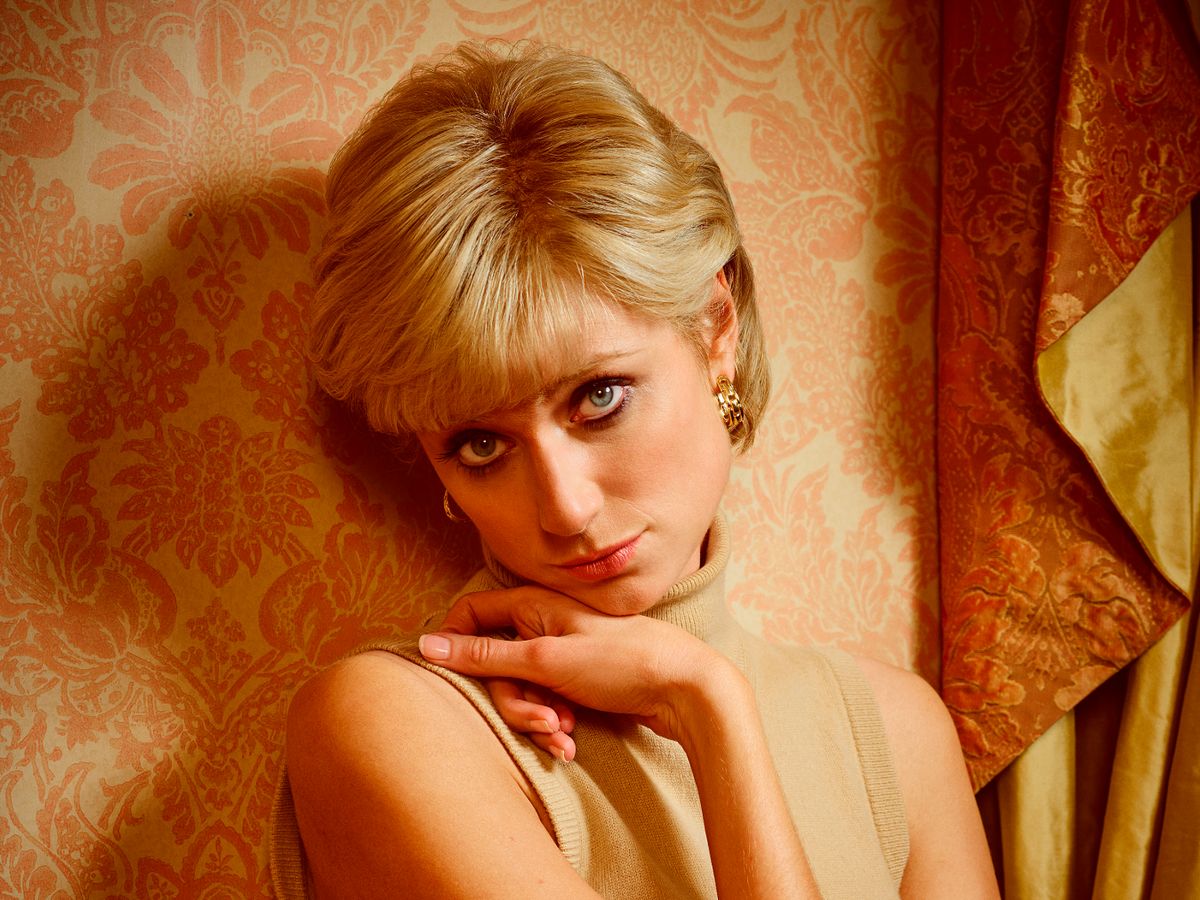
Elizabeth Dibecki as Princess Di

The fifth season of this hit dissection of the British royal family has gotten mixed reviews…possibly because as the latest Queen Elizabeth (Imelda Staunton) gets to exhibit mostly stiffness and steely resolve.

But I like the way the season has been fashioned to highlight peripheral characters in the grand saga.  

One episode begins in the post-war Mideast…it takes a while before we realize this is the backstory of Mohammed Al-Fayed, the wealthy businessman (he bought Harrod’s) whose son would die with Princess Diana. In fact, the elder Al-Fayed is so obsessed with being accepted but the Brits that he hires the valet of the late Duke of Windsor to give him a crash course in aristocratic do’s and don’t’s.

Another episode unfolds during the Russian Revolution and examines why the British monarchy deliberately chose not to come to the rescue of Tsar Alexander and his doomed family (their cousins, no less) when they were being held by the Bolsheviks.

And then there’s the backstory of Princess Di’s notorious 1995 BBC interview in which she described her marriage as a three-way (her, Prince Charles, and Camilla).  The series picks apart how journalist (now disgraced) Martin Bashir fabricated bank records to suggest to the Princess that the Royals were paying her servants to spy on her.

The series even returns to the nixed love affair between Princess Margaret and the King’s equerry Peter Townsend. Now, 40 years later, Margaret (played this season by Lesley Manville and Townsend (former 007 Timothy Dalton) have a bittersweet late-in-life reunion. 

Lots of familiar faces taking up major roles:  Dominic West as Prince Charles (don’t care what you say…Dominic West is cool even when he’s trying to play the terminally uncool), Elizabeth Debicki as Diana, Johnathan Pryce as Prince Philip.

Is “The Crown” as good as ever? Perhaps not, but you don’t think I’m gonna stop watching now, do you?

“INSIDE MAN” (Netflix)

Here’s an absolutely bonkers premise — not to mention a world-class case of subversive misanthropy —somehow redeemed )or maybe almost redeemed) by solid performances.

In an American prison, death row inmate Jefferson Grieff (Stanley Tucci) awaits his execution by helping the authorities solve outstanding crimes.  An acclaimed criminologist who murdered his wife, Grieff holds court in a prison interview room, weighing the evidence brought to him and invariably coming up with a solution. 

For added weirdness, this jailhouse Sherlock has his own Watson, a cynically  erudite but physically imposing serial killer (Atkins Estimond) who provides comic relief through his cheerful amorality.

Meanwhile, in Britain, an upstanding suburban vicar (David Tennant) finds himself caught up in a child pornography case and, to protect his teenage son, imprisons the boy’s math tutor (Dolly Wells) in the cellar. The only way out, it seems, is for the good Rev to murder the teacher before she goes to the cops.

The two plots come improbably  together when a Brit reporter (Lydia West) presents the case of the missing tutor to Grieff. 

Written by Steven Moffat and directed by Paul McGuigan, “Inside Man” is possibly the most cynical show now streaming, With a tone ranging (not always comfortably) from fierce black comedy to pseudo-tragic drama, the series delights in presenting characters who seem virtuous (or at least likeable) but who invariably reveal a staggering level of corruption.

The supporting cast kills, especially Dylan Baker as a prison warden and Lyndsey Marshal as the vicar’s atheistic spouse.

“Inside Man” is only four episodes long, but that is almost too much.  With race-against-time tension fueling the final hour and characters inducing off-the-charts discomfort, not every viewer will be able to go the course.

| Robert W. Butler

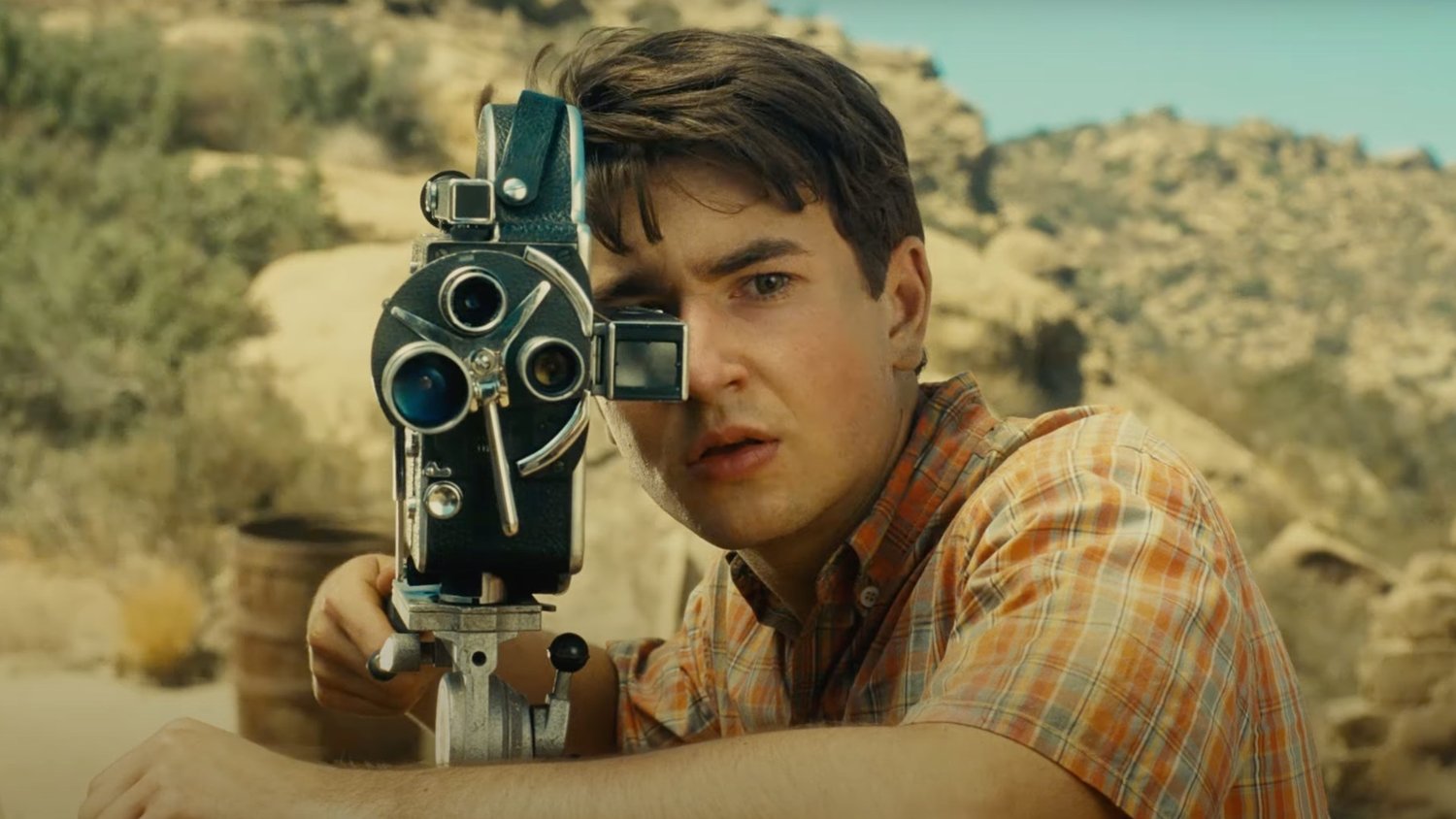
Gabriel LaBelle

“THE FABELMANS” My rating: B+ (Theaters)

151 minutes | MPAA rating: PG-13

There’s something about the autobiographical film that brings out the best in directors.

Fellini’s “Amarcord.” John Boorman’s “Hope and Glory.” Not to mention last year’s Oscar contender from Kenneth Branagh, “Belfast.”

To that honorable list we now add Steven Spielberg’s “The Fabelmans,” an episodic epic that dissects his own boyhood fascination with the act of moviemaking against the background of a loving but dysfunctional family.

We first meet little Sammy Fableman (Mateo Zoryon Francis-DeFord) in a queue outside a movie theater.  The year is 1952 and six-year-old Sammy is about to see his first film, Cecil B. DeMille’s circus melodrama “The Greatest Show on Earth.”  

Except that Sammy isn’t so sure he wants to get involved. Movies, he has heard, are big and noisy. They’re  emotional and visual roller coasters. Sounds scary.

In a good-cop-another-good-cop routine that will be repeated for the next 20 years,  his parents encourage him. 

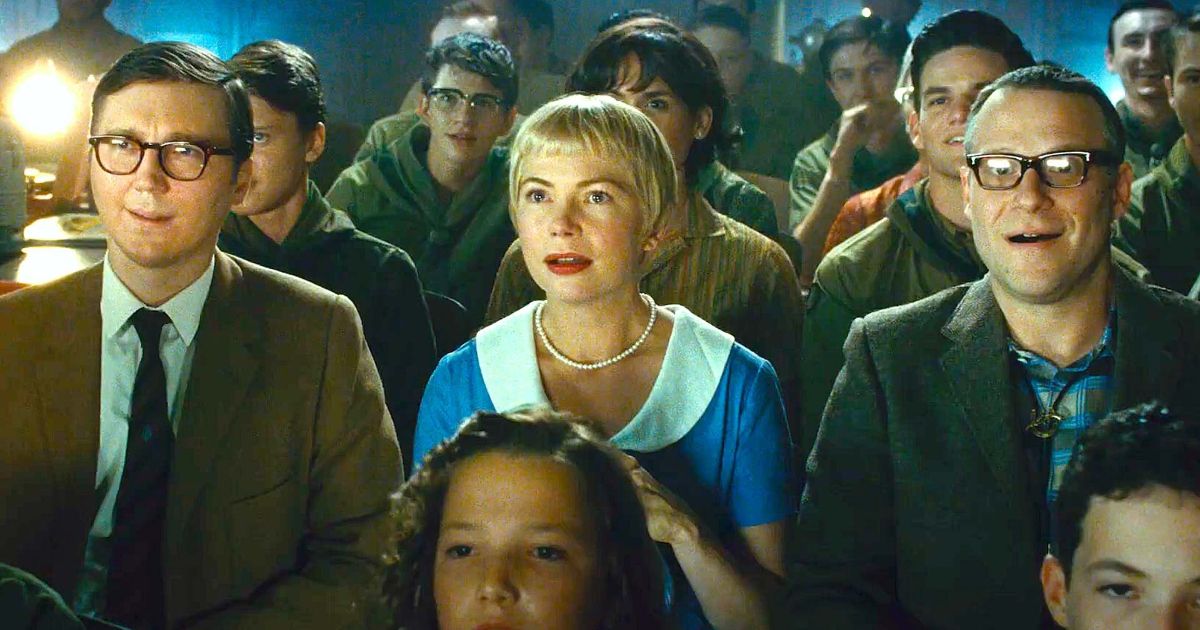
 Mitzi (Michelle Williams) — a feelings-on-her-sleeve artistic type who gave up a career as a concert pianist to be an Eisenhower-era mom — chatters on  about the fun and beauty of the movies. The magic.  

Dad Burt (Paul Dano) — an engineer rising through the ranks of the new world of computers — takes a more rational approach, analyzing the science of motion pictures. Sammy won’t be frightened once  he understands how individual still photographs can, through the phenomenon of persistence of vision, become lifelike movement on the big screen.

Once in the theater Sammy is predictably blown away, especially by the massive derailment of a circus train that is the movie’s action centerpiece.  In the following weeks he will beg his parents for a model train set and, once that’s in place, plead to use his dad’s movie camera.  He is compelled to recreate that scene from the movie, to pick it apart frame by frame, to understand how it was done and how it could affect him so.

“The Fabelmans”could have been a perfect 30-minute short examining a boy’s introduction to and fascination with movies, But of course it is much, much more than that.

Over 2 1/2 hours we follow Sammy into his late teens (he’s portrayed for most of the film by Gabriel LaBelle), moving with the clan as Burt’s career takes them first to Arizona and later to California.  

Paul Dano, Michelle Williams, Seth Rogan

Throughout, Sammy’s devotion to movies grows ever more intense. His equipment becomes increasingly sophisticated; his efforts evolve from home movies to mini-Westerns and, with the help of his entire Boy Scout troop, a bloody World War II combat film.

We are introduced to Burt’s best friend and protege, Ben (Seth Rogen, excellent in non-comedic mode), who spends so much time hanging around the Fabelmans that Sammy and his siblings think he’s an uncle.  Much later Sammy will discover that Ben is key to the breakup of Burt and Mitzi’s marriage.

And then there are the tormented teen years in which Sammy finds himself coping with antisemitism as one of the few Jewish students at a WASPish high school.  The unexpected upside is that as even an indifferent Jew he’s an object of romantic curiosity, with one lovely shiksa (Chloe East) attempting to win him over to Jesus through a bonkers regimen of prayer and petting. (The scene borders on comedic caricature…it’s one of the few times “The Fabelmans” misses the mark.)

In a very real sense”The Fabelmans” is only peripherally about Sammy.  As played by LaBelle and written by Spielberg and Tony Kushner, Sammy is often the least interesting character on screen, a guy who does most of his expressing through a camera lens. His art is intriguing; he’s much less so.

No, the film is basically a love letter to Mitzi, Burt and, to a lesser extent, Ben. All are strong personalities who mold Sammy’s character, whether the effect was encouraging (Mitzi) or cautionary (Burt, who sees a movie career as an unrealistic pipe dream).

Audiences will be particularly taken with Williams’ Mitzi, a frustrated pixie-cut ecdentric who struggles to be a conventional wife (she insists that the family dine on paper plates with plastic cutlery, so that the whole mess can be quickly wrapped up in a disposable table cloth) and battles depression. 

It doesn’t help that Mitzi loves her husband but isn’t actually in love with him. For his part, Burt will remain faithful to her long after the marriage has ended.

Spielberg has rarely been more real-world sensitive than he is in the depiction of his parents…it’s a a quietly spectacular achievement.

BTW: Look for a late-in-the film appearance by David Lynch as veteran director John Ford, who gives Sammy a bit of crusty but concise cinematic advice that provides “The Fabelmans” with its wonderful final image.

| Robert W. Butler

“CAUSEWAY” My rating: B+ (Apple TV +)

92 minutes | MPAA rating: R

Watching “The Causeway” I was reminded of “Winter’s Bone” and why we all fell in love with Jennifer Lawrence in the first place.

Lawrence, of course, is a decade, many movies, a couple of Oscars and a motherhood away from that superb indie effort in which she played a child of the Ozarks. But in “Causeway” she exhibits the same emotional honesty, lack of affectation and wise-beyond-her-years intelligence.

“Causeway” is the feature directing debut of Lila Neugebauer, whose credits to date have centered on episodic TV (“Room 104,” “The Sex Lives of College Girls,” “Maid”). It’s a stripped-down, humanistic paen to everyday lives, the sort of story Ken Loach might tell if he were a young American rather than an old Brit. 

It’s not showy, but it’s substantial, setting  an emotional hook that is not easily shaken.

Lawrence plays Lynsey, who in the film’s first 20 minutes is fighting back from some sort of traumatic experience.  She’s living temporarily with Sharon (Jayne Houdyshell), an older woman who offers her home as a sort of halfway house for veterans recovering from life-changing injuries.

Lynsey suffered traumatic brain damage in an IED explosion in Iraq. She’s not scarred on the outside, but her head is all messed up.  She has to relearn walking and controlling her hands. Moreover, her emotions have been scrambled. She’s living in a cocoon of numbness, barely able to express a normal range of feelings .

The screenplay (by Ottessa Moshfegh, Luke Gobble and Elizabeth Sanders) follows Lynsey to her hometown of New Orleans where she moves in with her not-unkind-but-definitely-remote mother (Linda Emond) and begins seeing a VA neurologist (Stephen McKinley Henderson) whose OK she needs if she is ever to return to active service.

The yarn’s center is Lynsey’s growing relationship with James (Brian Tyree Henry), an auto mechanic who fixes her broken truck, offers  her a ride home and ends up becoming her best — hell, her only — friend.

Brian Tyree Henry, Jennifer Lawrence

James is just as damaged in his own way as Lynsey.  His big bad moment came in an auto accident on a nearby causeway, a horror that claimed the life of his nephew and resulted in the destruction of his marriage.  Now he relies on weed and beer to numb all the raw edges of his bruised psyche.

In a weird way, Lynsey and James were made for one another.

But not in the movie-romance manner you might expect.  Fro one thing, Lynsey is gay (a revelation the film drops matter of factly…it’s no big deal).  Plus, these two are far more important to one another as emotional/intellectual sounding boards than as lovers.  Getting their rocks off is pretty far down their list of essential needs.

“Causeway” explores these two with unhurried calm and a minimum of fuss.  The film is in many ways anti-dramatic.  No big Oscar-bait scenes. Instead it offers a steady drip of insight into its characters’ lives,

The results feel absolutely, inarguably real. Lawrence and Henry (he plays the rapper Paper Boi on TV’s “Atlanta”) imbue their roles with aching loss and a quiet dignity.  They give two of the year’s most effective (if understated) performances.

| Robert W. Butler

“ANDOR” (Disney +)

For three decades the “Star Wars” franchise has been getting progressively dumber, bottoming out with the so-bad-I-couldn’t watch them “The Book of Boba Fett” and “Obi-Wan Kenobi.”

Which makes the stunning adultness of “Andor” all the more miraculous.

We were introduced to Cassian Andor (Diego Luna) in 2016’s “Rogue One: A Star Wars Story.” He was one of the commandoes  who die transmitting the schematics of the first Death Star to their rebel brethren. “Rogue One” had a few narrative blips but it at least stood on its own in the “Star Wars” universe as a dead serious, camp-free espionage thriller.

Disney’s “Andor” is a prequel depicting Cassian Andor’s early years, and it pushes the solemnity and darkness of “Rogue One” to the very edge. Showrunner and frequent screenwriter Tony Gilroy makes few concessions for the family audience. This series takes as its models police procedurals, film noir, prison pictures and political dramas, and the results are gritty, grim and glorious.

The show covers much territory, opening on a dank corporate-run planet where Cassian kills a couple of thuggish security officers and taking side trips to the Empire’s capital city of Coruscant, a watery prison planet  and, in flashbacks, the primitive tribal world where our hero was born.

This early episodes depict Andor’s life as a criminal fugitive and his run-ins with the Empire…presumably this self-serving mercenary will be thoroughly radicalized in the second season.

The series resurrects from the original “Star Wars” film the character of Mon Mothma (Genevieve O’Reilly), a member of the Imperial Senate working secretly for the rerbellion, and delivers a whole slew of new faces, among them Stellan Skarsgard as a Machiavellian rebel spymaster and Denise Gough as a dangerously effective Imperial security specialist.

What’s remarkable here is that none of these are throwaway roles.  The villains, usually only paper thin in the “Star Wars” universe, are here given substance and backgrounds. 

The dialogue is smart and the production values off the charts. Every episode, it seems, has at least one tour de force action sequence.

And so far there’s not a Jedi in sight.

“REBOOT”  (Hulu)

It takes a lot to make me laugh out loud at my TV set…but “Reboot” had me howling.

This wickedly clever comedy from Steven Levitan (“The Larry Sanders Show,” “Modern Family”) is an orgy of inside-show-biz rim shots.  The premise finds the cast of a cheesy ‘90s TV family sitcom being reunited 20 years later for an updated version (yeah, just like “Roseanne” and “The Connors”).

The years have not been good to the actors, who are thrilled to be back in the spotlight…and immediately pick up the bad habits they indulged in back in the day.

Keegan-Michael Key is an insecure leading man who overthinks everything; Judy Greer is perfect as his on-screen wife and off-screen ex-squeeze.  Johnny Knoxville  of “Jackass” fame is jaw-droppingly  good as the substance-abusing co-star trying to stay straight, while Paul Reiser and Rachel Bloom (“Crazy Ex-Girlfriend”) are sublime as the father-and-daughter producing team working out the kinks in their troubled relationship.

Along the way “Reboot” is practically a comic tutorial in how TV gets made.  The scenes in the writers’ room are among the funniest TV I’ve seen in years…think “The Dick Van Dyke” show with an unstoppable potty mouth.

“THE ENGLISH” (Amazon Prime)

This six-part Western from writer/director Hugo Blick often bites off more than it can swallow, and its narrative frequently becomes stranded in dead-end alleys.

Yet there’s something about it that kept me coming back for more.

For starters, the ever-watchable Emily Blunt. Here she plays Lady Cornelia Locke, a Brit aristocrat who comes to the 1890s Wild West on a mission of vengeance.  She’s looking to kill the man she blames for the death of her son.  The details of the boy’s demise are not revealed until late in the series, and when they finally hit  home “The English” comes on with the power of an Ibsen tragedy.

Cornelia shares her gruesome and dangerous quest with  Eli Whipp (Chaske Spencer), a Cherokee scout who has only recently resigned after years with the U.S. Army. That government gig that has left Eli seriously conflicted, given that his job was tracking down and killing other Native Americans.  Now he must come to terms with his new life as a second-class citizen and his forbidden (for more than one reason) intimacy with Cornelia.

Their journey plays out against an exquisitely photographed landscape (d.p. Arnau Valius Colonel takes full advance of the series’ Spanish locations) populated by characters who at best are wildly eccentric and at worst sadistically venal. 

But all of them speak in a florid style that reminds of “Deadwood’s” Al Swearengen. Black is a first-class wordsmith who can pack tons of meaning in brief exchanges; the dialogue is so spectacular that it helps gloss over the show’s meandering narrative.

| Robert W. Butler

“WEIRD: THE AL YANKOVIC STORY” My rating: B- (Roku)

108 minutes | No MPAA rating

For two thirds of its running time Roku’s “Weird: The Al Yankovic Story” is an amusing hoot, a parody of rock screen biographies that just happens to be about a guy who became famous by parodying famous rock songs.

If the movie limps to the finish line with an uninspired final 20 minutes … well, what comes before will leave most viewers in a charitable mood.

Penned by the real Al Yankovic and director Eric Appel, this elaborate spoof stars Daniel Radcliffe as Weird Al…or at least Weird Al as run through the filter of “Bohemian Rhapsody,” “Rocket Man” and other tuneful biopics.

So in this version the accordion-pumping parodist dates a man-eating Madonna (Evan Rachel Wood, obviously having a ball), develops a drinking problem, alienates his few friends and struggles to gain the acceptance of his squeezebox-hating father (Toby Huss) and Betty Crockerish mother (Julianne Nicholson).

The film also introduces a deliriously lunatic alternative history in which Weird Al writes the music and lyrics to “Eat It,” only to have the song stolen and parodied by Michael Jackson as “Beat It.”

Daniel Radcliffe Evan Rachel Wood

Along the way viewers can play their own game of Where’s Waldo? with a dozen cameos (some lasting only seconds) by famous (and often heavily disguised) faces: Will Forte, Patton Oswalt, Michael McKean, Lin-Manuel Miranda, Conan O’Brien, Emo Philips, Jack Black, Quinta Brunson, Josh Groban, Seth Green. 

Also, special kudos to Rainn Wilson, who in top hat and tux perfectly embodies Dr. Demento, the cult-rock deejay who becomes young Al’s mentor (kind of a benevolent Colonel Parker).

The real Weird Al even shows up to portray a clueless record label executive.

Holding it all together is Radlicliffe, who perfectly walks the tightrope between silly and sincere. Seems Harry Potter has become a first-class comic performer.

The movie is, I believe, 30 minutes too long.  Maybe a last-act letdown was inevitable, since “Weird” shoots out of the starting gate and gallops madly throughout its first hour.  That’s a hard act to keep going.

| Robert W. Butler